Korean
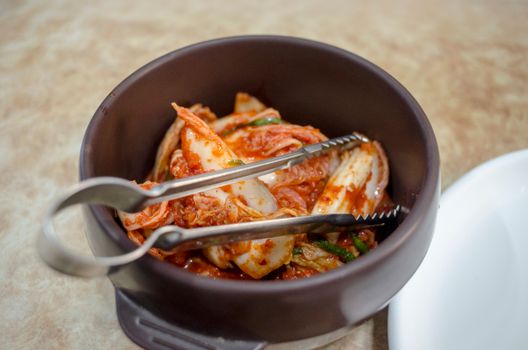
Kimchi (Baechu)
The diets react (see scores below)
Common Ingredients
- Napa cabbage
- gochugaru
- garlic
- ginger
- fish sauce
- scallions
- salt
- radish
Specific recipes may vary.
Incompatible with 4 of 11 diets
Diet Ratings
Traditional baechu kimchi is made from napa cabbage, which is a low-carb vegetable, but the combination of gochugaru (Korean chili flakes), garlic, ginger, and radish adds meaningful net carbs per serving. A typical 100g serving contains roughly 3-5g net carbs, which is manageable in small portions. However, kimchi is often consumed in larger quantities as a side dish, and cumulative carbs from garlic, gochugaru, and radish can add up. Some commercial versions also include sugar, but this homemade-style recipe avoids that. The fermentation process does not significantly reduce carbs. Small portions (30-50g) fit keto comfortably; larger servings warrant caution.
Strict keto practitioners flag kimchi due to the combined carb load of gochugaru, garlic, and radish — ingredients that, at typical Korean serving sizes, can push a meal closer to the daily carb ceiling. Some clinical keto protocols advise avoiding fermented condiments with multiple moderate-carb ingredients to eliminate guesswork.
This traditional Baechu kimchi recipe contains fish sauce, a clear animal-derived ingredient made from fermented fish. Fish sauce is a standard non-vegan ingredient that disqualifies this dish entirely. While all other ingredients (napa cabbage, gochugaru, garlic, ginger, scallions, salt, radish) are fully plant-based, the inclusion of fish sauce makes this version of kimchi incompatible with a vegan diet. Vegan kimchi versions do exist and are widely available, substituting fish sauce with soy sauce, miso paste, or kelp-based alternatives to achieve umami depth.
Kimchi Baechu contains added salt as a core ingredient, which is explicitly excluded under paleo rules. Salt is a processed/refined additive not consistent with the paleolithic diet philosophy. Beyond salt, the dish as a whole is a fermented, processed food product — the fermentation process itself is a form of food processing that contradicts the whole-food, unprocessed nature of paleo eating. Fish sauce, while derived from fish, is a heavily salted, processed condiment. The remaining ingredients — napa cabbage, gochugaru, garlic, ginger, scallions, and radish — are individually paleo-compliant vegetables and spices, but the combination as a salt-heavy, fermented, processed side dish falls outside paleo guidelines. The disqualifying factors are clear: added salt and processed/fermented food status.
Kimchi is a fermented vegetable dish composed primarily of napa cabbage, radish, garlic, ginger, and scallions — all whole, plant-based foods that align strongly with Mediterranean diet principles. Fermented foods are valued in the Mediterranean pattern for their probiotic benefits and contribution to gut health. The fish sauce adds a small amount of umami and trace seafood-derived nutrients, consistent with the diet's emphasis on fish and seafood. Gochugaru (Korean chili flakes) is simply a spice with no dietary concerns. The main caveat is the relatively high sodium content from salt and fish sauce, which warrants moderate consumption. Overall, kimchi is a nutrient-dense, minimally processed, plant-forward fermented side dish that fits comfortably within Mediterranean diet principles despite its non-Mediterranean origin.
Some strict Mediterranean diet frameworks focus on regional authenticity and may view fermented cabbage preparations outside of traditional Mediterranean ferments (e.g., Greek-style pickled vegetables, Italian giardiniera) with some skepticism, preferring locally rooted fermented vegetables. Additionally, the high sodium content leads some clinical Mediterranean diet practitioners to recommend limiting high-salt fermented foods.
Kimchi (Baechu) is almost entirely plant-based: napa cabbage, gochugaru (chili flakes), garlic, ginger, scallions, and radish are all plant-derived ingredients. While fish sauce is an animal product, it plays a minor supporting role in a dish that is fundamentally a fermented vegetable preparation. The carnivore diet strictly excludes all plant foods, making this dish incompatible regardless of the small fish sauce component. There is universal consensus across all carnivore tiers — from the strictest Lion Diet to broader animal-based approaches — that fermented vegetable dishes like kimchi are not permitted.
The listed ingredients for this homemade kimchi are individually Whole30-compliant: napa cabbage, gochugaru, garlic, ginger, fish sauce, scallions, salt, and radish are all allowed. However, two important caveats apply. First, commercial fish sauce frequently contains added sugar or preservatives — a compliant brand (e.g., Red Boat) must be used. Second, store-bought kimchi is the real concern: virtually all commercial kimchi contains added sugar, and many brands include rice flour paste (a grain) as part of the fermentation base, neither of which is listed here but are standard in traditional recipes. This evaluation assumes a homemade or verified compliant version with no sugar or rice flour. The fermentation process itself is not an issue. A 'caution' rating reflects the high likelihood that real-world kimchi — even when ingredient labels seem simple — contains hidden non-compliant additions.
Some Whole30 community members and coaches argue that traditional kimchi recipes often include rice flour paste (pul) as a binder for the gochugaru paste, which would make it non-compliant. Official Whole30 guidelines do not specifically address kimchi, so practitioners are divided on whether to approve it without explicit verification of every ingredient in commercial or restaurant versions.
Traditional baechu kimchi contains multiple high-FODMAP ingredients that make it unsuitable during the elimination phase. Garlic is the primary offender — it is one of the highest-FODMAP foods per Monash University, rich in fructans, and is used in significant quantities in any authentic kimchi paste. Scallions (green tops only are low-FODMAP, but white bulb portions are high-FODMAP and kimchi typically uses the whole scallion). Ginger is low-FODMAP at small amounts (up to 1 tsp fresh). Napa cabbage is low-FODMAP at 75g per Monash. Radish (daikon) is low-FODMAP at 2-3 slices. Gochugaru (Korean red pepper flakes, plain, no additives) is generally considered low-FODMAP. Fish sauce is low-FODMAP at typical serving sizes. However, because garlic is an essential and generous ingredient in kimchi that cannot be separated from the final product, the dish as a whole must be rated avoid. There is no realistic low-FODMAP-compliant version of traditional kimchi unless garlic is completely omitted and replaced with garlic-infused oil (which would no longer be traditional).
Some FODMAP practitioners note that fermentation may partially break down fructans in garlic over time, similar to how long-fermented sourdough reduces fructan content — however, Monash University has not validated this for kimchi specifically, and clinical FODMAP dietitians uniformly recommend avoiding kimchi during the elimination phase due to its garlic content. A small 'tasting' portion (under 15g) is sometimes tolerated anecdotally, but this is not supported by formal Monash guidance.
Kimchi (Baechu) is a fermented vegetable dish made primarily from napa cabbage, which is a DASH-friendly vegetable rich in fiber, vitamins, and minerals. However, traditional kimchi is very high in sodium due to the heavy salting of the cabbage during fermentation and the addition of fish sauce. A typical 100g serving of kimchi contains approximately 500–900mg of sodium, making it easy to exceed DASH sodium limits (1,500–2,300mg/day) even with modest portions. The vegetables, garlic, ginger, and radish are all DASH-positive ingredients, and fermented foods may offer probiotic benefits, but the sodium burden is the primary concern. Fish sauce adds additional sodium on top of the curing salt. Kimchi can be consumed in small portions (as a condiment rather than a full side serving) within a DASH plan, but regular or generous consumption conflicts with DASH sodium targets. Low-sodium kimchi recipes exist and would score significantly higher.
Kimchi (Baechu) is an excellent Zone Diet-compatible side dish. It is built almost entirely from low-glycemic, high-fiber vegetables — napa cabbage, radish, scallions, garlic, and ginger — which are precisely the colorful, non-starchy vegetables Dr. Sears champions as favorable carbohydrate sources. The net carbohydrate content per typical serving (roughly 30-50g or about 1/4 cup) is very low, around 1-2g net carbs, making it easy to incorporate as a carbohydrate block component without disrupting the 40/30/30 ratio. The fermentation process adds probiotic benefits and polyphenols (from gochugaru/red pepper), which align with Sears' anti-inflammatory focus. Fish sauce contributes negligible macros. There is no significant fat or protein in kimchi, so it functions purely as a favorable carbohydrate side that can complement a lean protein and monounsaturated fat to complete a Zone-balanced meal. The salt content is relatively high, which is a minor practical concern but not a Zone Diet issue per se.
Kimchi (Baechu) is a traditionally fermented Korean side dish with a strong anti-inflammatory profile. Napa cabbage provides fiber and glucosinolates (cruciferous compounds with anti-inflammatory and antioxidant properties). Gochugaru (Korean red pepper flakes) contains capsaicin, which has well-documented anti-inflammatory effects and may reduce NF-κB signaling. Garlic and ginger are both featured prominently in anti-inflammatory frameworks — garlic contains allicin and organosulfur compounds that suppress inflammatory cytokines, while ginger contains gingerols and shogaols with COX-inhibiting properties comparable to some NSAIDs. The fermentation process produces Lactobacillus bacteria (notably L. plantarum and L. brevis), which support gut microbiome diversity — a key axis of systemic inflammation regulation. Scallions and radish add polyphenols and additional fiber. The sodium content from salt and fish sauce is moderately high, which warrants attention for individuals with cardiovascular concerns, but is not a primary driver of systemic inflammation in typical serving sizes. Fish sauce contributes glutamates and is used in small amounts; its omega-3 contribution is negligible. Overall, kimchi's combination of fermented prebiotics and probiotics, capsaicin, alliums, and cruciferous vegetables places it firmly in the anti-inflammatory approve category.
While the broad anti-inflammatory consensus strongly supports fermented vegetables like kimchi, some autoimmune protocol (AIP) practitioners caution against nightshade-derived ingredients like gochugaru (a chili pepper) due to capsaicin and solanine-adjacent alkaloids potentially irritating gut mucosa in individuals with autoimmune conditions or intestinal permeability. Additionally, the high sodium content from salt and fish sauce is flagged by some cardiovascular-focused researchers as potentially pro-inflammatory at higher intake levels, though this is not a mainstream concern at typical serving sizes.
Kimchi is a nutrient-dense, low-calorie fermented vegetable side dish with meaningful fiber from napa cabbage and radish, and potential probiotic benefits that may support gut health — a relevant consideration given the GI side effects common with GLP-1 medications. It contains virtually no fat and minimal protein, making it a good complement to a protein-rich main but not a standalone nutritional contributor. The primary concern for GLP-1 patients is the gochugaru (Korean chili flakes), which makes kimchi moderately to significantly spicy. Spicy foods can worsen nausea, reflux, and GI discomfort — side effects that are already common on GLP-1 medications, particularly in early weeks or after dose escalation. The high sodium content (from salt and fish sauce) is also a consideration, as it can contribute to bloating and water retention, though it does not directly worsen GLP-1 side effects. In small amounts as a condiment-style side, kimchi is acceptable and its fermented fiber profile is a mild positive. Larger servings or use during periods of active GI side effects should be approached cautiously.
Some GLP-1-focused dietitians view fermented foods like kimchi favorably for their probiotic and prebiotic fiber content, arguing the gut microbiome support may help offset GLP-1-related constipation and GI dysregulation. Others counsel patients to avoid spicy fermented foods entirely during the first 3–6 months on GLP-1 therapy due to high individual variability in spice and acid tolerance, particularly as gastric emptying is already slowed.
*See how scores were generated at our methodology page.
Nutritional profile
Six traits that cut across every diet.
Fiber & Plants
How much whole-plant food and fiber it delivers.
Healthy Fats
The quality of its fats (unsaturated, omega-3).
Whole / Unprocessed
How close it is to its natural, unprocessed form.
Gut Gentle
How easy it is on digestion (low FODMAP, few irritants).
Low Glycemic
How little it spikes your blood sugar.
Protein Density
How much protein it packs per calorie.
Controversy Index
Higher controversy = more disagreement between diets.
Diet-Specific Tips
 Keto — 5/10
View tips
- Napa cabbage is low net-carb and keto-friendly as the base
- Gochugaru, garlic, ginger, and radish contribute cumulative net carbs
- No added sugar in this traditional homemade recipe — a key positive
- Fermentation does not meaningfully reduce carbohydrate content
- Portion size is critical — small servings (30-50g) are safe, larger portions risk exceeding carb limits
- Probiotic benefits are a bonus for gut health on keto
 Mediterranean — 8/10
View tips
- Primarily plant-based ingredients: napa cabbage, radish, garlic, ginger, scallions
- Fermented food with probiotic benefits, consistent with Mediterranean dietary values
- Minimal processing — no refined grains, added sugars, or unhealthy fats
- Fish sauce provides small seafood-derived component, aligned with diet principles
- High sodium content is the primary concern — moderate intake advised
- Non-Mediterranean origin but nutritional profile is highly compatible
 Whole30 — 5/10
View tips
- All listed ingredients are individually Whole30-compliant
- Fish sauce must be sugar-free — compliant brands like Red Boat are required
- Traditional kimchi recipes often include rice flour paste (a grain), which is not listed here but is a common omission in ingredient summaries
- Store-bought kimchi almost universally contains added sugar
- Fermentation itself is not an issue on Whole30
- Requires careful label-reading or homemade preparation to confirm compliance
 DASH — 4/10
View tips
- Very high sodium content from salting process and fish sauce (500–900mg per 100g serving)
- Core ingredients (napa cabbage, radish, scallions, garlic, ginger) are DASH-approved vegetables
- Fermented food with potential probiotic benefits not specifically addressed by DASH guidelines
- Fish sauce is a concentrated sodium source
- Small portions usable as a condiment within DASH sodium budget
- Low-sodium kimchi preparations would score higher (6–7)
 Zone — 8/10
View tips
- Primarily low-glycemic, non-starchy vegetables (napa cabbage, radish, scallions) — ideal Zone carbohydrate sources
- Very low net carbohydrates per serving, easy to fit into Zone carb blocks without glycemic disruption
- Fermented food with polyphenols from gochugaru aligns with Sears' anti-inflammatory dietary emphasis
- No significant fat or protein — must be paired with lean protein and monounsaturated fat to form a complete Zone meal
- High sodium content is a nutritional consideration but irrelevant to Zone macronutrient ratio assessment
- Garlic and ginger are Zone-favorable flavoring agents with anti-inflammatory properties
 Anti-Inflammatory — 8/10
View tips
- Fermented food — rich in Lactobacillus probiotics that support gut health and reduce systemic inflammation
- Gochugaru provides capsaicin, a well-studied anti-inflammatory compound that inhibits NF-κB
- Garlic and ginger are cornerstone anti-inflammatory herbs with strong research backing
- Napa cabbage offers cruciferous glucosinolates and prebiotic fiber
- No refined carbohydrates, added sugars, seed oils, or trans fats
- Moderate sodium from salt and fish sauce — not inflammatory per se but notable for sensitive populations
- Fermentation increases bioavailability of nutrients and generates beneficial short-chain fatty acids
 GLP-1 Friendly — 5/10
View tips
- Moderate spice level from gochugaru may worsen nausea, reflux, or GI discomfort in GLP-1 patients
- High sodium from salt and fish sauce may contribute to bloating
- Low fat and very low calorie — not a concern on fat or calorie dimensions
- Good fiber source from napa cabbage and radish — supports digestion and constipation prevention
- Fermented food with probiotic potential — may benefit GI health and microbiome
- Zero meaningful protein — must be paired with a protein-rich main dish
- Small portion use as a condiment is much safer than eating as a substantial side
- Tolerance is highly individual and may worsen during dose escalation periods