Photo: Theodore Nguyen / Pexels
Korean
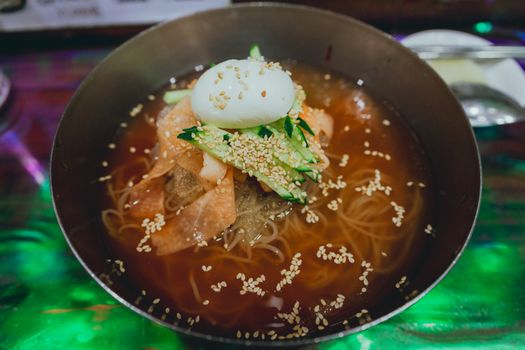
Naengmyeon (Cold Noodles)
The diets react (see scores below)
Common Ingredients
- buckwheat noodles
- beef broth
- cucumber
- Asian pear
- egg
- vinegar
- mustard
- sesame seeds
Specific recipes may vary.
Incompatible with 5 of 11 diets
Diet Ratings
Naengmyeon is fundamentally incompatible with a ketogenic diet. The primary ingredient — buckwheat noodles — is a high-carbohydrate grain-based noodle. A standard serving (approximately 200g of cooked noodles) contains roughly 50-60g of net carbs from the noodles alone, which already exceeds or maxes out an entire day's keto carb allowance. Asian pear adds additional sugar and carbohydrates (roughly 10-12g net carbs per small serving). Together, these two ingredients make a single serving of naengmyeon deliver well over 60g of net carbs, making ketosis impossible. The remaining ingredients (beef broth, cucumber, egg, vinegar, mustard, sesame seeds) are individually keto-friendly, but they cannot offset the massive carb load from the noodles and fruit. There is no practical way to consume this dish in a traditional form while maintaining ketosis.
Naengmyeon as described contains multiple animal-derived ingredients that disqualify it from a vegan diet. Beef broth is a direct animal product made by simmering beef bones and meat. The egg (typically a hard-boiled half placed on top) is an animal product explicitly excluded by veganism. These two ingredients alone make this dish clearly non-vegan, regardless of the otherwise plant-friendly components like buckwheat noodles, cucumber, Asian pear, vinegar, mustard, and sesame seeds.
Naengmyeon is fundamentally built around buckwheat noodles, which are a grain and explicitly excluded from the paleo diet regardless of their gluten-free status. Buckwheat, despite its name, is a grain-like seed (pseudocereal) that is banned under paleo rules alongside all other grains. The noodles are the defining ingredient of this dish — without them, it is no longer Naengmyeon. The remaining ingredients are largely paleo-compatible: beef broth, cucumber, Asian pear, egg, and vinegar are all acceptable, and sesame seeds are permitted (though sesame oil would be a seed oil concern, seeds themselves are fine). Mustard in its basic form is generally paleo-acceptable. However, the dish cannot be rescued by its supporting ingredients when its core structural component is a prohibited grain. This is a clear-cut avoid with high confidence.
Naengmyeon presents a mixed Mediterranean diet profile. The buckwheat noodles are a whole grain and nutritionally aligned with Mediterranean principles, offering fiber and nutrients superior to refined grains. Vegetables (cucumber) and fruit (Asian pear) are strongly encouraged components. Egg is acceptable in moderation. However, the dish's primary protein base is beef broth, which situates red meat as central rather than incidental — conflicting with the Mediterranean guideline of limiting red meat to a few times per month. Sesame seeds add healthy fats but are not traditional to the Mediterranean pattern. The dish lacks olive oil entirely and is outside Mediterranean culinary tradition, meaning its otherwise reasonable ingredient profile is offset by beef-centricity and the absence of core Mediterranean dietary elements.
Some Mediterranean diet interpreters focus on macronutrient and food quality patterns rather than strict cultural origin; from this lens, a light beef broth (low saturated fat) with whole-grain buckwheat noodles, fresh vegetables, and fruit could be viewed as acceptable, similar to how small amounts of lean red meat are tolerated in some traditional Mediterranean regional diets (e.g., parts of Southern Italy and Greece). The overall low caloric density and vegetable presence may warrant a more lenient reading.
Naengmyeon is almost entirely incompatible with the carnivore diet. The primary component is buckwheat noodles — a plant-based grain product that is strictly excluded. The dish also contains cucumber (vegetable), Asian pear (fruit), vinegar (plant-derived fermented product), mustard (plant-derived spice), and sesame seeds (plant seeds) — all of which violate carnivore principles. The beef broth is the only fully carnivore-compliant ingredient, and the egg is largely acceptable to most practitioners. However, the overwhelming majority of this dish's ingredients and its entire structural foundation are plant-based, making it firmly in the 'avoid' category with no meaningful adaptation possible short of completely deconstructing the dish.
Naengmyeon contains buckwheat noodles, which are explicitly excluded on the Whole30. Buckwheat is listed as a prohibited grain under the Whole30 rules, and noodles/pasta are additionally called out as a disallowed food form even if made with compliant ingredients. This dish fails on two counts: the grain (buckwheat) and the food form (noodles). The remaining ingredients — beef broth, cucumber, Asian pear, egg, vinegar, mustard, and sesame seeds — are generally Whole30-compatible, but they cannot redeem a dish built on an excluded foundation.
Naengmyeon contains several ingredients that require careful FODMAP evaluation. Buckwheat noodles are the central concern: pure buckwheat is low-FODMAP per Monash, but many commercial naengmyeon noodles are blended with wheat starch or sweet potato starch, which can introduce fructans or require portion awareness. If noodles are 100% buckwheat, they are low-FODMAP at a standard serving (~180g). Beef broth is low-FODMAP only if made without onion or garlic — traditional Korean broth often contains these high-FODMAP aromatics. Cucumber is low-FODMAP. Asian pear (bae) is a significant concern: pears are high in polyols (sorbitol) per Monash and are typically used as a topping or in the broth marinade, and even small servings can be problematic. Egg is low-FODMAP. Vinegar (rice or white) is low-FODMAP. Mustard (plain prepared mustard) is generally low-FODMAP in small amounts. Sesame seeds are low-FODMAP at standard servings (1 tbsp). The combination of potentially wheat-blended noodles, high-FODMAP broth ingredients, and Asian pear creates meaningful FODMAP risk at typical restaurant or home serving sizes, even if individual ingredients can be modified.
Monash University rates pure buckwheat noodles as low-FODMAP and Asian pear as high-FODMAP due to excess sorbitol — many clinical FODMAP practitioners would advise avoiding this dish entirely during elimination due to the near-universal inclusion of Asian pear and onion/garlic-containing broth, even though a carefully prepared home version with strict substitutions could be made safe.
Naengmyeon contains several DASH-friendly ingredients — buckwheat noodles are a whole grain with fiber and magnesium, cucumber and Asian pear contribute potassium and fiber, and the egg provides lean protein. However, the primary concern is sodium: traditional beef broth used in naengmyeon is typically high in sodium, and restaurant or packaged versions can contain 1,000–2,000mg of sodium per serving, potentially exceeding the standard DASH daily limit in a single dish. The broth is the defining feature of the dish and is consumed in significant quantity. Mustard and sesame seeds are acceptable in small amounts. The overall dish aligns partially with DASH principles but is limited by its sodium load from the broth. A homemade version using low-sodium beef broth could score considerably higher (7–8), making preparation method critical to DASH compatibility.
NIH DASH guidelines flag high-sodium broths and soups as problematic due to their direct impact on blood pressure. However, some DASH-oriented clinicians note that naengmyeon's vegetable and whole-grain components, combined with a relatively modest saturated fat profile, make it more compatible than other Korean dishes — and advocate that patients using low-sodium broth can incorporate it regularly without concern.
Naengmyeon presents a mixed Zone Diet picture. The buckwheat noodles are the central concern — while buckwheat has a lower glycemic index than white flour noodles and provides some fiber, it is still a grain-based carbohydrate that can push the meal toward carb-heavy territory, classified as 'unfavorable' in Zone terminology. The noodle portion would need to be carefully controlled (roughly 1/3 cup cooked per block) to stay in Zone ratios. On the positive side, cucumber is a favorable low-glycemic Zone vegetable, and the beef broth base is essentially zero-carb and can accompany lean protein. Asian pear adds natural sugars and raises the glycemic load somewhat, though it contains fiber that moderates blood sugar impact. The egg adds protein and fat in good proportion. Vinegar may actually improve glycemic response, and mustard is negligible. Sesame seeds provide some monounsaturated and polyunsaturated fat but are small in quantity. The dish's main structural challenge for Zone compliance is that it is noodle-centric — carbohydrates from buckwheat dominate the macronutrient profile, and the protein content (primarily egg, some beef if added) is likely insufficient relative to carb load in a typical serving. With careful portioning — smaller noodle portion, added lean beef slices, and emphasizing cucumber — it can be adapted into a Zone-compatible meal, but as traditionally served it skews carb-heavy.
Some Zone practitioners would rate buckwheat more favorably than other grains, citing its lower glycemic index (GI ~54) and status as a pseudo-grain with better amino acid profile. Dr. Sears' later writings on polyphenols and anti-inflammatory eating would also note that buckwheat contains rutin, a polyphenol with favorable properties. In this view, a moderate portion of naengmyeon with added lean beef could be treated as a reasonable Zone meal with only minor adjustments, pushing the score toward 6.
Naengmyeon presents a mixed anti-inflammatory profile. On the positive side, buckwheat noodles are a notable asset — buckwheat is a whole grain (technically a pseudograin) rich in rutin, quercetin, and other flavonoids with demonstrated anti-inflammatory properties, and it has a lower glycemic index than refined wheat noodles. Cucumber contributes hydration and antioxidants. Asian pear provides fiber, vitamin C, and polyphenols. Sesame seeds offer lignans, calcium, and modest anti-inflammatory compounds. Vinegar (particularly rice vinegar) is generally neutral to mildly beneficial. However, the beef broth and implicit lean beef in the dish represent a moderate inflammatory concern — red meat is in the 'limit' category. The egg is neutral to mildly beneficial. Mustard as a spice is benign. The dish is not heavily processed, low in added sugar, low in saturated fat in its traditional form, and relatively light — a broth-based cold dish rather than a fried or heavily sauced one. Overall, the buckwheat base and vegetable components partially offset the red meat concern, landing this in the moderate/caution range rather than avoid.
Some anti-inflammatory practitioners would rate this higher, emphasizing buckwheat's strong flavonoid content (rutin, quercetin) and the dish's overall lightness and low saturated fat load as meaningful positives, potentially placing it at the low end of 'approve.' Others following stricter red-meat-avoidance protocols (e.g., Dr. Weil's 2–4 servings per week maximum) might keep it at caution given beef broth as the base, especially if consumed regularly.
Naengmyeon is a light, low-fat Korean cold noodle dish that avoids most GLP-1 red flags — it is not fried, not greasy, not spicy, and not high in sugar. The broth-based preparation is easy to digest, and the cold serving temperature may actually be gentler on a sensitive stomach. However, the dish is protein-light for a main meal: a standard serving provides roughly 8-12g of protein (primarily from the half boiled egg and small amount of beef broth), falling well short of the 15-30g per meal target. Buckwheat noodles are a better refined-grain alternative — they offer moderate fiber (~2-3g per serving) and a lower glycemic index than white wheat noodles — but the overall carbohydrate load is high relative to the protein content. Cucumber and Asian pear contribute hydration and micronutrients but add sugar (pear) and minimal protein. Vinegar is beneficial as it may blunt post-meal glucose spikes. Sesame seeds and mustard are fine in typical condiment quantities. The dish is portion-friendly and easy to eat in small amounts, but as a standalone main it leaves a significant protein gap that would need to be addressed by adding a protein source such as extra sliced beef, a whole egg, or a side of tofu.
Some GLP-1-focused dietitians would rate this more favorably given its very low fat content, easy digestibility, and hydrating broth, arguing that pairing it with a protein supplement addresses the deficit without worsening GI side effects. Others would caution more strongly, noting that the high carbohydrate-to-protein ratio makes it a poor calorie investment for patients eating reduced volumes and at risk of muscle loss.
*See how scores were generated at our methodology page.
Nutritional profile
Six traits that cut across every diet.
Fiber & Plants
How much whole-plant food and fiber it delivers.
Healthy Fats
The quality of its fats (unsaturated, omega-3).
Whole / Unprocessed
How close it is to its natural, unprocessed form.
Gut Gentle
How easy it is on digestion (low FODMAP, few irritants).
Low Glycemic
How little it spikes your blood sugar.
Protein Density
How much protein it packs per calorie.
Controversy Index
Higher controversy = more disagreement between diets.
Diet-Specific Tips
 Mediterranean — 5/10
View tips
- Buckwheat noodles are a whole grain — positively aligned with Mediterranean diet
- Beef broth as primary protein base conflicts with red meat limitation guidelines
- Fresh vegetables (cucumber) and fruit (Asian pear) are strongly encouraged components
- Egg is acceptable in moderation within Mediterranean diet
- No olive oil present — core Mediterranean fat source entirely absent
- Sesame seeds provide healthy fats but are not traditional to the Mediterranean pattern
- Dish is nutritionally moderate but not culturally or structurally Mediterranean
 Low-FODMAP — 5/10
View tips
- Asian pear is high-FODMAP due to sorbitol and is a standard ingredient — significant risk
- Beef broth frequently contains garlic and onion which are high-FODMAP fructan sources
- Commercial buckwheat noodles often blended with wheat starch introducing fructans
- Pure buckwheat noodles without wheat blend are low-FODMAP at standard serving
- Cucumber, egg, vinegar, sesame seeds, and plain mustard are all low-FODMAP
- Dish can be made low-FODMAP with strict ingredient control but restaurant versions are high-risk
 DASH — 5/10
View tips
- High sodium risk from beef broth — traditional versions may contain 1,000–2,000mg sodium per serving
- Buckwheat noodles are a DASH-approved whole grain rich in fiber and magnesium
- Cucumber and Asian pear provide potassium, fiber, and natural sweetness without added sugar
- Egg adds moderate lean protein with no saturated fat concerns in DASH-moderate quantities
- No saturated fat or tropical oil concerns in the standard ingredient list
- Low-sodium broth substitution would significantly improve DASH compatibility
- Sesame seeds contribute healthy fats and minerals in small quantities
 Zone — 5/10
View tips
- Buckwheat noodles are an 'unfavorable' Zone carb but lower GI than white flour — requires strict portion control (~1/3 cup cooked per block)
- Dish is structurally carb-centric; typical serving skews heavily toward carbohydrates, disrupting 40/30/30 ratio
- Asian pear adds natural sugars and moderate glycemic load; should be limited to a small portion
- Egg provides protein and fat but insufficient alone to balance a full noodle serving — lean beef slices should be added
- Cucumber is a favorable Zone vegetable and supports the carb block quality
- Beef broth is essentially zero-carb and Zone-neutral
- Sesame seeds provide small amounts of fat but insufficient to meet monounsaturated fat block requirements — olive oil-based dressing addition would improve Zone compliance
- Vinegar may modestly improve glycemic response, a minor positive
 Anti-Inflammatory — 5/10
View tips
- Buckwheat noodles provide rutin and quercetin — notable anti-inflammatory flavonoids
- Beef broth and red meat protein place this in the 'limit' category for anti-inflammatory diets
- Asian pear and cucumber contribute polyphenols, fiber, and antioxidants
- Sesame seeds add lignans and modest anti-inflammatory benefit
- Low in saturated fat overall — broth-based, not fried or heavily sauced
- No refined flour, added sugars, or processed additives in traditional preparation
- Mustard and vinegar are neutral to mildly beneficial condiments
 GLP-1 Friendly — 5/10
View tips
- Low protein density for a main meal — typically 8-12g per serving, below the 15-30g per meal target
- Buckwheat noodles preferred over refined wheat — moderate fiber, lower glycemic index
- High carbohydrate load relative to protein content is a concern at reduced caloric intake
- Very low fat — supports GLP-1 side effect tolerance and easy digestibility
- Cold temperature and broth base are gentle on slowed gastric emptying
- Cucumber and broth contribute beneficial hydration
- Asian pear adds natural sugar — minor concern but not a dealbreaker
- Vinegar may support post-meal glycemic stability
- Needs a protein boost (extra beef slices, whole egg, tofu) to function as an adequate GLP-1-friendly main