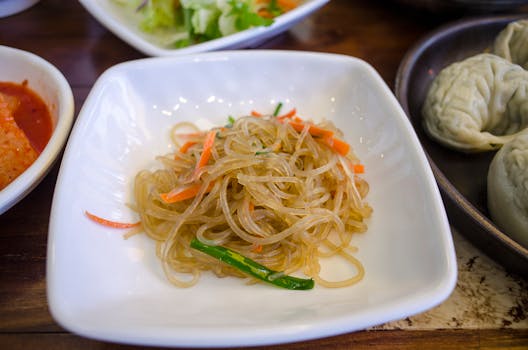
Korean
Korean Glass Noodles
The diets react (see scores below)
Common Ingredients
- sweet potato noodles
- spinach
- carrots
- onion
- mushrooms
- soy sauce
- sesame oil
- sugar
Specific recipes may vary.
Incompatible with 5 of 11 diets
Diet Ratings
Korean Glass Noodles (Japchae) are fundamentally incompatible with a ketogenic diet. Sweet potato noodles (dangmyeon) are the primary ingredient and are extremely high in starch — a single serving (~200g cooked) contains approximately 30-40g of net carbs from the noodles alone, easily exceeding the entire daily keto carb budget. Compounding this, the recipe explicitly includes added sugar, which has zero tolerance on keto. Carrots and onion add further net carbs. While spinach, mushrooms, soy sauce, and sesame oil are individually keto-friendly, they cannot redeem a dish built around a high-glycemic starch noodle base sweetened with sugar. There is no realistic portion size that makes this dish compatible with ketosis.
Korean Glass Noodles (Japchae) as listed here are fully plant-based. Sweet potato starch noodles are vegan, and all accompanying ingredients — spinach, carrots, onion, mushrooms, soy sauce, sesame oil, and sugar — are plant-derived. This version omits the beef and egg that appear in traditional Japchae recipes, making it a clean whole-food vegan dish. No animal products or animal-derived ingredients are present. The inclusion of whole vegetables and mushrooms as the primary components earns a high score within the approve range.
Korean Glass Noodles (Japchae) contains multiple non-paleo ingredients that disqualify it outright. Sweet potato noodles are a processed starch product — despite being derived from sweet potatoes, they are a highly refined, industrially extracted starch with no fiber or nutritional profile resembling whole sweet potatoes; they are not the same as eating a sweet potato. Soy sauce is a legume-based, heavily processed, sodium-laden condiment — excluded on multiple grounds (legumes, added salt, processing). Sesame oil is a seed oil, excluded under paleo seed oil rules. Refined sugar is explicitly excluded. The vegetables (spinach, carrots, onion, mushrooms) are individually paleo-approved, but they cannot redeem a dish built on a foundation of processed noodles, soy sauce, seed oil, and sugar. This dish fails on at least four distinct paleo criteria simultaneously.
Korean glass noodles (japchae) feature several Mediterranean-friendly elements: abundant vegetables (spinach, carrots, onion, mushrooms) and a plant-forward profile with no red meat. However, sweet potato starch noodles are a refined/processed starch with little fiber compared to whole grains like farro or barley favored in the Mediterranean diet. Sesame oil, while a healthy plant-based fat, is not the canonical Mediterranean fat (extra virgin olive oil), and the added sugar, though modest in typical japchae, runs counter to Mediterranean principles. Soy sauce is also a high-sodium processed condiment not part of the traditional Mediterranean pantry. The dish is not harmful and its vegetable density is genuinely positive, landing it in the 'caution' zone — acceptable occasionally but not a Mediterranean staple.
Some modern Mediterranean diet interpreters take a broader 'plant-forward' lens and would view japchae favorably given its emphasis on vegetables and plant-based fats, arguing that the spirit of the diet matters more than strict ingredient provenance. Traditional East Asian dietary patterns share meaningful overlap with Mediterranean principles, and a small amount of sugar and soy sauce may be considered negligible.
Korean Glass Noodles (Japchae) is entirely plant-based and contains zero animal products. Every single ingredient violates carnivore diet principles: sweet potato noodles are a starchy plant carbohydrate, spinach and carrots are vegetables, onion and mushrooms are plant foods, soy sauce is a fermented legume-grain product, sesame oil is a plant-derived oil, and sugar is a refined carbohydrate. There is no redeeming carnivore-compatible component in this dish whatsoever. This is one of the clearest possible violations of carnivore diet rules.
Korean Glass Noodles (Japchae) contains multiple Whole30-excluded ingredients. Soy sauce contains soy (a legume) and wheat (a grain), both of which are explicitly banned. Sugar is an added sweetener, also explicitly excluded. Sweet potato noodles, while made from sweet potato starch, fall under the rule prohibiting pasta and noodles — Whole30 explicitly lists noodles as a disallowed food even when made from compliant ingredients. The combination of soy sauce, sugar, and noodles makes this dish clearly non-compliant. The remaining ingredients (spinach, carrots, onion, mushrooms, sesame oil) are individually compliant, but they cannot rescue the dish from its core violations.
This Korean Glass Noodle dish (Japchae) contains two significant high-FODMAP ingredients that make it unsuitable during the elimination phase. Onion is one of the highest-FODMAP foods tested by Monash University, containing high levels of fructans at any meaningful serving size — there is no safe portion of onion during elimination. Mushrooms (commonly shiitake or wood ear in Japchae) are high in polyols (mannitol) and are high-FODMAP except at very small servings (e.g., canned mushrooms at 1/4 cup may be borderline). The sweet potato noodles themselves are low-FODMAP, as are spinach (low-FODMAP up to 75g), carrots (low-FODMAP up to 1 medium), sesame oil (fat-soluble, FODMAP-free), soy sauce (low-FODMAP at standard amounts — gluten trace in soy sauce is not a FODMAP concern), and sugar (FODMAP-free). However, onion alone makes this dish a clear avoid during elimination, regardless of portion size.
Korean Glass Noodles (Japchae) contain several DASH-friendly ingredients — spinach, carrots, onion, and mushrooms provide valuable potassium, magnesium, and fiber. Sweet potato noodles are a naturally gluten-free starch that is not inherently problematic. However, the dish is pulled down significantly by soy sauce, which is a high-sodium ingredient (standard soy sauce contains ~900mg sodium per tablespoon) and can push a single serving close to or over the DASH daily sodium threshold depending on quantity used. Sesame oil is a heart-friendly unsaturated fat and acceptable in DASH in moderation. The added sugar, while modest in typical Japchae preparations, adds empty calories and aligns with what DASH discourages. The vegetable-forward profile and absence of red meat or saturated fat are positives, but sodium management is the key concern for DASH adherence. Low-sodium soy sauce or tamari would meaningfully improve the score.
NIH DASH guidelines explicitly flag high-sodium condiments like soy sauce as incompatible at standard quantities. However, some DASH-oriented dietitians note that when soy sauce is used sparingly and paired with a potassium-rich vegetable profile (as in this dish), the overall meal can still fit within daily sodium budgets — particularly in the standard 2,300mg threshold rather than the stricter 1,500mg target.
Korean Glass Noodles (Japchae) present a mixed Zone Diet picture. The dish is carbohydrate-dominant with virtually no protein, which immediately breaks the 40/30/30 ratio requirement. Sweet potato noodles (dangmyeon) are made from sweet potato starch and have a moderate-to-high glycemic index — they are a 'unfavorable' carb in Zone terminology, though they are lower GI than white pasta. The vegetables (spinach, carrots, onion, mushrooms) are largely favorable Zone carbs, adding fiber, polyphenols, and micronutrients. However, sugar is added explicitly in the recipe, which is a Zone red flag. Sesame oil is omega-6 dominant, which conflicts with Zone's anti-inflammatory emphasis on monounsaturated and omega-3 fats — though the amount used is typically small. The complete absence of lean protein means this dish cannot function as a standalone Zone meal; it would need significant protein addition (e.g., tofu, chicken, or egg whites) to approach Zone balance. As a side dish with lean protein added separately, it could work in controlled portions, but even then the noodle-to-vegetable ratio needs adjustment and added sugar should be minimized or eliminated.
Some Zone practitioners note that sweet potato noodles, while starchy, have a surprisingly moderate glycemic response in part due to their resistant starch content and relatively lower caloric density per serving. Sears' later writings also give more latitude to traditional whole-food preparations like Japchae, provided the macro imbalance is corrected. Practitioners who focus on polyphenol intake (a Sears emphasis post-2000s) may highlight the spinach, mushrooms, and sesame as anti-inflammatory contributors worth keeping.
Japchae (Korean glass noodles) has a mixed anti-inflammatory profile. On the positive side, the dish is loaded with anti-inflammatory vegetables: spinach provides folate, vitamins K and C, and antioxidants; carrots supply beta-carotene (a potent carotenoid); onion contributes quercetin and other flavonoids; and mushrooms (likely shiitake or similar, common in japchae) are among the most emphasized anti-inflammatory foods in Dr. Weil's framework. Sesame oil, while high in omega-6 linoleic acid, also contains sesamin and sesamol — lignan antioxidants with documented anti-inflammatory properties — and is used in modest amounts as a finishing oil. Soy sauce in small quantities is not significantly inflammatory. The main concerns are the sweet potato starch noodles, which are a refined starch with a moderately high glycemic impact and very little fiber or nutritional density (despite the 'sweet potato' name, the starch is heavily processed), and the added sugar, which is a straightforward pro-inflammatory ingredient even in small amounts. Prepared lightly, this dish skews toward neutral-to-moderate anti-inflammatory; prepared with generous sugar and heavy sesame oil, it moves more toward caution. The vegetable-forward nature and mushroom content lift the score.
Some anti-inflammatory practitioners would rate this more favorably, arguing the abundant antioxidant-rich vegetables and mushrooms dominate the profile and the sugar/starch amounts are small relative to the whole dish. Others, particularly those following glycemic-focused anti-inflammatory approaches, would penalize sweet potato starch noodles more heavily as a high-GI refined carbohydrate that can spike blood glucose and promote downstream inflammatory signaling.
Korean glass noodles (japchae) are made from sweet potato starch, which is naturally gluten-free and relatively easy to digest, making them gentle on a slowed GI system. The vegetable mix — spinach, carrots, onion, and mushrooms — adds meaningful fiber and micronutrients. However, this dish has no listed protein source, which is a critical gap for GLP-1 patients who need 15–30g of protein per meal to prevent muscle loss. The addition of sugar and sesame oil introduces empty calories and fat in a meal that is already calorie-light but nutritionally incomplete. Soy sauce adds sodium, which is a minor concern. The dish scores reasonably on digestibility, fiber, and vegetable density, but fails on the #1 priority: protein. As a standalone main, it is not appropriate for GLP-1 patients without a significant protein addition (e.g., tofu, chicken, or edamame). As a side dish in a balanced meal, it is more acceptable.
*See how scores were generated at our methodology page.
Nutritional profile
Six traits that cut across every diet.
Fiber & Plants
How much whole-plant food and fiber it delivers.
Healthy Fats
The quality of its fats (unsaturated, omega-3).
Whole / Unprocessed
How close it is to its natural, unprocessed form.
Gut Gentle
How easy it is on digestion (low FODMAP, few irritants).
Low Glycemic
How little it spikes your blood sugar.
Protein Density
How much protein it packs per calorie.
Controversy Index
Higher controversy = more disagreement between diets.
Diet-Specific Tips
 Vegan — 9/10
View tips
- Sweet potato glass noodles are 100% plant-based
- All vegetables (spinach, carrots, onion, mushrooms) are whole plant foods
- Soy sauce and sesame oil are plant-derived condiments
- Sugar is plant-derived (note: bone char-processed white sugar is a concern for some strict vegans, but this is a minor processing debate, not an ingredient issue)
- No beef or egg present — traditional Japchae often includes both, but this recipe excludes them
- No animal products or animal-derived ingredients identified
 Mediterranean — 5/10
View tips
- Sweet potato starch noodles are a refined/low-fiber carbohydrate, not a Mediterranean whole grain
- Abundant vegetables (spinach, carrots, mushrooms, onion) align well with Mediterranean plant-forward emphasis
- Sesame oil is a healthy plant fat but not the canonical extra virgin olive oil
- Added sugar contradicts Mediterranean diet's minimal added sugars principle
- High-sodium soy sauce is a processed condiment outside the Mediterranean pantry
- No red meat or highly processed proteins — a positive factor
 DASH — 5/10
View tips
- Soy sauce is high in sodium and is the primary DASH concern in this dish
- Spinach, carrots, mushrooms, and onion provide DASH-valued potassium, magnesium, and fiber
- Sweet potato noodles are a refined starch but not as problematic as white flour noodles
- Sesame oil is an unsaturated fat acceptable in moderation on DASH
- Added sugar is discouraged on DASH but likely small in quantity
- No saturated fat, red meat, or full-fat dairy — structurally aligned with DASH
- Low-sodium soy sauce substitution would significantly improve DASH compatibility
 Zone — 4/10
View tips
- No protein source — critical Zone imbalance with 0% protein calories
- Sweet potato noodles are high-starch 'unfavorable' carbs in Zone terminology
- Added sugar is a Zone-unfavorable ingredient
- Sesame oil is omega-6 dominant, conflicting with Zone's anti-inflammatory fat preference
- Vegetables (spinach, mushrooms, carrots) are favorable low-GI Zone carbs
- Dish is carbohydrate-dominant and cannot function as a standalone Zone meal
- Could be rehabilitated with lean protein addition and sugar reduction
 Anti-Inflammatory — 6/10
View tips
- Spinach, carrots, and onion provide antioxidants, carotenoids, and quercetin — anti-inflammatory positives
- Mushrooms are a strongly emphasized anti-inflammatory food in Dr. Weil's framework
- Sweet potato glass noodles are a refined starch (low fiber, moderate-high glycemic index) despite the name
- Added sugar is a pro-inflammatory ingredient, even in small amounts
- Sesame oil contains sesamin/sesamol antioxidants but is omega-6 dominant — net effect is mixed
- Dish is plant-based and free of red meat, trans fats, and processed additives — structural positives
- No omega-3 source present; dish would benefit from added protein such as tofu, edamame, or fatty fish
 GLP-1 Friendly — 5/10
View tips
- No protein source listed — fails the primary GLP-1 dietary priority for a main dish
- Sweet potato noodles are easy to digest and gentle on slowed gastric emptying
- Good vegetable variety adds fiber and micronutrients
- Sugar in the recipe adds unnecessary empty calories
- Sesame oil contributes unsaturated fat, acceptable in small amounts but adds calories in a low-appetite context
- High sodium from soy sauce is a minor concern
- Acceptable as a side dish; poor as a standalone main for GLP-1 patients