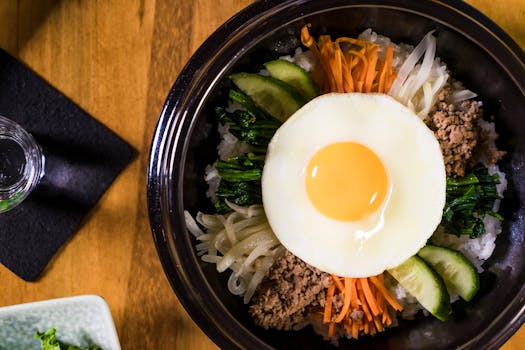
Photo: Luis Becerra Fotógrafo / Pexels
Korean
Korean Rice Bowl (Deopbap)
The diets react (see scores below)
Common Ingredients
- rice
- beef
- onion
- garlic
- soy sauce
- sesame oil
- scallions
- egg
Specific recipes may vary.
Incompatible with 7 of 11 diets
Diet Ratings
Korean Rice Bowl (Deopbap) is fundamentally incompatible with ketogenic eating due to its base ingredient: white rice. A standard serving of rice (1 cup cooked) contains approximately 45g of net carbs, which alone meets or exceeds the entire daily carb limit for most keto practitioners. The beef, egg, sesame oil, garlic, scallions, and onion are keto-friendly or acceptable in small amounts, but soy sauce may contain trace carbs and added sugars depending on the brand. Regardless, the rice makes this dish a clear avoid — no portion adjustment can make a rice bowl keto-compatible while preserving the dish's identity.
Korean Rice Bowl (Deopbap) as described contains multiple animal products that are clearly excluded from a vegan diet. Beef is a direct animal flesh product, and egg is an animal-derived ingredient. Both are unambiguous violations of vegan principles. The remaining ingredients — rice, onion, garlic, soy sauce, sesame oil, and scallions — are plant-based, but the presence of beef and egg makes this dish wholly incompatible with veganism. There is no meaningful debate within the vegan community about either of these ingredients.
Korean Rice Bowl (Deopbap) contains multiple non-paleo ingredients that are firmly excluded under any mainstream paleo framework. Rice is a grain and is excluded from standard paleo (unlike the niche 'Perfect Health Diet' exception, that debate applies to plain white rice, not rice as the foundational base of a dish). Soy sauce is a highly processed legume-derived product containing wheat, soy, and added salt — three separate paleo violations in one ingredient. Sesame oil is a seed oil, explicitly excluded in favor of animal fats, olive oil, or coconut oil. The beef, onion, garlic, scallions, and egg are all paleo-approved, but the structural and flavoring components of this dish are fundamentally incompatible with paleo principles. This is not a borderline case — the dish is built on rice and seasoned with soy sauce and sesame oil, making it clearly non-paleo.
This Korean rice bowl centers on red meat (beef or pork) as the primary protein, which directly contradicts Mediterranean diet principles that limit red meat to only a few times per month. The dish uses white rice (a refined grain) rather than whole grains, and sesame oil instead of extra virgin olive oil as the fat source. Soy sauce adds significant sodium and is a processed condiment not part of the Mediterranean tradition. While some ingredients like onion, garlic, and scallions are Mediterranean-friendly, the overall dish profile — red meat over refined white rice with non-Mediterranean fats and condiments — places it firmly in the 'avoid' category. The egg is a mild positive but insufficient to offset the core issues.
Korean Rice Bowl (Deopbap) is fundamentally incompatible with the carnivore diet. The dish is built on rice, a grain that is entirely excluded on carnivore. Beyond the rice, it contains multiple plant-derived ingredients: onion, garlic, soy sauce (fermented soy — a legume), sesame oil (plant oil), and scallions. The beef and egg are the only carnivore-compatible components. Soy sauce also typically contains wheat, adding another grain to the violation list. This dish is predominantly plant-based in its flavor profile and bulk, making it a clear avoid with high confidence across all tiers of carnivore eating.
This Korean Rice Bowl contains two clearly excluded ingredients: rice (a grain, explicitly prohibited on Whole30) and soy sauce (contains soy, a legume, and often wheat — both excluded). These are not edge cases or debatable items; both are explicitly listed as excluded by official Whole30 rules. The remaining ingredients — beef, onion, garlic, sesame oil, scallions, and egg — are all Whole30-compliant. However, the presence of rice and soy sauce makes this dish non-compliant as described. A modified version could substitute cauliflower rice for rice and coconut aminos for soy sauce, which would make it compliant.
This Korean rice bowl contains multiple high-FODMAP ingredients that make it unsuitable during the elimination phase. Garlic is one of the highest-FODMAP foods tested by Monash University, containing significant fructans even in very small amounts. Onion is similarly very high in fructans and is a primary FODMAP offender — both garlic and onion are avoid-level at any reasonable culinary quantity. Scallion bulbs (white parts) are also high in fructans, though the green tops are low-FODMAP. The standard preparation of this dish uses all three alliums together, creating a heavily stacked FODMAP load. The remaining ingredients — white rice, beef, soy sauce (small amounts), sesame oil, and egg — are all individually low-FODMAP and safe. However, the garlic-onion combination alone is disqualifying for elimination phase, regardless of the otherwise favorable ingredients.
Korean Rice Bowl (Deopbap) contains several DASH-compatible elements — rice (ideally whole grain), onion, garlic, scallions, and egg — but is undermined primarily by soy sauce, which is extremely high in sodium (roughly 900–1,000mg per tablespoon), and the use of beef or pork as the primary protein, which contributes saturated fat. Sesame oil is an unsaturated fat and acceptable in small amounts. The dish as commonly prepared in Korean cuisine likely exceeds DASH sodium targets in a single serving due to soy sauce quantity. If made with lean beef (e.g., sirloin) in modest portions, the saturated fat concern is moderate rather than severe. The egg is acceptable under most current DASH-aligned interpretations. The overall profile places this dish in 'caution' territory: it is not inherently incompatible with DASH if substantially modified (low-sodium soy sauce or tamari, reduced portion of soy sauce, lean beef or substitution with chicken/tofu, brown rice instead of white), but as commonly prepared it poses meaningful sodium and saturated fat concerns.
NIH DASH guidelines explicitly restrict sodium to under 2,300mg/day (or 1,500mg for stricter adherence), making standard soy sauce-based dishes problematic without modification. However, updated clinical interpretations of DASH increasingly focus on overall dietary pattern rather than individual meals, and some DASH-oriented dietitians allow higher-sodium dishes occasionally within a low-sodium overall day — a perspective not reflected in the original NIH DASH protocol.
Korean Rice Bowl (Deopbap) presents significant Zone Diet challenges primarily due to its white rice base. White rice is a high-glycemic carbohydrate that Sears explicitly categorizes as 'unfavorable' — it spikes insulin rapidly and provides little fiber, making it difficult to balance the 40/30/30 ratio without creating an insulin surge. A typical rice bowl is heavily carb-dominant, with rice constituting the bulk of the dish. The protein component (beef) is moderate to favorable depending on the cut — lean beef like sirloin or tenderloin is acceptable, but fattier cuts (bulgogi-style with higher fat content) add saturated fat. Sesame oil contributes some monounsaturated fat (Zone-friendly) but is also relatively high in omega-6 polyunsaturated fats, which Sears discourages due to their pro-inflammatory potential. The egg adds quality protein. Onion, garlic, and scallions are favorable low-glycemic vegetables. Soy sauce adds sodium but is negligible in macros. To fit the Zone, this dish would require a dramatically reduced rice portion (perhaps 1/3 cup cooked, or ~1 carb block), a larger protein portion from lean beef, and supplemental low-GI vegetables to make up the carbohydrate allowance. As typically served in a restaurant or home setting, the carb-to-protein-to-fat ratio is far out of Zone balance.
This Korean rice bowl presents a mixed anti-inflammatory profile. On the positive side, garlic and scallions are well-established anti-inflammatory alliums with sulfur compounds that inhibit NF-κB pathways. Sesame oil contains sesamol and sesamin, lignans with modest anti-inflammatory and antioxidant properties — though it's moderately high in omega-6 (linoleic acid), which is a consideration. The egg contributes choline and selenium, which have anti-inflammatory relevance. Soy sauce in small culinary amounts is unlikely to be a significant inflammatory driver, though it is high in sodium. The core concerns center on the protein and the carbohydrate base. Beef (especially if fatty cuts like bulgogi-style ribeye are used) contributes saturated fat and arachidonic acid, placing it in the 'limit' category per anti-inflammatory guidelines. White rice — the standard base — is a refined, high-glycemic carbohydrate that can spike blood glucose and modestly raise inflammatory markers (CRP) in susceptible individuals. If brown or mixed-grain rice were substituted, the score would be meaningfully higher. The dish as a whole is a culturally familiar, generally wholesome meal that fits comfortably in the 'acceptable in moderation' zone — not a pro-inflammatory dish, but not optimized for anti-inflammatory eating either.
Some anti-inflammatory practitioners (aligned with Dr. Weil's more flexible pyramid) would view this dish more favorably, emphasizing the beneficial alliums, the modest portion of sesame oil's antioxidant lignans, and the overall whole-food character of the ingredients — potentially rating it a 6. Conversely, stricter anti-inflammatory protocols (such as those targeting metabolic inflammation) would penalize white rice more heavily as a glycemic driver and flag beef's arachidonic acid content more aggressively, particularly for individuals with autoimmune conditions or elevated CRP.
A Korean rice bowl (deopbap) with beef or pork sits in caution territory for GLP-1 patients. The dish has genuine strengths — egg and beef/pork provide meaningful protein (roughly 20-28g depending on portion and cut), garlic and onion contribute modest fiber and micronutrients, and soy sauce adds flavor without significant calories. Sesame oil is an unsaturated fat used typically in small amounts, which is acceptable. However, several factors hold it back. White rice is a refined grain with low fiber and high glycemic load, occupying significant stomach volume that crowds out more nutrient-dense foods. The protein quality depends heavily on cut: lean ground beef or sirloin is far more GLP-1-appropriate than fattier cuts like bulgogi-style short rib or ground pork, which can push saturated fat into ranges that worsen nausea and bloating. Soy sauce is high in sodium, which matters for hydration balance on GLP-1s. The dish is also portion-sensitive — a restaurant-sized bowl with a large rice base and fatty meat would score lower (3-4), while a home-prepared version with lean beef, reduced rice, and extra egg would score higher (6-7).
Some GLP-1-focused RDs would rate this higher, arguing that the egg-plus-meat protein combination makes it a practical, culturally accessible meal that patients will actually eat consistently — adherence value being underweighted in strict scoring systems. Others flag that the white rice base and variable fat content of beef or pork make this unreliable as a regular GLP-1 meal without specific preparation guidance.
*See how scores were generated at our methodology page.
Nutritional profile
Six traits that cut across every diet.
Fiber & Plants
How much whole-plant food and fiber it delivers.
Healthy Fats
The quality of its fats (unsaturated, omega-3).
Whole / Unprocessed
How close it is to its natural, unprocessed form.
Gut Gentle
How easy it is on digestion (low FODMAP, few irritants).
Low Glycemic
How little it spikes your blood sugar.
Protein Density
How much protein it packs per calorie.
Controversy Index
Higher controversy = more disagreement between diets.
Diet-Specific Tips
 DASH — 4/10
View tips
- High sodium from soy sauce — major DASH concern, likely exceeds per-meal sodium budget
- Beef or pork as primary protein — contributes saturated fat, DASH recommends limiting red meat
- Sesame oil is an unsaturated fat, acceptable in small amounts on DASH
- Egg is acceptable under most current DASH-aligned clinical guidance
- White rice is less preferred than brown rice/whole grains on DASH
- Garlic, onion, scallions are DASH-positive vegetables
- Low-sodium soy sauce substitution would significantly improve DASH compatibility
- Lean beef portion control and substituting poultry or legumes would improve score
 Zone — 4/10
View tips
- White rice is a high-glycemic 'unfavorable' carb explicitly flagged by Sears — a major Zone liability
- As served, rice dominates the macro ratio, creating carb-heavy imbalance far from 40/30/30
- Beef protein is acceptable if lean cut is used; fattier bulgogi-style cuts add undesirable saturated fat
- Sesame oil has a high omega-6 to omega-3 ratio, which conflicts with Sears' anti-inflammatory focus
- Egg, garlic, onion, and scallions are Zone-friendly ingredients
- Could technically be adapted for Zone by dramatically reducing rice and adding vegetables, but loses authenticity
- Soy sauce adds sodium but does not materially affect Zone macro calculations
 Anti-Inflammatory — 5/10
View tips
- Beef is in the 'limit' category per anti-inflammatory guidelines due to saturated fat and arachidonic acid content
- White rice is a refined, high-glycemic carbohydrate linked to modest increases in inflammatory markers
- Garlic and scallions are potent anti-inflammatory alliums with NF-κB inhibiting sulfur compounds
- Sesame oil contains anti-inflammatory lignans (sesamol, sesamin) but is moderately high in omega-6 fatty acids
- Egg contributes choline and selenium with anti-inflammatory relevance — moderate profile overall
- Dish is made from whole, minimally processed ingredients with no trans fats or artificial additives
- Substituting lean pork loin (over fatty beef) and brown/mixed-grain rice would meaningfully improve the anti-inflammatory profile
 GLP-1 Friendly — 5/10
View tips
- Protein content is adequate but highly dependent on meat cut — lean beef preferred over fatty pork or short rib
- White rice is a low-fiber refined grain that displaces nutrient-dense ingredients and spikes blood sugar
- Sesame oil used in typical small quantities is acceptable as an unsaturated fat
- High sodium from soy sauce warrants attention given GLP-1 hydration concerns
- Egg adds high-quality easily digestible protein and improves the nutritional profile
- Dish is portion-sensitive — smaller rice portion and leaner meat significantly improves GLP-1 compatibility
- Fatty cuts of beef or pork can worsen nausea and GI side effects due to slowed gastric emptying