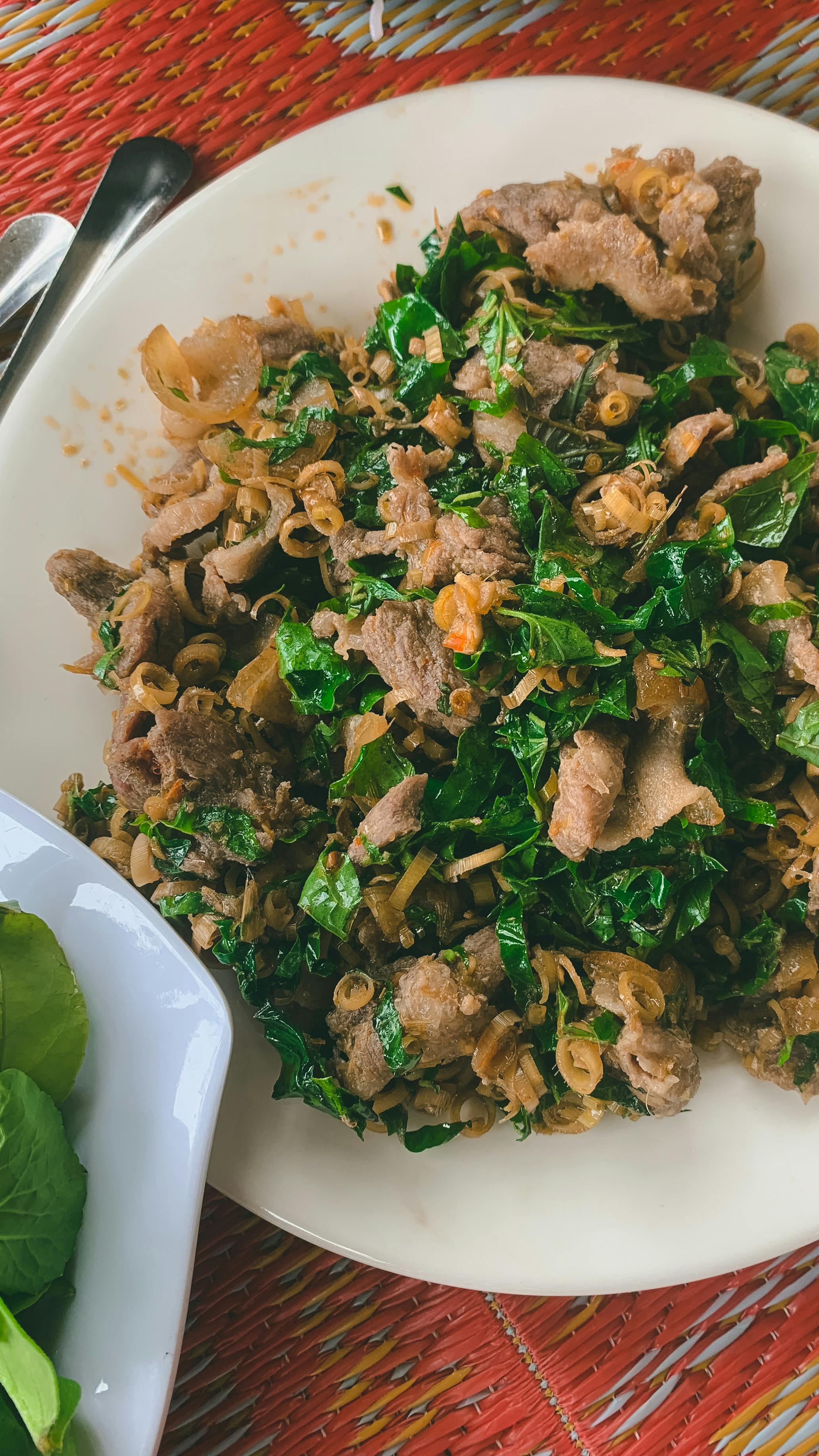
Photo: Khoa Nguyen / Pexels
The diets react (see scores below)
Common Ingredients
- ground pork
- toasted rice powder
- lime juice
- fish sauce
- mint
- cilantro
- shallots
- chiles
Specific recipes may vary.
Incompatible with 4 of 11 diets
Diet Ratings
Larb Moo is mostly keto-friendly — ground pork provides quality protein and fat, while herbs, lime juice, fish sauce, shallots, and chiles add minimal net carbs. The primary concern is toasted rice powder (khao khua), a traditional and essential ingredient that adds starchy carbs. A standard serving (1-2 teaspoons per serving) contributes roughly 3-5g net carbs from rice powder alone, and combined with shallots and lime juice, a full serving could push 8-12g net carbs. This is manageable within a daily keto budget if portion-controlled, but it is not a clean keto food. The dish can be adapted by omitting or reducing the rice powder.
Some lazy keto practitioners would approve this outright, arguing the rice powder quantity per serving is small enough to fit within a 50g daily carb limit without issue. Strict/clinical keto adherents, however, would avoid it entirely due to the intentional inclusion of a grain-based ingredient, regardless of quantity.
Larb Moo contains two clear animal-derived ingredients that disqualify it from any vegan diet. Ground pork is the primary protein — an unambiguous animal product. Fish sauce, a staple Thai condiment made from fermented fish, is also an animal product. Together these make this dish entirely incompatible with vegan principles. There is no meaningful debate within the vegan community on either ingredient.
Larb Moo is disqualified from paleo compliance primarily due to toasted rice powder (khao khua), which is a ground grain and a non-negotiable exclusion under all paleo frameworks. Fish sauce also typically contains added salt and sometimes sugar or preservatives, making it a processed condiment that conflicts with strict paleo principles. The remaining ingredients — ground pork, lime juice, fresh herbs (mint, cilantro), shallots, and chiles — are all fully paleo-approved and would make this dish an excellent paleo meal if the rice powder were omitted and a clean fish sauce (or coconut aminos) were substituted.
Larb Moo is a Thai ground pork salad that conflicts with core Mediterranean diet principles primarily due to its red meat base. Pork is a red meat limited to only a few times per month in the Mediterranean diet. While many individual ingredients are positive — fresh herbs (mint, cilantro), shallots, chiles, lime juice, and fish sauce are all minimally processed and herb-forward — the protein foundation works against the diet's guidelines. The dish contains no olive oil (it relies on the fat rendered from pork), no legumes, and no whole grains beyond the small amount of toasted rice powder. The herb-heavy, fresh preparation style and use of lime juice do echo some Mediterranean salad sensibilities, but the pork base and non-Mediterranean fat profile keep this firmly in 'avoid' territory for regular consumption.
Some flexible Mediterranean diet interpreters might rate this as 'caution' rather than 'avoid,' noting that the dish is essentially a lean protein with abundant fresh herbs and no added sugars or processed ingredients — qualities that align with the diet's anti-inflammatory spirit. If pork consumption is already being kept to the recommended few-times-per-month limit, a single serving of this lean preparation could be considered acceptable within that quota.
Larb Moo is fundamentally incompatible with the carnivore diet. While ground pork and fish sauce are animal-derived and acceptable, the dish is built around numerous plant-based ingredients that are strictly excluded: toasted rice powder (grain), lime juice (fruit), mint (herb), cilantro (herb), shallots (allium vegetable), and chiles (plant). The majority of the ingredient list — and the defining flavor profile of this dish — consists entirely of plant foods. This is not a borderline case; it is a plant-heavy Thai salad that happens to contain some meat.
Larb Moo is largely Whole30-compliant: ground pork, lime juice, fish sauce, mint, cilantro, shallots, and chiles are all permitted. The one ingredient requiring attention is toasted rice powder (khao khua), which is made from toasted raw rice that is ground — rice is a grain explicitly excluded from Whole30. While the quantity used is small (typically 1-2 tablespoons as a thickener/textural element), it is still a grain-derived ingredient and technically violates the rules. The dish can be made compliant by omitting the toasted rice powder, which affects texture and authenticity but preserves the core flavor profile. Fish sauce should also be label-checked to ensure no added sugar or non-compliant additives, though most traditional fish sauces contain only fish and salt.
Some Whole30 community members argue that the negligible amount of toasted rice powder used in larb is functionally insignificant, similar to how trace ingredients in spice blends are sometimes tolerated. However, Melissa Urban and official Whole30 guidelines are clear that rice in any form is excluded, with no exception for small quantities or incidental use.
Larb Moo contains several low-FODMAP ingredients (ground pork, lime juice, fish sauce, mint, cilantro, chiles, toasted rice powder) but is problematic due to shallots, which are high-FODMAP alliums containing fructans similar to onions. Shallots are not safe during the elimination phase at any standard culinary quantity. Toasted rice powder (khao khua) is low-FODMAP in the typical small amounts used as a seasoning. Fish sauce is generally low-FODMAP at standard serving sizes. The dish could theoretically be modified by omitting shallots, but as traditionally prepared, the shallots make it unsuitable for the elimination phase. The scoring reflects that with a simple modification (removing shallots), this dish becomes largely low-FODMAP friendly.
Monash University clearly lists shallots as high-FODMAP at typical serving sizes due to fructan content, making this dish an avoid in strict elimination. However, some clinical FODMAP practitioners may suggest the dish with shallots omitted or replaced with green onion tops (the green parts only), which would shift the verdict to approve — but as traditionally prepared with shallots, caution is warranted.
Larb Moo sits in a gray zone for DASH. The dish features ground pork, which is a red meat DASH limits, along with fish sauce, which is very high in sodium (roughly 1,000–1,400mg per tablespoon). However, the overall dish profile includes many DASH-positive elements: fresh herbs (mint, cilantro), shallots, lime juice, and chiles provide potassium, antioxidants, and fiber. Toasted rice powder adds a modest whole-grain component. The key concern is the fish sauce sodium load — a typical serving could deliver 600–900mg of sodium from fish sauce alone, which is significant given DASH's 1,500–2,300mg/day ceiling. Ground pork also contributes saturated fat, though leaner pork cuts used as ground pork (e.g., loin) are more DASH-compatible than fattier options. The dish is not heavily processed and lacks added sugars, tropical oils, or full-fat dairy. With portion control and reduced fish sauce, it becomes more DASH-compatible. As commonly prepared in restaurants, the sodium content pushes it toward caution.
NIH DASH guidelines explicitly limit red meat and high-sodium condiments like fish sauce, which would place this dish firmly in the caution-to-avoid range. However, some DASH-oriented clinicians note that when pork is lean and portions are moderate, the herb-forward, low-fat profile aligns reasonably well with DASH principles — particularly if low-sodium fish sauce or a reduced quantity is used.
Larb Moo is a reasonably Zone-compatible dish that comes close to favorable territory but requires some attention. The protein base (ground pork) is the primary concern: pork can range from lean (loin) to moderately fatty (ground pork at typical fat percentages), making it less ideal than skinless chicken or fish but still workable. The fat content in ground pork is often around 20-25% fat by weight, which includes saturated fat — a flag in Zone methodology. The flavor base is excellent from a Zone perspective: lime juice, fish sauce (minimal carbs), fresh herbs (mint, cilantro), shallots, and chiles are all low-glycemic, polyphenol-rich ingredients that align well with Sears' anti-inflammatory emphasis. Toasted rice powder is used in small quantities for texture and contributes minimal carbohydrate load. The dish is notably low in fat (no added oils, no avocado), which means it would need a fat source added to hit the 30% fat block target — a handful of almonds or a small amount of olive oil drizzled in would help balance it. The carb content is very low, so pairing with additional low-GI vegetables would be needed to hit the 40% carb block. As written, the macro ratio skews protein-heavy and carb-light, which is a Zone imbalance, but the dish itself is a solid protein-and-herb foundation to build a Zone meal around.
Some Zone practitioners would rate this higher (7) given the clean, whole-food, anti-inflammatory ingredient profile that aligns strongly with Sears' later writings emphasizing polyphenols and omega-3 focus. The leanness of the dish and herb density are positives. The counterargument for keeping it at caution is that ground pork's saturated fat content and the need for significant macro adjustment (adding fat and carb blocks) means it cannot stand alone as a Zone-balanced meal without modification.
Larb Moo presents a genuinely mixed anti-inflammatory profile. The dish is anchored by ground pork, which is a moderate red/processed meat depending on cut and fat content — lean ground pork falls into the 'limit' category (higher in saturated fat and arachidonic acid than poultry or fish, but not as inflammatory as processed red meats). The herb profile is strongly anti-inflammatory: fresh mint, cilantro, shallots, and chiles all contain meaningful polyphenols, flavonoids, and bioactive compounds (quercetin in shallots, capsaicin in chiles, rosmarinic acid in mint). Lime juice provides vitamin C and antioxidants. Fish sauce is high in sodium but minimally processed and provides umami without significant inflammatory compounds. Toasted rice powder is a whole grain product used in small quantities, adding negligible glycemic burden. The dish is notably free of seed oils, refined sugars, artificial additives, or trans fats — a meaningful positive. However, pork as the primary protein prevents an 'approve' rating; the anti-inflammatory framework would generally prefer fatty fish, legumes, or poultry as the protein base. If made with lean pork loin, the dish trends toward the higher end of 'caution'; with fattier ground pork it trends lower. Overall, this is a reasonably clean, herb-forward dish with one significant limiting factor.
Some anti-inflammatory practitioners, including those following Dr. Andrew Weil's pyramid (which permits lean pork occasionally), would view this dish more favorably given its exceptional herb density, lime, chiles, and absence of processed ingredients — potentially scoring it in the low 'approve' range. Conversely, stricter anti-inflammatory protocols, particularly those addressing autoimmune conditions, would flag pork's arachidonic acid content and emphasize that any red or pink meat should be minimized in favor of cold-water fish.
Larb Moo is a Thai minced pork salad with genuine nutritional strengths for GLP-1 patients but one meaningful drawback: the fat content. Ground pork is a moderate-to-high fat protein source depending on lean percentage — a standard serving using typical ground pork (80/20) can carry 15-20g fat, which risks worsening GLP-1 side effects like nausea, bloating, and reflux due to slowed gastric emptying. The dish scores well on several other criteria: it is light in volume with no heavy sauces or fried components, the toasted rice powder adds modest fiber and aids digestion, lime juice and fish sauce contribute flavor with negligible calories, and the fresh herbs (mint, cilantro) and shallots provide micronutrients and are easy on the stomach. The chiles are a moderate concern — not at habanero intensity but enough to potentially irritate the GI tract in sensitive patients. Protein content is solid for a small-portion dish. Overall this is a nutrient-dense, portion-friendly, low-sugar, minimally processed dish that fits GLP-1 dietary goals reasonably well if made with lean ground pork (93/7 or leaner) and with chiles kept mild or omitted.
Some GLP-1-focused dietitians would rate this higher, arguing that the dish is far superior to processed or fried alternatives and that lean ground pork is acceptable; others caution that pork fat content is highly variable in restaurant preparation and that chile irritants compound GI sensitivity that is already elevated on GLP-1 medications, particularly in the first months of use.
*See how scores were generated at our methodology page.
Nutritional profile
Six traits that cut across every diet.
Fiber & Plants
How much whole-plant food and fiber it delivers.
Healthy Fats
The quality of its fats (unsaturated, omega-3).
Whole / Unprocessed
How close it is to its natural, unprocessed form.
Gut Gentle
How easy it is on digestion (low FODMAP, few irritants).
Low Glycemic
How little it spikes your blood sugar.
Protein Density
How much protein it packs per calorie.
Controversy Index
Higher controversy = more disagreement between diets.
Diet-Specific Tips
 Keto — 5/10
View tips
- Toasted rice powder adds starchy net carbs and is a grain-based ingredient
- Ground pork is an excellent keto protein and fat source
- Fish sauce, lime juice, and herbs are low-carb flavor contributors
- Shallots add minor carbs but are used in small amounts
- Dish is adaptable — rice powder can be reduced or omitted
- Standard restaurant serving may push 8-12g net carbs total
- Fits within daily keto budget only with portion control
 Whole30 — 5/10
View tips
- Toasted rice powder (khao khua) is made from rice, an excluded grain
- All other ingredients — pork, lime juice, fish sauce, mint, cilantro, shallots, chiles — are fully compliant
- Fish sauce should be label-checked for added sugars or non-compliant additives
- Dish can be made fully compliant by omitting the rice powder
- Small quantity of rice powder does not exempt it from the grain exclusion rule
 Low-FODMAP — 5/10
View tips
- Shallots are high-FODMAP alliums (fructans) — primary concern in this dish
- Ground pork is low-FODMAP and safe
- Fish sauce is low-FODMAP at standard culinary amounts
- Toasted rice powder (khao khua) is low-FODMAP in small quantities used as seasoning
- Lime juice, mint, cilantro, and chiles are all low-FODMAP
- Dish is modifiable — removing shallots would make it largely elimination-phase safe
 DASH — 5/10
View tips
- Fish sauce is very high in sodium (~1,000–1,400mg/tbsp), the primary DASH concern
- Ground pork is a red meat, which DASH recommends limiting
- Lean ground pork (loin-based) reduces saturated fat concern
- Mint, cilantro, shallots, and chiles contribute potassium and antioxidants — DASH-positive
- Lime juice adds flavor without sodium, potentially reducing need for fish sauce
- No added sugars, tropical oils, or full-fat dairy
- Portion size and fish sauce quantity are critical variables
- Low-sodium fish sauce substitution would meaningfully improve DASH score
 Zone — 6/10
View tips
- Ground pork has moderate saturated fat content, less ideal than chicken breast or fish as a Zone protein
- Herb-heavy ingredient profile (mint, cilantro, chiles, lime) provides excellent polyphenols aligned with Zone anti-inflammatory goals
- Toasted rice powder contributes minimal glycemic load at traditional serving amounts
- No added fat in dish — requires a monounsaturated fat source (almonds, olive oil) to complete Zone fat blocks
- Very low carb profile means additional low-GI vegetables needed to balance the 40/30/30 ratio
- Fish sauce and lime juice are Zone-friendly flavor enhancers with negligible macro impact
- Dish is whole-food and unprocessed, consistent with Zone dietary principles
 Anti-Inflammatory — 5/10
View tips
- Ground pork is the primary protein — falls in 'limit' category due to saturated fat and arachidonic acid content
- Exceptionally herb-rich: mint, cilantro, shallots, and chiles contribute significant polyphenols and anti-inflammatory bioactives
- Chiles contain capsaicin, a well-documented anti-inflammatory compound
- Lime juice provides vitamin C and antioxidants
- No seed oils, refined sugars, or processed additives — a positive distinction from many restaurant dishes
- Fish sauce adds sodium but no significant pro-inflammatory compounds
- Toasted rice powder is whole grain, used in small quantity — minimal concern
- Overall profile improved by cooking method (no frying) and fresh ingredient focus
 GLP-1 Friendly — 5/10
View tips
- Ground pork fat content is portion- and preparation-dependent — lean ground pork significantly improves the rating
- No fried components, no added sugar, no heavy sauces — digestibility is generally good
- Chiles may worsen GLP-1-related nausea or reflux in sensitive patients
- Toasted rice powder adds modest fiber and digestive benefit
- Fresh herbs and lime juice are nutrient-dense and easy to digest
- Fish sauce adds sodium — relevant for patients monitoring blood pressure
- Small serving size is well-matched to reduced GLP-1 appetite
- Protein content is moderate per serving — should be paired with additional protein sources to meet daily targets