Photo: Horizon Content / Pexels
American
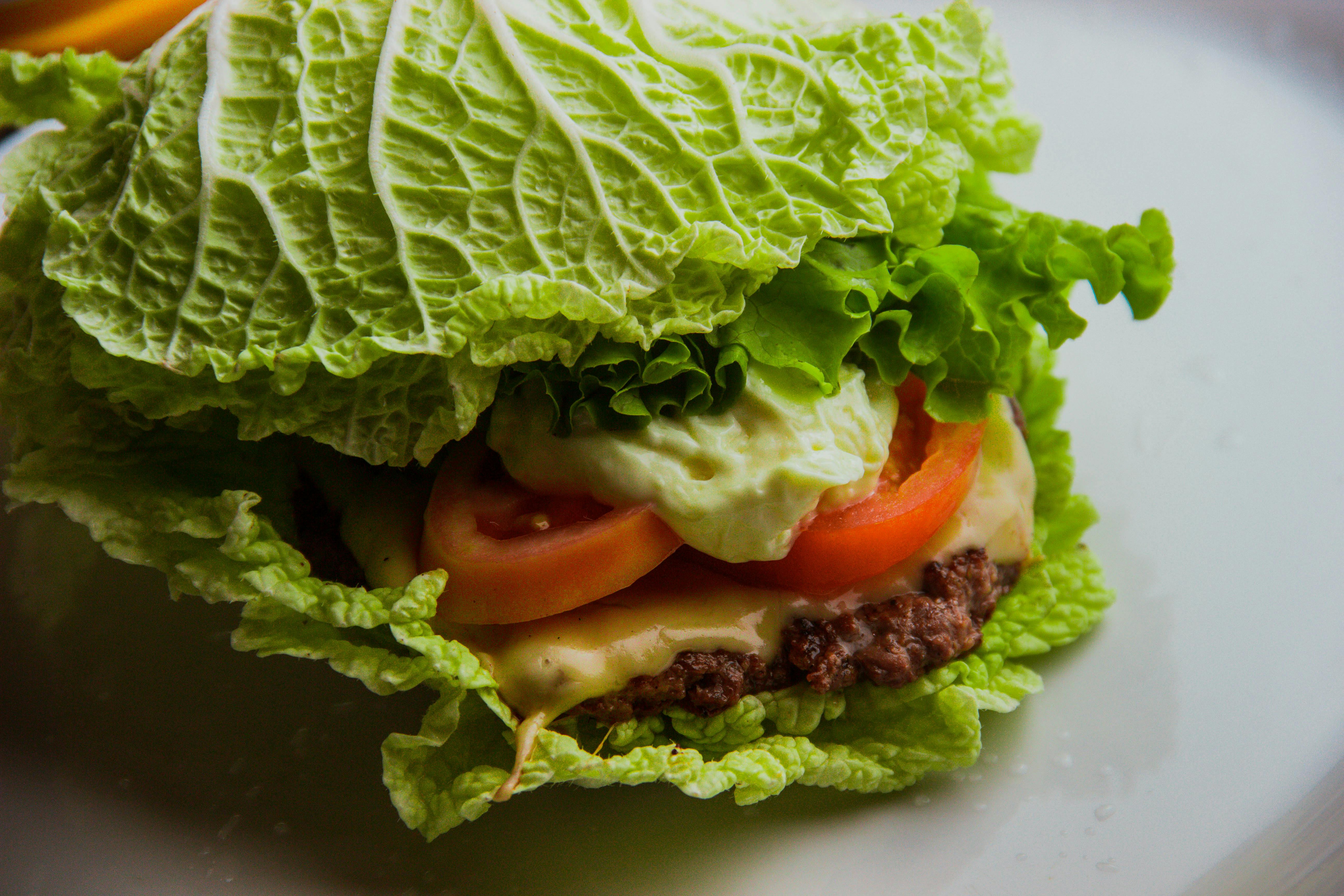
Lettuce-Wrapped Burger
The diets react (see scores below)
Common Ingredients
- ground beef
- iceberg lettuce
- tomato
- onion
- cheddar cheese
- pickles
- mustard
Specific recipes may vary.
Incompatible with 6 of 11 diets
Diet Ratings
A lettuce-wrapped burger is a classic keto-friendly adaptation of a traditionally incompatible dish. By replacing the bun with iceberg lettuce, the high-carb element is eliminated entirely. Ground beef provides high-quality fat and protein. Cheddar cheese adds healthy saturated fat. The remaining toppings — tomato, onion, pickles, and mustard — contribute minimal net carbs in standard burger portions (roughly 3-5g net carbs total). Iceberg lettuce itself is virtually zero net carbs. The macros align well with keto: high fat from beef and cheese, moderate protein, very low net carbs. This is a well-established keto meal choice.
Some stricter keto practitioners flag onion and tomato as borderline due to their natural sugar content, arguing that even small amounts can contribute to carb creep or trigger cravings. Carnivore-leaning keto adherents may also object to any plant-based toppings, preferring a pure meat-and-fat approach.
This dish contains multiple animal products: ground beef (meat) and cheddar cheese (dairy). Both are direct animal-derived ingredients that are unequivocally excluded from a vegan diet. The presence of plant-based ingredients such as iceberg lettuce, tomato, onion, pickles, and mustard does not offset the animal products. This is not compatible with a vegan diet in any interpretation.
The lettuce-wrapped format is a smart paleo adaptation, and the core ingredients — ground beef, iceberg lettuce, tomato, and onion — are fully paleo-approved. However, cheddar cheese is a clear dairy product excluded by all major paleo frameworks, and pickles are a processed food typically containing added salt, vinegar, and preservatives. Mustard in its commercial form commonly contains added salt, vinegar, and sometimes sugar or other additives, making it problematic under strict paleo rules. The combination of dairy (cheddar) and processed condiments/pickles pushes this dish into avoid territory as presented. Without the cheese, pickles, and commercial mustard, the base burger would be fully approved.
Ground beef is a red meat that the Mediterranean diet limits to only a few times per month. A burger patty as the centerpiece of a meal clearly contradicts the plant-forward, minimally processed principles of the diet. While the lettuce wrap is a clever substitution for a refined-grain bun, and the tomato and onion are genuinely positive Mediterranean elements, they do not offset the primary issue: a large serving of red meat with cheddar cheese (saturated fat from dairy) and no olive oil, legumes, whole grains, or other Mediterranean staples. Pickles and mustard are minor condiments that do not meaningfully affect the assessment. The dish is fundamentally built around an ingredient that should appear rarely, not as a dietary centerpiece.
While the ground beef patty is carnivore-approved and the cheddar cheese is at least animal-derived, the dish is fundamentally incompatible with the carnivore diet due to multiple plant-based ingredients. Iceberg lettuce, tomato, and onion are all plant foods explicitly excluded from the carnivore diet. Pickles are plant-derived and typically contain vinegar, sugar, and spices. Mustard is a plant-based condiment made from mustard seeds. The 'lettuce wrap' framing attempts to substitute a bread bun with a plant food, which does not make it carnivore-friendly — it simply replaces one excluded item with another. The only salvageable components are the ground beef patty and potentially the cheddar cheese (debated). This dish as constructed cannot be considered carnivore.
This lettuce-wrapped burger contains cheddar cheese, which is dairy and explicitly excluded on Whole30. Additionally, most commercial pickles contain added sugar or other non-compliant additives, and many mustards contain added sugar or other excluded ingredients. While the concept of a lettuce-wrapped burger (no bun) is a classic Whole30-friendly adaptation, the dish as described with cheddar cheese makes it non-compliant. Even if compliant pickles and mustard were sourced, the cheddar cheese alone disqualifies this dish.
This burger contains two high-FODMAP ingredients that make it unsuitable during the elimination phase. Onion is one of the highest-FODMAP foods tested by Monash University, containing significant fructans at any reasonable serving size — even small amounts cooked into a burger patty or served raw on top are problematic. Cheddar cheese is actually low-FODMAP (hard/aged cheeses have minimal lactose), and ground beef, iceberg lettuce, tomato (up to ~65g), mustard (small amounts), and pickles are generally low-FODMAP. However, the presence of onion alone is sufficient to classify this dish as high-FODMAP. Without onion, and with portion control on tomato, this dish would be highly suitable for the low-FODMAP diet given its lettuce-wrap format (avoiding wheat buns entirely).
The lettuce-wrapped burger replaces a refined white bun with iceberg lettuce, which is a meaningful improvement for DASH compliance by reducing refined carbs and sodium. However, ground beef is a red meat that DASH limits due to saturated fat content — the fat percentage of the ground beef matters greatly (80/20 vs. 93/7 lean). Cheddar cheese is a full-fat dairy, which DASH specifies should be limited in favor of low-fat dairy. Pickles and mustard add sodium, and pickles in particular can contribute significantly (a typical pickle spear adds 300-500mg sodium). Tomato and onion are DASH-positive vegetables. The dish avoids the worst DASH offenders (no processed bun, no sugary sauce, no fried preparation noted), but the combination of red meat, full-fat cheese, and high-sodium condiments keeps this in 'caution' territory. Using lean ground beef (≥93% lean), reduced-fat cheese, and low-sodium or no pickles would substantially improve the DASH score.
NIH DASH guidelines explicitly limit red meat and full-fat dairy, placing this dish firmly in caution. However, some updated clinical interpretations note that lean ground beef in moderation, combined with vegetable-forward components and the absence of a refined bread bun, may fit within a flexible DASH framework for non-severely hypertensive individuals — particularly if sodium from pickles and mustard is managed carefully.
The lettuce-wrapped burger is a genuinely Zone-friendly adaptation of a classic American sandwich. By replacing the bun with iceberg lettuce, the highest-glycemic, nutritionally empty component is eliminated, which is a strong Zone move. The remaining carbs come from tomato, onion, and pickles — all low-glycemic, favorable Zone vegetables. However, ground beef is not the ideal Zone protein: unless it is extra-lean (90%+ lean), it carries significant saturated fat, which Sears consistently flags as an inflammatory concern. Cheddar cheese adds both protein and saturated fat, further compressing the fat block's quality toward unfavorable saturated sources rather than the preferred monounsaturated fats like olive oil or avocado. Mustard is essentially free in Zone terms (negligible macros). With careful portioning — lean ground beef (93%+ lean), a small amount of cheddar, and controlling overall fat intake — this meal can be constructed close to a 3-block Zone meal. The primary issue is that the saturated fat load from beef plus cheese makes hitting the 30% fat target with quality monounsaturated fats difficult without adding avocado or substituting the cheese.
Some Zone practitioners and Sears' later writings (particularly 'The Mediterranean Zone' and 'The Zone Diet and Its Anti-Inflammatory Benefits') show a softening on saturated fat when the overall anti-inflammatory profile is strong. If the beef is very lean, the cheese portion is minimal, and the meal is accompanied by a polyphenol-rich addition, stricter Zone adherents might rate this as a low-7 approve. Conversely, if standard 80/20 ground beef and a full slice of cheddar are used, the saturated fat content pulls this closer to a 4-5.
The lettuce-wrapped burger is a grain-free modification that removes refined carbohydrates (bun) from a traditional burger, which is a meaningful anti-inflammatory improvement. However, the dish is still centered on ground beef, which is a red meat classified as 'limit' in anti-inflammatory frameworks due to saturated fat content and arachidonic acid, which can promote inflammatory pathways. Cheddar cheese adds full-fat dairy and additional saturated fat, both of which are flagged as pro-inflammatory at regular intake. On the positive side, iceberg lettuce, tomato, and onion provide modest antioxidants and polyphenols (quercetin in onion, lycopene in tomato). Mustard is a low-concern condiment and pickles are generally neutral. The dish lacks strong anti-inflammatory anchors like omega-3s, olive oil, or significant phytonutrient density. The leanness of the ground beef matters — a lean 90/10 or 93/7 grind is substantially less inflammatory than an 80/20 grind, but this cannot be assumed. Overall, the lettuce wrap is a smarter structural choice than a bun, but the protein and cheese core keep this firmly in 'caution' territory.
Some anti-inflammatory practitioners (particularly those aligned with ancestral or carnivore-adjacent frameworks like Paul Saladino) argue that unprocessed red meat from quality sources is not inherently pro-inflammatory and that saturated fat's role in inflammation has been overstated in mainstream nutrition. Conversely, mainstream anti-inflammatory guidance from Dr. Weil and most research-backed protocols consistently places red meat and full-fat cheese in the 'limit' category due to saturated fat and arachidonic acid content.
A lettuce-wrapped burger eliminates the refined grain bun, which is a meaningful improvement for GLP-1 patients — it reduces empty carbohydrates and makes the meal smaller and easier to digest. Ground beef provides substantial protein (roughly 20-25g per 3-4 oz patty), which supports the #1 GLP-1 dietary priority. However, ground beef is typically 15-20% fat depending on the grind, contributing saturated fat that can worsen GLP-1 side effects like nausea, bloating, and reflux. Cheddar cheese adds additional saturated fat and calories with modest protein contribution. Iceberg lettuce, tomato, onion, and pickles add minimal fiber and high water content, which is beneficial. Mustard is a low-calorie, non-fatty condiment — a good choice. The overall dish is moderate protein, moderate-to-high saturated fat, and low fiber. It scores better than a standard bun burger but falls short of leaner protein options. Portion and grind selection matter significantly — a 90/10 lean grind with a smaller patty and without cheese would push this toward approve territory.
Some GLP-1-focused dietitians accept ground beef as a practical, accessible protein source and view the lettuce wrap format as a smart adaptation that reduces overall caloric load and digestive burden — particularly for patients struggling to meet protein targets on a reduced appetite. Others flag that the saturated fat content of typical ground beef and cheddar creates meaningful nausea and reflux risk, especially in early titration phases, and recommend substituting turkey or bison until GI tolerance is established.
*See how scores were generated at our methodology page.
Nutritional profile
Six traits that cut across every diet.
Fiber & Plants
How much whole-plant food and fiber it delivers.
Healthy Fats
The quality of its fats (unsaturated, omega-3).
Whole / Unprocessed
How close it is to its natural, unprocessed form.
Gut Gentle
How easy it is on digestion (low FODMAP, few irritants).
Low Glycemic
How little it spikes your blood sugar.
Protein Density
How much protein it packs per calorie.
Controversy Index
Higher controversy = more disagreement between diets.
Diet-Specific Tips
 Keto — 8/10
View tips
- Lettuce wrap eliminates bun, removing ~25-30g net carbs
- Ground beef is high-fat, high-protein — ideal keto protein source
- Cheddar cheese adds beneficial fat with near-zero carbs
- Tomato and onion add ~2-4g net carbs per standard serving — manageable
- Pickles and mustard are very low carb condiments
- Total estimated net carbs: 3-6g per serving, well within keto limits
- No grains, added sugars, or high-carb ingredients present
 DASH — 5/10
View tips
- Ground beef is a DASH-limited red meat; fat content of beef significantly affects saturated fat load
- Lettuce wrap positively replaces refined white bun, reducing sodium and refined carbs
- Cheddar cheese is full-fat dairy, which DASH specifies should be minimized
- Pickles are high in sodium (300-500mg per spear), a significant DASH concern
- Mustard adds moderate sodium (~55-65mg per teaspoon)
- Tomato and onion are DASH-positive vegetables providing potassium and fiber
- No sugary sauces or fried preparation noted, which is a positive
- Using 93% lean beef, reduced-fat cheese, and low-sodium/no pickles would raise score to 6-7
 Zone — 6/10
View tips
- Lettuce wrap replaces high-glycemic bun — strong Zone substitution
- Ground beef fat content is variable; lean (93%+) is required for Zone compliance
- Cheddar cheese adds saturated fat, conflicting with Zone's monounsaturated fat preference
- Tomato, onion, and pickles are favorable low-glycemic Zone carbohydrates
- No added sugars or high-glycemic carbohydrates in the ingredient list
- Mustard is Zone-neutral (negligible macros)
- Protein block needs to be calibrated — a standard beef patty (~3–4 oz cooked lean) fits ~3 protein blocks
- Adding avocado instead of or alongside cheddar would improve Zone fat quality significantly
 Anti-Inflammatory — 4/10
View tips
- Ground beef (red meat) is pro-inflammatory at regular consumption due to saturated fat and arachidonic acid — classified as 'limit'
- Lettuce wrap replaces refined-carbohydrate bun, removing a pro-inflammatory element and improving the dish's overall profile
- Cheddar cheese adds full-fat dairy and saturated fat, both flagged as pro-inflammatory in anti-inflammatory frameworks
- Tomato and onion contribute modest polyphenols and antioxidants (lycopene, quercetin)
- No significant anti-inflammatory anchors present (no omega-3s, olive oil, turmeric, or high-antioxidant ingredients)
- Beef fat percentage significantly affects inflammatory load — lean grinds are meaningfully better
 GLP-1 Friendly — 5/10
View tips
- Lettuce wrap eliminates refined grain bun — a meaningful GLP-1 improvement
- Ground beef provides 20-25g protein per standard patty — supports protein priority
- Typical ground beef fat content (15-20%) contributes saturated fat that may worsen nausea and reflux
- Cheddar cheese adds saturated fat with modest protein benefit
- Low fiber content overall — tomato, onion, and pickles contribute minimally
- Mustard is an appropriate low-fat condiment
- Iceberg lettuce and tomato support hydration
- Lean grind selection (93/7 or 90/10) and omitting cheese would significantly improve the rating
- Small portion execution matters — a large double-patty version would score lower