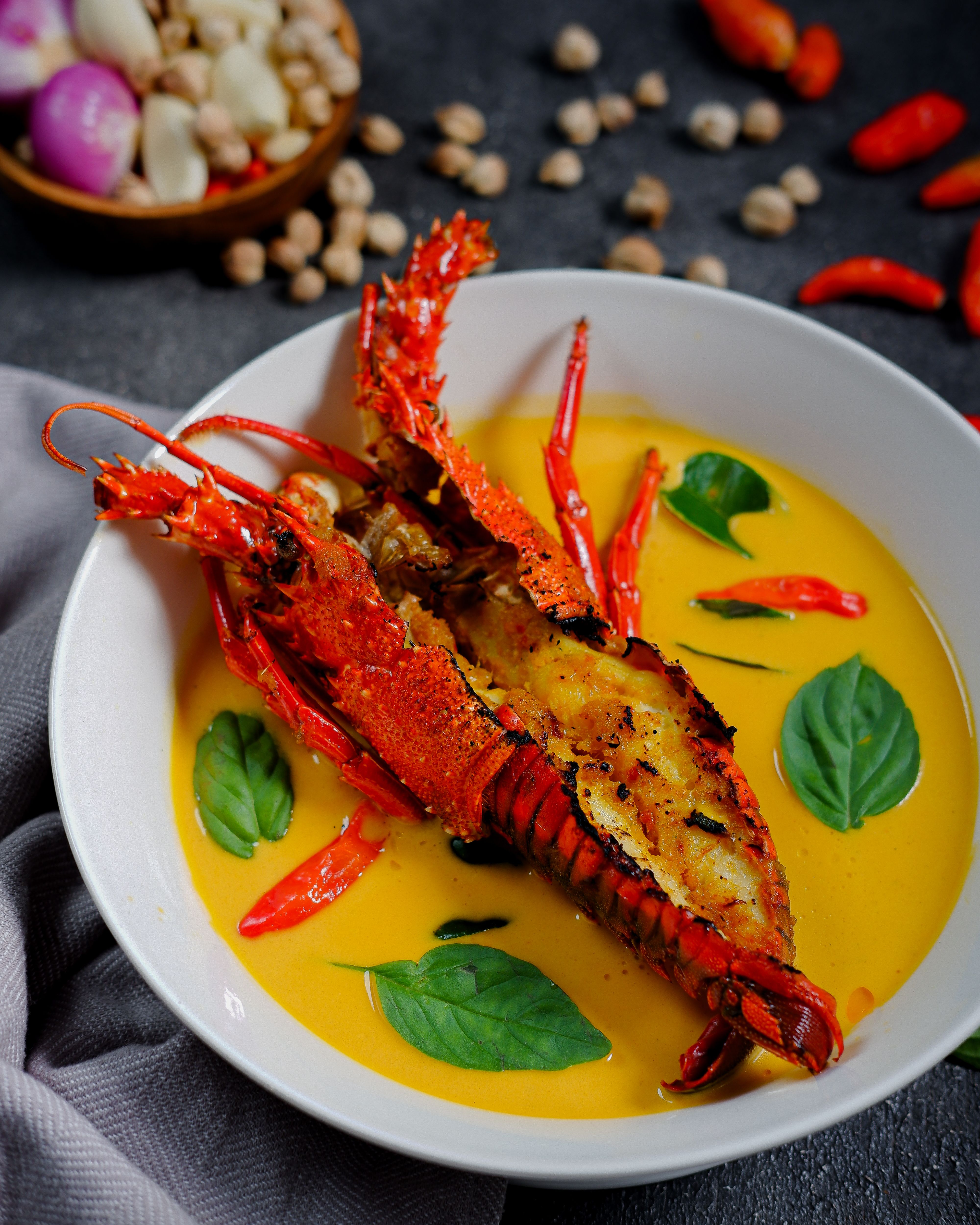
Photo: Dadan Ramdani / Pexels
French
Lobster Thermidor
The diets react (see scores below)
Common Ingredients
- lobster
- butter
- heavy cream
- Dijon mustard
- Gruyère cheese
- cognac
- shallots
- tarragon
Specific recipes may vary.
Incompatible with 9 of 11 diets
Diet Ratings
Lobster Thermidor is a rich, high-fat dish that aligns well with ketogenic principles. Lobster itself is a lean, high-quality protein with virtually zero carbs. The sauce is built on butter, heavy cream, and Gruyère — all keto-staple high-fat dairy ingredients. Dijon mustard adds negligible carbs, tarragon is an herb with trace carbs, and shallots contribute only a small amount (~2-3g net carbs per typical serving portion). The main concern is cognac: while most alcohol burns off during cooking, some residual sugar/carbs may remain, and some keto practitioners flag spirits used in cooking. Overall net carbs per serving are likely under 5-7g, making this dish solidly keto-compatible in standard restaurant or home portions.
Strict keto protocols may flag cognac (even cooked) due to residual sugars and the general principle of avoiding alcohol-derived ingredients. Additionally, some carnivore-adjacent keto practitioners question the insulin response from dairy-heavy cream sauces with Gruyère, preferring simpler preparations.
Lobster Thermidor is entirely incompatible with a vegan diet. The dish is built around lobster, a marine animal, and is compounded by multiple additional animal-derived ingredients: butter and heavy cream (dairy), Gruyère cheese (dairy), and eggs are sometimes used in the sauce base. Every major component of this dish violates the core vegan principle of excluding all animal products. There is no plant-based version of this dish that could be called Lobster Thermidor in any meaningful sense.
Lobster Thermidor contains multiple non-paleo ingredients that disqualify it clearly. While lobster itself is an excellent paleo protein, the dish is built around a dairy-rich cream sauce featuring butter, heavy cream, and Gruyère cheese — all excluded dairy products under paleo rules. Dijon mustard often contains added salt, vinegar, and sometimes sugar. Cognac, while derived from grapes, is an alcohol and a processed product. The combination of multiple dairy ingredients makes this dish firmly non-paleo regardless of the high-quality seafood base. Shallots and tarragon are paleo-approved, but they cannot offset the core violations.
While lobster itself is a seafood and technically aligns with the Mediterranean principle of eating fish and seafood regularly, Lobster Thermidor is fundamentally incompatible with Mediterranean diet principles due to its preparation method. The dish is dominated by butter, heavy cream, and Gruyère cheese — none of which are core Mediterranean fats or ingredients. Olive oil, the primary fat in the Mediterranean diet, is entirely absent and replaced by saturated-fat-heavy dairy ingredients. The rich cream sauce and cheese gratin topping make this a high-saturated-fat dish more aligned with French haute cuisine than Mediterranean eating patterns. The cognac is a minor concern but not disqualifying on its own. This is an occasional indulgence dish at best, not remotely a Mediterranean staple.
Lobster Thermidor contains multiple plant-derived ingredients that disqualify it from the carnivore diet. While lobster, butter, heavy cream, and Gruyère cheese are animal-derived (though dairy is debated), the dish also includes Dijon mustard (plant-based, contains vinegar and mustard seeds), shallots (allium vegetable), tarragon (herb/plant), and cognac (alcohol distilled from grapes — plant-derived). The combination of several non-animal ingredients makes this dish clearly non-compliant as prepared. Even the most liberal carnivore practitioners who include dairy and shellfish would need to strip this dish down entirely to its animal components to make it compatible.
Lobster Thermidor contains multiple excluded ingredients. Butter (regular, not ghee or clarified butter) is a dairy product explicitly excluded on Whole30 — only ghee and clarified butter are permitted. Heavy cream is dairy and excluded. Gruyère cheese is dairy and excluded. Cognac is alcohol, which is fully excluded. Any one of these four ingredients would disqualify this dish; together they make it clearly non-compliant. The lobster, shallots, tarragon, and Dijon mustard (plain) would otherwise be fine.
Lobster Thermidor contains several high-FODMAP ingredients that make it problematic during the elimination phase. Shallots are high in fructans and are a significant FODMAP trigger — they cannot be made safe at any typical culinary quantity. Heavy cream is borderline (low-FODMAP at ~2 tbsp but often used in larger quantities in this dish). Gruyère is an aged hard cheese and is generally low-FODMAP due to minimal lactose. Butter is low-FODMAP. Lobster itself is low-FODMAP. Cognac in small culinary quantities may be tolerable. Dijon mustard at small servings is typically low-FODMAP. However, the shallots alone make this dish a clear avoid during elimination — they are a core aromatic ingredient and cannot simply be omitted without fundamentally altering the dish. Tarragon as a herb is low-FODMAP in culinary amounts.
Some FODMAP-aware chefs substitute shallots with the green tops of spring onions or garlic-infused oil to create a low-FODMAP version of Thermidor — in that modified form, the dish could be cautiously approved. However, as traditionally prepared with shallots, clinical FODMAP practitioners universally advise avoidance during the elimination phase.
Lobster Thermidor is fundamentally incompatible with the DASH diet. While lobster itself is a lean protein source with notable potassium and magnesium content, the preparation is dominated by high-saturated-fat ingredients that DASH explicitly limits: butter and heavy cream drive saturated fat to very high levels, and Gruyère cheese adds both saturated fat and substantial sodium. The cognac adds empty calories with no nutritional benefit. Together, these ingredients create a dish that is high in total fat, saturated fat, cholesterol, and sodium — directly opposing DASH's core principles of limiting saturated fat and sodium while emphasizing nutrient-dense foods. There is no meaningful modification short of a complete recipe overhaul that would bring this dish into DASH compliance.
Lobster Thermidor presents a mixed Zone profile. The lobster itself is an excellent lean protein source — low fat, high quality protein that fits neatly into Zone protein blocks. However, the sauce is built almost entirely from saturated fat sources: butter, heavy cream, and Gruyère cheese. This creates a fat profile that is heavily saturated rather than the monounsaturated fats (olive oil, avocado, almonds) Dr. Sears favors. The dish also lacks the required carbohydrate component entirely — no low-glycemic vegetables, no fruit — making it impossible to achieve the 40/30/30 ratio as served. Cognac adds negligible sugar in cooking quantities. Shallots and tarragon are favorable aromatics. To bring this into Zone compliance, a practitioner would need to significantly reduce the butter and cream, substitute olive oil where possible, reduce or eliminate the Gruyère, and serve with a substantial portion of low-glycemic vegetables (e.g., steamed broccoli, asparagus, or a mixed green salad). As traditionally prepared, the dish skews toward a high-fat, near-zero-carb profile — structurally opposite to Zone ratios. It is salvageable with modification, which places it firmly in 'caution' territory rather than 'avoid,' given that lobster protein is genuinely favorable.
Some Zone practitioners following Sears' later anti-inflammatory writings (The OmegaRx Zone, Zone Perfect Meals in Minutes) note that Sears somewhat relaxed his position on saturated fat, particularly from dairy in small quantities, when overall omega-3 supplementation is adequate. Under this interpretation, a modest portion of Lobster Thermidor served alongside a large vegetable side could be considered a workable Zone meal, pushing the score closer to a 5-6. Additionally, heavy cream and butter contain very few carbohydrates, meaning the fat blocks, though saturated, are at least not disrupting the carb ratio — the carb deficit remains the primary structural problem.
Lobster Thermidor is a rich French-American classic that presents significant anti-inflammatory concerns. While lobster itself is a lean shellfish with modest anti-inflammatory properties (selenium, zinc, some omega-3s), it is buried under a heavily pro-inflammatory sauce. Butter and heavy cream are concentrated sources of saturated fat, linked to elevated inflammatory markers including CRP and IL-6. Gruyère cheese adds additional saturated fat and full-fat dairy. This triple combination of butter, heavy cream, and high-fat cheese represents exactly the pattern anti-inflammatory dietary frameworks caution against. Cognac contributes alcohol, which beyond red wine is flagged for avoidance in anti-inflammatory protocols. The only genuinely anti-inflammatory contributors are the shallots (quercetin, allicin), tarragon (polyphenols), and Dijon mustard (minimal benefit), but these are minor components in the context of the overall dish. As a preparation, this dish is structurally dominated by ingredients on the 'limit' or 'avoid' list of virtually every anti-inflammatory framework. It is not a dish that can be rehabilitated by moderation of portion size — the sauce itself is the problem.
Lobster Thermidor is a fundamentally poor fit for GLP-1 patients despite lobster itself being a lean, high-protein shellfish. The dish is dominated by butter, heavy cream, and Gruyère cheese — a combination that delivers a very high saturated fat load per serving. This directly worsens the most common GLP-1 side effects: nausea, bloating, reflux, and prolonged gastric discomfort, since high-fat meals are retained in the slowed GLP-1 stomach far longer than normal. Cognac introduces alcohol, which adds empty calories. The caloric density is extremely high relative to the nutritional return per bite, undermining the nutrient-density imperative. While the lobster protein base is a positive, it is entirely overwhelmed by the preparation method — the same way a fried chicken breast rates poorly despite its protein content.
*See how scores were generated at our methodology page.
Nutritional profile
Six traits that cut across every diet.
Fiber & Plants
How much whole-plant food and fiber it delivers.
Healthy Fats
The quality of its fats (unsaturated, omega-3).
Whole / Unprocessed
How close it is to its natural, unprocessed form.
Gut Gentle
How easy it is on digestion (low FODMAP, few irritants).
Low Glycemic
How little it spikes your blood sugar.
Protein Density
How much protein it packs per calorie.
Controversy Index
Higher controversy = more disagreement between diets.
Diet-Specific Tips
 Keto — 8/10
View tips
- Lobster is zero-carb, high-quality protein — ideal for keto
- Butter, heavy cream, and Gruyère provide the keto-preferred high-fat base
- Shallots contribute minimal net carbs (~2-3g per serving) and are manageable in small quantities
- Cognac may introduce trace residual sugars after cooking, a concern for strict practitioners
- Dijon mustard and tarragon are essentially carb-free in recipe quantities
- Overall net carbs per serving estimated at 4-7g, well within keto daily limits
 Zone — 4/10
View tips
- Lobster is a lean, high-quality Zone-favorable protein source
- Butter and heavy cream are saturated fat sources, contrary to Zone's monounsaturated fat preference
- Gruyère cheese adds additional saturated fat and minimal protein benefit
- Dish contains virtually no carbohydrates — fails 40/30/30 ratio without sides
- No low-glycemic vegetables present to supply the required carbohydrate blocks
- Cognac used in cooking contributes negligible alcohol/sugar in final dish
- Shallots and tarragon are Zone-neutral favorable aromatics
- Dish requires significant modification (reduce cream/butter, add vegetable sides) to achieve Zone balance