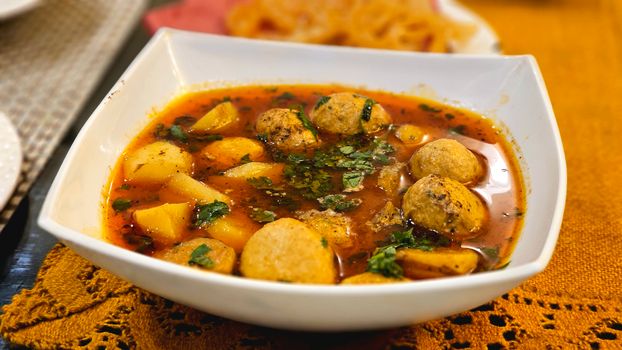
Photo: Muhammad Khawar Nazir / Pexels
The diets react (see scores below)
Common Ingredients
- paneer
- potatoes
- tomatoes
- cashews
- heavy cream
- onion
- garam masala
- kasuri methi
Specific recipes may vary.
Incompatible with 8 of 11 diets
Diet Ratings
Malai Kofta is fundamentally incompatible with ketogenic eating in its standard form. The kofta balls are made with potatoes, which are a high-starch vegetable delivering roughly 15-17g net carbs per 100g. A typical serving contains multiple kofta balls, easily pushing the dish well over the daily 20-50g net carb threshold from potatoes alone. Additionally, cashews add moderate carbs (~8g net per 28g). While the gravy base of heavy cream, paneer, tomatoes, onion, and spices contains keto-friendly elements, the structural role of potatoes in the kofta cannot be avoided without fundamentally reinventing the dish. The creamy, high-fat sauce and paneer protein are keto-positive, but they cannot offset the carb load from potatoes.
Malai Kofta contains multiple animal-derived ingredients that disqualify it from a vegan diet. Paneer is a fresh dairy cheese made from cow's milk, and heavy cream is a dairy product derived from milk. Both are directly excluded under vegan rules. The remaining ingredients — potatoes, tomatoes, cashews, onion, garam masala, and kasuri methi — are all plant-based, but the dish as described cannot be considered vegan due to its two core dairy components. A vegan version could be made by substituting paneer with firm tofu or a chickpea-based alternative and replacing heavy cream with full-fat coconut cream or blended cashew cream.
Malai Kofta contains multiple non-paleo ingredients that make it incompatible with the diet. Paneer is a fresh dairy cheese, which is excluded under paleo rules regardless of processing level. Heavy cream is full dairy and equally prohibited. These two ingredients alone are disqualifying. While potatoes are debated and tomatoes, cashews, onion, and garam masala are generally paleo-friendly, the dish's foundational components — paneer and heavy cream — are clear violations with strong consensus across paleo authorities including Loren Cordain, Mark Sisson, and Robb Wolf.
Malai Kofta is a rich Indian dish that sits uneasily within Mediterranean diet principles. Paneer (fresh cheese) is a dairy product acceptable in moderation, and tomatoes, onions, and potatoes are Mediterranean-friendly vegetables. Cashews are a nutritious nut, consistent with the diet's emphasis on nuts. However, the heavy cream significantly elevates saturated fat content well beyond what the Mediterranean diet endorses — olive oil, not cream, is the canonical fat source. The dish is also typically fried (the kofta balls), adding refined oil and caloric density. There is no olive oil, whole grains, or legumes. While not a processed food and containing some whole-food ingredients, the overall fat profile and preparation method deviate from Mediterranean principles. A caution rating reflects that some components are acceptable, but the cream-heavy sauce and fried preparation make this an occasional indulgence rather than a dietary staple.
Some Mediterranean diet interpreters would note that moderate dairy including cheese and even small amounts of cream have historical presence in certain regional Mediterranean cuisines (e.g., southern Italian). From this perspective, if the dish is prepared with reduced cream and baked rather than fried koftas, it could be viewed as a reasonable moderate-frequency meal given its vegetable and nut content.
Malai Kofta is fundamentally incompatible with the carnivore diet. The dish is dominated by plant-based ingredients: potatoes and tomatoes form the kofta base, cashews are used in the sauce, onion adds flavor, and garam masala and kasuri methi (dried fenugreek leaves) are plant-derived spices. While paneer and heavy cream are animal-derived dairy products, they are minor components in a dish that is overwhelmingly plant-based. No amount of dairy salvages a dish whose primary structure, flavor, and character come from vegetables, legumes (cashews are tree nuts), and plant spices. This is a traditional Indian vegetarian dish with no meaningful carnivore-compatible adaptation possible without completely deconstructing it.
Malai Kofta contains two dairy ingredients that are excluded on Whole30: paneer (a fresh cheese) and heavy cream. Paneer is unambiguously dairy — it is not ghee or clarified butter, which are the only dairy exceptions permitted by the Whole30 program. Heavy cream is similarly excluded dairy. The remaining ingredients (potatoes, tomatoes, cashews, onion, garam masala, kasuri methi) are all Whole30-compliant, but the dish as described cannot be made compliant without fundamentally changing its character by removing both the paneer and the cream.
Malai Kofta contains multiple high-FODMAP ingredients that make it unsafe during the elimination phase. Onion is one of the highest-FODMAP foods (rich in fructans) and is a foundational ingredient in the sauce. Cashews become high-FODMAP at portions above ~10 nuts (GOS content), and they are typically used in quantity to create the rich sauce base. Paneer is considered low-FODMAP in moderate servings (~125g) as it is a hard/pressed cheese with negligible lactose, but heavy cream in larger quantities can be borderline. Potatoes, tomatoes, garam masala (in small amounts), and kasuri methi are generally low-FODMAP. However, the combination of onion and cashews — both core structural ingredients of authentic Malai Kofta — means this dish cannot be made FODMAP-safe in its traditional form without significant reformulation. Even small residual onion in the sauce presents a fructan risk. The dish as described is not appropriate for the elimination phase.
Malai Kofta is a rich Indian dish that conflicts with DASH dietary principles on multiple fronts. The heavy cream is high in saturated fat, which DASH explicitly limits — a single cup can contain 50+ grams of saturated fat. Paneer (full-fat Indian cheese) is a full-fat dairy product, contrary to DASH's emphasis on fat-free or low-fat dairy. Cashews add healthy fats and magnesium but also caloric density. The kofta preparation typically involves deep-frying the paneer-potato dumplings, adding further saturated or unhealthy fat load. While tomatoes, onions, and kasuri methi (fenugreek) offer some DASH-friendly nutrients (potassium, fiber), they are overwhelmed by the high saturated fat content from cream and full-fat paneer. Restaurant preparations also tend to be high in sodium. The dish as commonly consumed does not align with DASH's limits on saturated fat and full-fat dairy.
NIH DASH guidelines explicitly limit saturated fat and specify low-fat dairy, making heavy cream and paneer problematic. However, some updated clinical interpretations note emerging evidence that full-fat dairy may not worsen cardiovascular outcomes, and a modified version of this dish — made with low-fat paneer, reduced cream or a yogurt substitute, and baked rather than fried kofta — could potentially be acceptable in moderation under a less conservative DASH interpretation.
Malai Kofta presents several Zone Diet challenges. The primary protein is paneer, a full-fat cheese that is moderately high in saturated fat — usable as a vegetarian protein source in Zone but not ideal. More significantly, the kofta balls typically contain potatoes, which are a high-glycemic carbohydrate that Sears explicitly lists as unfavorable. The sauce is built on cashews and heavy cream, both of which are high in fat — cashews are predominantly monounsaturated (a Zone positive) but calorie-dense, while heavy cream is high in saturated fat. The overall dish skews heavily toward fat (particularly saturated fat from cream and paneer) and includes a high-glycemic carbohydrate (potato), making the 40/30/30 ratio very difficult to achieve. Tomatoes and onion provide some low-glycemic carbohydrate and polyphenols, which are Zone-positive. The dish is also vegetarian, meaning fat blocks count at 3g rather than 1.5g per block, which slightly helps account for the higher fat load. However, the combination of high saturated fat, high-glycemic potato, and calorie density from cream and cashews makes this a challenging Zone meal that requires significant modification (reducing cream, eliminating or minimizing potato content) to approach Zone balance.
Some Zone practitioners following Sears' later anti-inflammatory framework (Toxic Fat, The Mediterranean Zone) may view cashews' monounsaturated fat content and the polyphenol-rich spices (garam masala, kasuri methi) more favorably. If potatoes are minimized in the kofta and cream is reduced, a small portion could potentially be worked into a Zone meal with a large low-glycemic vegetable side to correct the carbohydrate balance. The dish's unfavorable classification hinges heavily on potato content and cream volume, both of which vary by recipe.
Malai Kofta is a mixed dish from an anti-inflammatory perspective. On the positive side, tomatoes provide lycopene and antioxidants, onions offer quercetin, garam masala includes anti-inflammatory spices (cumin, coriander, cardamom, cloves), and kasuri methi (dried fenugreek leaves) has demonstrated anti-inflammatory and blood sugar-regulating properties. Cashews provide some healthy fats and minerals. However, the dish has meaningful inflammatory concerns: heavy cream is high in saturated fat, which anti-inflammatory frameworks consistently flag as a food to limit. Paneer is full-fat dairy, also in the 'limit' category due to saturated fat content. Together, cream and paneer make this a high saturated fat dish — a significant drawback. Potatoes are a neutral starch, acceptable in moderation. The dish lacks omega-3 sources, leafy greens, or other strong anti-inflammatory components. It's not a dish to avoid outright, but its heavy cream and full-fat dairy base pull it solidly into caution territory, particularly for those monitoring cardiovascular inflammation markers. Occasional consumption is fine; regular consumption is not well-aligned with anti-inflammatory principles.
Some anti-inflammatory practitioners, particularly those following South Asian dietary traditions, argue that ghee and full-fat dairy in moderation are part of an Ayurvedic anti-inflammatory approach and that the spice blend in dishes like Malai Kofta provides meaningful cumulative benefit. However, mainstream anti-inflammatory nutrition research (including Dr. Weil's guidelines) consistently recommends limiting saturated fat from full-fat dairy, placing heavy cream in the 'limit' category regardless of cultural context.
Malai Kofta is a high-fat, calorie-dense Indian dish that is poorly suited for GLP-1 patients. The kofta balls are typically deep-fried (paneer and potato), and the sauce is built on cashews and heavy cream — two of the highest-fat, most calorie-dense ingredients possible. Heavy cream and cashews together create a sauce that is extremely rich and high in saturated fat, which directly worsens GLP-1 side effects including nausea, bloating, reflux, and prolonged gastric discomfort due to slowed gastric emptying. Paneer provides some protein but at a poor protein-to-fat ratio compared to lean alternatives. Potatoes add starchy carbohydrates with minimal fiber. The dish offers very low fiber overall. Despite some nutritional value from paneer and tomatoes, the dominant nutritional profile is high fat, moderate refined carbohydrate, low fiber, and moderate protein — the opposite of what GLP-1 patients need. Even a small serving is likely to trigger significant GI side effects.
Some GLP-1-focused dietitians working with South Asian patients acknowledge that cultural food preferences matter for long-term adherence, and may suggest a heavily modified version — baked kofta, coconut milk or low-fat yogurt substituted for cream, and cashews reduced or omitted — as an occasional meal. However, the traditional preparation as described here would broadly be rated as avoid by most clinicians given the fried component and heavy cream base.
*See how scores were generated at our methodology page.
Nutritional profile
Six traits that cut across every diet.
Fiber & Plants
How much whole-plant food and fiber it delivers.
Healthy Fats
The quality of its fats (unsaturated, omega-3).
Whole / Unprocessed
How close it is to its natural, unprocessed form.
Gut Gentle
How easy it is on digestion (low FODMAP, few irritants).
Low Glycemic
How little it spikes your blood sugar.
Protein Density
How much protein it packs per calorie.
Controversy Index
Higher controversy = more disagreement between diets.
Diet-Specific Tips
 Mediterranean — 4/10
View tips
- Heavy cream is high in saturated fat, contradicting the olive-oil-as-primary-fat principle
- Paneer is dairy — acceptable in moderation but not a core Mediterranean protein
- Kofta balls are typically deep-fried, adding excess fat from non-olive-oil sources
- Cashews and tomatoes/onions are Mediterranean-compatible ingredients
- No whole grains or legumes; limited fiber density
- Not a processed food — made from whole ingredients, which is a positive factor
 Zone — 4/10
View tips
- Potatoes in kofta are high-glycemic, explicitly unfavorable in Zone methodology
- Heavy cream contributes significant saturated fat, skewing fat profile away from monounsaturated ideal
- Paneer is a viable vegetarian Zone protein but carries moderate saturated fat
- Cashews provide monounsaturated fat (Zone-positive) but are very calorie-dense
- Overall macro ratio skews heavily fat-forward, making 40/30/30 difficult without modification
- Tomatoes and onion are Zone-favorable low-glycemic carbohydrate contributors
- Polyphenol-rich spices (garam masala, kasuri methi) align with Sears' anti-inflammatory emphasis
 Anti-Inflammatory — 4/10
View tips
- Heavy cream is high in saturated fat — a consistent 'limit' item in anti-inflammatory frameworks
- Paneer (full-fat dairy) adds additional saturated fat load
- Tomatoes provide lycopene and antioxidant polyphenols
- Garam masala and kasuri methi contribute anti-inflammatory spice compounds
- Onions supply quercetin, a flavonoid with anti-inflammatory properties
- Cashews offer healthy fats and minerals but also add caloric density
- No omega-3 sources present; dish lacks strong anti-inflammatory proteins
- Dish is not processed and contains no trans fats or refined sugar — limits the damage