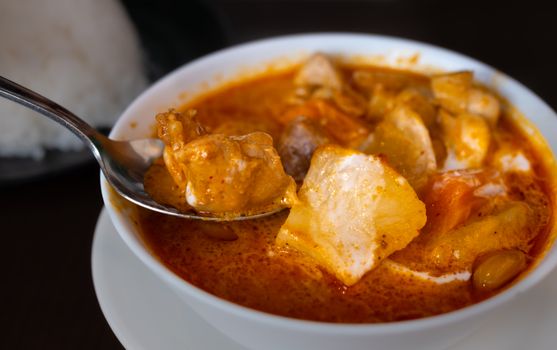
The diets react (see scores below)
Common Ingredients
- beef
- coconut milk
- massaman curry paste
- potatoes
- peanuts
- cinnamon
- cardamom
- tamarind
Specific recipes may vary.
Incompatible with 8 of 11 diets
Diet Ratings
Massaman Curry is one of the most carb-heavy Thai curries and is largely incompatible with ketogenic eating in its traditional form. The primary concern is potatoes, a high-starch vegetable that alone can deliver 15-30g of net carbs per serving, easily busting a daily keto budget. Massaman curry paste also typically contains sugar, shrimp paste, and tamarind, which adds additional carbs and sugars. Tamarind itself is notably high in natural sugars (~10g net carbs per tablespoon). Peanuts add moderate carbs as well. The coconut milk base and beef/chicken are keto-friendly, but the overall dish as traditionally prepared is not. Even a modest portion would likely exceed 30-40g net carbs, making ketosis maintenance extremely difficult. A modified version (removing potatoes, reducing paste, swapping tamarind) could be made keto-compatible, but the dish as described is not.
Some lazy keto or flexible keto practitioners argue that a small portion of Massaman Curry — particularly if potato quantity is reduced and consumed alongside a high-fat meal — may fit within a 50g daily carb ceiling. Additionally, some keto cooks advocate for a modified version using turnips or cauliflower in place of potatoes, which they consider functionally keto even if the base dish is not.
Massaman Curry as described contains beef (or chicken) as the primary protein, which are direct animal products and strictly excluded under all vegan frameworks. There is no ambiguity here — this dish is fundamentally non-vegan in its traditional form. While the remaining ingredients (coconut milk, potatoes, peanuts, spices, tamarind) are plant-based, and a vegan version of Massaman Curry could be made by substituting the meat with tofu or chickpeas, the dish as presented with beef or chicken cannot be approved.
Massaman Curry contains multiple non-paleo ingredients that disqualify it outright. Peanuts are legumes and are firmly excluded from the paleo diet. White potatoes are debated but even under lenient modern paleo interpretations they remain a gray area — and their presence here is secondary to the more serious violations. Massaman curry paste is a processed commercial product that typically contains added salt, sugar, shrimp paste with preservatives, and other additives, making it non-compliant. The combination of peanuts (a legume) and processed curry paste means this dish cannot be approved or even cautioned — it clearly falls into the avoid category. Beef, coconut milk, cinnamon, cardamom, and tamarind are individually paleo-friendly, but they cannot redeem the dish when core ingredients are excluded foods.
Massaman Curry is a Thai dish with little connection to Mediterranean dietary traditions, and its ingredient profile conflicts with core Mediterranean principles in several ways. Coconut milk is the primary fat source — a saturated fat not recognized in Mediterranean eating patterns, which rely almost exclusively on extra virgin olive oil. If beef is used as the protein, it falls into the 'red meat' category that the Mediterranean diet limits to a few times per month. Even with chicken, the dish is still dominated by coconut milk's high saturated fat content. The curry paste may contain refined or processed ingredients. On the positive side, potatoes and peanuts are plant-based foods, and spices like cinnamon and cardamom have antioxidant value. However, the overall fat profile and potential for red meat make this a poor fit for Mediterranean guidelines.
Some modern, flexible interpretations of the Mediterranean diet focus on overall dietary patterns — high plant diversity, legumes, and spices — rather than strict regional authenticity. Under this view, a chicken-based Massaman Curry with peanuts, potatoes, and anti-inflammatory spices could be seen as a reasonable occasional meal, with coconut milk viewed similarly to how some practitioners treat small amounts of saturated fat from dairy.
Massaman Curry is almost entirely incompatible with the carnivore diet. While beef is a cornerstone carnivore food, it is surrounded by a long list of plant-derived ingredients that are all strictly excluded. Coconut milk is a plant-based fat source, massaman curry paste is a complex blend of plant spices and herbs, potatoes are a starchy vegetable, peanuts are a legume, and cinnamon, cardamom, and tamarind are all plant-derived spices or fruits. The dish is fundamentally a plant-forward Thai curry that happens to contain meat — the non-animal ingredients define the dish's character, flavor, and macronutrient profile. There is no meaningful way to adapt this dish within carnivore principles without completely deconstructing it down to just the beef.
Massaman Curry contains peanuts, which are legumes and explicitly excluded on the Whole30 program. This alone disqualifies the dish. Additionally, most commercial massaman curry pastes contain shrimp paste, fish sauce, and often added sugar or other non-compliant ingredients that would require careful vetting. Even if a compliant curry paste could be sourced or made from scratch, the peanuts are a core, traditional ingredient in this dish and cannot simply be omitted without fundamentally changing the recipe.
Massaman curry as traditionally prepared contains multiple high-FODMAP ingredients that make it unsuitable during the elimination phase. The primary concern is massaman curry paste, which virtually always contains garlic and shallots/onion — both high-FODMAP fructan sources — as core ingredients. These are nearly impossible to avoid in any commercial or restaurant preparation of this paste. Coconut milk is low-FODMAP at approximately 1/2 cup per serve, which is feasible in a curry. Beef or chicken are both low-FODMAP proteins. Potatoes are low-FODMAP. Peanuts are low-FODMAP at a small serving (32g). Cinnamon and cardamom are low-FODMAP at culinary doses. Tamarind paste is high-FODMAP above 1 teaspoon due to excess fructose, and typical curry preparations exceed this threshold. The deal-breaker is the curry paste: garlic and onion/shallot are foundational to massaman paste and cannot be omitted without fundamentally changing the dish. Unless made from scratch with a FODMAP-safe paste using garlic-infused oil and green onion tops only, this dish is high-FODMAP at any standard restaurant or home serving.
If prepared at home using a FODMAP-modified curry paste — substituting garlic-infused oil for garlic cloves and omitting shallots/onion — Monash University guidelines would support approving most individual ingredients. However, clinical FODMAP practitioners consistently advise avoiding all curry pastes and restaurant curries during elimination due to the near-universal inclusion of onion and garlic in paste formulations, making safe sourcing practically very difficult.
Massaman Curry presents multiple significant conflicts with DASH diet principles. Coconut milk is a tropical oil-derived product high in saturated fat, which DASH explicitly limits — a single cup can contain 40-50g of saturated fat. Beef (especially in Thai curries, often a fattier cut like chuck) is red meat, which DASH discourages. Massaman curry paste is typically high in sodium. Peanuts, while acceptable in small portions under DASH, add caloric density. The combination results in a dish that is high in saturated fat, high in sodium, and centered on red meat — three simultaneous DASH violations. Potatoes and the spices (cinnamon, cardamom, tamarind) are DASH-compatible ingredients, but they don't offset the core issues. If made with chicken instead of beef and light coconut milk, the profile improves marginally but still falls short due to saturated fat and sodium concerns from the curry paste and full-fat coconut milk.
NIH DASH guidelines explicitly limit saturated fat and red meat, placing traditional Massaman Curry firmly in the avoid category. However, some updated clinical interpretations note that the saturated fat in coconut milk (predominantly lauric acid) may have a more neutral cardiovascular effect than previously thought, and a version made with chicken, light coconut milk, and low-sodium curry paste could be reconsidered as an occasional 'caution' food by more flexible DASH practitioners.
Massaman Curry presents a mixed Zone profile with several problematic elements that require careful management. The primary concern is the combination of high-glycemic potatoes (an 'unfavorable' carb in Zone terminology that Sears explicitly discourages) and coconut milk, which is high in saturated fat and disrupts the preferred monounsaturated fat profile. Peanuts add fat but are high in omega-6s, conflicting with Sears' anti-inflammatory emphasis. On the positive side, the spices (cinnamon, cardamom, tamarind) are polyphenol-rich and anti-inflammatory, aligning well with Zone principles. Chicken as the protein source is lean and Zone-favorable; beef is more cautious due to saturated fat. The curry paste may contain sugar, adding glycemic load. To make this more Zone-compatible, one would need to: replace potatoes with lower-GI vegetables (e.g., bell peppers, zucchini), reduce coconut milk volume or use light coconut milk, increase lean protein proportion, and carefully control portion size. As typically prepared in a restaurant, the macros skew heavily toward fat (saturated) and high-GI carbs, making the 40/30/30 ratio very difficult to achieve without significant modification.
Some Zone practitioners following Sears' later anti-inflammatory writings (e.g., 'The Anti-Inflammation Zone') might view the polyphenol-rich spice profile — cinnamon, cardamom, and tamarind — as partially redeeming. Additionally, moderate coconut milk consumption has been reassessed in some integrative nutrition contexts, and a small portion of Massaman Curry over cauliflower rice with chicken could be constructed to approximate Zone blocks. The food is not categorically excluded, and practitioners willing to portion-engineer could make it work.
Massaman curry is a dish of competing anti-inflammatory signals. On the positive side, the spice blend is genuinely impressive: cinnamon and cardamom both have documented anti-inflammatory properties, and massaman curry paste typically contains turmeric, ginger, galangal, lemongrass, and chili — all strongly anti-inflammatory ingredients. Peanuts provide some resveratrol and monounsaturated fats. Tamarind contains antioxidant polyphenols. Potatoes, while starchy, are a whole food with vitamin C and potassium. However, the dish carries meaningful inflammatory liabilities. Coconut milk is high in saturated fat (lauric acid), which is debated but falls in the 'limit' category under most anti-inflammatory frameworks. Beef — especially as used in traditional massaman (often fatty chuck or brisket) — is a red meat that anti-inflammatory guidelines recommend limiting due to saturated fat and potential arachidonic acid contribution. When prepared with chicken instead of beef, the profile improves meaningfully, pushing this dish closer to a 6. The overall dish is not inherently harmful and contains genuinely protective spice compounds, but the combination of full-fat coconut milk and beef places it squarely in the moderation zone rather than an endorsement.
Some anti-inflammatory practitioners — including those following Dr. Weil's broader dietary philosophy — would argue that coconut milk in culinary amounts is acceptable and that lauric acid's saturated fat effects differ from other saturated fats; they might rate this dish more favorably given its rich anti-inflammatory spice profile. Conversely, stricter anti-inflammatory and AIP-adjacent protocols would flag both the coconut milk saturated fat load and peanuts (a legume with moderate omega-6 content) more harshly, potentially pushing toward a lower caution or avoid verdict.
Massaman curry is a nutrient-rich dish with meaningful protein from beef or chicken and some fiber from potatoes and peanuts, but the defining ingredient — full-fat coconut milk — is high in saturated fat and can significantly worsen GLP-1 side effects including nausea, bloating, and reflux due to slowed gastric emptying. A standard serving is calorie-dense relative to its protein yield, especially with the beef version. The curry paste and spices (cinnamon, cardamom, tamarind) are generally well-tolerated and bring micronutrient value. Peanuts add healthy unsaturated fat but also add caloric density in a context where every calorie needs to count. The chicken version scores better than beef due to lower saturated fat content. With modifications — light coconut milk, chicken breast, smaller portion, served with cauliflower rice instead of white rice — this dish can be made more GLP-1 compatible.
Some GLP-1-focused dietitians accept full-fat coconut milk dishes in moderate portions, particularly for patients who are not experiencing active GI side effects, arguing that the overall fat and spice load matters more than any single ingredient. Others flag coconut milk as a consistent GI trigger in GLP-1 patients due to its high saturated fat density and recommend it be avoided regardless of portion size.
*See how scores were generated at our methodology page.
Nutritional profile
Six traits that cut across every diet.
Fiber & Plants
How much whole-plant food and fiber it delivers.
Healthy Fats
The quality of its fats (unsaturated, omega-3).
Whole / Unprocessed
How close it is to its natural, unprocessed form.
Gut Gentle
How easy it is on digestion (low FODMAP, few irritants).
Low Glycemic
How little it spikes your blood sugar.
Protein Density
How much protein it packs per calorie.
Controversy Index
Higher controversy = more disagreement between diets.
Diet-Specific Tips
 Zone — 4/10
View tips
- Potatoes are explicitly 'unfavorable' high-glycemic carbs in Zone methodology
- Coconut milk is high in saturated fat, conflicting with Zone's monounsaturated fat preference
- Peanuts are high in omega-6 fatty acids, counter to Zone's anti-inflammatory goals
- Chicken protein option is lean and Zone-favorable; beef adds saturated fat concern
- Polyphenol-rich spices (cinnamon, cardamom, tamarind) are a Zone positive
- Curry paste may contribute added sugar, increasing glycemic load
- As traditionally prepared, 40/30/30 macro ratio is very difficult to achieve without major modifications
 Anti-Inflammatory — 5/10
View tips
- Rich anti-inflammatory spice base (cinnamon, cardamom, turmeric, ginger, lemongrass, chili in paste)
- Coconut milk is high in saturated fat — falls in the 'limit' category under anti-inflammatory guidelines
- Beef as primary protein is a red meat — anti-inflammatory frameworks recommend limiting red meat
- Chicken substitution significantly improves the anti-inflammatory profile
- Peanuts provide some monounsaturated fats and resveratrol but have moderate omega-6 content
- Tamarind and potatoes are whole-food ingredients with mild anti-inflammatory or neutral properties
- Overall dish is anti-inflammatory in spicing but pro-inflammatory in its fat and protein sources
 GLP-1 Friendly — 4/10
View tips
- Full-fat coconut milk is high in saturated fat and likely to worsen nausea, bloating, and reflux on GLP-1 medications
- Chicken version preferred over beef — lower saturated fat, easier to digest, better protein-to-calorie ratio
- Potatoes add fiber and potassium but also increase carbohydrate load and portion density
- Peanuts contribute unsaturated fat and some protein but add caloric density in a small-appetite context
- Spices (cinnamon, cardamom, tamarind) are generally GLP-1 tolerable and add micronutrient value without GI risk
- Dish can be improved significantly with light coconut milk and chicken breast substitution
- Not ideal for patients in the early adjustment phase when GI side effects are most pronounced