Photo: Loren Castillo / Pexels
American
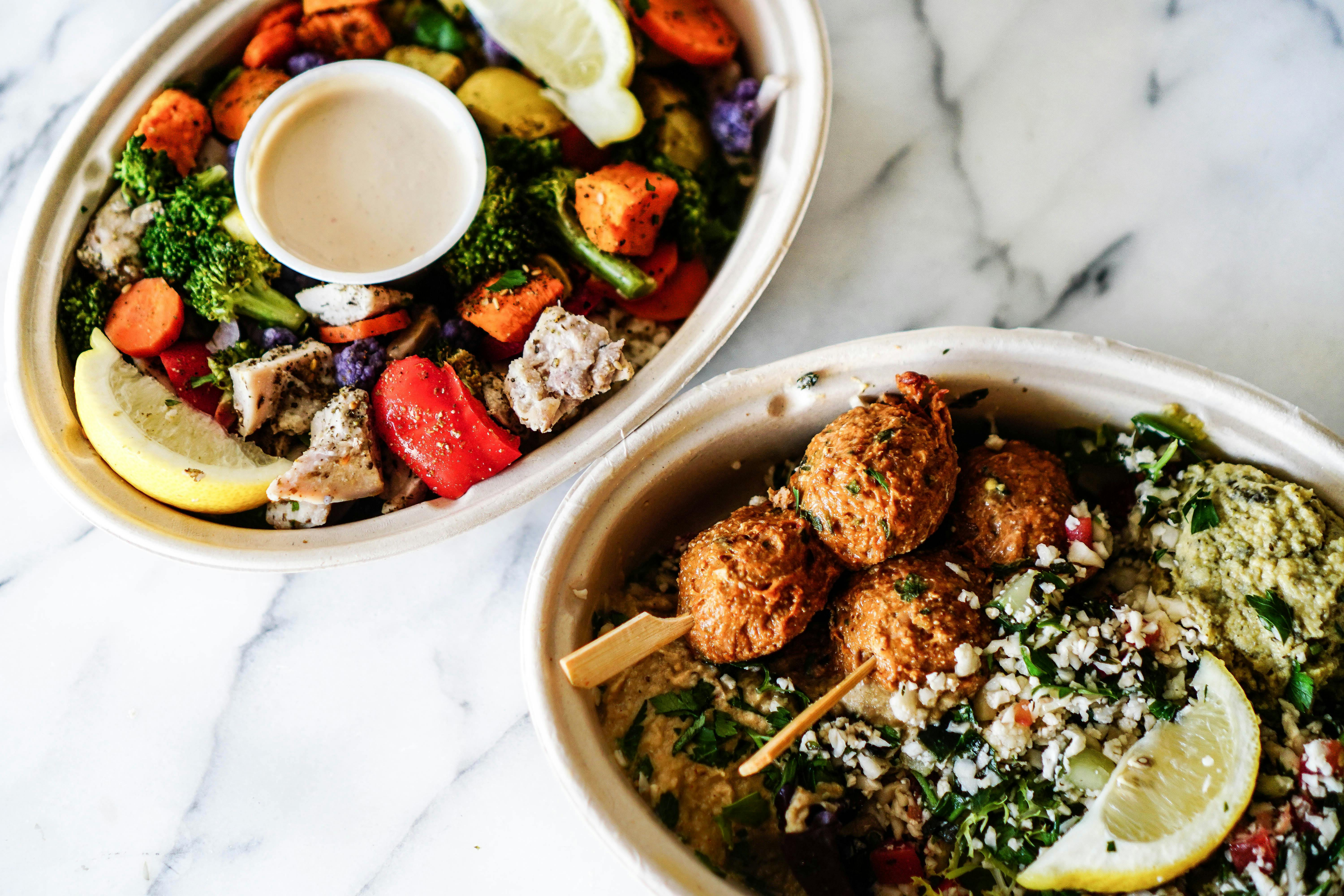
American Mediterranean Bowl
The diets react (see scores below)
Common Ingredients
- quinoa
- chicken breast
- hummus
- cucumber
- tomato
- Kalamata olives
- feta cheese
- tahini
Specific recipes may vary.
Incompatible with 6 of 11 diets
Diet Ratings
This bowl is fundamentally incompatible with ketogenic eating. Quinoa is the primary base and a major problem — a single cup of cooked quinoa contains ~34g net carbs, likely pushing a standard serving well beyond the entire daily keto carb allowance on its own. Hummus (made from chickpeas) adds another significant carb load (~6-8g per 2 tbsp serving, and bowls typically use more). Falafel as the alternate protein is made from ground chickpeas and flour, making it even more carb-dense than the hummus. While several individual components are keto-friendly (chicken breast, cucumber, Kalamata olives, feta cheese, tahini), the dish as constructed — built around a quinoa base with hummus — cannot be made keto-compatible without replacing its foundational ingredients entirely.
The American Mediterranean Bowl as listed contains multiple animal-derived ingredients that make it incompatible with a vegan diet. Chicken breast is animal flesh, and feta cheese is a dairy product — both are clearly excluded under vegan rules. Even in the falafel variant, feta cheese remains in the ingredient list as a standard component of the dish. The bowl cannot be considered vegan without removing the chicken and feta entirely. The remaining ingredients — quinoa, hummus, cucumber, tomato, Kalamata olives, and tahini — are all fully plant-based and would form an excellent vegan base, but the dish as described is not vegan-compliant.
This dish contains multiple hard paleo violations with near-universal consensus against them. Quinoa is a grain (pseudocereal) excluded by all mainstream paleo authorities. Hummus is made from chickpeas, a legume, making it a clear avoid. Falafel is also chickpea-based, adding a second legume source. Feta cheese is dairy, excluded under paleo. Tahini, made from sesame seeds, is borderline — sesame is technically a seed, but sesame oil is classified as a seed oil to avoid; tahini in whole paste form is debated, though many paleo authorities exclude it. The paleo-compliant ingredients (chicken breast, cucumber, tomato, Kalamata olives) are approved on their own, but they represent a minority of this dish's composition. The cumulative weight of grains, legumes, and dairy makes this dish a clear avoid with high confidence.
This bowl is strongly aligned with Mediterranean diet principles. The base of quinoa provides whole-grain nutrition (though not a traditional Mediterranean grain, it functions similarly to bulgur or farro). Vegetables like cucumber and tomato are core Mediterranean staples. Hummus and tahini are legume- and seed-based condiments deeply rooted in Mediterranean cuisine. Kalamata olives contribute healthy monounsaturated fats. Feta cheese is a traditional Mediterranean dairy, appropriate in moderate amounts. The protein choice matters: falafel (chickpea-based) is a plant-forward, highly approved option, while chicken breast is lean poultry acceptable in moderation. No refined grains, added sugars, or processed ingredients are present.
Quinoa is not a traditional Mediterranean grain — modern clinical guidelines sometimes flag American-style 'Mediterranean bowls' as cultural reinterpretations that substitute non-regional ingredients. Purists following traditional Greek or Cretan dietary patterns would prefer bulgur, barley, or farro as the grain base, and might note that feta in combination with hummus and tahini could push sodium levels higher than traditional single-dish norms.
This dish is overwhelmingly plant-based and incompatible with the carnivore diet. The base is quinoa, a grain that is strictly excluded. Hummus is made from chickpeas and tahini (sesame paste), both plant-derived. Cucumber and tomato are vegetables/fruits, excluded entirely. Kalamata olives are plant-derived. Tahini is a seed paste. Feta cheese is the only animal-derived ingredient, and even that is debated within strict carnivore circles. The optional protein source is falafel, which is entirely plant-based (ground chickpeas). Even selecting the chicken breast option, the chicken itself would be buried under a mountain of prohibited plant foods and plant-based condiments. There is no version of this dish that is carnivore-compatible without a complete reconstruction.
This dish contains multiple Whole30-excluded ingredients that make it clearly non-compliant. Quinoa is a grain and explicitly excluded. Hummus is made from chickpeas, which are legumes and excluded. Feta cheese is a dairy product and excluded. Falafel (the alternative protein) is made from chickpeas (legumes) and often contains flour (grains), making it doubly excluded. Even if chicken breast were chosen as the protein, the remaining excluded ingredients (quinoa, hummus, feta) disqualify the dish entirely. The only compliant components are cucumber, tomato, Kalamata olives, tahini, and chicken breast.
This bowl contains multiple high-FODMAP ingredients that make it unsuitable during the elimination phase. Hummus (made from chickpeas/GOS and garlic/fructans) is high-FODMAP at any standard serving — a typical bowl portion of 2-4 tablespoons is well above the Monash low-FODMAP threshold of roughly 2 tablespoons, and most commercial hummus also contains garlic. Falafel (the alternative protein) is made from chickpeas or fava beans, both high in GOS, making it definitively high-FODMAP. Feta cheese contains moderate lactose and is considered moderate-to-high FODMAP at typical serving sizes used in bowls. The combination of hummus and feta alone creates a high-FODMAP dish. The remaining ingredients — quinoa, chicken breast, cucumber, tomato, Kalamata olives, and tahini — are individually low-FODMAP at standard servings. However, the dish as described, particularly with hummus as a standard component, cannot be made low-FODMAP without significant substitutions. Tahini itself is low-FODMAP. If one were to remove the hummus and falafel option, use chicken only, limit feta to a very small garnish (~28g or less), the bowl could become low-FODMAP — but as described, it should be avoided during elimination.
The American Mediterranean Bowl has a strong DASH-compatible foundation — quinoa is an excellent whole grain rich in fiber, magnesium, and protein; chicken breast is a lean protein explicitly encouraged by DASH; cucumber and tomato are core DASH vegetables; and hummus and tahini provide plant-based protein, healthy fats, and minerals. However, several ingredients introduce meaningful caveats. Kalamata olives are high in sodium (roughly 400–700mg per typical serving) and saturated fat, though they also provide monounsaturated fats. Feta cheese is a full-fat, high-sodium dairy product (one ounce contains ~260–320mg sodium), not the low-fat dairy DASH emphasizes. Hummus and tahini add healthy unsaturated fats but also moderate sodium depending on brand. Cumulatively, the sodium load from olives, feta, and store-bought hummus can push a single bowl toward or past 800–1,200mg sodium, which is a significant fraction of even the standard DASH limit (2,300mg/day) and potentially problematic for the stricter 1,500mg/day target. The falafel option adds refined or fried carbs and more sodium depending on preparation. With mindful portioning — reduced olives, low-fat or reduced-sodium feta, low-sodium hummus, and grilled chicken — this bowl can be solid DASH fare, but as commonly assembled it warrants caution.
NIH DASH guidelines emphasize low-fat dairy and strict sodium limits, which standard feta and Kalamata olives clearly challenge. However, updated Mediterranean-DASH hybrid interpretations (including the MIND diet) recognize that small amounts of olives and traditional cheeses provide beneficial fats and bioactive compounds, and some DASH-oriented clinicians accept these in moderation within an otherwise low-sodium day — particularly given emerging research suggesting the overall dietary pattern matters more than individual sodium sources.
The American Mediterranean Bowl has a strong foundation for Zone eating but requires careful portioning to hit the 40/30/30 ratio. Chicken breast is an ideal Zone lean protein, but falafel (the alternative) is fried chickpea-based and carries significantly more fat and carbohydrates, making it harder to block correctly. Quinoa is a moderate-glycemic grain — Zone classifies grains as 'unfavorable' carbs (0-1 servings/day), so it must be portioned conservatively (roughly 1/3 cup cooked per meal). Cucumber and tomato are excellent low-glycemic Zone-favorable vegetables. Hummus and tahini both contribute healthy monounsaturated and polyunsaturated fats but also add meaningful carbohydrate and fat calories that count toward the block totals — easy to over-pour. Kalamata olives are a nearly perfect Zone fat source (monounsaturated). Feta cheese adds saturated fat and a small protein contribution; early Zone strictly limited saturated fat, though Sears' later work is more permissive. The dish as typically served at restaurants likely comes with oversized quinoa portions and generous hummus/tahini drizzles, pushing carb and fat blocks well above the Zone target for one meal. With disciplined portioning (small quinoa base, measured hummus/tahini, chicken breast as protein anchor), this bowl can be tuned into a reasonable Zone meal.
Zone practitioners using Sears' later anti-inflammatory framework (The OmegaRx Zone, The Zone Diet) may score this higher (7) because of the strong polyphenol content (olives, tomatoes, cucumber), omega-3-friendly fat profile from tahini and olive oil, and the absence of processed ingredients. The feta and falafel option introduce saturated fat and less favorable fat profiles respectively, which early Zone (Enter the Zone) would penalize more heavily than later Zone writing would.
This Mediterranean-inspired bowl is broadly well-aligned with anti-inflammatory principles. Quinoa is a fiber-rich whole grain with a complete amino acid profile and polyphenol content. Chicken breast (lean protein) and falafel (legume-based, if chosen) are both acceptable-to-favorable protein sources. Hummus and tahini are sesame- and chickpea-based, providing healthy fats, fiber, and some anti-inflammatory minerals like zinc and magnesium. Cucumber and tomato contribute antioxidants, hydration, and polyphenols (including lycopene in tomato). Kalamata olives are a standout anti-inflammatory ingredient — rich in oleic acid, polyphenols, and vitamin E, closely aligned with extra virgin olive oil's profile. The primary concern is feta cheese: as a full-fat dairy product, it is in the 'limit' category due to saturated fat content, though it is used in modest quantities here as a topping. Tomato carries a low-confidence caveat for those following autoimmune-adjacent protocols (see dissenting view). Overall, the bowl's macro composition — whole grain base, lean or plant protein, legume spreads, olive-based fats, and fresh vegetables — reflects a Mediterranean dietary pattern consistently associated with reduced inflammatory markers including CRP and IL-6.
Tomatoes are considered anti-inflammatory by mainstream authorities including Dr. Weil (lycopene, vitamin C, quercetin), but autoimmune protocol (AIP) and some functional medicine practitioners (e.g., Dr. Tom O'Bryan) argue that nightshade solanine alkaloids and lectins may trigger inflammation in genetically susceptible individuals. Feta, while moderate in saturated fat, is flagged more strictly under anti-inflammatory protocols that emphasize reducing all full-fat dairy.
The chicken breast version of this bowl is a strong GLP-1-friendly meal. Quinoa provides complete protein plus fiber (~8g protein and ~5g fiber per cup cooked), chicken breast is a lean, high-density protein source, and the vegetables (cucumber, tomato) add hydration and micronutrients with minimal calories. Hummus contributes additional fiber and plant protein. The fat load is the main concern: Kalamata olives, feta cheese, and tahini all add fat — primarily unsaturated and dairy fat respectively — which can accumulate to a level that worsens nausea or reflux in GLP-1 patients sensitive to fat. These three ingredients together in standard serving sizes could push total fat to 20-30g, which approaches the threshold where GI side effects become likely. Portion control on tahini, olives, and feta is essential. The falafel version swaps lean animal protein for a fried chickpea patty — typically deep-fried, higher in fat, and less protein-dense per calorie — which reduces the score meaningfully. With chicken and modest amounts of the high-fat components, this bowl is nutrient-dense, protein-forward, fiber-rich, and well-suited to small portions, earning a solid approval. With falafel or heavy-handed tahini and feta, it slides toward caution.
Some GLP-1-focused dietitians would rate this higher, arguing that the fats here are predominantly unsaturated and anti-inflammatory, and that Mediterranean dietary patterns are consistently recommended in obesity medicine. Others would flag that GLP-1 patients with active nausea cannot reliably tolerate combined fat sources (tahini plus olives plus feta in one sitting), and recommend building up to this bowl rather than including it early in treatment when side effects are most pronounced.
*See how scores were generated at our methodology page.
Nutritional profile
Six traits that cut across every diet.
Fiber & Plants
How much whole-plant food and fiber it delivers.
Healthy Fats
The quality of its fats (unsaturated, omega-3).
Whole / Unprocessed
How close it is to its natural, unprocessed form.
Gut Gentle
How easy it is on digestion (low FODMAP, few irritants).
Low Glycemic
How little it spikes your blood sugar.
Protein Density
How much protein it packs per calorie.
Controversy Index
Higher controversy = more disagreement between diets.
Diet-Specific Tips
 Mediterranean — 8/10
View tips
- Quinoa is a whole grain analog, acceptable but not traditional Mediterranean
- Hummus and tahini are authentic Mediterranean legume/seed-based components
- Kalamata olives provide core Mediterranean healthy fats
- Feta cheese is a traditional Mediterranean dairy — moderate portion is appropriate
- Chicken breast is lean poultry, acceptable in moderation per Mediterranean guidelines
- Falafel option makes this fully plant-forward and even more Mediterranean-aligned
- No processed foods, refined grains, or added sugars detected
- Fresh vegetables (cucumber, tomato) are staple Mediterranean ingredients
 DASH — 6/10
View tips
- Quinoa is a DASH-approved whole grain high in fiber and magnesium
- Grilled chicken breast is an ideal DASH lean protein
- Kalamata olives are high in sodium (~400–700mg per serving) — a significant DASH concern
- Feta cheese is full-fat and high in sodium (~280–320mg/oz), not aligned with DASH low-fat dairy guidance
- Hummus and tahini add healthy monounsaturated/polyunsaturated fats but contribute moderate sodium
- Cucumber and tomato are excellent DASH vegetables
- Combined sodium from olives, feta, and hummus can approach 1,000mg+ per bowl
- Low-sodium hummus, reduced feta, and fewer olives would significantly improve DASH compatibility
- Falafel option may add saturated fat and sodium depending on preparation method
 Zone — 6/10
View tips
- Chicken breast is ideal Zone lean protein (~25g per 3.5 oz serving); falafel alternative is much harder to block correctly due to fat+carb density
- Quinoa is an 'unfavorable' Zone carb (grain); must be limited to ~1/3 cup cooked to stay within 1-2 carb blocks
- Cucumber and tomato are Zone-favorable low-glycemic vegetables — strong positive contributors
- Kalamata olives are an excellent monounsaturated Zone fat source
- Hummus and tahini add healthy fats but also carb and calorie density — easy to over-portion beyond Zone fat block targets
- Feta cheese introduces saturated fat; small amounts acceptable but adds to block complexity
- As typically served, portion sizes likely skew carb and fat blocks too high for a single Zone meal
- Polyphenol and anti-inflammatory profile is strong, aligning well with Sears' later nutritional emphasis
 Anti-Inflammatory — 8/10
View tips
- Quinoa: fiber-rich whole grain with polyphenols — anti-inflammatory base
- Kalamata olives: high in oleic acid and polyphenols, strongly anti-inflammatory
- Hummus and tahini: legume and sesame-based, provide fiber, healthy fats, and minerals
- Chicken breast: lean protein, acceptable under anti-inflammatory guidelines
- Falafel (alternate): legume-based protein, favorable anti-inflammatory profile
- Cucumber: hydrating, low glycemic, mild anti-inflammatory
- Tomato: lycopene and antioxidants (pro for general population; flagged in AIP for nightshade alkaloids)
- Feta cheese: moderate saturated fat — acceptable in small amounts but in 'limit' category
 GLP-1 Friendly — 7/10
View tips
- Chicken breast version provides 30-40g protein per standard serving — meets per-meal protein target
- Quinoa adds ~5g fiber plus complete amino acids — supports both protein and fiber goals
- Cucumber and tomato contribute hydration and micronutrient density with minimal calories
- Tahini, feta, and Kalamata olives together create a significant cumulative fat load — portion discipline required
- Falafel substitution typically means fried preparation — higher fat, lower protein density per calorie, reduces score to caution range
- Hummus is a positive addition: fiber, plant protein, and healthy fat in moderate amounts
- Small-portion friendly: bowl format works well in 4-5 small meal pattern
- No refined grains, no added sugar, no fried components in the chicken version — clean nutritional profile