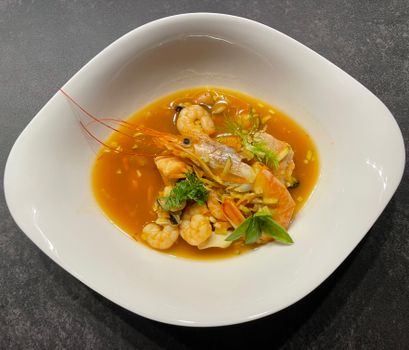
Photo: Rudi Kessler / Pexels
Mediterranean
Mediterranean Fish Stew (Kakavia)
The diets react (see scores below)
Common Ingredients
- white fish
- potatoes
- onion
- tomato
- carrots
- celery
- olive oil
- lemon
Specific recipes may vary.
Incompatible with 3 of 11 diets
Diet Ratings
Mediterranean Fish Stew (Kakavia) is incompatible with a ketogenic diet primarily due to potatoes, which are a high-starch vegetable containing approximately 15-17g net carbs per 100g. A standard serving of this stew would likely contain a significant portion of potato, easily pushing net carbs well above the 20-50g daily keto limit in a single bowl. Carrots and onions add additional net carbs (roughly 6-8g and 7-9g per 100g respectively), compounding the problem. The tomatoes also contribute modest sugars. While the white fish is an excellent lean protein and olive oil is keto-friendly, the starchy and moderately high-carb vegetables make this dish fundamentally incompatible with ketosis in its traditional form. A keto-adapted version would require substituting potatoes with cauliflower or zucchini and reducing onion and carrot quantities significantly.
Mediterranean Fish Stew (Kakavia) contains white fish as its primary protein, which is an animal product derived from aquatic animals. Fish is unambiguously excluded from a vegan diet under all major vegan frameworks including the Vegan Society. The remaining ingredients — potatoes, onion, tomato, carrots, celery, olive oil, and lemon — are all plant-based, but the presence of fish makes the dish entirely incompatible with veganism. There is no meaningful debate within the vegan community about fish consumption.
Mediterranean Fish Stew (Kakavia) is largely paleo-friendly but is held back by the inclusion of white potatoes, which remain a debated ingredient. The base is excellent: white fish is a clean, hunter-gatherer protein; olive oil is a preferred paleo fat; and onion, tomato, carrots, celery, and lemon are all unprocessed vegetables and fruits with no paleo objection. The sticking point is white potatoes. Loren Cordain's original framework discouraged them due to glycoalkaloid content and high glycemic load, and The Paleo Diet's official guide continues to discourage them. However, a significant portion of the modern paleo community — including Mark Sisson and the Whole30 protocol — now accepts white potatoes as a whole, unprocessed food. Without the potatoes (or substituting sweet potatoes), this dish would be a strong approve. As written, it sits in the caution zone due to this well-documented debate.
Mark Sisson (Primal Blueprint) and the Whole30 protocol both include white potatoes as an acceptable whole food, arguing that a plain, unprocessed potato is nutritionally sound and was available to pre-agricultural humans. Substituting sweet potatoes would resolve the debate entirely for even the strictest paleo adherents.
Kakavia is one of the oldest and most authentic Mediterranean dishes, originating from ancient Greek fishermen who would cook their catch directly on boats. Every ingredient aligns perfectly with Mediterranean diet principles: white fish provides lean protein and omega-3 fatty acids (meeting the 2-3 times weekly seafood recommendation), olive oil is the sole fat source, and the dish is packed with vegetables (onion, tomato, carrots, celery) and potatoes for complex carbohydrates. Lemon adds brightness and vitamin C with no added sugars or processed ingredients. This is a textbook Mediterranean meal — whole, unprocessed, plant-forward, and fish-centered.
Mediterranean Fish Stew (Kakavia) is fundamentally incompatible with the carnivore diet. While white fish is a carnivore-approved protein, the dish is loaded with multiple plant-based ingredients: potatoes, onion, tomato, carrots, celery, olive oil, and lemon. These plant foods are categorically excluded from the carnivore diet. Olive oil is a plant-derived oil (not animal fat), and lemon/vegetables add plant compounds, antinutrients, and carbohydrates that directly violate carnivore principles. The dish cannot be modified to be carnivore-compatible without fundamentally changing its character — it would simply become plain fish. The plant ingredients are not minor additives but core structural components of the stew.
Mediterranean Fish Stew (Kakavia) is composed entirely of Whole30-compliant ingredients. White fish is an explicitly allowed protein, and all vegetables listed — potatoes, onion, tomato, carrots, and celery — are compliant whole vegetables. Olive oil is a natural fat fully permitted on Whole30, and lemon is a compliant fruit/flavoring. There are no grains, legumes, dairy, added sugars, or any other excluded ingredients in this dish. This is a clean, whole-food meal that aligns perfectly with the spirit of the Whole30 program.
Mediterranean Fish Stew (Kakavia) contains several low-FODMAP ingredients — white fish, potatoes, tomato (in standard servings), carrots, olive oil, and lemon — but onion is a significant high-FODMAP ingredient that is a core component of the dish. Onion contains fructans and is rated 'avoid' at any typical serving size during the elimination phase. Celery is also problematic: Monash rates celery as low-FODMAP only at very small portions (1 small stalk, ~10g), and a typical stew would exceed this. Tomato is low-FODMAP in moderate amounts (up to ~65g canned or 1 medium fresh), but can become moderate-FODMAP in larger quantities. If the onion is removed and celery is kept minimal, the dish could be made low-FODMAP compliant, but as traditionally prepared with onion as a base ingredient, it is not safe during the elimination phase. The dish earns a 'caution' rather than 'avoid' because the problematic ingredients are modifiable, and much of the dish is otherwise FODMAP-friendly.
Monash University clearly rates onion as high-FODMAP at any standard serving, making the traditional recipe a avoid during strict elimination. However, some FODMAP-trained dietitians may suggest that a modified version — substituting onion with the green tops of spring onions (scallions) and keeping celery minimal — can render the dish elimination-safe, since the fish, potato, carrot, lemon, and olive oil base is well-tolerated.
Mediterranean Fish Stew (Kakavia) is an excellent fit for the DASH diet. It features lean white fish as the primary protein, which is explicitly encouraged by DASH guidelines as a heart-healthy protein source rich in omega-3s. The vegetable base of tomatoes, onions, carrots, and celery provides potassium, magnesium, and fiber — all key DASH nutrients. Potatoes contribute additional potassium. Olive oil is the recommended fat in DASH-aligned eating patterns. Lemon juice adds flavor without sodium, reducing the need for added salt. The dish contains no red meat, no saturated fat sources, no added sugar, and no processed ingredients. As prepared traditionally, sodium is controlled by the cook and can easily fall within DASH limits. This dish closely mirrors the DASH dietary pattern in nearly every dimension.
Mediterranean Fish Stew (Kakavia) is built on several Zone-friendly pillars: white fish is an excellent lean protein source, olive oil provides ideal monounsaturated fat, and vegetables like onion, tomato, carrots, and celery are low-glycemic favorable carbohydrates rich in polyphenols. The lemon adds polyphenol value with negligible glycemic impact. The stew's primary Zone concern is the potatoes, which are classified as an 'unfavorable' high-glycemic carbohydrate in Zone methodology — Dr. Sears explicitly lists potatoes as a carb to minimize due to their high glycemic index and glycemic load. However, in a stew where potatoes are one of several vegetables and portioned appropriately, the overall glycemic impact is diluted. With careful portioning — reducing potato quantity, increasing the vegetable-to-potato ratio, and ensuring the fish protein portion (~3 oz) balances the carb load — this dish can be made Zone-compatible. The fat profile from olive oil is exemplary. This dish sits at the higher end of caution rather than approve primarily because the potato inclusion requires active management.
Some Zone practitioners and later Sears writings acknowledge that small amounts of potatoes in a mixed vegetable context (as in a stew) have a lower net glycemic impact than eating potatoes alone, due to fiber from other vegetables and the overall food matrix. A moderate-portion serving where potato pieces are limited could be treated as an acceptable 'unfavorable' carb inclusion within an otherwise highly favorable Zone meal, potentially justifying a low 'approve' score of 7 in practice.
Kakavia is an exemplary anti-inflammatory dish. Extra virgin olive oil provides oleocanthal and monounsaturated fats with well-documented anti-inflammatory effects. White fish supplies lean protein and meaningful omega-3 fatty acids (EPA/DHA), though at lower levels than fatty fish like salmon. Tomatoes are rich in lycopene and vitamin C; onions and celery deliver quercetin and other anti-inflammatory flavonoids; carrots contribute beta-carotene and carotenoids. Lemon juice adds vitamin C and supports iron absorption. Potatoes are a whole-food complex carbohydrate with potassium and resistant starch. The dish contains no refined carbohydrates, added sugars, seed oils, trans fats, or processed ingredients. The overall ingredient profile — vegetables, lean fish, EVOO, and citrus — closely mirrors the Mediterranean dietary pattern that is the foundational model for anti-inflammatory eating. The only minor limitation is that white fish is less omega-3-rich than fatty fish like salmon or mackerel, preventing a perfect 10.
Mediterranean Fish Stew (Kakavia) is a strong fit for GLP-1 patients. White fish provides lean, high-quality protein with very low fat content, supporting the 100-120g daily protein target without the saturated fat burden of fattier proteins. The broth-based format is easy to digest and gentle on a slowed GI tract, making it well-tolerated even on higher-side-effect days. Vegetables (tomato, carrot, celery, onion) contribute meaningful fiber and micronutrients, supporting the 25-30g daily fiber goal. Potatoes add moderate fiber and potassium — a useful electrolyte for GLP-1 patients who may be losing fluid. Olive oil provides heart-healthy unsaturated fat in what is typically a small quantity per serving. Lemon juice supports palatability without added sugar and may mildly aid digestion. The soup format is inherently small-portion-friendly and high in water content, directly supporting hydration — a key concern given GLP-1-reduced thirst sensation. Nutrient density per calorie is high. The main limitation is that white fish alone may not deliver 20-30g protein per small bowl without a generous portion of fish; patients should ensure the fish-to-broth ratio is sufficient to hit protein targets per meal.
*See how scores were generated at our methodology page.
Nutritional profile
Six traits that cut across every diet.
Fiber & Plants
How much whole-plant food and fiber it delivers.
Healthy Fats
The quality of its fats (unsaturated, omega-3).
Whole / Unprocessed
How close it is to its natural, unprocessed form.
Gut Gentle
How easy it is on digestion (low FODMAP, few irritants).
Low Glycemic
How little it spikes your blood sugar.
Protein Density
How much protein it packs per calorie.
Controversy Index
Higher controversy = more disagreement between diets.
Diet-Specific Tips
 Paleo — 5/10
View tips
- White fish is a clean, approved paleo protein
- Olive oil is a preferred paleo-compliant fat
- Onion, tomato, carrots, celery, and lemon are all unprocessed and fully paleo-approved
- White potatoes are the sole debated ingredient — excluded by Cordain and The Paleo Diet guide, accepted by Sisson and Whole30
- No grains, legumes, dairy, seed oils, or processed ingredients present
- Swapping white potatoes for sweet potatoes would elevate this to a high-confidence approve
 Mediterranean — 10/10
View tips
- White fish is a core Mediterranean protein source, fulfilling the 2-3x weekly seafood guideline
- Extra virgin olive oil is the only fat used, perfectly aligned with Mediterranean principles
- Rich vegetable base (tomato, onion, carrot, celery) provides fiber, vitamins, and antioxidants
- No processed ingredients, refined grains, added sugars, or red meat
- Potatoes provide complex carbohydrates and are traditional in Mediterranean coastal cuisines
- Lemon juice adds flavor without calories or unhealthy additives
- Kakavia is a historically authentic dish from Greek Mediterranean culinary tradition
 Whole30 — 9/10
View tips
- White fish is an explicitly allowed Whole30 protein
- All vegetables (potatoes, onion, tomato, carrots, celery) are fully compliant
- Olive oil is a permitted natural fat
- Lemon is a compliant flavoring/acid
- No excluded ingredients present
- Dish is a whole, unprocessed preparation that honors the spirit of Whole30
 Low-FODMAP — 5/10
View tips
- Onion is high-FODMAP at any standard serving due to fructans — a core traditional ingredient that makes the dish unsafe as written
- Celery is low-FODMAP only at very small portions (~10g); typical stew quantities would exceed safe threshold
- White fish is fully low-FODMAP and a safe protein source
- Potatoes are low-FODMAP at standard servings (1 medium potato, ~150g)
- Carrots are low-FODMAP at standard serving sizes
- Tomato is low-FODMAP at moderate amounts but can become moderate-FODMAP in large quantities
- Olive oil and lemon juice are both low-FODMAP
- Dish can be made elimination-compliant by replacing onion with green scallion tops and limiting celery
 DASH — 9/10
View tips
- Lean white fish is a DASH-recommended protein source
- Rich in potassium from tomatoes, carrots, potatoes, and celery
- Olive oil is a heart-healthy, DASH-compatible fat
- Lemon juice replaces salt as a flavor enhancer, supporting sodium control
- No saturated fat, red meat, added sugar, or processed ingredients
- Vegetables provide fiber, magnesium, and potassium aligned with DASH goals
- Sodium can vary if salt is added generously — home preparation allows easy control
- Traditional preparation uses whole, minimally processed ingredients
 Zone — 6/10
View tips
- White fish is an ideal Zone lean protein — low fat, high-quality protein, easily portioned to ~3 oz per serving
- Olive oil is a top-tier Zone fat source — pure monounsaturated, anti-inflammatory, exactly what Dr. Sears recommends
- Potatoes are explicitly 'unfavorable' in Zone methodology due to high glycemic index — the primary drawback of this dish
- Onion, tomato, carrots, and celery are all favorable low-glycemic Zone carbohydrates that offset potato impact
- Lemon contributes polyphenols, supporting Zone's anti-inflammatory objectives
- Overall fat-to-carb-to-protein balance is manageable with portion control but requires attention to potato quantity
- No processed ingredients, trans fats, or added sugars — clean whole-food profile aligns with Zone anti-inflammatory principles
 Anti-Inflammatory — 9/10
View tips
- Extra virgin olive oil is a cornerstone anti-inflammatory fat (oleocanthal, polyphenols)
- White fish provides lean protein and moderate omega-3 EPA/DHA
- Tomatoes supply lycopene and vitamin C
- Onions and celery are rich in quercetin and anti-inflammatory flavonoids
- Carrots contribute beta-carotene and carotenoids
- Lemon juice adds vitamin C and phytochemicals
- No refined carbs, added sugars, seed oils, or processed ingredients
- Whole-food Mediterranean profile strongly supported by anti-inflammatory research
 GLP-1 Friendly — 8/10
View tips
- Lean white fish delivers high-quality protein with minimal saturated fat
- Broth base is easy to digest and supports hydration
- Olive oil provides unsaturated fat in moderate, portion-controlled quantity
- Mixed vegetables contribute fiber, micronutrients, and antioxidants
- Potatoes offer potassium supporting electrolyte balance
- Small-portion-friendly format suits reduced GLP-1 appetite
- No fried, high-sugar, carbonated, or high-saturated-fat components
- Protein per bowl may vary — fish-to-broth ratio matters for hitting per-meal protein targets