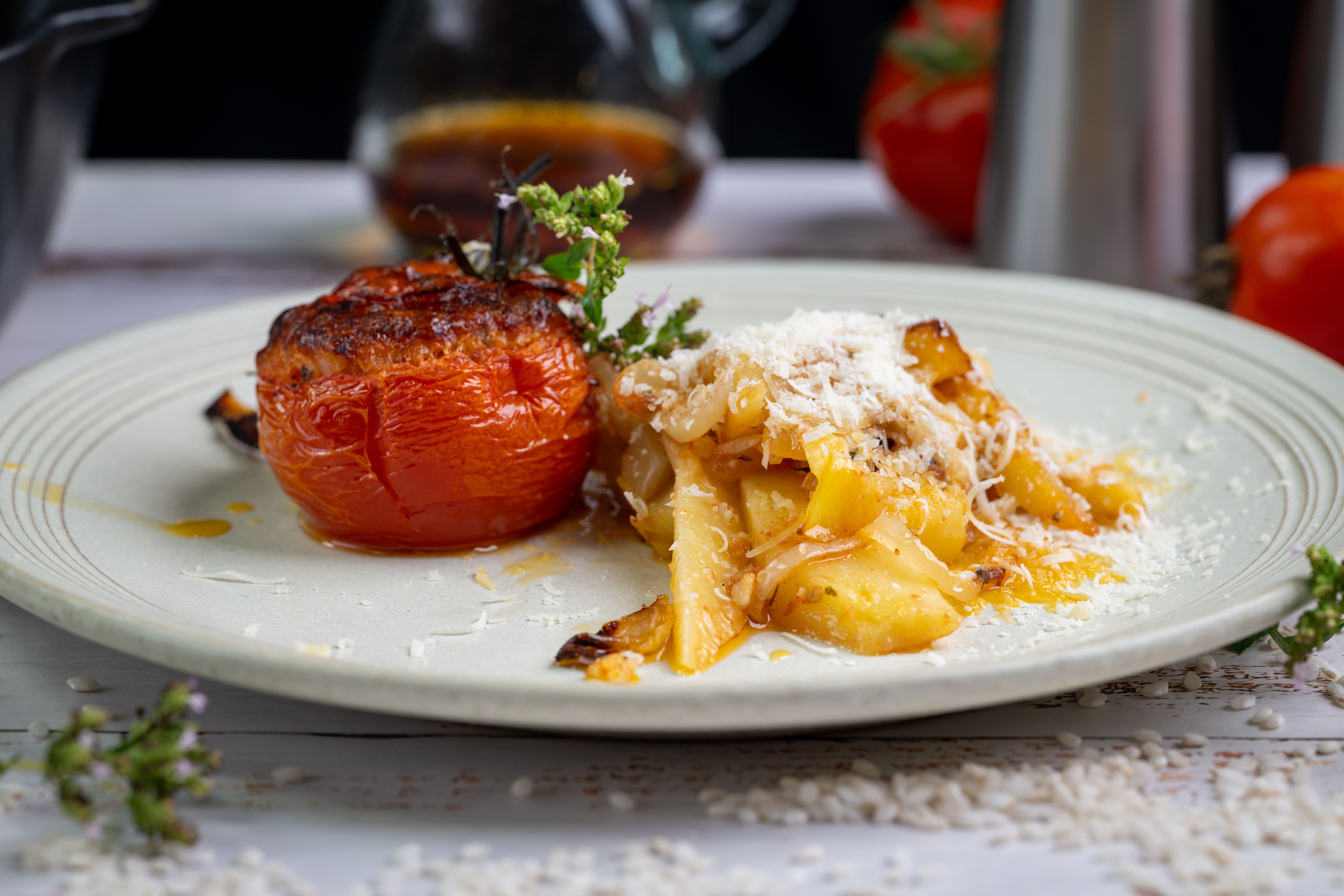
Photo: Jana Ohajdova / Pexels
Mediterranean
Stuffed Tomatoes
The diets react (see scores below)
Common Ingredients
- tomatoes
- white rice
- onion
- pine nuts
- dill
- mint
- parsley
- olive oil
Specific recipes may vary.
Incompatible with 5 of 11 diets
Diet Ratings
Stuffed tomatoes with white rice is fundamentally incompatible with ketogenic eating. White rice is a high-glycemic grain containing approximately 45g of net carbs per cooked cup, which alone exceeds the entire daily keto carb allowance. Tomatoes also contribute additional net carbs (roughly 3-4g per medium tomato). Together, a standard serving of this dish would deliver 50-70g of net carbs, instantly breaking ketosis. The olive oil and pine nuts are keto-friendly, but they cannot offset the massive carbohydrate load from the rice and tomatoes combined. This dish is a classic high-carb Mediterranean preparation with no straightforward keto adaptation without a complete overhaul of the core ingredients.
This Mediterranean stuffed tomato dish is entirely plant-based. Every ingredient — tomatoes, white rice, onion, pine nuts, dill, mint, parsley, and olive oil — is derived from plants with no animal products or animal-derived ingredients present. The dish features whole vegetables, herbs, nuts, and a minimally processed grain, making it a strong fit for a vegan diet. The use of pine nuts provides healthy fats and some protein, while the fresh herbs contribute micronutrients. Olive oil is a standard vegan fat. There are no contested ingredients here.
White rice is a grain and is excluded from standard paleo guidelines. While the remaining ingredients — tomatoes, onion, pine nuts, dill, mint, parsley, and olive oil — are all paleo-approved, the white rice is the central filling of this dish and cannot be treated as incidental. A dish built around a non-paleo ingredient cannot be approved or placed in the caution zone. The overall verdict is 'avoid' driven entirely by the white rice component.
Paul Jaminet's Perfect Health Diet — widely cited in ancestral health circles — specifically includes white rice as a 'safe starch,' arguing it is uniquely low in anti-nutrients and well-tolerated compared to other grains. Some paleo-adjacent practitioners following this framework would accept this dish.
Stuffed tomatoes (Gemista) are a classic Mediterranean dish, rich in vegetables, fresh herbs, olive oil, and pine nuts — all strongly aligned with Mediterranean diet principles. The primary concern is white rice, a refined grain that modern Mediterranean diet guidelines generally discourage in favor of whole grains. However, the overall dish is plant-forward, uses extra virgin olive oil as the fat source, and features a diverse array of vegetables and herbs. The white rice is used in modest quantities as a filling component rather than as the base of the meal, which somewhat mitigates its impact. The dish earns a solid caution-to-approve borderline score.
Traditional Greek practice (Gemista) has always used white rice as the standard stuffing grain, and several Mediterranean diet authorities acknowledge that white rice in moderate amounts within an otherwise plant-rich dish is acceptable, particularly given its cultural authenticity. Some modern clinical guidelines, however, would upgrade this to a full approval only if brown or whole-grain rice were substituted.
Stuffed Tomatoes is entirely plant-based with zero animal-derived ingredients. Every single component — tomatoes, white rice, onion, pine nuts, dill, mint, parsley, and olive oil — is explicitly excluded from the carnivore diet. There is no protein source, no animal fat, and no animal product of any kind. This dish represents the antithesis of carnivore eating: a grain-and-vegetable-forward Mediterranean preparation cooked in plant oil and seasoned with plant herbs. No modification short of a complete recipe overhaul could make this carnivore-compatible.
This dish contains white rice, which is a grain explicitly excluded on the Whole30 program. All grains — including rice — are eliminated for the full 30 days. The remaining ingredients (tomatoes, onion, pine nuts, dill, mint, parsley, olive oil) are all Whole30-compliant, but the inclusion of white rice as a core stuffing ingredient makes the entire dish non-compliant. There is no workaround within the Whole30 framework for rice.
This dish contains onion, which is one of the highest-FODMAP ingredients in the Monash system due to its very high fructan content. Onion is high-FODMAP at any reasonable cooking quantity and must be strictly avoided during the elimination phase — even small amounts used for flavoring can trigger symptoms. The remaining ingredients are largely low-FODMAP: tomatoes (low-FODMAP up to ~75g per serve), white rice (low-FODMAP), pine nuts (low-FODMAP up to ~1 tbsp/14g), fresh herbs like dill, mint, and parsley (low-FODMAP in typical culinary amounts), and olive oil (low-FODMAP). However, the presence of onion as a structural filling ingredient — not just a trace flavoring — makes this dish unsuitable for the elimination phase. Substituting spring onion greens (not the white bulb) or omitting onion entirely would make this dish largely low-FODMAP.
Stuffed tomatoes prepared Mediterranean-style align well with DASH principles. Tomatoes are rich in potassium, lycopene, and fiber — core DASH vegetables. Olive oil is explicitly recommended in DASH as a healthy vegetable oil. Fresh herbs (dill, mint, parsley) add flavor without sodium. Onion contributes additional nutrients and flavor, reducing the need for salt. Pine nuts provide healthy unsaturated fats, magnesium, and protein, consistent with DASH's inclusion of nuts and seeds. The main concern is white rice, a refined grain rather than a whole grain, which DASH guidelines deprioritize in favor of brown rice or other whole grains. The dish has no added sodium from processed ingredients, no saturated fat sources, and no red meat or full-fat dairy. Portion control matters given the caloric density of olive oil and pine nuts.
NIH DASH guidelines emphasize whole grains over refined grains like white rice, which has a higher glycemic index and less fiber. Some DASH-oriented clinicians would reduce the score if white rice is used in large quantities, recommending substitution with brown rice or farro to better align with DASH's whole grain targets.
Stuffed tomatoes with white rice present a classic Zone challenge: the dish has some favorable elements but is structurally imbalanced. Tomatoes are an excellent low-glycemic Zone vegetable, and olive oil provides ideal monounsaturated fat. Pine nuts add both fat and a small amount of protein. The fresh herbs (dill, mint, parsley) are polyphenol-rich, which aligns with Sears' anti-inflammatory emphasis. However, the primary carbohydrate source is white rice, which is a high-glycemic 'unfavorable' carb in Zone terminology — it spikes insulin and is difficult to balance within the 40/30/30 framework. Critically, the dish as described has no primary protein source, meaning it cannot achieve the Zone's required 30% protein ratio without significant modification. As presented, this dish is carbohydrate-heavy (white rice + tomatoes) with fat from olive oil and pine nuts, but essentially protein-deficient. To make it Zone-compatible, white rice should be replaced or minimized in favor of cauliflower rice, and a lean protein (ground turkey, chickpeas, or low-fat feta) must be added. Pine nuts do contribute some protein, but not enough to meet Zone requirements. The dish can work as a Zone component with substantial modification, hence 'caution' rather than 'avoid.'
Stuffed tomatoes is a classic Mediterranean dish with a mixed anti-inflammatory profile. On the positive side, tomatoes are rich in lycopene (a potent carotenoid antioxidant with well-documented anti-inflammatory effects, especially when cooked), and the fresh herbs — dill, mint, and parsley — contribute polyphenols, flavonoids, and antioxidants. Extra virgin olive oil is a cornerstone anti-inflammatory fat, providing oleocanthal and monounsaturated fatty acids. Pine nuts offer some healthy fats and minerals. Onion adds quercetin, a notable anti-inflammatory flavonoid. However, white rice is the limiting factor: as a refined carbohydrate, it lacks the fiber and micronutrients of whole grains, and refined carbs are generally flagged in anti-inflammatory frameworks for their potential to spike blood glucose and promote low-grade inflammation. The dish scores moderately well because the anti-inflammatory ingredients (olive oil, tomatoes, herbs, onion) dominate in terms of phytochemical richness, but the white rice anchor prevents a full approval. Substituting brown rice or a whole grain would significantly improve the anti-inflammatory rating.
Some Mediterranean diet researchers and practitioners (e.g., those following the traditional Mediterranean diet framework) would view white rice used in modest amounts within a vegetable-forward dish as nutritionally acceptable, noting that Mediterranean populations who consume white rice in such preparations do not show elevated inflammatory markers — context and overall dietary pattern matter more than any single refined grain. Conversely, stricter anti-inflammatory protocols (e.g., Dr. Weil's pyramid which emphasizes whole grains) and glycemic-focused anti-inflammatory approaches would penalize white rice more heavily, particularly for individuals with insulin resistance.
Stuffed tomatoes made with white rice, pine nuts, olive oil, and herbs are a low-protein, moderate-fat Mediterranean dish that falls short of GLP-1 dietary priorities. The primary protein source is listed as none, and the ingredients confirm this — white rice is a refined carbohydrate with minimal protein, pine nuts add healthy unsaturated fat but also caloric density with little protein, and the tomato shell contributes modest fiber and hydration. On the positive side, tomatoes provide water content and some fiber, fresh herbs offer micronutrients, and olive oil is a preferred unsaturated fat. However, with no meaningful protein source and white rice as the starch base, this dish fails the #1 GLP-1 priority. A patient eating a small portion (as expected on GLP-1s) would consume very few grams of protein, missing the 15-30g per meal target significantly. The dish is easy to digest and unlikely to worsen GI side effects, which is a mild positive. As a standalone main, it is not appropriate for GLP-1 patients without significant modification — adding a lean protein (chicken, tuna, white beans, or lentils) and substituting brown rice or quinoa for white rice would substantially improve its suitability.
*See how scores were generated at our methodology page.
Nutritional profile
Six traits that cut across every diet.
Fiber & Plants
How much whole-plant food and fiber it delivers.
Healthy Fats
The quality of its fats (unsaturated, omega-3).
Whole / Unprocessed
How close it is to its natural, unprocessed form.
Gut Gentle
How easy it is on digestion (low FODMAP, few irritants).
Low Glycemic
How little it spikes your blood sugar.
Protein Density
How much protein it packs per calorie.
Controversy Index
Higher controversy = more disagreement between diets.
Diet-Specific Tips
 Vegan — 9/10
View tips
- All ingredients are 100% plant-based
- No animal products, dairy, eggs, or animal-derived additives
- Predominantly whole foods with minimal processing
- Pine nuts, herbs, and olive oil align well with whole-food plant-based eating
- White rice is slightly refined but uncontroversial in a vegan context
- Classic Mediterranean preparation with no hidden non-vegan components
 Mediterranean — 6/10
View tips
- Tomatoes as the primary vessel provide excellent lycopene and micronutrients
- Extra virgin olive oil used as the primary fat — strongly aligned
- Fresh herbs (dill, mint, parsley) add phytonutrients consistent with Mediterranean eating
- Pine nuts contribute healthy fats and plant protein
- White rice is a refined grain, not preferred by modern Mediterranean diet guidelines
- No animal protein, making this an entirely plant-based dish
- Dish is a recognized traditional Mediterranean recipe (Greek Gemista)
 DASH — 8/10
View tips
- Tomatoes are a DASH-ideal vegetable: high in potassium, fiber, and antioxidants
- Olive oil is a DASH-recommended healthy fat
- Fresh herbs add flavor complexity with zero sodium
- Pine nuts contribute DASH-friendly unsaturated fats and magnesium
- White rice is a refined grain — substituting brown rice would improve DASH alignment
- No processed ingredients, added salt, saturated fat, or red meat
- Low sodium profile overall — dish score improves further if no salt is added during preparation
- Portion awareness needed for olive oil and pine nuts due to caloric density
 Zone — 4/10
View tips
- White rice is a high-glycemic 'unfavorable' carbohydrate in Zone methodology — raises insulin significantly
- No primary protein source listed — dish cannot meet the Zone's 30% protein target without addition of lean protein
- Tomatoes are a favorable low-glycemic Zone vegetable and a positive element
- Olive oil provides ideal monounsaturated fat aligned with Zone fat guidelines
- Pine nuts offer monounsaturated fat and trace protein but insufficient to meet protein block requirements
- Fresh herbs (dill, mint, parsley) provide polyphenols consistent with Sears' anti-inflammatory principles
- Overall macro ratio is heavily skewed toward carbohydrates and fat with minimal protein — not Zone-balanced as written
 Anti-Inflammatory — 6/10
View tips
- Tomatoes: lycopene-rich, anti-inflammatory carotenoid especially potent when cooked
- Extra virgin olive oil: oleocanthal provides ibuprofen-like anti-inflammatory activity
- Fresh herbs (dill, mint, parsley): polyphenols and antioxidants support anti-inflammatory profile
- Onion: quercetin content is a notable anti-inflammatory flavonoid
- Pine nuts: source of healthy fats and minerals, modest omega-6 content acceptable in small amounts
- White rice: refined carbohydrate, lacks fiber, may promote glycemic response — key limiting factor
- No pro-inflammatory proteins, trans fats, added sugars, or artificial additives present
 GLP-1 Friendly — 4/10
View tips
- No meaningful protein source — fails the 15-30g per meal protein target
- White rice is a refined carbohydrate with low fiber and low protein density
- Pine nuts and olive oil add healthy unsaturated fats but also caloric density in a low-calorie-budget context
- Tomatoes provide hydration support and some fiber — a mild positive
- Fresh herbs (dill, mint, parsley) are micronutrient-dense and GLP-1 safe
- Easy to digest — unlikely to worsen nausea or gastric emptying side effects
- Would require adding a lean protein and swapping white rice for a high-fiber grain to become GLP-1 appropriate as a main