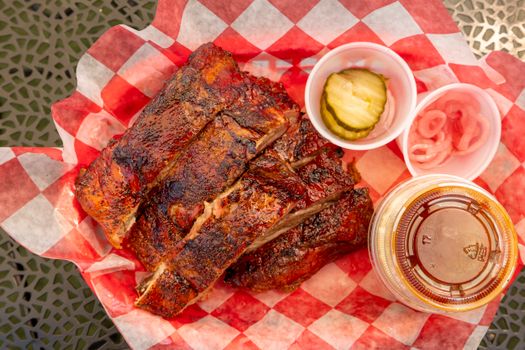
Photo: Nobleseed Nobleseed / Pexels
American
Memphis BBQ Ribs
The diets react (see scores below)
Common Ingredients
- pork spareribs
- paprika
- brown sugar
- black pepper
- garlic powder
- onion powder
- cayenne
- mustard powder
Specific recipes may vary.
Incompatible with 9 of 11 diets
Diet Ratings
Memphis BBQ Ribs present a mixed keto picture. The pork spareribs themselves are excellent for keto — high in fat and protein with zero carbs. However, the dry rub contains brown sugar, which is a direct source of added sugar and carbohydrates. The amount of brown sugar in a typical Memphis-style rub (often 2-4 tablespoons per rack) can add 5-15g of net carbs per serving depending on portion size. The remaining spices (paprika, garlic powder, onion powder, cayenne, mustard powder) contribute minimal carbs. The dish is not disqualifying, but the brown sugar is a real concern. A keto-adapted version replacing brown sugar with a keto sweetener (erythritol, monk fruit) would easily push this to 'approve.' As prepared with traditional brown sugar, careful portioning and tracking are required to stay within daily carb limits.
Strict keto practitioners would argue this dish should be avoided entirely due to the non-negotiable presence of added brown sugar — any added sugar violates the zero-tolerance rule for sugar regardless of quantity. Lazy keto or flexible keto followers, however, would say the small amount of rub spread over a full rack means per-serving sugar intake is modest and trackable within a 20-50g daily carb budget.
Memphis BBQ Ribs are built around pork spareribs, which are unambiguously an animal product (pig flesh). This dish is entirely incompatible with a vegan diet. The dry rub ingredients — paprika, brown sugar, black pepper, garlic powder, onion powder, cayenne, and mustard powder — are all plant-based, but the primary ingredient, pork, disqualifies the dish outright. There is no vegan version of this dish without replacing the ribs entirely with a plant-based alternative such as jackfruit or seitan.
Pork spareribs themselves are fully paleo-approved — unprocessed meat is a cornerstone of the diet. However, the dry rub contains brown sugar, which is refined sugar and a clear paleo violation. The remaining spices (paprika, black pepper, garlic powder, onion powder, cayenne, mustard powder) are all paleo-compliant herbs and spices. The dish fails primarily due to the brown sugar, a non-negotiable exclusion in virtually all paleo frameworks. If the brown sugar were removed or substituted with a paleo-friendly sweetener like a small amount of raw honey or medjool date paste, the dish could be approved or reach caution territory.
Memphis BBQ Ribs are fundamentally incompatible with the Mediterranean diet. Pork spareribs are a fatty red/processed meat, which the Mediterranean diet restricts to a few times per month at most. The dish is built around a dry rub featuring brown sugar (added sugar) and is prepared in a style typical of American BBQ — not aligned with Mediterranean culinary traditions. There is no olive oil, no vegetables, no legumes, and no whole grains involved. The high saturated fat content from pork spareribs, combined with added sugar in the rub, directly contradicts core Mediterranean diet principles of minimizing red meat, processed preparations, and added sugars.
Memphis BBQ Ribs are fundamentally incompatible with the carnivore diet. While the base protein — pork spareribs — is a perfectly acceptable animal product, the dish is loaded with plant-derived spices (paprika, black pepper, garlic powder, onion powder, cayenne, mustard powder) and brown sugar. Brown sugar is an outright excluded plant-derived sweetener, and the spice rub is a textbook blend of plant compounds. All carnivore camps — strict Lion Diet, Baker's approach, and even Saladino's more permissive animal-based framework — exclude added sugars and heavily spiced preparations. The ribs themselves would score a 9, but this preparation method disqualifies the dish entirely.
Memphis BBQ Ribs contain brown sugar, which is an added sugar explicitly excluded on the Whole30 program. While pork spareribs and all the spices (paprika, black pepper, garlic powder, onion powder, cayenne, mustard powder) are fully compliant, the inclusion of brown sugar in the dry rub disqualifies this dish entirely. There is no ambiguity here — added sugar in any form is one of the core exclusions of the Whole30 program.
Memphis BBQ Ribs contain two significant high-FODMAP ingredients in the dry rub: garlic powder and onion powder. Both are among the highest-FODMAP foods tested by Monash University — they are concentrated sources of fructans and are problematic even in small quantities (as little as 1/4 teaspoon of garlic powder is high-FODMAP). These are not trace amounts in a typical dry rub; they are core flavoring components applied in meaningful quantities across the meat. The pork spareribs themselves are FODMAP-free, and most other rub ingredients (paprika, black pepper, cayenne, mustard powder) are low-FODMAP at standard amounts. Brown sugar contains no FODMAPs in typical quantities. However, garlic powder and onion powder alone are sufficient to classify this dish as high-FODMAP and unsuitable during the elimination phase.
Memphis BBQ Ribs are fundamentally incompatible with the DASH diet. Pork spareribs are a fatty red meat high in saturated fat and cholesterol — exactly the type of food DASH explicitly limits. Spareribs are one of the fattiest cuts of pork, with significant saturated fat per serving. The dry rub includes brown sugar (added sugar), and while the spice ingredients themselves are low in sodium, ribs as commonly consumed in a BBQ context are typically served in large portions with high caloric density from fat. DASH guidelines specifically call for limiting red meat, fatty cuts, and high saturated fat foods. Even without added sodium (no salt listed, though most dry rubs include salt), the underlying cut disqualifies this dish. The combination of fatty pork, added sugar, and large typical serving sizes makes this an avoid under any DASH interpretation.
Memphis BBQ Ribs present multiple Zone Diet challenges. Pork spareribs are a fatty cut of meat — significantly higher in saturated fat than Zone-preferred lean proteins like skinless chicken or fish. The dry rub contains brown sugar, which adds glycemic load and empty carbohydrates with no fiber benefit. However, the Zone is ratio-based rather than exclusion-based, so ribs are not categorically off-limits. A carefully portioned serving (focusing on the meat, not excessive rub) could be incorporated into a Zone meal if balanced with a large serving of low-glycemic vegetables and minimal added fat. The key issues are: (1) spareribs have a poor protein-to-fat ratio compared to Zone-ideal proteins, making it difficult to hit 30% protein without overshooting 30% fat; (2) brown sugar in the rub pushes carbs toward high-glycemic territory; (3) the overall dish is calorie-dense and difficult to block accurately. This is an 'unfavorable' protein source in Zone terminology — usable occasionally in controlled portions but not a building block of a Zone lifestyle.
Some Zone practitioners and later Sears writings take a more relaxed view of saturated fat, particularly in the context of an overall anti-inflammatory diet rich in omega-3s and polyphenols. If the rub's sugar is minimal and the meal is accompanied by abundant colorful vegetables, a small portion of ribs could fit within Zone ratios. Additionally, pork does provide complete protein and some B vitamins, so it isn't without nutritional merit.
Memphis BBQ Ribs present a strongly pro-inflammatory profile. Pork spareribs are a high-fat cut of red meat, rich in saturated fat and arachidonic acid, both of which are associated with elevated inflammatory markers (CRP, IL-6) in research. The anti-inflammatory framework places red and processed meats in the 'limit' to 'avoid' category, and fatty cuts like spareribs are among the most problematic. Brown sugar adds refined/added sugar, which is a well-established driver of inflammation and explicitly flagged in all major anti-inflammatory protocols. The dry rub does contain some redemptive spices — paprika (antioxidant carotenoids), garlic powder, cayenne (capsaicin), mustard powder, and black pepper all have mild anti-inflammatory properties — but these are present in small seasoning quantities insufficient to meaningfully offset the pro-inflammatory base. The overall dish is dominated by saturated fat from pork ribs and added sugar, making it a poor fit for an anti-inflammatory dietary pattern.
Memphis BBQ ribs are a poor choice for GLP-1 patients on nearly every relevant dimension. Pork spareribs are one of the fattiest cuts of pork, with a typical serving (3-4 ribs, ~150g) delivering 30-40g of fat — predominantly saturated — alongside only 20-25g of protein. That fat load is a primary driver of the nausea, bloating, and reflux that GLP-1 medications already predispose patients to, as slowed gastric emptying means high-fat food sits in the stomach far longer than usual. The dry rub adds brown sugar (empty calories, blood sugar spike) and cayenne (potential reflux/nausea trigger). There is no fiber, negligible micronutrient density, and the dish is inherently large-portion and slow to digest. Even a 'small serving' of ribs is a fatty, dense, difficult-to-digest meal. This is a near-ideal example of a food category GLP-1 guidelines consistently flag as problematic: fatty red/processed meat, high saturated fat, low fiber, low nutrient density per calorie, and a known GI side effect amplifier.
*See how scores were generated at our methodology page.
Nutritional profile
Six traits that cut across every diet.
Fiber & Plants
How much whole-plant food and fiber it delivers.
Healthy Fats
The quality of its fats (unsaturated, omega-3).
Whole / Unprocessed
How close it is to its natural, unprocessed form.
Gut Gentle
How easy it is on digestion (low FODMAP, few irritants).
Low Glycemic
How little it spikes your blood sugar.
Protein Density
How much protein it packs per calorie.
Controversy Index
Higher controversy = more disagreement between diets.
Diet-Specific Tips
 Keto — 5/10
View tips
- Pork spareribs are naturally high-fat, zero-carb, and ideal for keto
- Brown sugar in the dry rub introduces added sugar and net carbs — the primary concern
- Typical Memphis rub ratios add approximately 5-15g net carbs per serving
- All other spices contribute negligible carbohydrates
- Dish can be made fully keto-compliant by substituting brown sugar with a keto sweetener
- Portion size is critical — overeating the rub increases carb load significantly
 Zone — 4/10
View tips
- Pork spareribs are high in saturated fat, making it hard to stay within Zone's 30% fat target without exceeding it
- Unfavorable protein source compared to Zone-preferred lean meats like chicken breast or fish
- Brown sugar in dry rub adds high-glycemic carbohydrates with no fiber offset
- Difficult to accurately block due to complex fat-to-protein ratio in rib meat
- Portion control is critical — a small serving with abundant low-GI vegetables can make this work
- No omega-3 benefit; spareribs lean toward omega-6 heavy profile, counter to Zone's anti-inflammatory goals