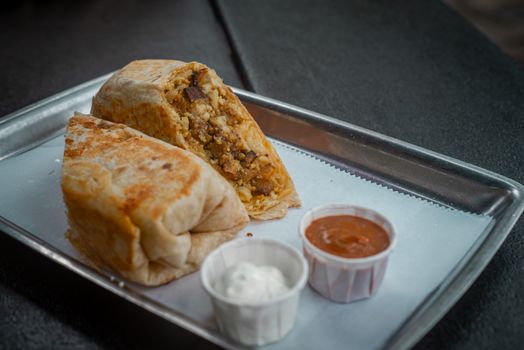
Photo: Connor Scott McManus / Pexels
Mexican
Mexican Breakfast Burrito
The diets react (see scores below)
Common Ingredients
- flour tortilla
- eggs
- Mexican chorizo
- potatoes
- refried beans
- Monterey Jack
- salsa
- cilantro
Specific recipes may vary.
Incompatible with 9 of 11 diets
Diet Ratings
The Mexican Breakfast Burrito is fundamentally incompatible with a ketogenic diet due to multiple high-carb ingredients stacked together. The flour tortilla alone contributes roughly 30-40g of net carbs, effectively blowing the entire daily carb budget in a single wrap. Potatoes add another 15-25g of net carbs, and refried beans contribute an additional 20-25g. Combined, these three ingredients alone can deliver 65-90g of net carbs — two to four times the maximum daily keto allowance. There is no realistic portion size that makes this dish keto-compatible in its traditional form. The eggs, chorizo, and Monterey Jack are keto-friendly components, but they are outweighed by the carb-heavy base ingredients.
This dish contains multiple animal products that are fundamentally incompatible with a vegan diet. Eggs are a direct animal product (excluded under vegan rule #1). Mexican chorizo is a meat product, typically made from ground pork or beef (excluded under vegan rule #1). Monterey Jack is a dairy cheese (excluded under vegan rule #1). Refried beans are sometimes prepared with lard, adding another potential animal-derived ingredient. There is no ambiguity here — this dish is built around animal products as its primary components. The plant-based elements (flour tortilla, potatoes, salsa, cilantro) are entirely overwhelmed by the non-vegan ingredients.
The Mexican Breakfast Burrito is definitively non-paleo. The flour tortilla alone disqualifies it — wheat is a grain and one of the most clearly excluded foods in paleo. Beyond that, the dish contains multiple additional violations: refried beans are a legume (excluded), Monterey Jack is dairy (excluded), and Mexican chorizo is typically a processed meat containing additives, preservatives, and often fillers. The potatoes add a debated element, but they're irrelevant here given the cascade of clear violations. The only paleo-compliant ingredients in the entire dish are eggs, cilantro, and possibly the salsa (if fresh). This dish fails paleo criteria on at least four independent counts.
This dish combines multiple elements that conflict with Mediterranean diet principles. Mexican chorizo is a heavily processed, high-saturated-fat red meat product — one of the clearest 'avoid' items in the Mediterranean framework. The flour tortilla is a refined grain with no whole-grain benefit. Refried beans, while legumes are a Mediterranean staple, are typically prepared with lard, negating their benefit. Monterey Jack cheese adds further saturated fat. The overall dish is high in processed meat, refined carbohydrates, and saturated fat, with no olive oil and no meaningful plant-forward emphasis despite the eggs and beans. The salsa and cilantro are the only genuinely Mediterranean-compatible components.
The Mexican Breakfast Burrito is almost entirely incompatible with the carnivore diet. The base is a flour tortilla — a grain-based food that is strictly excluded. Potatoes are a plant-based carbohydrate, refried beans are legumes, salsa contains tomatoes and other plant ingredients, and cilantro is an herb — all plant-derived foods that are categorically off-limits. Mexican chorizo typically contains spices, chili peppers, and often sugar or vinegar, making even the meat component a processed product with significant plant additives. Monterey Jack cheese is dairy, which is debated, but it is the least of the concerns here. The only partially acceptable elements are the eggs and possibly the cheese. This dish is fundamentally a plant-heavy, grain-wrapped meal with token animal ingredients.
This Mexican Breakfast Burrito violates Whole30 rules on multiple fronts. The flour tortilla is a grain-based wrap explicitly excluded under both the grains rule and the 'no recreating baked goods/junk food' rule (wraps are specifically listed as prohibited). Refried beans are legumes, which are excluded. Monterey Jack cheese is dairy, which is excluded. Mexican chorizo commonly contains added sugar and potentially other non-compliant additives. Even if those issues were resolved, the burrito format itself — a wrap — is explicitly named as a prohibited food form under Whole30's junk food recreation rule.
This Mexican Breakfast Burrito contains multiple high-FODMAP ingredients that make it unsuitable during the elimination phase. The flour tortilla is made from wheat and is high in fructans — a primary FODMAP offender. Refried beans are made from pinto or black beans, which are high in GOS (galacto-oligosaccharides) and fructans at any standard serving. Mexican chorizo typically contains garlic and onion as core seasoning ingredients, both of which are among the highest-FODMAP foods (fructans). Salsa commonly contains onion and garlic. With three to four independently high-FODMAP components in a single dish, there is no realistic way to consume this burrito in a standard serving while staying within low-FODMAP limits. The eggs, potatoes (in moderate portions), Monterey Jack cheese, and cilantro are individually low-FODMAP, but they cannot offset the cumulative FODMAP load from the other ingredients.
The Mexican Breakfast Burrito is heavily misaligned with DASH diet principles across multiple dimensions. Mexican chorizo is a high-sodium, high-saturated-fat processed red meat — one of the most problematic foods for DASH. A large flour tortilla adds refined carbohydrates and moderate sodium. Refried beans, while legumes are DASH-friendly in principle, are typically prepared with lard and high sodium in standard form. Monterey Jack cheese contributes saturated fat and sodium. Combined, this dish likely exceeds 1,000–1,500mg of sodium in a single serving and delivers substantial saturated fat — a double strike against core DASH targets. The eggs and potatoes are relatively neutral, and salsa/cilantro are DASH-positive ingredients, but they cannot offset the dominant problematic components. This dish as commonly consumed represents the kind of high-sodium, high-saturated-fat combination that DASH was specifically designed to reduce.
The Mexican Breakfast Burrito presents significant Zone Diet challenges across multiple macronutrient categories. The flour tortilla is a high-glycemic refined carbohydrate that spikes insulin rapidly — an 'unfavorable' carb in Zone terminology. Potatoes are explicitly flagged as unfavorable/avoid in Zone literature due to their high glycemic load. Refried beans, while containing fiber, are typically made with lard and add substantial starchy carbohydrates. Mexican chorizo is a high-saturated-fat, high-sodium fatty sausage — far from the lean protein ideal. Monterey Jack adds more saturated fat. Taken together, this dish stacks multiple Zone-unfavorable elements: refined starch (tortilla) + high-GI starch (potatoes) + fatty processed meat (chorizo) + saturated fat (cheese), with very little monounsaturated fat or low-glycemic vegetable content. The eggs are a Zone-reasonable protein and the salsa/cilantro add polyphenols, but these positives are overwhelmed by the problematic components. While Zone is ratio-based and not exclusionary, this particular combination makes achieving a 40/30/30 balance extremely difficult without radical ingredient substitution — it skews heavily toward carbohydrate calories from unfavorable sources and saturated fat. A score of 3 reflects that it is technically a food (not pure sugar/soda) but is one of the harder dishes to adapt to Zone without fundamentally changing its character.
Some Zone practitioners argue that a modified version — using a smaller corn tortilla (lower GI than flour), swapping chorizo for lean turkey sausage, eliminating potatoes, and using egg whites — could be portioned into a legitimate Zone meal. The beans do provide fiber that lowers net carb count, and Sears' later work acknowledges that traditional Mexican foods with whole-food ingredients can be adapted. In this view, the dish earns a 'caution' rather than near-avoid, with the score dependent on portion size and willingness to modify.
This Mexican breakfast burrito presents a mixed anti-inflammatory profile with several competing factors. On the positive side: eggs provide choline and selenium with some anti-inflammatory value; refried beans (whole legumes) are a clear anti-inflammatory positive, offering fiber, plant protein, and polyphenols; salsa delivers tomatoes (lycopene), chili peppers (capsaicin), and cilantro (antioxidants, quercetin) — all beneficial. Potatoes are a neutral-to-modest starchy vegetable. On the negative side: Mexican chorizo is a processed, cured pork product high in saturated fat, sodium, and often contains additives — it is the most pro-inflammatory component here. Flour tortilla is a refined carbohydrate with minimal fiber or micronutrient value. Monterey Jack cheese adds saturated fat from full-fat dairy, which is in the 'limit' category. The combination of processed meat, refined flour, and full-fat cheese tips the dish into caution territory. It is not an outright 'avoid' because the beans, salsa, and eggs provide genuine anti-inflammatory value, and the overall framework allows for mixed dishes in moderation. Substituting soyrizo or chicken sausage, using a whole wheat tortilla, and reducing cheese would meaningfully improve the profile.
Some anti-inflammatory practitioners would rate this more harshly (score 2-3) given that processed cured meats like chorizo are consistently linked to elevated inflammatory markers (CRP, IL-6) in research, and the refined flour tortilla adds a glycemic burden — the combination echoes the 'processed food' category that the framework broadly discourages. Others following Dr. Weil's less restrictive approach would note that eggs, legumes, and tomato-based salsa are net positives and that occasional mixed dishes like this are compatible with an overall anti-inflammatory dietary pattern.
This Mexican breakfast burrito presents multiple significant concerns for GLP-1 patients. Mexican chorizo is the primary red flag: it is a high-fat, highly processed pork sausage with roughly 23-26g of fat per 2-oz serving, predominantly saturated, and is known to worsen GLP-1 side effects including nausea, reflux, and bloating due to its grease content and spice level. The large flour tortilla adds refined carbohydrates with minimal fiber or protein payoff. Fried or pan-cooked potatoes add more fat and starchy empty calories. Refried beans offer fiber and some protein but are often prepared with lard, compounding the fat load. Monterey Jack cheese adds saturated fat. Taken together, this is a high-fat, high-calorie, large-volume meal — the opposite of what GLP-1 patients need. The eggs and refried beans are the only genuinely GLP-1-friendly components. The dish as described is likely to trigger nausea, slow gastric emptying further, cause reflux or bloating, and deliver a poor protein-to-fat-to-calorie ratio in a large portion format that is poorly tolerated on GLP-1 medications.
Some GLP-1-focused dietitians note that a heavily modified version — substituting turkey or soyrizo, using a smaller whole-wheat tortilla, limiting cheese, and using fat-free refried beans — could shift this into a caution-range meal. The disagreement centers on whether the dish category is inherently problematic or whether ingredient substitution makes it salvageable, with most clinicians landing on the side that the traditional preparation warrants avoidance.
*See how scores were generated at our methodology page.
Nutritional profile
Six traits that cut across every diet.
Fiber & Plants
How much whole-plant food and fiber it delivers.
Healthy Fats
The quality of its fats (unsaturated, omega-3).
Whole / Unprocessed
How close it is to its natural, unprocessed form.
Gut Gentle
How easy it is on digestion (low FODMAP, few irritants).
Low Glycemic
How little it spikes your blood sugar.
Protein Density
How much protein it packs per calorie.
Controversy Index
Higher controversy = more disagreement between diets.
Diet-Specific Tips
 Zone — 5/10
View tips
- Flour tortilla is a high-glycemic refined carbohydrate — Zone 'unfavorable'
- Potatoes are explicitly unfavorable in Zone diet due to high glycemic index
- Mexican chorizo is high in saturated fat and far from Zone's lean protein ideal
- Refried beans add starchy carbs and often saturated fat (lard)
- Monterey Jack cheese contributes additional saturated fat
- Macro ratio likely skews heavily toward unfavorable carbs and saturated fat
- Eggs are a Zone-reasonable protein source — a positive element
- Salsa and cilantro provide polyphenols — minor positive
- Dish is very difficult to balance to 40/30/30 without radical substitution
 Anti-Inflammatory — 4/10
View tips
- Mexican chorizo is a processed cured pork product high in saturated fat, sodium, and additives — the primary pro-inflammatory concern
- Refried beans are a strong anti-inflammatory positive: fiber, plant protein, and polyphenols
- Flour tortilla is a refined carbohydrate with low fiber and high glycemic load
- Eggs are moderate — some anti-inflammatory value (choline, selenium) but arachidonic acid is debated
- Salsa and cilantro contribute lycopene, capsaicin, and antioxidants — beneficial
- Monterey Jack adds saturated fat from full-fat dairy, placing it in the 'limit' category
- Overall dish is high in sodium, saturated fat, and refined carbs — acceptable occasionally, not as a regular pattern