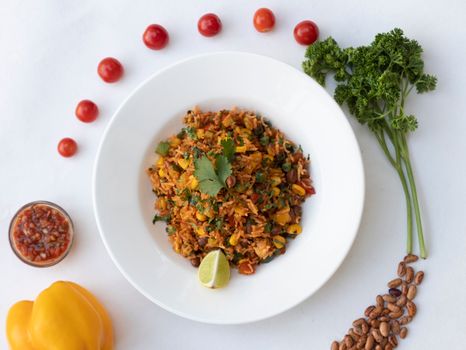
Photo: Prem Singh Tanwar / Pexels
Mexican
Mexican Rice
The diets react (see scores below)
Common Ingredients
- long-grain rice
- tomato sauce
- chicken broth
- onion
- garlic
- peas
- carrots
- cumin
Specific recipes may vary.
Incompatible with 6 of 11 diets
Diet Ratings
Mexican Rice is fundamentally incompatible with a ketogenic diet. Long-grain rice is the primary ingredient and is one of the highest net-carb foods available, delivering approximately 35-45g of net carbs per half-cup cooked serving alone — enough to exceed or completely consume the entire daily keto carb budget in a single side dish. The additional starchy vegetables (peas, carrots) further compound the carb load. There is no meaningful fat content, no protein base, and no pathway to making this dish keto-friendly without entirely replacing the rice, at which point it would no longer be Mexican Rice.
This Mexican rice recipe contains chicken broth, which is an animal-derived ingredient made by simmering chicken bones and meat. All other ingredients (long-grain rice, tomato sauce, onion, garlic, peas, carrots, cumin) are fully plant-based, but the chicken broth disqualifies the dish from vegan compliance. A simple substitution of vegetable broth would make this dish fully vegan-approved.
Mexican Rice is fundamentally incompatible with the paleo diet. Long-grain rice is a grain, which is explicitly excluded from paleo eating. Additionally, peas are legumes, another excluded food group. Chicken broth may contain added salt or preservatives depending on the variety, and tomato sauce may contain added sugar or salt. The remaining ingredients — onion, garlic, carrots, cumin — are paleo-approved, but the foundational components of the dish (rice and peas) are clear violations with strong consensus across all major paleo authorities.
Mexican Rice is built on long-grain white rice, a refined grain that modern Mediterranean diet guidelines discourage in favor of whole grains. However, it is meaningfully upgraded by the inclusion of tomato sauce, onion, garlic, peas, and carrots — all Mediterranean-friendly vegetables and aromatics. Cumin is a spice used across Mediterranean and Middle Eastern cuisines. The chicken broth adds minimal concern. The dish is not heavily processed, contains no added sugar or saturated fat, and the vegetable content partially offsets the refined grain base. Overall it sits in the moderation zone: acceptable as an occasional side but not a dietary staple.
Some Mediterranean diet practitioners note that white rice is a traditional staple in certain Mediterranean regions (e.g., Spanish arroz dishes, Greek rice pilafs) and that a vegetable-enriched preparation like this is nutritionally superior to plain white rice, making a case for broader acceptance in the context of an otherwise plant-rich meal.
Mexican Rice is entirely plant-based and grain-based, with no animal products whatsoever. Every single ingredient — long-grain rice, tomato sauce, onion, garlic, peas, carrots, and cumin — is excluded on the carnivore diet. Rice is a grain, a core excluded food group. The vegetables (onion, garlic, peas, carrots) are all plant foods. Tomato sauce is plant-derived. Cumin is a plant spice. The only marginally relevant ingredient is chicken broth, which is animal-derived, but it functions here merely as a cooking liquid in an otherwise entirely plant-based dish. This dish is the antithesis of carnivore eating — it has no primary protein, no animal fat, and is built entirely around a grain with plant-based accompaniments.
Mexican Rice contains long-grain rice, which is a grain and explicitly excluded on the Whole30 program. Grains of all kinds — including rice — are prohibited for the full 30 days. Regardless of the other ingredients (most of which are compliant: tomato sauce, chicken broth, onion, garlic, cumin, carrots), the rice alone makes this dish non-compliant. Peas (green peas, not snap or snow peas) are also legumes and excluded on Whole30, adding a second violation.
Mexican Rice as traditionally prepared contains multiple high-FODMAP ingredients that make it unsuitable during the elimination phase. Onion and garlic are among the highest-FODMAP foods tested by Monash University — both are rich in fructans and must be avoided entirely during elimination, not just reduced. Standard chicken broth is typically made with onion and/or garlic and is therefore also high-FODMAP unless specifically certified low-FODMAP. Peas (green peas) are high in GOS and fructans at typical serving sizes (safe only at very small amounts like 1/8 cup, which is far less than what would appear in a rice dish). The combination of onion, garlic, peas, and likely FODMAP-containing broth creates a cumulative FODMAP load that is clearly problematic. Long-grain white rice, carrots, tomato sauce (in moderate amounts), and cumin are individually low-FODMAP, but they cannot rescue this dish given the multiple high-FODMAP components baked into the recipe.
Mexican rice contains white long-grain rice rather than a whole grain, which is less emphasized in DASH guidelines that favor whole grains for their fiber, potassium, and magnesium content. The dish also typically uses chicken broth and tomato sauce, both of which can be significant sources of sodium — standard versions can easily contribute 400–700mg sodium per serving, pushing toward DASH limits. On the positive side, the inclusion of vegetables (peas, carrots, onion, garlic) adds fiber, potassium, and micronutrients aligned with DASH principles, and there is no saturated fat or added sugar concern. The spice profile (cumin, garlic) is DASH-friendly. The main concerns are the refined grain and sodium from broth and tomato sauce. If made with low-sodium broth and low-sodium tomato sauce, the score would rise closer to 7. As commonly prepared in restaurant or home settings, it warrants caution due to sodium load and refined grain base.
NIH DASH guidelines explicitly favor whole grains over refined grains; however, updated clinical interpretations note that white rice consumed in moderate portions with vegetables and minimal added sodium can fit within a DASH-style eating pattern, and some DASH-oriented dietitians focus more on overall dietary pattern than individual grain refinement status.
Mexican Rice is carbohydrate-heavy and dominated by long-grain white rice, which is a high-glycemic, 'unfavorable' carbohydrate in Zone terminology. While the dish contains some favorable ingredients — tomatoes, onion, garlic, peas, and carrots provide polyphenols, fiber, and micronutrients — the white rice base makes this a carb-dense side dish that easily disrupts the 40/30/30 ratio when eaten in typical serving sizes. A standard cup of Mexican rice delivers roughly 35-40g of carbs with minimal protein and fat, skewing heavily toward carbohydrates and requiring very precise portioning to fit into a Zone block structure. The vegetables (peas, carrots) and tomato sauce add modest fiber and nutrients but do not meaningfully offset the glycemic impact of the rice. Zone practitioners classify white rice as 'unfavorable' but not completely off-limits — a small portion (about 1/3 cup cooked) can serve as a single carb block if carefully weighed and paired with lean protein and monounsaturated fat to complete the Zone ratio. As a standalone side dish without protein or fat components, it is not Zone-balanced on its own.
Mexican rice is a mixed bag from an anti-inflammatory perspective. On the positive side, it contains several genuinely beneficial ingredients: garlic and onion provide quercetin and allicin with documented anti-inflammatory properties; cumin offers antioxidants and anti-inflammatory compounds; tomatoes (via tomato sauce) contribute lycopene and other carotenoids; peas and carrots add fiber, beta-carotene, and micronutrients. These ingredients collectively support an anti-inflammatory profile. The main concern is the long-grain white rice as the base — it's a refined carbohydrate with a moderate-to-high glycemic index that can promote insulin spikes and, over time, low-grade inflammation when consumed regularly. Chicken broth is neutral to mildly positive (especially if homemade). Tomato sauce quality matters — canned or jarred versions often contain added sugar and sodium, which nudges the dish in a more inflammatory direction. Overall, the dish is not inherently harmful and contains meaningful anti-inflammatory contributors, but the refined white rice foundation prevents an 'approve' verdict. Swapping to brown or wild rice would substantially improve the profile.
Some anti-inflammatory practitioners (including those following Dr. Weil's broader Mediterranean-adjacent guidance) would view this dish more favorably, arguing that the cumulative polyphenol load from garlic, onion, tomato, cumin, and vegetables offsets the glycemic impact of white rice, especially when eaten as part of a balanced meal. Others in stricter anti-inflammatory or blood sugar-focused camps (e.g., Zone Diet, Glucose Goddess methodology) would score it lower due to the refined carbohydrate base and potential glycemic spike.
Mexican rice is a refined carbohydrate-dominant side dish with no meaningful protein contribution and modest fiber from peas and carrots. The ingredients are low in fat and easy to digest, which is compatible with GLP-1 side effect management, but the dish scores poorly on the two highest priorities: protein density and fiber per calorie. Long-grain white rice is a refined grain with a moderate-to-high glycemic index, offering little nutritional value beyond calories. The vegetables (peas, carrots) and tomato sauce add small amounts of fiber and micronutrients, and chicken broth contributes negligible protein. As a side dish eaten in a small portion alongside a high-protein main, it is acceptable but should not displace more nutrient-dense options. Patients on GLP-1s eating reduced calorie volumes cannot afford many empty-calorie fillers, making this a low-priority choice.
*See how scores were generated at our methodology page.
Nutritional profile
Six traits that cut across every diet.
Fiber & Plants
How much whole-plant food and fiber it delivers.
Healthy Fats
The quality of its fats (unsaturated, omega-3).
Whole / Unprocessed
How close it is to its natural, unprocessed form.
Gut Gentle
How easy it is on digestion (low FODMAP, few irritants).
Low Glycemic
How little it spikes your blood sugar.
Protein Density
How much protein it packs per calorie.
Controversy Index
Higher controversy = more disagreement between diets.
Diet-Specific Tips
 Mediterranean — 5/10
View tips
- White long-grain rice is a refined grain, not preferred over whole grains in modern Mediterranean guidelines
- Tomato sauce, peas, carrots, onion, and garlic add meaningful plant-based nutritional value
- No red meat, added sugar, or unhealthy fats present
- Cumin and garlic align with Mediterranean flavor profiles
- Chicken broth is a minor ingredient with negligible dietary impact
- White rice is used in some traditional Mediterranean cuisines, creating interpretive flexibility
 DASH — 5/10
View tips
- White rice (refined grain) rather than whole grain reduces DASH alignment
- Chicken broth adds significant sodium — low-sodium broth would improve score
- Tomato sauce may add additional sodium depending on preparation
- Vegetables (peas, carrots, onion, garlic) contribute potassium and fiber, supporting DASH goals
- No saturated fat, trans fat, or added sugar concerns
- Cumin and garlic are DASH-compatible flavorings
- Portion control important — rice servings can be calorie-dense
 Zone — 4/10
View tips
- Long-grain white rice is a high-glycemic 'unfavorable' carbohydrate in Zone methodology
- Dish is carbohydrate-dominant with no protein or fat to balance the 40/30/30 ratio
- Small portions (~1/3 cup) can be incorporated as a single carb block with careful measurement
- Vegetables (peas, carrots, tomato, onion, garlic) add polyphenols and modest fiber, partially offsetting glycemic impact
- As a side dish without protein or fat, cannot form a Zone-balanced meal on its own
- Typical restaurant or home serving sizes (3/4 to 1 cup) would represent 3-4 carb blocks with negligible protein or fat
 Anti-Inflammatory — 5/10
View tips
- White long-grain rice is a refined carbohydrate with moderate-to-high glycemic index — a concern for inflammation
- Garlic and onion provide quercetin, allicin, and anti-inflammatory sulfur compounds
- Cumin contributes antioxidants and anti-inflammatory phenolic compounds
- Tomato sauce supplies lycopene; commercial versions may add sugar and sodium
- Peas and carrots contribute fiber, beta-carotene, and vitamins
- No added fats, trans fats, processed additives, or sugar listed — a neutral positive
- Dish would score higher with brown or wild rice substitution
 GLP-1 Friendly — 4/10
View tips
- No meaningful protein — fails the #1 GLP-1 dietary priority
- Refined white rice offers low fiber and low nutrient density per calorie
- Small vegetable additions (peas, carrots) provide modest fiber but not enough to elevate the dish
- Low fat content and mild seasoning are GLP-1 side-effect friendly
- Acceptable only in small portions as a side alongside a high-protein main dish
- Brown rice substitution would improve fiber and nutrient density meaningfully