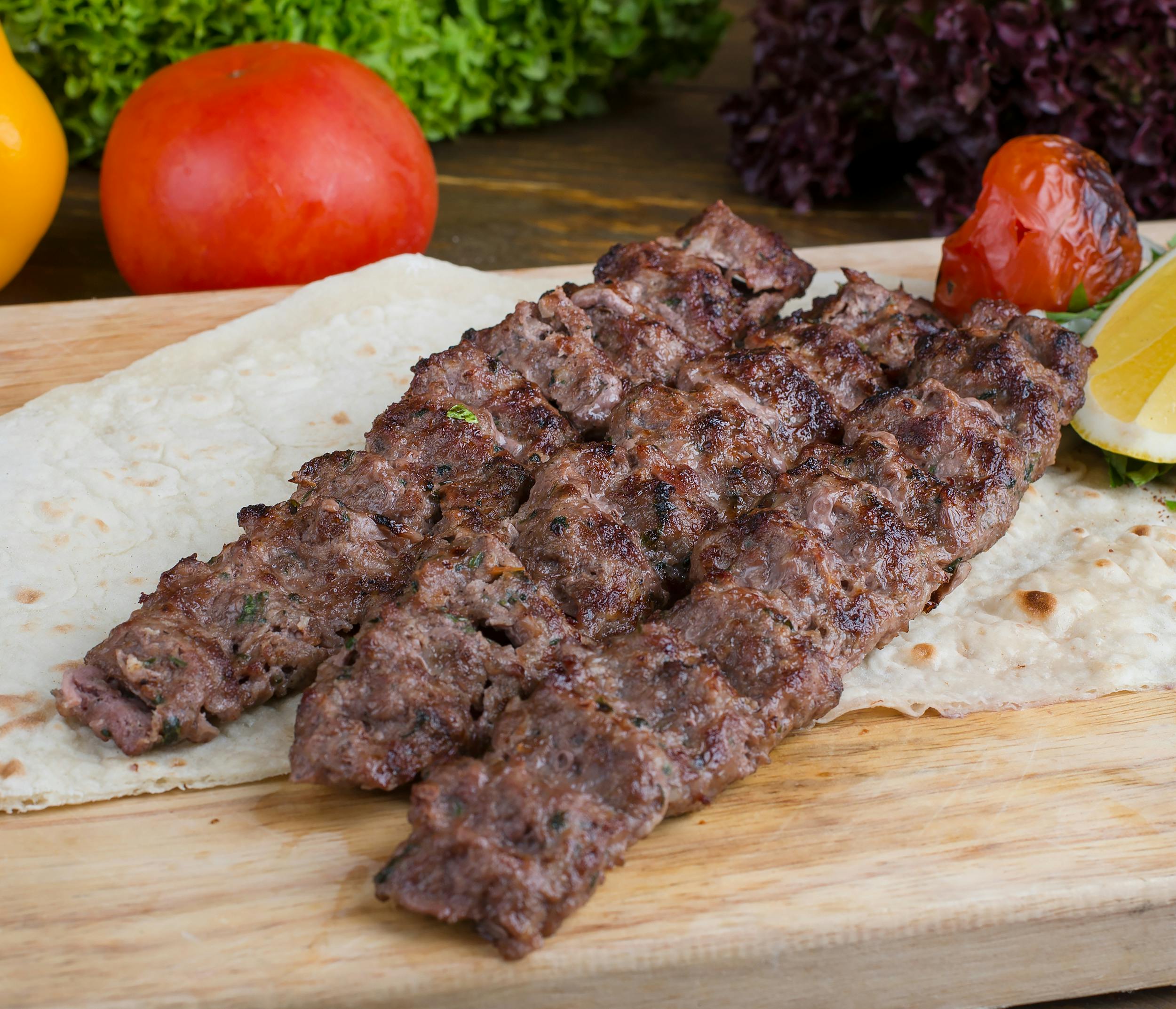
Photo: Shameel mukkath / Pexels
Middle-Eastern
Middle Eastern Beef Kebab
The diets react (see scores below)
Common Ingredients
- ground beef
- onion
- parsley
- cumin
- coriander
- garlic
- sumac
- allspice
Specific recipes may vary.
Incompatible with 4 of 11 diets
Diet Ratings
Middle Eastern Beef Kebab is an excellent keto meal. Ground beef provides high-quality protein and substantial fat, forming a solid keto foundation. The spices and aromatics (cumin, coriander, garlic, sumac, allspice, parsley) are used in small quantities and contribute negligible net carbs. Onion adds a small amount of carbs but in the quantities typical for kebab binding, it remains well within keto limits. The dish is naturally grain-free, sugar-free, and whole-food based. Net carbs per standard serving are very low (estimated 2-4g), making this comfortably compatible with ketosis without any portion manipulation required.
Middle Eastern Beef Kebab contains ground beef as its primary protein, which is unambiguously an animal product. Beef is derived from cattle and is categorically excluded from any vegan diet. The remaining ingredients (onion, parsley, cumin, coriander, garlic, sumac, allspice) are all plant-based, but the presence of beef alone makes this dish entirely incompatible with vegan dietary principles.
Middle Eastern Beef Kebab is an excellent paleo dish. Ground beef is a core paleo protein, and every seasoning — onion, parsley, cumin, coriander, garlic, sumac, and allspice — consists of whole herbs and spices that were available to pre-agricultural humans. There are no grains, legumes, dairy, refined sugars, seed oils, or processed additives present. This is essentially meat seasoned with plants, which is the foundation of paleo eating. The only minor caveat is that commercial spice blends can sometimes contain added salt or anti-caking agents, but evaluating the ingredients in their unprocessed forms, this dish is fully compliant.
Ground beef is red meat, which the Mediterranean diet limits to a few times per month. While the spice blend (cumin, coriander, garlic, sumac, allspice) and aromatics (onion, parsley) are wholly compatible with Mediterranean principles and reflect authentic Middle Eastern culinary traditions that overlap with the Mediterranean region, the primary protein source—ground beef—contradicts the diet's core guidance to minimize red meat consumption. The dish is otherwise unprocessed and uses no added sugars or refined grains, which prevents it from scoring at the very bottom, but the red meat base keeps it firmly in the 'avoid' category for regular consumption.
Some Mediterranean diet authorities, particularly those focusing on traditional Levantine and Eastern Mediterranean cuisines, note that small portions of lean grilled red meat were historically part of festive or weekly meals in these regions. The Harvard-based Mediterranean diet pyramid allows red meat a few times per month, so an occasional, portion-controlled kebab could be interpreted as a borderline 'caution' rather than a strict 'avoid.'
While the primary protein is ground beef, which is fully carnivore-compliant, this dish is heavily loaded with plant-based ingredients that make it incompatible with the carnivore diet. Onion, parsley, cumin, coriander, garlic, sumac, and allspice are all plant-derived. The spices (cumin, coriander, sumac, allspice) are seeds, berries, or plant parts explicitly excluded from carnivore. Parsley is a plant herb, onion and garlic are vegetables/alliums. The beef itself would be approved, but as prepared in this dish, the majority of ingredients violate carnivore principles. A carnivore version would strip everything except the ground beef and salt.
Middle Eastern Beef Kebab is fully Whole30-compliant as listed. Ground beef is an approved protein, onion and parsley are compliant vegetables, and all the spices — cumin, coriander, garlic, sumac, and allspice — are natural herbs and spices explicitly allowed on the program. There are no excluded ingredients: no grains, no legumes, no dairy, no added sugars, no soy, and no other prohibited additives. This is a straightforward whole-food, minimally processed dish that aligns perfectly with the spirit and rules of Whole30.
This dish contains two well-established high-FODMAP ingredients that make it unsuitable during the elimination phase: onion and garlic. Both are among the highest-fructan foods in the Monash system and are high-FODMAP even in very small quantities. Onion is a particularly significant FODMAP trigger — even 1/4 of a small onion exceeds safe thresholds — and it is mixed directly into the ground beef, making it impossible to remove. Garlic is similarly problematic and is included as a direct ingredient rather than as an infused oil. Ground beef itself is low-FODMAP, and the spices (cumin, coriander, sumac, allspice) are low-FODMAP at typical culinary doses. Parsley is also low-FODMAP. However, the presence of both onion and garlic as structural ingredients in the kebab mixture makes this dish a clear avoid during the elimination phase. There is no practical way to reduce the FODMAP load of this dish without fundamentally reformulating it — for example, replacing onion with the green tops of scallions and replacing garlic with garlic-infused oil.
Middle Eastern beef kebab presents a mixed DASH profile. The spice blend (cumin, coriander, garlic, sumac, allspice) and aromatics (onion, parsley) are excellent — low in sodium, rich in antioxidants, and fully DASH-compatible. However, the primary protein is ground beef, which DASH guidelines limit due to its saturated fat content. DASH explicitly recommends lean meats and limits red meat to no more than a few servings per week. Ground beef fat content varies widely (70/30 vs. 90/10 lean), and leaner formulations (93%+ lean) bring this dish much closer to DASH compliance. Notably, this recipe contains no added sodium from processed ingredients, which is a significant advantage over many other beef preparations. The dish is acceptable in moderation — particularly with lean ground beef — but does not qualify as a core DASH food due to the red meat component.
NIH DASH guidelines broadly categorize red meat as a food to limit, recommending lean poultry and fish as preferred proteins. However, updated clinical interpretations increasingly distinguish between lean cuts of red meat and fatty processed red meats, with some DASH-oriented dietitians allowing lean ground beef (90%+ lean) in moderate weekly portions as part of a balanced DASH pattern, particularly when saturated fat intake is managed across the full day.
Middle Eastern Beef Kebab is a workable Zone meal component but requires attention to fat content. Ground beef is a moderate Zone protein — it provides the necessary ~25g lean protein per meal but carries more saturated fat than ideal Zone proteins like skinless chicken or fish. The fat content depends heavily on the lean percentage of the ground beef used (80/20 vs. 90/10 or 95/5 — leaner grinds score much better). The spices (cumin, coriander, sumac, allspice, garlic, parsley) are Zone-friendly, anti-inflammatory, and polyphenol-rich, which aligns well with Sears' later emphasis on anti-inflammatory eating. Onion and parsley contribute minimal low-glycemic carbs. The dish lacks a fat block (no olive oil or avocado present), which would need to be added as a side. Most importantly, this is a protein-dominant component that must be paired with abundant low-glycemic vegetables (grilled peppers, cucumber, tomato, leafy greens) and a Zone-friendly carb source to hit the 40/30/30 ratio. As a standalone dish without accompaniments, the macro balance is off — too protein- and fat-heavy, too carb-light.
Sears' earlier Zone writings (Enter the Zone) placed lean beef in the 'unfavorable' protein category due to saturated fat concerns, preferring fish and poultry. However, his later anti-inflammatory framework (The OmegaRx Zone, Zone Perfect Meals) acknowledged that lean beef is acceptable in moderation, especially when the saturated fat content is managed by choosing lean grinds. Some Zone practitioners treat 95/5 ground beef as a near-favorable protein, while others still recommend limiting it in favor of lower-saturated-fat options.
This dish presents a genuinely mixed anti-inflammatory profile. On the positive side, it features an impressive array of anti-inflammatory spices: garlic (allicin, organosulfur compounds), cumin (thymoquinone), coriander (linalool, quercetin), sumac (gallic acid, anthocyanins — a potent antioxidant-rich spice particularly notable in anti-inflammatory research), and allspice (eugenol). Parsley contributes apigenin and vitamin C, while onion provides quercetin and fisetin. These spices collectively represent some of the most well-studied anti-inflammatory flavor agents. The limiting factor is ground beef, which falls in the 'limit' category due to saturated fat content, arachidonic acid, and associations with elevated CRP and IL-6 in research. Ground beef is more concerning than whole cuts because fat is distributed throughout and fat content is often higher. However, the dish is not a processed food, contains no refined carbohydrates, added sugars, or trans fats, and the spice density genuinely offsets some inflammatory burden. Lean ground beef (90%+ lean) would improve the profile meaningfully. This is an acceptable occasional dish rather than a regular staple.
Some anti-inflammatory practitioners, including those aligned with Dr. Weil's more flexible pyramid, would consider this dish acceptable in moderation given the high spice density and whole-food preparation — particularly if lean beef is used. Conversely, stricter plant-forward anti-inflammatory frameworks (such as those promoted by Dr. Neal Barnard or the Physicians Committee for Responsible Medicine) would flag any red meat as pro-inflammatory regardless of spice accompaniment, citing consistent epidemiological links between red meat consumption and inflammatory markers.
Middle Eastern beef kebab provides meaningful protein from ground beef, typically delivering 20-25g per serving, which supports the high protein priority for GLP-1 patients. However, ground beef — even lean varieties — carries moderate-to-high saturated fat content depending on the grind used (80/20 is common in kebabs and can run 15-20g fat per serving). The spice blend is largely well-tolerated: cumin, coriander, garlic, parsley, and sumac are gentle and anti-inflammatory. Allspice is generally fine in small amounts. No fiber-rich ingredients are present beyond trace amounts from herbs and onion. The dish scores positively on nutrient density and protein delivery but is held back by saturated fat content, absence of fiber, and the potential for GI discomfort from fat load given slowed gastric emptying on GLP-1 medications. Preparation method matters significantly — grilled kebab is far preferable to pan-fried or cooked in oil. Pairing with a high-fiber side (tabbouleh, lentils, roasted vegetables) would substantially improve the meal's overall GLP-1 compatibility.
Some GLP-1-focused dietitians accept lean ground beef kebabs as a practical high-protein option, particularly when made with 90/10 or 93/7 beef, arguing the protein density outweighs saturated fat concerns at reasonable portions. Others flag red meat more broadly due to its saturated fat content and slower digestibility, which can amplify nausea and bloating in patients with already-delayed gastric emptying.
*See how scores were generated at our methodology page.
Nutritional profile
Six traits that cut across every diet.
Fiber & Plants
How much whole-plant food and fiber it delivers.
Healthy Fats
The quality of its fats (unsaturated, omega-3).
Whole / Unprocessed
How close it is to its natural, unprocessed form.
Gut Gentle
How easy it is on digestion (low FODMAP, few irritants).
Low Glycemic
How little it spikes your blood sugar.
Protein Density
How much protein it packs per calorie.
Controversy Index
Higher controversy = more disagreement between diets.
Diet-Specific Tips
 Keto — 8/10
View tips
- Ground beef is high in fat and protein with zero carbs
- Spice blend contributes minimal to no net carbs at typical serving quantities
- Onion adds small carbs but is used in modest binding amounts — not a concern
- No grains, sugars, or starchy fillers present
- Sumac and allspice are trace-quantity spices with negligible carb impact
- Naturally whole and unprocessed ingredients align with keto food quality standards
- Estimated net carbs per serving: ~2-4g
 Paleo — 9/10
View tips
- Ground beef is a staple paleo protein
- All seasonings (cumin, coriander, sumac, allspice, garlic, parsley) are whole, unprocessed herbs and spices
- No grains, legumes, dairy, or refined ingredients
- Onion and garlic are unprocessed vegetables fully approved on paleo
- Sumac is a wild-harvested berry spice with deep ancestral roots
- No seed oils or refined fats involved
- Simple preparation aligns with paleo philosophy
 Whole30 — 9/10
View tips
- Ground beef is an approved Whole30 protein
- Onion and parsley are compliant vegetables
- Cumin, coriander, garlic, sumac, and allspice are all natural spices — fully allowed
- No grains, dairy, legumes, or added sugars present
- Dish form (kebab) is not a recreated junk food or baked good — it is a straightforward grilled meat preparation
- Compliant with both the letter and spirit of the Whole30 program
 DASH — 5/10
View tips
- Ground beef is red meat, which DASH guidelines recommend limiting due to saturated fat
- Fat content of ground beef varies significantly — 93%+ lean substantially reduces saturated fat burden
- No processed or added sodium in ingredient list — a notable DASH-positive attribute
- Spices and aromatics (garlic, onion, parsley, cumin, coriander, sumac) are all DASH-compatible
- Acceptable as an occasional meal; frequency and beef fat percentage are key modifiers
- Grilling preparation (typical for kebab) reduces fat compared to pan-frying
 Zone — 6/10
View tips
- Ground beef fat percentage is critical — 90/10 or leaner is necessary for Zone compatibility; 80/20 adds excessive saturated fat
- Rich anti-inflammatory spice profile (sumac, cumin, coriander) aligns with Sears' polyphenol emphasis
- Protein-dominant dish with minimal carbs — must be paired with vegetables and low-GI carbs to achieve 40/30/30 balance
- No added fat block present; olive oil drizzle or avocado side needed to complete Zone fat allocation
- Onion and parsley contribute favorable low-glycemic carb microblocks
- Zone-compatible when portioned correctly (~3 oz cooked) as part of a complete balanced plate
 Anti-Inflammatory — 5/10
View tips
- Ground beef is categorized as 'limit' on anti-inflammatory diets due to saturated fat and arachidonic acid content
- Sumac is exceptionally high in gallic acid and anthocyanins — one of the most antioxidant-rich spices in Middle Eastern cooking
- Garlic, cumin, coriander, and allspice all have documented anti-inflammatory mechanisms in research
- Parsley contributes apigenin and vitamin C, adding antioxidant value
- Onion provides quercetin and fisetin, both well-studied anti-inflammatory polyphenols
- No processed ingredients, trans fats, refined carbs, or added sugars
- Fat content of ground beef varies significantly — leaner blends substantially improve the inflammatory profile
- Whole-food preparation method preserves bioavailability of spice compounds
 GLP-1 Friendly — 5/10
View tips
- Good protein source: ~20-25g per serving supports muscle preservation
- Ground beef fat content is preparation-dependent — 80/20 grind is high fat and problematic; 90/10 or leaner is significantly better
- Saturated fat in standard ground beef may worsen nausea and bloating due to GLP-1 slowed gastric emptying
- Spice blend is generally well-tolerated — no high-risk spices present
- Zero fiber in the dish itself — requires fiber-rich accompaniments to meet daily targets
- Grilling preferred over frying or oil cooking to minimize added fat
- Portion sensitivity: a small serving is acceptable; a large portion amplifies fat load concerns