This dish contains raw or undercooked ingredients. Consume at your discretion.
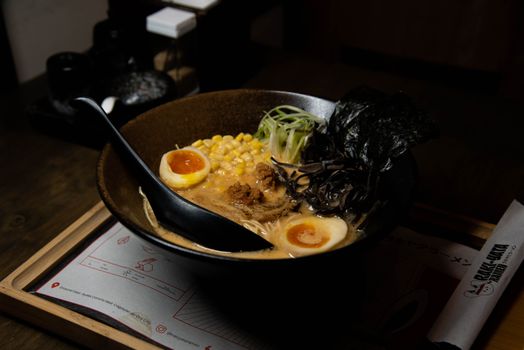
Photo: Christian Dala / Pexels
The diets react (see scores below)
Common Ingredients
- ramen noodles
- red miso
- pork broth
- ground pork
- corn
- scallions
- bean sprouts
- soft-boiled egg
Specific recipes may vary.
Incompatible with 8 of 11 diets
Diet Ratings
Miso Ramen is fundamentally incompatible with ketogenic eating. The primary offender is ramen noodles — wheat-based noodles that deliver roughly 50-60g of net carbs per serving on their own, instantly exceeding the entire daily keto carb budget. Red miso adds additional carbs from fermented soybeans and grains. Corn is a starchy vegetable with significant net carbs (~15-20g per typical serving) that is explicitly off-limits on keto. Together, these three ingredients make this dish impossible to fit within a 20-50g daily net carb limit. The pork broth, ground pork, soft-boiled egg, scallions, and bean sprouts are individually keto-friendly, but they cannot salvage a dish built on a grain-noodle and starch foundation. This is not a portion-control issue — even a half-portion would exceed keto thresholds.
Miso Ramen as described contains multiple animal products that disqualify it entirely from a vegan diet. Pork broth and ground pork are direct meat/animal products, and the soft-boiled egg is an animal-derived ingredient. These are unambiguous violations of vegan principles with no debate within the vegan community.
Miso Ramen is incompatible with the Paleo diet on multiple fronts. Ramen noodles are made from wheat flour, a grain explicitly excluded from Paleo. Red miso is a fermented soybean paste, making it a legume-based product — also strictly excluded. Corn is a grain and likewise forbidden. Bean sprouts, derived from mung beans or soybeans, are legumes and not permitted. The pork broth, ground pork, scallions, and soft-boiled egg are the only Paleo-compliant components. With at least four major non-Paleo ingredients forming the structural and flavor backbone of this dish, there is no meaningful way to consider it Paleo-compatible in its standard form.
Miso Ramen conflicts with Mediterranean diet principles on multiple fronts. The primary protein is ground pork, a red/processed meat that should be limited to only a few times per month. Ramen noodles are refined grains, explicitly discouraged. Pork broth is likely high in sodium and saturated fat. The dish contains no olive oil, the canonical Mediterranean fat source. While some individual ingredients — scallions, bean sprouts, corn, soft-boiled egg — are acceptable or even encouraged, they are minor components in a dish dominated by pork and refined noodles. The overall profile is high in sodium, refined carbohydrates, and saturated fat from pork, placing it firmly in the 'avoid' category.
Miso Ramen is fundamentally incompatible with the carnivore diet. The dish is dominated by plant-based and grain-based ingredients: ramen noodles are wheat-based grains, red miso is a fermented soybean paste (legume), corn is a grain/vegetable, scallions are plant alliums, and bean sprouts are germinated legumes. While pork broth, ground pork, and the soft-boiled egg are carnivore-compatible animal products, they are minor components of a dish whose identity and flavor base are entirely plant-derived. No modification short of completely rebuilding the dish would make it carnivore-appropriate.
Miso Ramen contains multiple excluded ingredients that make it clearly incompatible with Whole30. First, ramen noodles are a grain-based pasta/noodle product — grains (wheat) are excluded, and noodles are also explicitly called out in the 'no recreating' rule. Second, red miso is made from soybeans, which are a legume and explicitly excluded from Whole30. These two violations alone would disqualify the dish, even before considering that corn is also an excluded grain. The remaining ingredients (pork broth, ground pork, scallions, bean sprouts, soft-boiled egg) are individually compliant, but the dish as a whole cannot be made Whole30-compatible without fundamentally changing its identity.
Miso Ramen contains multiple high-FODMAP ingredients that make it unsuitable during the elimination phase. Ramen noodles are wheat-based, making them high in fructans. Red miso (aka miso) is made from fermented soybeans and typically contains significant GOS and fructans — Monash rates miso paste as high-FODMAP even at small servings due to soybean content. Pork broth made with onion or garlic (standard in ramen preparation) would add fructans. Scallions/green onions: the green tops are low-FODMAP, but if the white bulb portions are included, they are high in fructans. Corn is low-FODMAP at a cob or ~38g kernels. Bean sprouts are low-FODMAP at 65g. Soft-boiled egg is low-FODMAP. Ground pork is low-FODMAP. However, the combination of wheat-based ramen noodles and red miso paste alone is sufficient to render this dish high-FODMAP. The dish would need substantial reformulation — gluten-free noodles, low-FODMAP miso alternative or a very small portion of white miso, onion/garlic-free broth — to be considered safe during elimination.
Miso Ramen is fundamentally incompatible with DASH diet principles due to extremely high sodium content. A typical bowl contains 1,500–3,000mg of sodium — potentially exceeding the entire daily sodium budget for both standard DASH (<2,300mg) and low-sodium DASH (<1,500mg) in a single meal. Red miso alone contributes ~600–900mg sodium per tablespoon, and pork broth adds substantial additional sodium. Ground pork contributes saturated fat, and refined ramen noodles lack the fiber of whole grains. While some ingredients (corn, scallions, bean sprouts, soft-boiled egg) are individually DASH-compatible, the overall dish is defined by its sodium load from miso and broth, making it a clear avoid under DASH guidelines.
Miso Ramen presents several Zone challenges but is not categorically off-limits. The primary issue is the ramen noodles — a refined, high-glycemic carbohydrate that Dr. Sears classifies as 'unfavorable.' A standard serving delivers a large carbohydrate block load with minimal fiber, spiking insulin well beyond Zone targets. The ground pork and pork broth add saturated fat that the Zone discourages, particularly compared to leaner proteins like chicken or fish. Corn is also an 'unfavorable' carbohydrate in Zone terminology due to its higher glycemic impact. On the positive side, the dish contains genuinely favorable Zone elements: bean sprouts are an excellent low-glycemic vegetable, scallions are a polyphenol-rich favorable carb, soft-boiled egg contributes lean protein blocks, and miso provides fermented soy protein with anti-inflammatory properties. The overall macronutrient ratio will be heavily carb-skewed (noodles dominate) with insufficient lean protein relative to carb load and likely too much saturated fat. A Zone practitioner could rehabilitate this dish by dramatically reducing noodle portions, substituting shirataki or zucchini noodles, using leaner pork or adding tofu, and increasing the vegetable garnishes — but as typically served, the ratio is far from 40/30/30.
Some Zone practitioners and Sears' later writings on the Mediterranean-Zone approach acknowledge that fermented foods like miso have meaningful anti-inflammatory and polyphenol benefits that may partially offset glycemic concerns. Additionally, ramen broth-based soups have high satiety per calorie, and a small noodle portion paired with egg, sprouts, and scallions could theoretically be block-balanced with careful portioning — making this a 'caution' rather than 'avoid' depending on how it's constructed and portioned.
Miso ramen presents a mixed anti-inflammatory profile. On the positive side, red miso is a fermented whole soy food — explicitly emphasized in anti-inflammatory frameworks (Dr. Weil's pyramid includes fermented soy) — and provides beneficial probiotics, isoflavones, and umami compounds. Scallions, bean sprouts, and corn contribute antioxidants, fiber, and phytonutrients. The soft-boiled egg adds choline and selenium with a mixed but acceptable profile. However, several elements temper the dish's anti-inflammatory credentials: ground pork and pork broth are red/processed meat sources — high in saturated fat and arachidonic acid — which anti-inflammatory guidelines place in the 'limit' category. Ramen noodles are refined carbohydrates with a high glycemic index, offering little fiber or nutrient density, which can promote blood sugar spikes and downstream inflammatory signaling. Sodium content is typically very high in this dish (miso broth + pork broth), and chronic high sodium intake is linked to elevated inflammatory markers. The dish is not built around anti-inflammatory staples, but it's also not a purely pro-inflammatory food — it occupies a genuine middle ground. It could be improved by substituting pork with salmon or tofu, using whole-grain or shirataki noodles, and controlling sodium.
Some anti-inflammatory practitioners, particularly those following autoimmune or low-FODMAP-adjacent protocols, would rate this lower given the pork, refined noodles, and sodium load. Conversely, traditional Japanese dietary patterns — of which miso soup and fermented soy are cornerstones — are associated with reduced chronic disease and inflammatory markers in epidemiological research, suggesting the fermented miso component carries meaningful benefit that partially offsets the pork and refined carbohydrate concerns.
Miso ramen has a mixed nutritional profile for GLP-1 patients. On the positive side, it offers meaningful protein from ground pork, a soft-boiled egg, and miso — a combination that can deliver 20-28g protein per bowl. Bean sprouts and scallions add modest fiber and micronutrients, and the broth-based format is hydrating and relatively easy to digest compared to heavier meals. Miso itself is a fermented food with potential gut health benefits. However, several factors limit its rating: ground pork is a moderately fatty protein source, pork broth is often high in sodium and saturated fat, and ramen noodles are refined carbohydrates with minimal fiber or nutritional density. The sodium load (often 1,500-2,500mg per bowl) is a meaningful concern, as GLP-1 patients eating smaller volumes are still exposed to the full salt content. The combination of fat from pork, refined noodles, and a large broth volume may also challenge slowed gastric emptying and contribute to bloating or nausea. A standard restaurant portion is also large — most GLP-1 patients would realistically consume only a partial serving, which reduces both the protein benefit and the fat/sodium burden. A modified home version with lean ground turkey or chicken, whole wheat or high-protein noodles, reduced-sodium miso, and an extra egg would score considerably higher.
Some GLP-1-focused dietitians view broth-based soups favorably because the high water content supports hydration and the warm liquid format can soothe GI discomfort — factors that make ramen more tolerable than its macros alone suggest. Others emphasize the refined noodles and pork fat as meaningful drawbacks that displace higher-quality protein and fiber opportunities, particularly given the reduced caloric budget on GLP-1 therapy.
*See how scores were generated at our methodology page.
Nutritional profile
Six traits that cut across every diet.
Fiber & Plants
How much whole-plant food and fiber it delivers.
Healthy Fats
The quality of its fats (unsaturated, omega-3).
Whole / Unprocessed
How close it is to its natural, unprocessed form.
Gut Gentle
How easy it is on digestion (low FODMAP, few irritants).
Low Glycemic
How little it spikes your blood sugar.
Protein Density
How much protein it packs per calorie.
Controversy Index
Higher controversy = more disagreement between diets.
Diet-Specific Tips
 Zone — 4/10
View tips
- Ramen noodles are refined, high-glycemic 'unfavorable' carbohydrates that dominate the carb blocks
- Ground pork and pork broth contribute saturated fat, less favorable than lean Zone proteins
- Corn is an unfavorable Zone carbohydrate with higher glycemic index
- Soft-boiled egg provides a favorable, lean protein block contribution
- Bean sprouts and scallions are excellent low-glycemic Zone-favorable vegetables
- Miso offers fermented soy protein and polyphenols with anti-inflammatory value
- As served, macronutrient ratio is heavily carb-skewed, far from 40/30/30
- Dish is rehabilitatable with noodle reduction and protein adjustment but requires significant modification
 Anti-Inflammatory — 4/10
View tips
- Red miso is a fermented whole soy food — anti-inflammatory and probiotic-rich
- Pork (ground + broth) is red meat high in saturated fat and arachidonic acid — flagged as 'limit' by anti-inflammatory guidelines
- Ramen noodles are refined carbohydrates — low fiber, high glycemic, neutral to mildly pro-inflammatory
- Very high sodium content from miso and pork broth — linked to elevated inflammatory markers at excess intake
- Scallions, bean sprouts, and corn contribute antioxidants and phytonutrients
- Egg is acceptable in moderation with a mixed but non-disqualifying inflammatory profile
- Dish lacks omega-3 sources, colorful vegetables, or anti-inflammatory fats (EVOO, avocado)
 GLP-1 Friendly — 5/10
View tips
- Moderate protein from ground pork and soft-boiled egg (~20-28g estimated), but pork is a fatty protein source
- Refined ramen noodles are low in fiber and nutrient-poor — a poor use of limited caloric capacity
- Very high sodium content typical of miso ramen broth may cause water retention and cardiovascular concern
- Broth-based format supports hydration, a genuine benefit for GLP-1 patients with reduced thirst
- Pork fat content may worsen nausea, bloating, or reflux due to slowed gastric emptying
- Standard restaurant portion is large; GLP-1 patients likely eat a partial serving, moderating both risks and benefits
- Miso is fermented and may support gut health, a modest positive
- Corn adds minimal fiber; bean sprouts and scallions add micronutrients but negligible fiber or protein