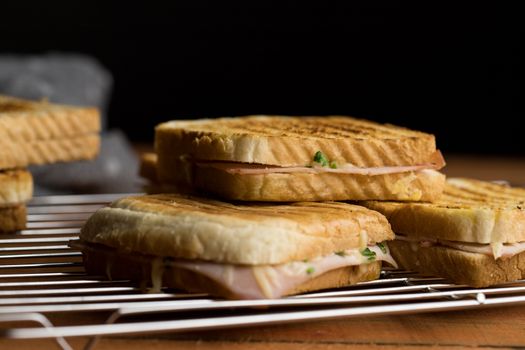
Photo: Mateusz Feliksik / Pexels
American
Monte Cristo Sandwich
The diets react (see scores below)
Common Ingredients
- ham
- turkey
- Swiss cheese
- white bread
- eggs
- milk
- butter
- powdered sugar
Specific recipes may vary.
Incompatible with 11 of 11 diets
Diet Ratings
The Monte Cristo Sandwich is fundamentally incompatible with a ketogenic diet. White bread alone provides roughly 25-30g of net carbs per two slices, and this sandwich typically uses three slices, pushing net carbs well above 40-50g from bread alone. The addition of powdered sugar as a topping adds further simple sugars. White bread is a refined grain — a zero-tolerance item on keto. The ham, turkey, Swiss cheese, eggs, and butter are keto-friendly components, but they are entirely negated by the bread and powdered sugar. There is no portion adjustment that makes this dish compatible; the bread and sugar are structural to the recipe, not optional additions.
The Monte Cristo Sandwich is entirely incompatible with a vegan diet. It contains multiple animal products: ham and turkey (meat/poultry), Swiss cheese (dairy), eggs, milk, and butter (dairy). Every major component of this dish — the protein, the egg-and-milk batter used for dipping, the cheese filling, and the butter for frying — derives from animals. There is no meaningful vegan debate here; this dish is unambiguously non-vegan across all its core ingredients.
The Monte Cristo Sandwich is fundamentally incompatible with the Paleo diet. It contains multiple core non-Paleo ingredients: white bread (a refined grain product), Swiss cheese (dairy), milk (dairy), and powdered sugar (refined sugar). These are not minor additions or debated gray-area items — they are explicitly excluded under Paleo principles. Ham and turkey can be Paleo-compliant in their unprocessed forms, but processed deli meats are typically avoided. Eggs and butter are closer to Paleo (butter is debated), but they cannot offset the foundational violations present in this dish. This sandwich is essentially built around grains, dairy, and refined sugar — three of the primary exclusion categories in Paleo.
The Monte Cristo Sandwich is a poor fit for the Mediterranean diet on multiple fronts. It is built on white bread (refined grain), uses butter as the primary cooking fat instead of olive oil, and is finished with powdered sugar (added sugar). The protein sources — ham and processed deli turkey — are processed meats, which the Mediterranean diet discourages strongly. Swiss cheese adds saturated fat. While eggs and milk are acceptable in moderation, they do not redeem a dish that is fundamentally structured around refined carbohydrates, processed meats, butter, and added sugar. The overall preparation method (deep-fried or pan-fried in butter) further distances it from Mediterranean principles.
The Monte Cristo Sandwich is fundamentally incompatible with the carnivore diet. While it does contain animal-derived ingredients (ham, turkey, Swiss cheese, eggs, milk, butter), the dish is defined by its white bread coating — a grain-based, plant-derived food that is categorically excluded from all tiers of the carnivore diet. Additionally, powdered sugar is a processed plant-derived sweetener, and milk adds a secondary plant-adjacent concern (though dairy itself is debated, it is not the disqualifying factor here). No amount of high-quality animal protein can redeem a dish whose structural foundation is bread and whose finishing touch is sugar. This is a classic processed, mixed dish that violates the core carnivore principle of eating exclusively animal products.
The Monte Cristo Sandwich contains multiple excluded ingredients and also violates the 'no recreating baked goods/junk food' rule. White bread is a grain product (wheat), which is explicitly excluded. Swiss cheese is dairy, also excluded. Milk is dairy, excluded. Butter (regular, not ghee) is dairy, excluded. Powdered sugar is added sugar, excluded. Additionally, even if somehow all ingredients were made compliant, a sandwich is structurally a bread-based item that falls squarely into the excluded 'bread, wraps, tortillas' category under Rule 4. This dish fails on nearly every Whole30 dimension.
The Monte Cristo Sandwich contains multiple high-FODMAP ingredients that make it incompatible with the elimination phase. White bread made from wheat is high in fructans — a primary FODMAP trigger — and a standard sandwich uses 2 slices, well above any safe threshold. Swiss cheese is generally low-FODMAP as an aged hard cheese with minimal lactose, but the egg wash uses milk, which contains lactose and is high-FODMAP at the quantities used for dipping and coating. Ham and turkey are naturally FODMAP-free proteins, but they cannot offset the fructan load from the wheat bread. The powdered sugar topping is low-FODMAP on its own. Overall, the wheat bread alone makes this dish a clear avoid during the elimination phase.
The Monte Cristo Sandwich is highly problematic for the DASH diet on multiple fronts. Ham is a processed, cured meat that is very high in sodium — a single serving can contain 700–1,000mg of sodium, already approaching or exceeding the entire daily target for low-sodium DASH. Swiss cheese adds additional sodium and saturated fat. White bread is a refined grain with minimal fiber, directly contrary to DASH's emphasis on whole grains. Butter used for frying contributes saturated fat, which DASH explicitly limits. Powdered sugar on top adds unnecessary added sugar, another category DASH discourages. The egg-and-milk batter, while not inherently anti-DASH, cannot offset the compounding negatives. This dish is essentially a deep-fried or pan-fried processed meat sandwich coated in sugar — nearly every component conflicts with DASH principles. The combination of high sodium from processed meats and cheese, saturated fat from butter and cheese, refined carbohydrates from white bread, and added sugar from powdered sugar places this firmly in the 'avoid' category.
The Monte Cristo Sandwich is a near-perfect storm of Zone-unfavorable elements stacked together. White bread is a high-glycemic carbohydrate that Dr. Sears explicitly categorizes as unfavorable, causing rapid insulin spikes. The egg-and-milk batter used for deep-frying or pan-frying adds additional high-GI carbs and saturated fat from butter. The powdered sugar dusting — a defining feature of the dish — is essentially pure sugar, which Sears would categorize as a hard avoid. The fat profile is dominated by saturated fat from butter and Swiss cheese rather than the preferred monounsaturated fats. While ham and turkey provide legitimate lean protein blocks, they are overwhelmed by the surrounding ingredients. The 40/30/30 macro balance is severely distorted: carbohydrate calories skew high-glycemic, fat calories skew saturated, and the protein-to-carb ratio is badly misaligned. Even with careful portioning, the signature preparation method (battered, fried, dusted with powdered sugar) cannot be modified into a Zone-compatible format without ceasing to be a Monte Cristo. This is one of the rare combination foods where the structural identity of the dish is fundamentally incompatible with Zone principles.
The Monte Cristo sandwich is a poor fit for an anti-inflammatory diet across nearly every ingredient. White bread is a refined carbohydrate with a high glycemic index, spiking blood sugar and promoting inflammatory markers like CRP and IL-6. Butter is a saturated fat source that the anti-inflammatory framework consistently recommends limiting, and here it is used generously for pan-frying or deep-frying the sandwich. Swiss cheese, while lower in fat than some cheeses, still contributes saturated fat and falls into the 'limit' category as full-fat dairy. Ham is a processed red meat product — processed meats are consistently flagged as pro-inflammatory due to nitrates, sodium, and saturated fat content. Turkey is the most neutral ingredient, qualifying as lean poultry in the moderate category. The egg-and-milk batter itself is not severely problematic, but in this context it adds to a saturated-fat-heavy profile. The powdered sugar finish adds refined sugar with zero nutritional benefit, further promoting the inflammatory cascade. There are no anti-inflammatory positives in this dish — no omega-3s, no significant antioxidants, no fiber, no beneficial polyphenols. The preparation method (pan-frying in butter) amplifies the inflammatory load. This dish represents a convergence of multiple 'limit' and 'avoid' category ingredients with no offsetting benefits.
The Monte Cristo sandwich is a poor fit for GLP-1 patients on nearly every key criterion. It is made with white bread (refined grains, low fiber, low nutrient density), battered in an egg-and-milk mixture and pan-fried in butter (high fat, greasy, difficult to digest), loaded with Swiss cheese (adds significant saturated fat), and finished with powdered sugar (added sugar, empty calories). The slow gastric emptying caused by GLP-1 medications makes high-fat, greasy, fried-style foods especially problematic — they sit in the stomach much longer, significantly worsening nausea, bloating, and reflux. While ham and turkey do contribute some protein, the overall protein density per calorie is low given the fat and refined carbohydrate load. The added sugar topping provides zero nutritional value. This dish fails on fat content, digestibility, nutrient density, refined carbohydrates, and added sugar simultaneously — a rare combination of nearly all the major GLP-1 dietary red flags in a single meal.
*See how scores were generated at our methodology page.
Nutritional profile
Six traits that cut across every diet.
Fiber & Plants
How much whole-plant food and fiber it delivers.
Healthy Fats
The quality of its fats (unsaturated, omega-3).
Whole / Unprocessed
How close it is to its natural, unprocessed form.
Gut Gentle
How easy it is on digestion (low FODMAP, few irritants).
Low Glycemic
How little it spikes your blood sugar.
Protein Density
How much protein it packs per calorie.
Controversy Index
Higher controversy = more disagreement between diets.