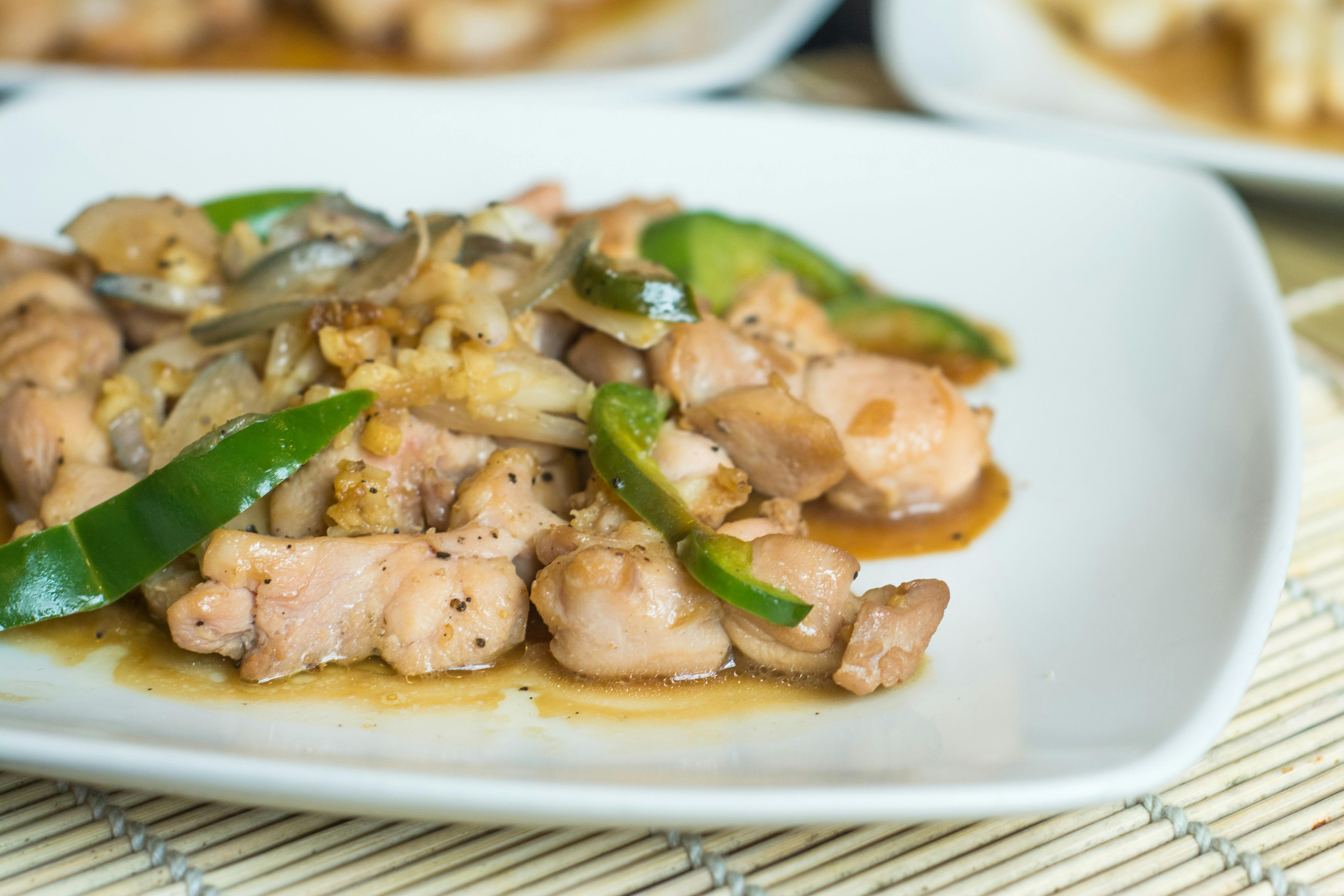
Photo: Marvin Sacdalan / Pexels
Chinese
Moo Goo Gai Pan
The diets react (see scores below)
Common Ingredients
- chicken breast
- button mushrooms
- snow peas
- water chestnuts
- bamboo shoots
- chicken broth
- cornstarch
- ginger
Specific recipes may vary.
Incompatible with 5 of 11 diets
Diet Ratings
Moo Goo Gai Pan has several keto-friendly components (chicken breast, mushrooms, ginger, chicken broth) but contains multiple problematic ingredients. Water chestnuts are notably high in net carbs (~14g per 100g), snow peas add moderate carbs (~5-6g net per 100g), and bamboo shoots are relatively benign (~3g net per 100g). Most critically, cornstarch is a thickening agent that is pure starch and directly spikes blood sugar — a standard serving can add 5-10g of net carbs from cornstarch alone. The dish is also notably low in fat, relying on lean chicken breast, making it poorly aligned with keto's 70-80% fat macro target. With modifications (substituting xanthan gum for cornstarch, omitting water chestnuts, reducing snow peas), a keto-compatible version is achievable, but the standard restaurant preparation presents real challenges for maintaining ketosis.
Some lazy keto or flexible keto practitioners may consider a small portion acceptable, arguing that the total carb load from a modest restaurant serving could fit within a 50g daily limit if the rest of the day's intake is very low-carb. Strict keto adherents, however, would flag cornstarch and water chestnuts as deal-breakers regardless of portion size.
Moo Goo Gai Pan contains multiple animal-derived ingredients that disqualify it from any vegan diet. Chicken breast is poultry (a direct animal product), and chicken broth is also derived from animal flesh and bones. These are unambiguous animal ingredients with no debate within vegan discourse. The vegetable components — button mushrooms, snow peas, water chestnuts, bamboo shoots, ginger — are all fully plant-based, but their presence does not offset the core animal proteins and stock.
Moo Goo Gai Pan contains two clear paleo violations. Cornstarch is a processed grain-derived thickener extracted from corn, which is explicitly excluded from the paleo diet. Snow peas are legumes and are also excluded under strict paleo rules. The remaining ingredients — chicken breast, button mushrooms, water chestnuts, bamboo shoots, ginger, and chicken broth — are largely paleo-compatible, but the presence of cornstarch and snow peas disqualifies the dish as traditionally prepared. A paleo adaptation would need to substitute arrowroot or tapioca for cornstarch and remove the snow peas entirely.
Moo Goo Gai Pan is a vegetable-forward dish with lean chicken breast and an array of non-starchy vegetables (mushrooms, snow peas, water chestnuts, bamboo shoots), which align well with Mediterranean diet principles emphasizing plant diversity and lean protein. Chicken is an acceptable moderate protein source. However, it deviates from Mediterranean patterns in a few ways: it uses no olive oil (typically sesame or neutral oil in Chinese cooking), relies on cornstarch as a thickener (a refined carbohydrate), and is not part of traditional Mediterranean cuisine. The overall dish is light and nutritious, but it lacks the core Mediterranean fat source and culinary context.
Some modern Mediterranean diet practitioners take a broader 'spirit of the diet' approach, emphasizing the vegetable-rich, low-saturated-fat profile of dishes like this one regardless of geographic origin. From this perspective, swapping in olive oil and reducing cornstarch could easily bring this dish into full alignment.
Moo Goo Gai Pan is fundamentally incompatible with the carnivore diet. While it contains chicken and chicken broth (both acceptable), the dish is dominated by plant-based ingredients: button mushrooms, snow peas, water chestnuts, bamboo shoots, ginger, and cornstarch (a grain-derived starch used as thickener). The majority of the dish's volume and flavor profile comes from vegetables and plant-derived thickeners, making this a clear avoid. Even the chicken breast used is a lean cut, which is lower on the carnivore preference scale compared to fatty ruminant cuts. No meaningful adaptation could make this dish carnivore-compliant without stripping out most of its defining ingredients.
Moo Goo Gai Pan as listed contains cornstarch, which is explicitly excluded on the Whole30 program. Cornstarch is a prohibited ingredient regardless of quantity. All other ingredients — chicken breast, button mushrooms, snow peas (explicitly allowed despite being a legume-adjacent vegetable), water chestnuts, bamboo shoots, chicken broth, and ginger — are fully compliant. However, the presence of cornstarch as a thickener disqualifies the dish as written. A compliant version could substitute arrowroot powder or simply omit the thickener, but as listed this dish cannot be approved.
Moo Goo Gai Pan is mostly low-FODMAP in its core ingredients, but button mushrooms are a significant concern. Button mushrooms (Agaricus bisporus) are high in polyols (mannitol) and are rated high-FODMAP by Monash University even at small servings (75g or roughly 1 cup raw). This is a primary ingredient in the dish, making it problematic during strict elimination. The remaining ingredients are largely safe: chicken breast is low-FODMAP, cornstarch is low-FODMAP, ginger is low-FODMAP at standard culinary amounts, snow peas are low-FODMAP at up to 5 pods, and bamboo shoots and water chestnuts are low-FODMAP at standard servings. Chicken broth needs to be verified as onion/garlic-free (commercial broths commonly contain these high-FODMAP ingredients). Without mushrooms and with a certified low-FODMAP or homemade broth, this dish would be approvable. As typically prepared with mushrooms, caution is warranted.
Monash University rates button mushrooms as high-FODMAP due to mannitol at typical serving sizes, and most clinical FODMAP practitioners would advise removing them entirely during elimination. However, some practitioners note that if mushrooms are used in very small amounts as a minor flavoring rather than a bulk ingredient, individual tolerance may vary — though this approach is not consistent with strict Monash elimination protocol.
Moo Goo Gai Pan as listed contains several DASH-friendly ingredients: lean chicken breast (excellent lean protein), button mushrooms, snow peas, water chestnuts, bamboo shoots (fiber-rich vegetables), and ginger. These core components align well with DASH principles. However, the dish as commonly prepared in restaurants typically includes soy sauce or oyster sauce (which can add 600-1,200mg+ sodium per serving), and even the chicken broth used at home or in restaurants contributes meaningful sodium. The listed ingredients omit soy sauce, but real-world preparation almost universally includes it, making the as-consumed version a sodium concern. Cornstarch is neutral but signals a sauce-thickened dish. At home with low-sodium broth and minimal or low-sodium soy sauce, this dish could score 7-8 and approach 'approve' territory. Restaurant versions are likely too high in sodium for DASH compliance.
NIH DASH guidelines would flag typical restaurant Moo Goo Gai Pan due to high sodium from soy-based sauces and salted broth. However, updated clinical interpretations note that the ingredient profile (lean poultry, non-starchy vegetables) is exemplary for DASH, and some DASH-oriented dietitians approve this dish when prepared at home with low-sodium broth and reduced-sodium soy sauce or coconut aminos.
Moo Goo Gai Pan is an excellent Zone Diet-compatible dish. The primary protein is chicken breast — one of the leanest, most favorable Zone proteins. The vegetable mix (button mushrooms, snow peas, bamboo shoots, water chestnuts) consists almost entirely of low-glycemic, high-fiber vegetables that are ideal Zone carbohydrate sources. The only mild concern is cornstarch, used as a thickener, which is a high-glycemic starch — however, the quantity used in a typical preparation is small (1-2 teaspoons distributed across multiple servings), contributing minimal net carbs per portion. Ginger and chicken broth add flavor without meaningfully altering the macro profile. The dish is naturally low in fat, which means a small addition of a monounsaturated fat source (e.g., a teaspoon of sesame oil or a few almonds on the side) would help complete the Zone 40/30/30 ratio. Overall, this dish maps cleanly onto Zone block structure: lean protein blocks from chicken, favorable carb blocks from the low-GI vegetables, with only minor adjustments needed for fat balance.
Moo Goo Gai Pan is a relatively clean, vegetable-forward Chinese dish with a favorable anti-inflammatory profile. Chicken breast is lean white meat, acceptable under moderate guidelines. The vegetable base — snow peas, water chestnuts, bamboo shoots — provides fiber, antioxidants, and micronutrients. Ginger is a well-documented anti-inflammatory spice with gingerol compounds that inhibit COX-2 pathways. Button mushrooms, while not as potent as Asian medicinal varieties (shiitake, maitake, lion's mane), still contain beta-glucans and ergothioneine with modest anti-inflammatory properties. Cornstarch is a minor concern as a refined carbohydrate used as a thickener, but in typical cooking quantities it contributes negligibly. The dish is traditionally prepared with minimal oil and no heavy sauces, though restaurant versions may add soy sauce (sodium concerns) or oyster sauce. Home preparation with light broth-based sauce, minimal refined starch, and extra virgin olive oil or avocado oil would push this higher. The absence of red meat, processed ingredients, trans fats, and added sugars is a notable positive.
The confidence is medium primarily due to preparation variability. Restaurant versions often use seed oils (soybean or corn oil) for stir-frying — oils that most anti-inflammatory protocols flag for high omega-6 content and oxidation potential at high heat, even though mainstream nutrition science (AHA) considers them acceptable. Additionally, cornstarch and any added sugar in the sauce represent minor refined carbohydrate inputs that stricter anti-inflammatory practitioners (e.g., AIP or Weil guidelines emphasizing whole foods) would flag.
Moo Goo Gai Pan is an excellent GLP-1-friendly dish. Chicken breast is a lean, high-protein primary ingredient that supports muscle preservation during weight loss. The vegetable base — mushrooms, snow peas, water chestnuts, and bamboo shoots — provides meaningful fiber, micronutrients, and high water content, all critical for GLP-1 patients. The broth-based sauce is low in fat and easy to digest. Cornstarch is used in small amounts as a thickener and poses minimal concern at typical serving quantities. Ginger may actually help with GLP-1-associated nausea. The dish is naturally low in saturated fat, avoids frying, and is portion-friendly. The main limitation is that cornstarch adds refined carbohydrates with minimal nutritional value, and restaurant versions may use more sodium or oil than a home-prepared version.
*See how scores were generated at our methodology page.
Nutritional profile
Six traits that cut across every diet.
Fiber & Plants
How much whole-plant food and fiber it delivers.
Healthy Fats
The quality of its fats (unsaturated, omega-3).
Whole / Unprocessed
How close it is to its natural, unprocessed form.
Gut Gentle
How easy it is on digestion (low FODMAP, few irritants).
Low Glycemic
How little it spikes your blood sugar.
Protein Density
How much protein it packs per calorie.
Controversy Index
Higher controversy = more disagreement between diets.
Diet-Specific Tips
 Keto — 4/10
View tips
- Cornstarch thickener adds significant net carbs and is pure starch — a primary concern
- Water chestnuts are high net-carb (~14g/100g) and should be avoided
- Snow peas contribute moderate carbs and require strict portion control
- Lean chicken breast provides protein but virtually no fat, misaligning with keto macros
- Bamboo shoots and mushrooms are relatively keto-friendly
- Dish can be modified (xanthan gum, omit water chestnuts) for a keto-compliant version
 Mediterranean — 6/10
View tips
- Lean chicken breast is an acceptable moderate protein (poultry category)
- Abundant non-starchy vegetables align strongly with Mediterranean plant emphasis
- No olive oil used — primary fat source is absent or replaced
- Cornstarch is a refined grain thickener, minimally processed but not whole grain
- No added sugars, minimal sodium if low-sodium broth is used
- Not a traditional Mediterranean dish — cultural context is Chinese
- Overall low in saturated fat and calories, consistent with Mediterranean health goals
 DASH — 6/10
View tips
- Lean chicken breast is an ideal DASH protein source
- Snow peas, mushrooms, water chestnuts, and bamboo shoots provide fiber, potassium, and magnesium
- Restaurant preparation typically adds high-sodium soy sauce and salted broth, potentially exceeding DASH sodium limits
- Homemade version with low-sodium broth and reduced-sodium soy sauce would be DASH-compliant
- No saturated fat, added sugar, or refined grains in the listed ingredients
- Cornstarch in moderate amounts is acceptable but adds minimal nutritional value
 Zone — 8/10
View tips
- Chicken breast is a top-tier Zone protein — lean, easily portioned to 25g per meal
- Mushrooms, snow peas, bamboo shoots, and water chestnuts are all low-glycemic, favorable Zone carbohydrates
- Cornstarch is technically a high-glycemic ingredient but used in trace amounts as a thickener — minimal glycemic impact per serving
- Dish is naturally low in fat; requires addition of monounsaturated fat (e.g., olive oil, avocado, almonds) to complete Zone ratio
- No sugar, heavy sauces, or refined grains — typical restaurant versions may add soy sauce sodium but this does not affect Zone macro balance
- Ginger provides anti-inflammatory polyphenols, aligning with Sears' broader anti-inflammatory protocol
 Anti-Inflammatory — 7/10
View tips
- Lean chicken breast — acceptable moderate protein under anti-inflammatory guidelines
- Ginger — well-established anti-inflammatory spice (gingerols inhibit COX-2)
- Snow peas and bamboo shoots — fiber-rich vegetables with antioxidant content
- Button mushrooms — modest beta-glucan and ergothioneine content; not as potent as Asian medicinal mushrooms
- Cornstarch — refined carbohydrate, minor concern in small thickening quantities
- No red meat, trans fats, added sugar, or processed ingredients
- Preparation method matters — seed oil stir-fry vs. broth-based cooking significantly affects profile
- Restaurant versions may include sodium-heavy sauces (soy, oyster) which are not ideal but not strictly pro-inflammatory
 GLP-1 Friendly — 8/10
View tips
- Lean chicken breast provides high-quality protein with minimal saturated fat
- Broth-based sauce is low fat and supports easy digestibility
- Diverse vegetable mix contributes fiber and high water content
- Ginger may have antiemetic benefits relevant to GLP-1 nausea
- Cornstarch adds minor refined carbohydrate load — minimal concern at typical amounts
- Restaurant versions may contain excess sodium or added oil — home preparation preferred
- No fried, spicy, carbonated, or high-sugar components