Photo: Kleine Beyers / Pexels
Chinese
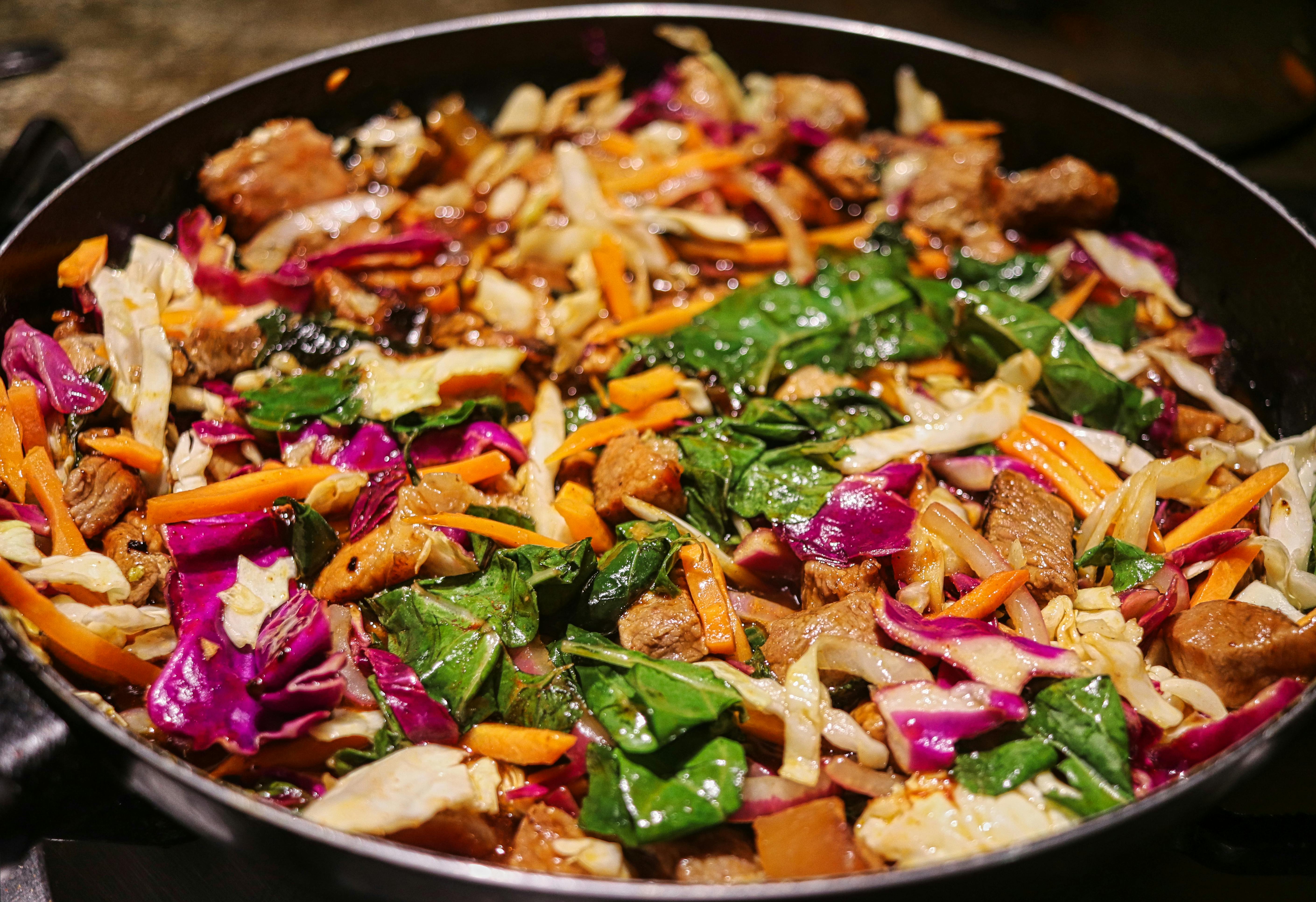
Moo Shu Pork
The diets react (see scores below)
Common Ingredients
- pork loin
- Napa cabbage
- wood-ear mushrooms
- eggs
- mandarin pancakes
- hoisin sauce
- scallions
- soy sauce
Specific recipes may vary.
Incompatible with 7 of 11 diets
Diet Ratings
Moo Shu Pork as traditionally prepared is incompatible with a ketogenic diet primarily due to two major offenders: mandarin pancakes (thin wheat-flour crepes) and hoisin sauce. The mandarin pancakes are made from refined wheat flour and are high in net carbs — typically 2-3 pancakes add 30-45g of net carbs alone, nearly or fully exhausting the daily keto limit. Hoisin sauce compounds the problem significantly, as it is loaded with sugar and starch, contributing another 8-12g of net carbs per tablespoon. The underlying filling ingredients — pork loin, eggs, Napa cabbage, wood-ear mushrooms, scallions, and soy sauce — are mostly keto-friendly or low-carb in modest portions, but the dish cannot be evaluated without its defining components. Wood-ear mushrooms are slightly higher in carbs than many mushrooms but manageable in small amounts. As traditionally served, this dish is a clear keto violation.
Moo Shu Pork contains multiple animal-derived ingredients that are strictly excluded from a vegan diet. Pork loin is a direct animal flesh product, and eggs are an animal product. Both are unambiguous violations of vegan principles. There is no meaningful debate within the vegan community about either ingredient. The remaining components — Napa cabbage, wood-ear mushrooms, mandarin pancakes (typically flour and water), hoisin sauce, scallions, and soy sauce — are generally plant-based, but the dish as traditionally prepared cannot be made compliant without fundamentally replacing its primary protein and egg components.
Moo Shu Pork contains multiple non-paleo ingredients that make it clearly incompatible with the Paleolithic diet. The mandarin pancakes are made from wheat flour — a grain explicitly excluded from paleo. Hoisin sauce is a processed condiment containing soy (a legume), sugar, and often wheat. Soy sauce is derived from fermented soybeans and wheat, violating both the legume and grain exclusions. While pork loin, Napa cabbage, wood-ear mushrooms, eggs, and scallions are all paleo-approved ingredients, the dish as traditionally prepared cannot be considered paleo due to these foundational violations. The core structure of the dish — wrapping in wheat pancakes with a soy-based sauce — is fundamentally incompatible with paleo principles.
Moo Shu Pork conflicts with Mediterranean diet principles on multiple fronts. Pork loin is a red meat, which the Mediterranean diet restricts to a few times per month. The mandarin pancakes are made from refined white flour, contradicting the emphasis on whole grains. Hoisin sauce is a processed condiment high in added sugars and sodium. Soy sauce adds significant sodium load. The dish is not built on olive oil as the primary fat, uses no legumes, and the overall composition is not plant-forward despite the presence of cabbage, mushrooms, and scallions. While those vegetables are positive elements, they play a secondary role in a dish dominated by problematic components.
Moo Shu Pork is fundamentally incompatible with the carnivore diet. While pork loin and eggs are carnivore-approved ingredients, the dish is overwhelmingly plant-based and grain-based in its composition. Napa cabbage and scallions are vegetables, wood-ear mushrooms are fungi, and mandarin pancakes are wheat-flour wraps — all strictly excluded plant foods. Hoisin sauce is a heavily processed condiment made from soybeans, sugar, and various plant-derived ingredients, and soy sauce is a fermented soy and wheat product. This dish is essentially a vehicle for plant foods with only minor animal components, making it a clear avoid with high confidence across all carnivore frameworks.
Moo Shu Pork contains multiple Whole30-excluded ingredients. Mandarin pancakes are grain-based wraps, which are explicitly excluded both as a grain product and as a 'wrap/tortilla' recreation of junk food. Soy sauce contains soy (a legume) and typically wheat (a grain), both excluded. Hoisin sauce contains soy, sugar, and often other non-compliant ingredients. These are not incidental or trace exclusions — they are core, structural components of the dish. The pork, cabbage, mushrooms, eggs, and scallions are individually compliant, but the dish as traditionally prepared cannot be considered Whole30-compatible.
Moo Shu Pork contains multiple high-FODMAP ingredients that make it unsuitable during the elimination phase. Mandarin pancakes are made from wheat flour, which is high in fructans — a primary FODMAP concern. Hoisin sauce typically contains wheat, garlic, and often onion, making it a concentrated source of fructans. Scallions (green onion bulbs/white parts) are high in fructans, though the green tops alone are low-FODMAP. Wood-ear mushrooms are high in polyols (mannitol) per Monash University testing. The combination of wheat-based pancakes, hoisin sauce, and mushrooms makes this dish very difficult to render low-FODMAP without fundamental recipe changes. Pork loin, eggs, Napa cabbage (in moderate servings), and soy sauce are generally low-FODMAP, but the problematic ingredients are core to the dish's identity and not easily omitted.
Moo Shu Pork presents a mixed DASH profile. On the positive side, pork loin is a lean protein acceptable in DASH, and the vegetables — Napa cabbage, wood-ear mushrooms, and scallions — are DASH-friendly, providing fiber and micronutrients. Eggs are acceptable in moderation. However, the dish is significantly compromised by its sodium load: soy sauce is one of the highest-sodium condiments used in cooking (one tablespoon contains ~900mg sodium), and hoisin sauce adds additional sodium plus added sugars. Together these easily push a single serving well above DASH sodium thresholds. The refined-flour mandarin pancakes are not whole grain. As commonly prepared in restaurants, this dish likely exceeds 1,000–1,500mg sodium per serving, which conflicts directly with DASH's core sodium limitation of <2,300mg/day (standard) or <1,500mg/day (low-sodium). With home preparation using low-sodium soy sauce, reduced hoisin, and portion control, the score could rise into the caution-to-approve range.
Moo Shu Pork is a mixed Zone dish. On the positive side, pork loin is a relatively lean protein, eggs add additional lean protein, and Napa cabbage, scallions, and wood-ear mushrooms are excellent low-glycemic Zone-favorable vegetables rich in polyphenols and fiber. These components align well with Zone principles. The problematic elements are the mandarin pancakes (thin wheat flour wrappers that are high-glycemic refined carbohydrates, unfavorable in Zone terminology) and hoisin sauce (high in sugar, contributing significant glycemic load). The soy sauce is relatively benign in small amounts. As traditionally prepared and served, the dish tips toward an unfavorable carb profile due to the pancakes and hoisin. However, with modification — reducing or eliminating the pancakes, using hoisin sparingly, and increasing the vegetable-to-wrapper ratio — the filling itself can be a solid Zone component. The protein and vegetable base is Zone-friendly; the delivery vehicle and sauce are not.
Some Zone practitioners would score this higher (6-7) by noting that the pancakes can be portioned as controlled carb blocks (1-2 small pancakes) and hoisin sauce used in teaspoon-level amounts as a condiment, making the overall dish workable within Zone block math. Others would score it lower (3-4) citing that in real restaurant servings, the ratio of high-glycemic pancake carbs to protein is typically far out of Zone balance and the dish is rarely eaten in modified form.
Moo Shu Pork presents a mixed anti-inflammatory profile. On the positive side, Napa cabbage is a cruciferous vegetable with anti-inflammatory glucosinolates; wood-ear mushrooms are a beneficial fungus with documented immunomodulatory and anti-inflammatory properties; scallions contribute quercetin and other polyphenols; and eggs provide choline and selenium. Pork loin is a relatively lean cut, placing it closer to the 'moderate' category than fatty red meats. However, several components pull the dish in a pro-inflammatory direction. Mandarin pancakes are refined white flour wraps — essentially refined carbohydrates — which the anti-inflammatory framework consistently cautions against. Hoisin sauce is a processed condiment typically high in added sugar and sodium, with possible artificial additives depending on the brand. Soy sauce, while fermented, is high in sodium; some anti-inflammatory authorities flag excessive sodium as contributing to inflammatory states. The overall dish is not overtly harmful — the vegetable and mushroom content offer real benefits — but the refined pancakes and processed hoisin sauce prevent a higher rating. Modifications like using whole grain wrappers, limiting hoisin, or choosing a low-sodium tamari could meaningfully improve the profile.
Some anti-inflammatory practitioners, particularly those following stricter protocols like AIP or those who emphasize glycemic control, would rate this lower due to the refined flour pancakes and high-sugar hoisin sauce driving blood sugar spikes and AGE formation. Conversely, a more permissive reading of Dr. Weil's framework — which allows moderate lean protein, eggs, and occasional whole soy condiments — would accept this dish as a reasonable occasional choice given its vegetable and mushroom content.
Moo Shu Pork has a mixed nutritional profile for GLP-1 patients. On the positive side, pork loin is a relatively lean protein source, eggs add additional protein and nutrients, and Napa cabbage and wood-ear mushrooms contribute fiber, micronutrients, and high water content. The dish can deliver a reasonable protein hit (15-20g) in a modest serving. However, the mandarin pancakes are refined-grain wrappers that add low-nutrient carbohydrates and make portion control harder, and hoisin sauce is high in sugar and sodium. The dish as traditionally prepared is not fried, which helps digestibility, but restaurant versions often use more oil than home-prepared versions and may include fattier pork cuts. The hoisin sauce specifically is a concern — it adds significant sugar with minimal nutritional value, which is counterproductive given the limited caloric budget of GLP-1 patients. A modified home version (extra pork loin, minimal hoisin, skipping or halving the pancakes) would rate higher, but the standard restaurant preparation warrants caution.
Some GLP-1-focused dietitians would rate this more favorably, noting that pork loin is one of the leaner pork preparations, the vegetable-to-protein ratio is solid, and the overall fat content is lower than many Chinese restaurant dishes. Others would rate it lower, emphasizing that the refined pancakes and sugar-heavy hoisin sauce represent empty calories that crowd out nutrient-dense options in a reduced-appetite context.
*See how scores were generated at our methodology page.
Nutritional profile
Six traits that cut across every diet.
Fiber & Plants
How much whole-plant food and fiber it delivers.
Healthy Fats
The quality of its fats (unsaturated, omega-3).
Whole / Unprocessed
How close it is to its natural, unprocessed form.
Gut Gentle
How easy it is on digestion (low FODMAP, few irritants).
Low Glycemic
How little it spikes your blood sugar.
Protein Density
How much protein it packs per calorie.
Controversy Index
Higher controversy = more disagreement between diets.
Diet-Specific Tips
 DASH — 4/10
View tips
- High sodium from soy sauce (~900mg per tablespoon) directly conflicts with DASH sodium limits
- Hoisin sauce adds additional sodium and added sugars
- Refined-flour mandarin pancakes are not whole grain as DASH recommends
- Pork loin is a lean protein consistent with DASH guidelines
- Napa cabbage, mushrooms, and scallions are DASH-approved vegetables
- Eggs are acceptable in moderation under current DASH interpretations
- Low-sodium soy sauce substitution would meaningfully improve DASH compatibility
- Restaurant portions likely exceed single-serving sodium guidelines significantly
 Zone — 5/10
View tips
- Pork loin is a lean, Zone-favorable protein source
- Napa cabbage and wood-ear mushrooms are excellent low-glycemic Zone vegetables
- Eggs contribute additional lean protein blocks
- Mandarin pancakes are refined wheat flour, high-glycemic, and unfavorable in Zone
- Hoisin sauce is high in sugar, adding significant glycemic load
- As traditionally served, carb-to-protein ratio skews high due to pancakes
- Filling alone (without pancakes, minimal hoisin) would score significantly higher
- Omega-6 concerns if cooked in seed oils, common in Chinese restaurant preparation
 Anti-Inflammatory — 5/10
View tips
- Pork loin is a lean cut, acceptable in moderation under anti-inflammatory guidelines
- Wood-ear mushrooms provide documented anti-inflammatory and immunomodulatory benefits
- Napa cabbage contributes cruciferous anti-inflammatory compounds and fiber
- Mandarin pancakes are refined carbohydrates — a consistent caution point in anti-inflammatory eating
- Hoisin sauce is high in added sugar and processed additives, a meaningful negative
- Scallions and eggs add modest positive nutritional value (quercetin, choline)
- High sodium from soy sauce is a secondary concern
 GLP-1 Friendly — 5/10
View tips
- Pork loin is a lean protein source, supporting muscle preservation
- Eggs add high-quality protein and improve overall protein density
- Napa cabbage and wood-ear mushrooms provide fiber and high water content
- Mandarin pancakes are refined grains — low fiber, low protein, low nutrient density
- Hoisin sauce is high in sugar and sodium — counterproductive for limited caloric budget
- Not a fried dish — easier to digest than many Chinese restaurant options
- Restaurant versions likely use excess oil and may substitute fattier pork cuts
- Portion-sensitive: skipping or limiting pancakes significantly improves the nutritional profile