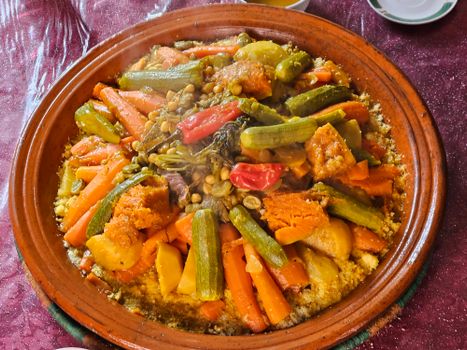
Photo: abdellatif jellab / Pexels
African
Moroccan Couscous with Vegetables
The diets react (see scores below)
Common Ingredients
- couscous
- carrots
- turnips
- zucchini
- chickpeas
- cabbage
- onion
- ras el hanout
Specific recipes may vary.
Incompatible with 5 of 11 diets
Diet Ratings
Moroccan Couscous with Vegetables is fundamentally incompatible with a ketogenic diet. Couscous is a refined grain (semolina wheat) and the single largest ingredient, delivering approximately 35g of net carbs per 100g cooked — far exceeding the entire daily keto carb budget in a single serving. Chickpeas compound the problem, adding another 20-25g net carbs per half-cup serving. Carrots and onions also contribute meaningful carbs. There is no redeeming fat content or macronutrient profile here; this dish is carbohydrate-dominant by design, with virtually zero fat and no primary protein source. Even a small portion would likely breach ketosis thresholds.
Moroccan couscous with vegetables is an entirely plant-based dish. Every ingredient — couscous (semolina wheat), carrots, turnips, zucchini, chickpeas, cabbage, onion, and ras el hanout (a spice blend of plant-origin spices) — is derived exclusively from plants. Chickpeas provide a solid protein and fiber contribution, making this nutritionally well-rounded. The dish is minimally processed whole food in character, relying on legumes, vegetables, and a whole grain as its base. Ras el hanout typically contains spices such as cumin, coriander, cinnamon, ginger, turmeric, and pepper — all plant-derived. The traditional Moroccan preparation sometimes includes meat or butter, but as listed here with no animal ingredients, this version is fully vegan-compliant. A high score of 9 is warranted given the whole-food, nutrient-dense profile.
Moroccan Couscous with Vegetables contains two major paleo-excluded food groups that are non-negotiable in virtually all paleo frameworks. Couscous is a processed wheat-derived grain — one of the clearest 'avoid' foods in paleo. Chickpeas are a legume, equally prohibited due to their lectin and phytate content and their absence from a hunter-gatherer diet. These two ingredients alone disqualify the dish entirely, regardless of the paleo-friendly vegetables (carrots, zucchini, turnips, cabbage, onion) and spice blend (ras el hanout) also present. There is no version of mainstream paleo that accommodates wheat grains or legumes.
Moroccan couscous with vegetables is a nutrient-rich, plant-forward dish featuring an abundance of vegetables (carrots, turnips, zucchini, cabbage, onion) and legumes (chickpeas), all highly consistent with Mediterranean diet principles. The ras el hanout spice blend aligns well with the diet's emphasis on herbs and spices. The main caveat is the couscous itself: while made from semolina (durum wheat) and traditional to North African Mediterranean cuisine, it is a refined grain rather than a whole grain. Modern Mediterranean diet guidelines prefer whole grains (e.g., whole wheat couscous or farro), though traditional practice embraces regular couscous. The chickpeas add excellent plant-based protein and fiber, partially offsetting the refined grain concern.
Traditional North African and Levantine Mediterranean diets have long included refined semolina couscous as a staple without concern; some Mediterranean diet researchers (e.g., those following the original Ancel Keys framework) accept regional grain traditions, meaning this dish could be scored higher as a culturally authentic Mediterranean preparation. Modern clinical guidelines, however, consistently recommend replacing refined grains with whole grain alternatives.
Moroccan Couscous with Vegetables is entirely plant-based and completely incompatible with the carnivore diet. Every single ingredient is excluded: couscous is a processed wheat grain, carrots and turnips and zucchini and cabbage are vegetables, chickpeas are legumes, onion is a plant allium, and ras el hanout is a blend of plant-derived spices. There is no animal product whatsoever in this dish. This is about as far from carnivore-compatible as a meal can get.
This dish contains two excluded ingredients: couscous (a grain made from wheat/semolina) and chickpeas (a legume). Both are explicitly prohibited on the Whole30 program. Couscous falls squarely in the grains category, and chickpeas are a classic legume with no exception granted (unlike green beans, sugar snap peas, or snow peas). The remaining ingredients — carrots, turnips, zucchini, cabbage, onion, and ras el hanout spice blend — are generally Whole30-compliant, but the two foundational components of this dish make it entirely incompatible with the program.
This dish contains multiple high-FODMAP ingredients that make it unsuitable during the elimination phase. Couscous is made from wheat semolina and is high in fructans — a primary FODMAP concern. Onion is one of the highest-FODMAP foods tested by Monash, rich in fructans, and problematic even in small amounts. Chickpeas are high in GOS (galacto-oligosaccharides) at typical serving sizes, though canned and rinsed chickpeas are low-FODMAP at a very restricted 1/4 cup serving. Ras el hanout spice blend typically contains onion and garlic powder, both high-FODMAP fructan sources. Cabbage in larger quantities can also contribute moderate FODMAPs. With at least three definitively high-FODMAP ingredients (couscous/wheat, onion, ras el hanout with garlic/onion powder) and a fourth borderline ingredient (chickpeas), this dish is not appropriate for the elimination phase without substantial reformulation.
Moroccan Couscous with Vegetables aligns well with DASH principles. Couscous is a whole-grain-adjacent refined grain (regular semolina couscous is not technically whole grain, though whole wheat versions exist) that is low in sodium and moderate in fiber. The dish is loaded with DASH-friendly vegetables (carrots, zucchini, cabbage, turnips, onion) providing potassium, magnesium, and fiber. Chickpeas are an excellent DASH protein source — legumes are explicitly encouraged, contributing fiber, plant protein, and potassium. Ras el hanout is a spice blend that, as commonly prepared at home or in restaurants, is sodium-free or very low sodium (unlike salt-heavy seasoning packets), making it an ideal way to add flavor without sodium. No saturated fat, no added sugar, no high-sodium processed ingredients are present. The main caution is that regular couscous is refined semolina rather than a true whole grain, which slightly reduces its standing compared to whole wheat couscous or other whole grains like bulgur. Portion control of the couscous portion is advisable. Overall this is a nutrient-dense, plant-forward, low-sodium dish that fits comfortably within DASH guidelines.
NIH DASH guidelines emphasize whole grains specifically, and standard couscous is a refined grain (semolina); some DASH-oriented clinicians would flag this and recommend substituting whole wheat couscous or bulgur wheat to maximize fiber and micronutrient benefits. However, updated clinical interpretations note that when refined grains are paired with abundant vegetables and legumes as here, the overall glycemic and nutritional impact remains favorable for cardiovascular health.
Moroccan Couscous with Vegetables is a carbohydrate-heavy dish that presents significant Zone balancing challenges. Couscous is a refined grain with a moderately high glycemic index (GI ~65), classified as an 'unfavorable' carbohydrate in Zone terminology — usable but not ideal. The vegetables (carrots, turnips, zucchini, cabbage, onion) are mostly Zone-favorable low-glycemic carbs that add fiber and polyphenols. Chickpeas provide both protein and carbohydrates, which complicates block counting but do contribute meaningful plant protein and are relatively low-GI. The ras el hanout spice blend is polyphenol-rich, which aligns with Sears' anti-inflammatory emphasis. The primary Zone concern is the lack of a dedicated lean protein source — with no animal protein listed, the dish is carbohydrate-dominant and would require significant portioning adjustments or the addition of a lean protein (chicken, fish, or extra chickpeas) to approach the 40/30/30 ratio. Fat content is also absent or minimal, requiring monounsaturated fat addition (olive oil drizzle, a few almonds). As served, this dish skews heavily toward the carbohydrate block and cannot stand alone as a Zone-balanced meal. With modifications — small couscous portion, generous vegetables, chickpeas counted carefully for both protein and carb blocks, added lean protein, and olive oil — it becomes workable.
Some Zone practitioners treat chickpeas as a reasonably favorable dual protein-carb source and would allow a larger serving of this dish in a vegetarian Zone context, counting chickpeas' protein contribution more generously. Additionally, Sears' later writings in 'The Mediterranean Zone' (2014) embrace Mediterranean and North African dietary patterns more warmly, suggesting dishes like this — with their polyphenol-rich spices and legume base — fit the anti-inflammatory spirit of the Zone even if macros require adjustment.
Moroccan Couscous with Vegetables is predominantly a plant-based dish with several anti-inflammatory strengths. Chickpeas are a standout ingredient — a legume high in fiber, plant protein, and associated with reduced inflammatory markers. The vegetable medley (carrots, zucchini, turnips, cabbage, onion) provides a broad spectrum of antioxidants, polyphenols, and fiber. Ras el hanout is a significant anti-inflammatory asset: this North African spice blend typically includes turmeric, ginger, cinnamon, coriander, cumin, black pepper, and other botanicals, many of which have well-documented anti-inflammatory properties (curcumin in turmeric, gingerols, cinnamaldehyde). The main limitation is couscous itself — it is a refined wheat product (semolina), not a whole grain, which places it in the 'limit' category for anti-inflammatory diets due to its refined carbohydrate profile and moderate glycemic index. This is the primary drag on the score. The dish contains no processed ingredients, added sugars, trans fats, or seed oils, which is a meaningful positive. Overall, the dish leans clearly anti-inflammatory due to its legume base, vegetable density, and spice profile, tempered by the refined grain component.
Most anti-inflammatory frameworks including Dr. Weil's pyramid recommend whole grains over refined grains, and some stricter protocols (e.g., grain-free AIP or paleo-influenced approaches) would flag couscous entirely as a refined, gluten-containing carbohydrate. However, mainstream anti-inflammatory nutrition does not categorically prohibit refined grains in an otherwise vegetable- and legume-rich context, and the Mediterranean-adjacent dietary pattern this dish reflects is broadly associated with reduced inflammation in epidemiological research.
Moroccan couscous with vegetables is a nutrient-dense, low-fat, high-fiber dish with meaningful plant-based protein from chickpeas, making it a reasonable GLP-1 meal choice. However, it falls short on total protein — chickpeas provide roughly 7-9g per half-cup serving, well below the 15-30g per meal target. Couscous is a refined grain with a relatively high glycemic index, which is a drawback compared to whole grains. On the positive side, the dish is easy to digest, low in saturated fat, rich in vegetables with high water content, and ras el hanout is a mild spice blend unlikely to trigger reflux or nausea. The fiber contribution from chickpeas, cabbage, carrots, turnips, and zucchini is a genuine strength. The main limitation is protein inadequacy as a standalone meal — this dish would need a significant protein addition (grilled chicken, fish, or extra chickpeas) to meet GLP-1 dietary protein targets. Couscous portion should be kept small relative to vegetables and chickpeas.
Some GLP-1-focused dietitians are more permissive about plant-forward meals like this, accepting that legume-based protein combined with a variety of vegetables delivers sufficient micronutrient density even when protein falls short of the per-meal target — particularly for patients who tolerate animal protein poorly due to GI side effects. Others are stricter, arguing that refined couscous should be swapped for a high-protein whole grain like farro or quinoa to address both the glycemic and protein gaps simultaneously.
*See how scores were generated at our methodology page.
Nutritional profile
Six traits that cut across every diet.
Fiber & Plants
How much whole-plant food and fiber it delivers.
Healthy Fats
The quality of its fats (unsaturated, omega-3).
Whole / Unprocessed
How close it is to its natural, unprocessed form.
Gut Gentle
How easy it is on digestion (low FODMAP, few irritants).
Low Glycemic
How little it spikes your blood sugar.
Protein Density
How much protein it packs per calorie.
Controversy Index
Higher controversy = more disagreement between diets.
Diet-Specific Tips
 Vegan — 9/10
View tips
- All listed ingredients are 100% plant-derived
- Chickpeas provide plant protein and fiber, making it nutritionally substantive
- Couscous is a minimally processed whole grain (semolina wheat)
- Ras el hanout is a plant-based spice blend with no animal derivatives
- No dairy, eggs, meat, or animal-derived additives present
- Traditional versions may use butter or meat, but this listed version does not
- High nutritional diversity from multiple vegetable sources
 Mediterranean — 6/10
View tips
- Abundant vegetables (carrots, turnips, zucchini, cabbage, onion) strongly align with Mediterranean principles
- Chickpeas provide excellent plant-based protein and fiber
- Couscous is a refined grain, not a whole grain — modern guidelines prefer whole grain alternatives
- Ras el hanout is a herb/spice blend consistent with Mediterranean flavor profiles
- No red meat, processed foods, or added sugars
- Dish is North African Mediterranean in origin, making it culturally authentic to the diet's broader region
 DASH — 8/10
View tips
- Chickpeas provide DASH-recommended legume servings with fiber and plant protein
- Abundant vegetables (carrots, zucchini, cabbage, turnips, onion) rich in potassium, magnesium, and fiber
- Ras el hanout is a low/no-sodium spice blend — flavorful without added sodium
- Standard couscous is a refined grain, not whole grain — whole wheat couscous would score higher
- No saturated fat, cholesterol, added sugar, or processed high-sodium ingredients
- Plant-based dish with no red meat aligns with DASH protein recommendations
- Naturally low in calories and fat, supporting heart-healthy eating pattern
 Zone — 5/10
View tips
- Couscous is a refined, moderately high-GI grain classified as 'unfavorable' in Zone terminology
- No dedicated lean protein source listed — dish is carbohydrate-dominant and cannot balance Zone blocks as presented
- Chickpeas provide dual protein and carbohydrate blocks but are insufficient alone to hit 30% protein target
- Vegetables (zucchini, cabbage, carrots, turnips) are Zone-favorable low-glycemic carbs
- No fat source listed — olive oil addition would be needed to meet the 30% fat target
- Ras el hanout spice blend is polyphenol-rich, supporting Sears' anti-inflammatory focus
- Dish requires addition of lean protein and monounsaturated fat, plus portion control on couscous, to become Zone-compliant
 Anti-Inflammatory — 7/10
View tips
- Chickpeas provide fiber, plant protein, and are associated with reduced CRP
- Ras el hanout delivers potent anti-inflammatory spices including turmeric, ginger, and cinnamon
- Diverse vegetable base (carrots, zucchini, cabbage, onion, turnips) supplies antioxidants and polyphenols
- Couscous is a refined wheat product, not a whole grain — moderate glycemic impact is a drawback
- No processed ingredients, added sugars, trans fats, or seed oils
- Fully plant-based with no pro-inflammatory animal fats or red meat
 GLP-1 Friendly — 5/10
View tips
- Chickpeas provide plant-based protein but insufficient alone to meet 15-30g per meal target
- Couscous is a refined grain with moderate glycemic index — not ideal compared to whole grain alternatives
- Excellent fiber profile from chickpeas, cabbage, carrots, turnips, and zucchini supports GLP-1 digestion needs
- Very low saturated fat — no animal fats or processed oils in standard preparation
- Ras el hanout is a mild, complex spice blend unlikely to worsen nausea or reflux
- High vegetable variety supports hydration and micronutrient density
- Small portions of couscous with large vegetable and chickpea ratio improves the nutritional profile
- Needs a protein addition (lean meat, fish, or tofu) to qualify as a complete GLP-1-friendly meal