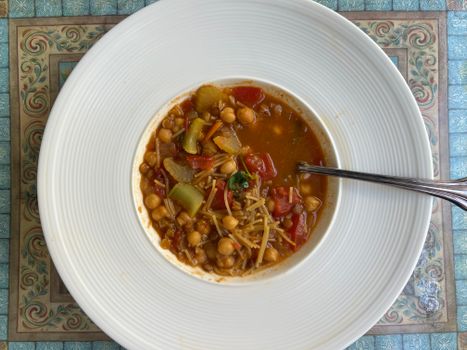
Photo: Brad Hines / Pexels
The diets react (see scores below)
Common Ingredients
- lentils
- chickpeas
- tomatoes
- lamb
- onion
- cilantro
- celery
- ras el hanout
Specific recipes may vary.
Incompatible with 6 of 11 diets
Diet Ratings
Harira is fundamentally incompatible with a ketogenic diet. The two primary bulk ingredients — lentils and chickpeas — are high-carbohydrate legumes that alone can deliver 30-50g+ of net carbs in a standard serving. Lentils contain roughly 20g net carbs per 100g cooked, and chickpeas around 22g net carbs per 100g cooked. Together in a soup serving they easily blow through the entire daily keto carb budget. Tomatoes add additional net carbs, and onion contributes further. While lamb is an excellent keto protein and the spices (ras el hanout, cilantro) and aromatics (celery) are keto-friendly, the legume base makes this dish a non-starter for ketosis. This is not a portion-control situation — even a small bowl would exceed daily limits.
Harira as prepared here contains lamb, which is animal flesh and categorically incompatible with a vegan diet. Despite the dish featuring several excellent plant-based ingredients — lentils, chickpeas, tomatoes, onion, celery, cilantro, and ras el hanout — the inclusion of lamb as the primary protein makes it unsuitable for vegans. A vegan adaptation of harira is entirely possible by simply omitting the lamb, as the legumes provide ample protein and the spice profile remains fully plant-based.
Harira contains two major paleo exclusions: lentils and chickpeas, both of which are legumes. Legumes are firmly off-limits in the paleo diet due to their lectin and phytate content, which are considered anti-nutrients. These two ingredients are foundational to Harira — not minor additions — making the dish incompatible with paleo regardless of its otherwise acceptable components (lamb, tomatoes, onion, cilantro, celery, and ras el hanout are all paleo-approved). The dish cannot be considered paleo without fundamentally changing its identity.
Harira is a nutrient-dense, plant-forward soup with an excellent Mediterranean-compatible base: lentils, chickpeas, tomatoes, onion, celery, and fresh herbs like cilantro are all staple Mediterranean ingredients. The spice blend (ras el hanout) adds flavor without nutritional concern. However, the primary protein is lamb, which is red meat — limited to a few times per month under Mediterranean diet guidelines. The dish is wholesome and minimally processed, so it is far from an 'avoid,' but the lamb content prevents a full 'approve.' Enjoyed occasionally, with a small portion of lamb relative to the legume base, this soup aligns reasonably well with Mediterranean principles.
Some Mediterranean diet interpretations, particularly those rooted in North African and Levantine traditions (which are geographically and culinarily Mediterranean), view lamb in modest quantities within a legume-rich dish as acceptable and even traditional. Modern clinical guidelines (e.g., PREDIMED framework) focus more strictly on red meat frequency and quantity, which could push this closer to an 'avoid' if lamb portions are large or consumed frequently.
Harira is a traditional Moroccan/North African soup that is fundamentally incompatible with the carnivore diet. While it does contain lamb, the dish is predominantly plant-based: lentils and chickpeas are legumes, tomatoes are fruit/vegetables, onion is a vegetable, celery is a vegetable, cilantro is a herb, and ras el hanout is a blend of plant-derived spices. The majority of the ingredients — and the bulk of the caloric and macronutrient profile — come from plant sources. Legumes like lentils and chickpeas are among the most explicitly excluded foods on carnivore due to their carbohydrate content, antinutrients (lectins, phytates), and plant-derived nature. There is no version of this dish that could be considered carnivore-compliant without stripping away essentially everything that makes it Harira.
Harira contains both lentils and chickpeas, which are legumes explicitly excluded on the Whole30 program. While the remaining ingredients — lamb, tomatoes, onion, cilantro, celery, and ras el hanout spice blend — are all Whole30-compliant, the legume components are foundational to this dish and cannot be omitted without fundamentally changing what harira is. There is no workaround that preserves the dish's identity while making it compliant.
Harira contains multiple high-FODMAP ingredients that make it unsuitable during the elimination phase. Chickpeas are high in GOS and are high-FODMAP at typical serving sizes (safe only at a very small 42g canned portion). Lentils are similarly high in GOS, though canned/drained lentils are lower; in a soup like harira they are typically used in larger quantities that exceed safe thresholds. Onion is one of the highest-fructan foods and is a core ingredient in harira — there is no safe serving size. Celery becomes high-FODMAP at amounts commonly used in cooking (over 75g). Ras el hanout spice blend frequently contains garlic and/or onion powder, both of which are extremely high in fructans. Lamb itself is low-FODMAP, tomatoes are low-FODMAP at standard servings, and cilantro is fine. However, with onion, chickpeas, lentils, and likely garlic-containing spice blend all present, this dish has multiple compounding high-FODMAP triggers and cannot be made safe without fundamental reformulation.
Harira contains several DASH-friendly ingredients — lentils and chickpeas are excellent sources of fiber, plant protein, potassium, and magnesium; tomatoes, celery, and onion are DASH-approved vegetables; and cilantro adds flavor without sodium. However, lamb is a red meat with higher saturated fat content than DASH-preferred lean proteins (poultry, fish, legumes), which DASH guidelines explicitly limit. Ras el hanout is a complex spice blend that is nutritionally neutral on its own, but restaurant or packaged versions can contain added salt, raising sodium concerns. As a soup, sodium levels depend heavily on preparation — homemade versions with no added salt can be quite DASH-compatible, while restaurant preparations may easily exceed 800–1,200mg sodium per serving. The dish's strong legume and vegetable base pulls it toward approval, but the lamb and variable sodium content require moderation.
NIH DASH guidelines categorize red meat as a food to limit due to saturated fat content. However, updated clinical interpretations note that lamb in moderate portions within an otherwise plant-forward, legume-rich dish like harira may be acceptable, especially if trimmed of visible fat — some DASH practitioners now focus more on overall dietary pattern than strict exclusion of individual red meat servings.
Harira is a nutritious Moroccan/North African soup with a complex macro profile that requires careful Zone management. The legume base (lentils and chickpeas) provides both protein and carbohydrates simultaneously, which complicates block counting — these are 'unfavorable' Zone carbs due to their higher glycemic load in quantity, though they do carry fiber which reduces net carbs. Lamb is a fatty red meat rather than a lean Zone protein, adding saturated fat that Sears traditionally discourages. However, the tomatoes, celery, and onion are favorable low-glycemic vegetables, and cilantro adds polyphenols. Ras el hanout is a spice blend with anti-inflammatory properties (curcumin, ginger, etc.) that align with Sears' later anti-inflammatory emphasis. The dish can fit Zone principles if portion size is strictly controlled (smaller serving to limit carb load from legumes), the lamb is lean-trimmed, and the meal is balanced with additional lean protein and a monounsaturated fat source. The protein-carb overlap from legumes and the saturated fat from lamb make this a 'caution' rather than an 'approve' in standard Zone methodology.
In Sears' later anti-inflammatory Zone writings (The Anti-Inflammation Zone, Zone Diet evolution post-2000s), legumes are increasingly recognized as acceptable carb/protein sources with beneficial fiber, polyphenols, and a lower glycemic impact than grains. Some Zone practitioners would rate lentils and chickpeas as moderately favorable carbs given their high fiber and moderate GI. Additionally, Sears acknowledged that traditional Mediterranean and Middle Eastern dietary patterns — of which harira is a part — are broadly consistent with Zone anti-inflammatory principles. From this perspective, a carefully portioned bowl of harira using lean lamb or substituting with chicken could score as high as 6-7.
Harira is a nutrient-dense Moroccan soup with a strongly anti-inflammatory foundation — lentils and chickpeas provide fiber, plant protein, and polyphenols; tomatoes contribute lycopene and vitamin C; onion and celery add quercetin and antioxidants; and cilantro offers anti-inflammatory phytonutrients. Ras el hanout is a notable positive — this North African spice blend typically includes turmeric, ginger, cinnamon, coriander, and other spices that are well-documented for reducing inflammatory markers like CRP and IL-6. The primary concern is lamb, a red meat with moderate-to-high saturated fat content, which is in the 'limit' category of anti-inflammatory guidelines. However, lamb in a broth-based soup context is likely used in modest portions relative to the legume volume, and the dish as a whole skews plant-forward. The overall profile is mixed: exceptional plant-based components and anti-inflammatory spices partially offset by the red meat. Prepared with a smaller amount of lean lamb, this would approach an approval rating.
Some anti-inflammatory practitioners, including those following Dr. Weil's pyramid, would consider a small serving of lamb in a predominantly plant-based legume soup as an acceptable occasional inclusion, potentially rating this higher. Conversely, stricter anti-inflammatory protocols like the AIP or those focused on cardiovascular inflammation would flag lamb's arachidonic acid and saturated fat content as a reason to avoid or substitute with a leaner protein such as chicken.
Harira is a nutrient-dense North African soup with a strong nutritional foundation — lentils and chickpeas deliver meaningful plant-based protein and substantial fiber, tomatoes and celery add hydration and micronutrients, and ras el hanout is a spice blend that is generally well-tolerated in moderate amounts. The soup format itself is GLP-1-friendly: easy to digest, high water content, and naturally portion-controlled. However, lamb is the primary protein, and it is a fatty red meat with notable saturated fat content depending on the cut and preparation. Fatty meats are a known trigger for GLP-1 side effects including nausea, bloating, and reflux due to slowed gastric emptying. The saturated fat load from lamb downgrades what would otherwise be a high-scoring dish. If lamb is used in small quantity as a flavoring rather than the dominant protein, or if it is a lean cut (leg of lamb, trimmed), the dish improves meaningfully. The legume base partially compensates by boosting fiber and protein without adding fat.
Some GLP-1-focused dietitians would rate this higher, noting that lamb in a slow-cooked soup sheds some fat into the broth (which can be skimmed), and that the overall legume-to-meat ratio in traditional harira often makes the dish more plant-forward than the ingredient list implies. Others maintain that any fatty red meat as the named primary protein warrants consistent caution regardless of preparation method, given how unpredictably GLP-1 patients tolerate saturated fat.
*See how scores were generated at our methodology page.
Nutritional profile
Six traits that cut across every diet.
Fiber & Plants
How much whole-plant food and fiber it delivers.
Healthy Fats
The quality of its fats (unsaturated, omega-3).
Whole / Unprocessed
How close it is to its natural, unprocessed form.
Gut Gentle
How easy it is on digestion (low FODMAP, few irritants).
Low Glycemic
How little it spikes your blood sugar.
Protein Density
How much protein it packs per calorie.
Controversy Index
Higher controversy = more disagreement between diets.
Diet-Specific Tips
 Mediterranean — 5/10
View tips
- Lentils and chickpeas provide excellent plant-based protein and fiber — core Mediterranean foods
- Tomatoes, onion, celery, and cilantro are all strongly encouraged Mediterranean vegetables and herbs
- Lamb is red meat, limited to a few times per month under Mediterranean guidelines
- Dish is whole, unprocessed, and contains no refined grains or added sugars
- Legume-to-meat ratio matters — a lamb-light preparation would score higher
- North African culinary tradition overlaps with Mediterranean diet patterns, adding contextual acceptance
 DASH — 5/10
View tips
- Lentils and chickpeas are DASH-ideal legumes rich in fiber, potassium, and plant protein
- Lamb is a red meat with saturated fat — DASH guidelines recommend limiting red meat
- Strong vegetable base (tomatoes, celery, onion) aligns well with DASH
- Ras el hanout spice blend may add sodium in packaged/restaurant forms
- Soup format carries high sodium risk — homemade low-sodium versions score significantly higher (7–8)
- Overall dietary pattern is plant-forward despite the red meat component
 Zone — 5/10
View tips
- Lentils and chickpeas are dual protein-carb sources, complicating Zone block counting and skewing toward higher carb load
- Lamb is a fatty red meat with saturated fat, less ideal than Zone-preferred lean proteins like chicken or fish
- Legumes are 'unfavorable' Zone carbs but have significant fiber reducing net carb impact
- Tomatoes, celery, and onion are favorable low-glycemic Zone vegetables supporting the carb portion
- Ras el hanout spice blend contains anti-inflammatory compounds (turmeric, ginger, cinnamon) aligning with Sears' later Zone evolution
- Cilantro adds polyphenols consistent with Zone anti-inflammatory goals
- Portion control is critical — a small bowl fits better than a full serving; large portions would over-deliver carbs
 Anti-Inflammatory — 6/10
View tips
- Lentils and chickpeas are anti-inflammatory staples — high in fiber, plant protein, and polyphenols
- Ras el hanout spice blend likely contains turmeric, ginger, and cinnamon — potent anti-inflammatory compounds
- Tomatoes provide lycopene, especially bioavailable when cooked
- Lamb is a red meat — contains saturated fat and arachidonic acid, placing it in the 'limit' category
- Broth-based soup format likely moderates lamb portion relative to vegetables and legumes
- Cilantro and onion contribute additional antioxidants and anti-inflammatory phytonutrients
- No processed ingredients, refined carbs, or added sugars — clean whole-food profile
 GLP-1 Friendly — 6/10
View tips
- Lentils and chickpeas provide high fiber (supports digestion and GLP-1 side effect prevention) and plant protein
- Lamb is a fatty red meat — saturated fat content can worsen nausea, bloating, and reflux on GLP-1 medications
- Soup format is inherently GLP-1-friendly: high water content, easy digestibility, small-portion compatible
- Ras el hanout is a moderate spice blend — generally tolerated, but individual sensitivity varies
- Tomatoes and celery add hydration support and micronutrient density
- Dish rating improves significantly if lamb is used in small quantity or replaced with a leaner protein such as chicken or extra legumes