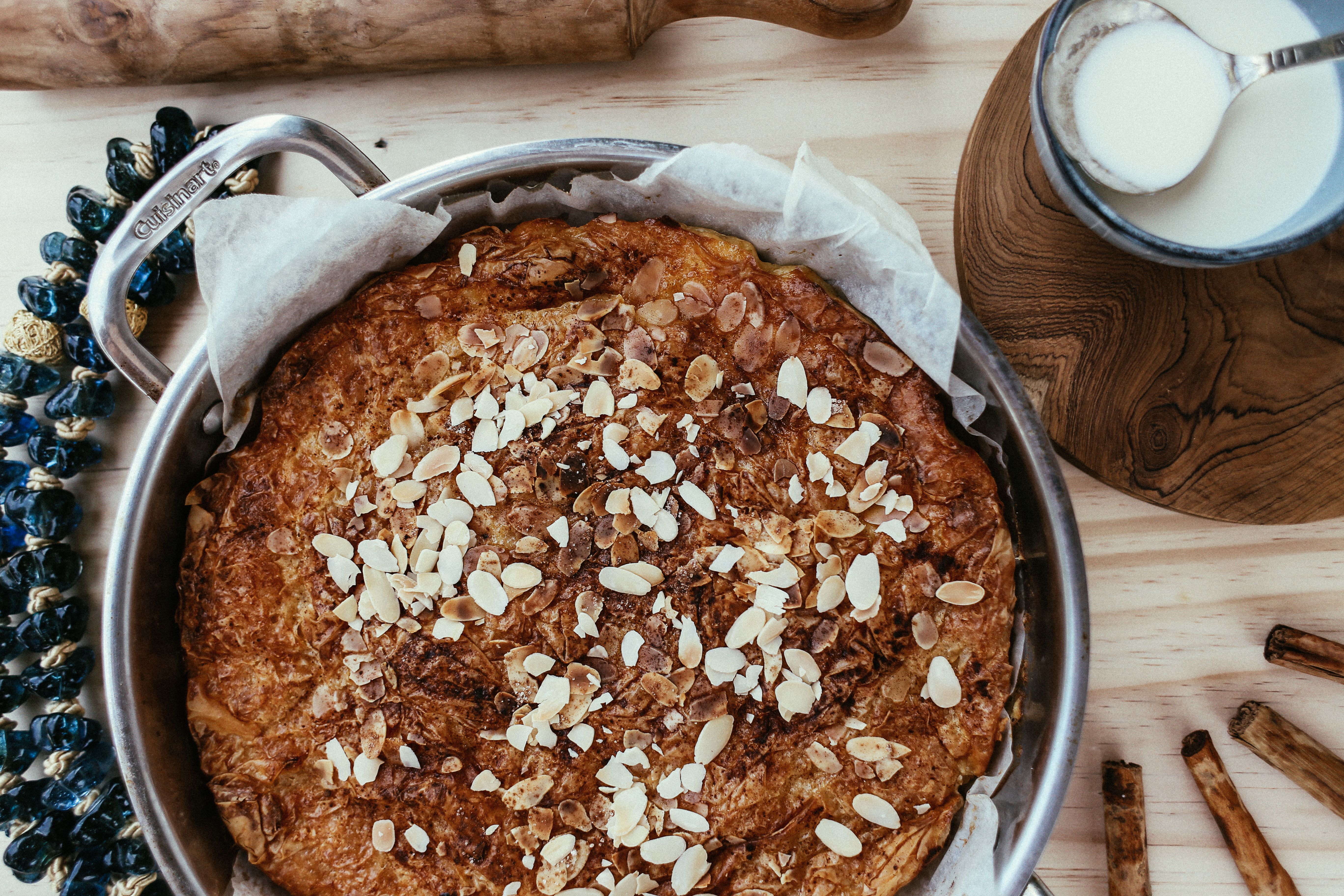
Photo: Rachel Claire / Pexels
The diets react (see scores below)
Common Ingredients
- phyllo dough
- chicken
- almonds
- eggs
- onion
- saffron
- cinnamon
- powdered sugar
Specific recipes may vary.
Incompatible with 6 of 11 diets
Diet Ratings
Pastilla is fundamentally incompatible with ketogenic eating. The dish is built on phyllo dough, a grain-based pastry that is extremely high in net carbs — a single serving can easily contribute 40-60g of net carbs from the dough alone, blowing the entire daily keto carb budget. Compounding this, powdered sugar is explicitly added as a topping, introducing direct refined sugar. These two ingredients alone place this dish firmly in the 'avoid' category regardless of the keto-friendly components (chicken, almonds, eggs) also present. There is no realistic portion size that makes this dish compatible with ketosis.
Pastilla is a traditional Moroccan savory pie that contains multiple animal products. Chicken is the primary protein, eggs are used to bind the filling, and phyllo dough in its traditional form often contains butter. This dish is fundamentally incompatible with a vegan diet due to these core animal-derived ingredients.
Pastilla is fundamentally incompatible with the paleo diet. The dish's defining structure is phyllo dough, a refined wheat-based pastry that is explicitly excluded under paleo rules as a grain product. Powdered sugar is refined sugar, another clear violation. While several ingredients are paleo-approved — chicken (protein), eggs, almonds, onion, saffron, and cinnamon — the two core non-negotiable disqualifiers (phyllo dough and powdered sugar) make this dish firmly in the 'avoid' category. There is no ambiguity here within the paleo community regarding refined wheat flour or refined sugar.
Pastilla is a traditional Moroccan dish that sits at the intersection of Mediterranean and North African culinary traditions. It contains several Mediterranean-friendly ingredients: chicken (acceptable poultry), almonds (encouraged nuts), eggs, onion, saffron, and cinnamon. However, the phyllo dough is a refined grain product, and the powdered sugar topping adds refined sugar — both of which are discouraged in strict Mediterranean diet interpretations. The dish is not cooked in olive oil as its primary fat (traditionally uses butter or smen). Overall, it is a culturally adjacent dish with some good components but notable departures from Mediterranean diet principles.
North African cuisines, including Moroccan, are often considered part of the broader Mediterranean dietary tradition, and some researchers (such as those studying the 'expanded Mediterranean diet') include dishes like Pastilla as culturally valid expressions of the pattern. In this view, the nuts, spices, and moderate poultry content are highlighted while the sugar and refined pastry are treated as occasional celebratory elements.
Pastilla is fundamentally incompatible with the carnivore diet. The dish is built around phyllo dough, a grain-based wrapper that is entirely plant-derived and processed. Beyond the dough, it contains almonds (nuts), onion (vegetable), saffron and cinnamon (plant spices), and powdered sugar — all strictly excluded on carnivore. While chicken and eggs are acceptable carnivore foods, they represent a minority of this dish's composition and are thoroughly mixed with prohibited plant ingredients. This dish cannot be adapted to carnivore; it would need to be entirely reconstructed.
Pastilla contains multiple excluded ingredients. Phyllo dough is a grain-based product (wheat flour), making it non-compliant on Whole30. Additionally, powdered sugar is an added sugar, which is explicitly excluded. These two ingredients alone are sufficient to disqualify this dish. Even setting aside the spirit-of-the-program concern about recreating a pastry-style baked good, the core structural ingredients (phyllo and sugar) are directly prohibited.
Pastilla contains multiple high-FODMAP ingredients that make it unsuitable during the elimination phase. Phyllo dough is made from wheat flour, which is high in fructans — a major FODMAP. Onion is one of the highest-FODMAP foods tested by Monash University, containing significant fructans even in small amounts. These two ingredients alone are sufficient to classify this dish as high-FODMAP. Almonds are low-FODMAP only at a very small serving (10 nuts/12g per Monash), but traditional pastilla uses them in larger quantities. Chicken, eggs, saffron, cinnamon, and powdered sugar are low-FODMAP and not problematic. However, the wheat-based phyllo dough and onion together make this dish clearly high-FODMAP at any standard serving size.
Pastilla is a complex Moroccan-origin dish that contains several DASH-friendly ingredients (chicken, almonds, eggs, onion, spices) alongside some that require moderation. Phyllo dough contributes refined carbohydrates and, depending on the amount of butter used during preparation (traditional pastilla is typically brushed with generous amounts of butter between layers), can add significant saturated fat. The powdered sugar topping adds unwanted added sugars, which DASH limits. On the positive side, chicken is a lean protein, almonds provide heart-healthy fats, magnesium, and fiber, eggs offer protein (with evolving DASH guidance now generally permitting moderate egg consumption), and onion, saffron, and cinnamon are all DASH-compatible. The overall dish is not inherently high in sodium (no inherently high-sodium processed ingredients), but the butter-laden phyllo and added sugar prevent it from being a DASH-approved food. In home or restaurant preparation, sodium from seasoning could also vary considerably. As an occasional dish with portion control and minimal added butter, it can fit within a DASH pattern, but it is not a core DASH food.
NIH DASH guidelines would flag the refined phyllo dough, added sugar (powdered sugar), and likely saturated fat from butter in preparation as concerns warranting caution. However, updated clinical interpretations note that almonds and lean chicken contribute meaningfully to DASH nutrient goals (potassium, magnesium, protein), and if prepared with minimal butter and modest sugar, the dish could be viewed more favorably — some DASH-oriented dietitians would consider a small, mindfully prepared portion acceptable within a balanced DASH day.
Pastilla is a Moroccan-origin pie that presents a mixed Zone profile. The chicken filling is a lean, Zone-favorable protein, and almonds provide monounsaturated fat which aligns well with Zone fat guidelines. Eggs also contribute lean protein and healthy fats. However, the phyllo dough is a refined, high-glycemic carbohydrate that is classified as 'unfavorable' in Zone terminology — it will spike insulin and is nutritionally empty compared to vegetable-based carbs. The powdered sugar dusting adds additional glycemic load and is essentially a Zone 'avoid' ingredient. The combination of refined starch and added sugar makes balancing the 40/30/30 ratio very difficult without drastically limiting portion size. The spices (saffron, cinnamon, onion) are Zone-neutral or even beneficial (cinnamon has anti-inflammatory properties Sears endorses). As a whole dish, Pastilla skews heavily carbohydrate-heavy and toward high-glycemic sources, making it a 'caution' food that requires very small portions and careful pairing with additional lean protein and low-GI vegetables to approach Zone balance.
A Zone-aware practitioner could argue that Pastilla, consumed in a small portion (e.g., one small slice), can be incorporated into a Zone meal if paired with a large salad or steamed vegetables to offset the glycemic load of the phyllo and sugar. The almond and egg content naturally contributes protein and monounsaturated fat that partially self-balance the dish. Sears' later writings emphasize polyphenol-rich spices like cinnamon and saffron as anti-inflammatory allies, which Pastilla contains in meaningful quantities. Some Zone adherents would rate this a 5-6 rather than a 4 if portioned carefully.
Pastilla is a Moroccan-origin savory-sweet pie with a mixed anti-inflammatory profile. On the positive side, it contains several genuinely anti-inflammatory ingredients: cinnamon is well-documented for its anti-inflammatory polyphenols, saffron contains crocin and safranal which have demonstrated anti-inflammatory properties, almonds provide vitamin E, healthy monounsaturated fats, and fiber, onion contributes quercetin (a flavonoid with anti-inflammatory action), and lean chicken is an acceptable moderate protein in anti-inflammatory frameworks. Eggs also contribute beneficial nutrients including choline and selenium. However, the dish has notable concerns: phyllo dough is a refined carbohydrate with minimal nutritional benefit, and powdered sugar adds refined sugar — both of which are inflammatory when consumed in meaningful amounts. The dish is also typically prepared with butter brushed on the phyllo layers, which adds saturated fat (though the query doesn't list it explicitly, it is nearly universal in preparation). The sweet-savory combination with refined carbs and added sugar prevents a full approval. Overall, Pastilla is a complex dish where its rich spice profile and quality protein are offset by refined carbohydrate and sugar components — making it appropriate for occasional consumption rather than a regular anti-inflammatory staple.
Some anti-inflammatory practitioners following stricter protocols (such as AIP or grain-free frameworks) would rate this lower due to the refined wheat in phyllo and added sugar, potentially scoring it 3-4. Conversely, Mediterranean/North African diet advocates might note that the traditional spice complexity (saffron, cinnamon) and almond content align with anti-inflammatory eating patterns and deserve more credit, particularly compared to Western pastry equivalents.
Pastilla is a traditional Moroccan savory-sweet pie that presents a mixed nutritional profile for GLP-1 patients. The chicken and eggs provide meaningful protein, and almonds contribute healthy unsaturated fats and some fiber. However, several features work against it: the phyllo dough layers are a refined carbohydrate with low fiber and low nutrient density per calorie; the powdered sugar topping adds empty calories and simple sugars; the almond filling adds significant fat per serving, increasing the risk of GLP-1 side effects like nausea, bloating, and reflux; and the dish is inherently calorie-dense relative to its protein yield per serving. The sweet-savory combination with sugar and cinnamon on top is atypical for a protein-forward meal and adds unnecessary glycemic load. Phyllo is lighter than puff pastry and not fried, which partially mitigates the fat concern, but the overall dish is portion-sensitive and difficult to optimize in a small serving. A typical restaurant portion would likely deliver moderate protein but excessive refined carbs, sugar, and fat relative to GLP-1 dietary priorities.
Some GLP-1-focused dietitians may view pastilla more favorably in a controlled home-prepared portion — the chicken and egg filling can be protein-rich, almonds provide heart-healthy fats, and phyllo is lower in fat than shortcrust or puff pastry. The disagreement centers on whether the refined carbohydrate and sugar components are disqualifying or merely something to manage through portion control.
*See how scores were generated at our methodology page.
Nutritional profile
Six traits that cut across every diet.
Fiber & Plants
How much whole-plant food and fiber it delivers.
Healthy Fats
The quality of its fats (unsaturated, omega-3).
Whole / Unprocessed
How close it is to its natural, unprocessed form.
Gut Gentle
How easy it is on digestion (low FODMAP, few irritants).
Low Glycemic
How little it spikes your blood sugar.
Protein Density
How much protein it packs per calorie.
Controversy Index
Higher controversy = more disagreement between diets.
Diet-Specific Tips
 Mediterranean — 5/10
View tips
- Chicken is an acceptable moderate-consumption protein in the Mediterranean diet
- Almonds and eggs are Mediterranean-friendly ingredients
- Phyllo dough is a refined grain, not a whole grain
- Powdered sugar adds refined sugar, contradicting Mediterranean diet principles
- Traditionally uses butter rather than olive oil as primary fat
- Dish is culturally North African, adjacent to but not canonical Mediterranean
 DASH — 5/10
View tips
- Phyllo dough is a refined carbohydrate; traditional preparation uses butter between layers, adding saturated fat
- Powdered sugar topping adds unwanted added sugars, which DASH limits
- Chicken is a lean protein — DASH-approved
- Almonds provide healthy unsaturated fats, fiber, magnesium — DASH-friendly
- Eggs are acceptable in moderation under current DASH-aligned guidelines
- No inherently high-sodium processed ingredients, but preparation sodium can vary
- Portion size is important; smaller servings reduce saturated fat and sugar impact
 Zone — 4/10
View tips
- Phyllo dough is a refined, high-glycemic carbohydrate — classified as 'unfavorable' in Zone terminology
- Powdered sugar adds unnecessary glycemic load and is a Zone 'avoid' ingredient
- Chicken is a lean, Zone-approved protein source
- Almonds contribute Zone-favorable monounsaturated fats
- Eggs add lean protein and healthy fat, supporting Zone balance
- Overall macro ratio skews high-carb with poor carbohydrate quality
- Cinnamon and saffron are anti-inflammatory spices consistent with Sears' anti-inflammatory framework
- Dish requires very small portions and strategic pairing to fit Zone ratios
 Anti-Inflammatory — 5/10
View tips
- Cinnamon: well-documented anti-inflammatory polyphenols (cinnamaldehyde)
- Saffron: contains crocin and safranal with anti-inflammatory properties
- Almonds: vitamin E, monounsaturated fats, and fiber support anti-inflammatory profile
- Onion: quercetin (flavonoid) with anti-inflammatory action
- Lean chicken: acceptable moderate protein in anti-inflammatory frameworks
- Phyllo dough: refined carbohydrate — pro-inflammatory when consumed regularly
- Powdered sugar: added refined sugar raises inflammatory concern
- Typical butter in phyllo layers (assumed preparation): adds saturated fat
 GLP-1 Friendly — 4/10
View tips
- Chicken and eggs provide moderate protein but overall protein density per calorie is reduced by the phyllo and sugar components
- Phyllo dough is a refined carbohydrate with minimal fiber, reducing nutrient density
- Powdered sugar topping adds empty calories and simple sugars — counterproductive on GLP-1
- Almonds contribute unsaturated fats but also increase overall fat content per serving, raising GI side effect risk
- Dish is calorie-dense and portion-sensitive — a standard serving may exceed recommended fat and carb thresholds
- No significant fiber contribution from the ingredients listed
- Spices (saffron, cinnamon) are well-tolerated and not a concern
- Not fried — phyllo is baked, which partially mitigates fat concerns compared to heavier pastry options