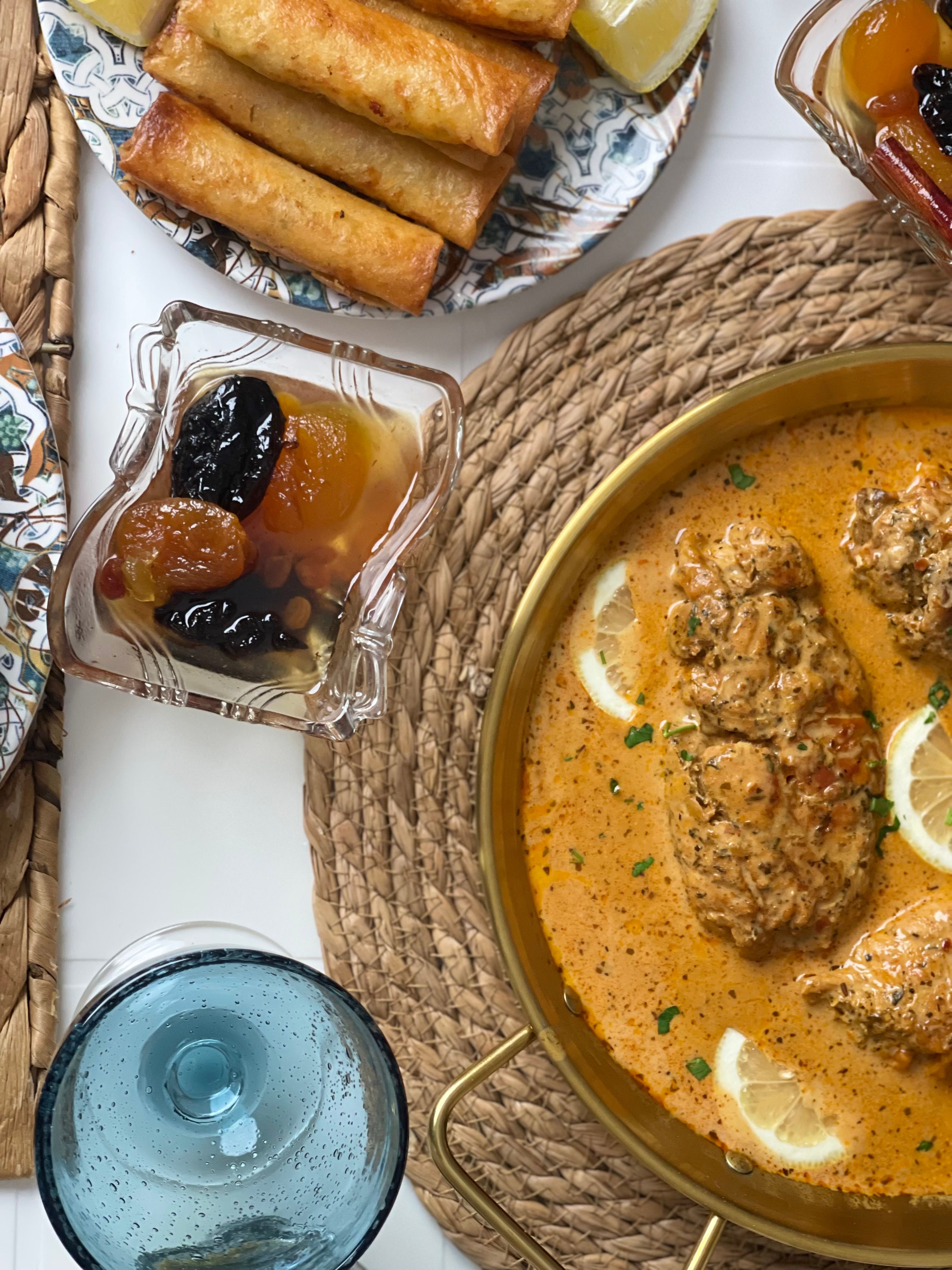
Photo: zhor abdellkader / Pexels
African
Chicken Tagine with Preserved Lemon
The diets react (see scores below)
Common Ingredients
- chicken
- preserved lemon
- green olives
- saffron
- ginger
- onion
- garlic
- cilantro
Specific recipes may vary.
Incompatible with 3 of 11 diets
Diet Ratings
Chicken Tagine with Preserved Lemon is mostly keto-compatible but requires attention to portions and preparation. Chicken is an excellent lean protein, green olives provide healthy fats, and spices like saffron, ginger, and garlic are keto-friendly in typical amounts. The main concerns are onion (moderate carbs, ~7g net carbs per 100g) and preserved lemon (salt-cured but still contains some carbohydrate and occasionally added sugar in commercial preparations). A standard serving is unlikely to blow the carb budget on its own, but onion quantity matters — traditional tagines can use substantial amounts. There are no grains, starches, or high-sugar ingredients listed, which is a positive. With careful portioning of onion and verified sugar-free preserved lemon, this dish can fit keto comfortably.
Some strict keto practitioners flag onion as too carb-dense for regular use and would recommend substituting with leek greens or scallion tops only; they would rate this a caution-to-avoid depending on onion quantity used in the recipe.
Chicken Tagine with Preserved Lemon is clearly incompatible with a vegan diet. Chicken is animal flesh — one of the most straightforward exclusions under any definition of veganism. All remaining ingredients (preserved lemon, green olives, saffron, ginger, onion, garlic, cilantro) are plant-based, but the primary protein is an animal product, making the dish as a whole non-vegan. There is no meaningful debate within the vegan community on this point.
This dish is largely paleo-friendly — chicken, saffron, ginger, onion, garlic, and cilantro are all clearly approved whole foods. However, two ingredients introduce complexity: preserved lemons and green olives. Preserved lemons are cured with salt (and sometimes sugar), making them a processed food with added salt, which is excluded under strict paleo rules. Green olives are similarly cured in a salt brine and often contain additives or preservatives. While olives themselves are a whole food approved by most paleo frameworks, the brining/preservation process places them in a gray area. Strict paleo purists (Cordain school) would flag both ingredients due to added salt and processing. The overall dish is nutritionally sound and grain/legume/dairy-free, but the preserved and cured components prevent a full approval.
Many modern paleo practitioners (Mark Sisson, Whole30-adjacent communities) accept olives and preserved lemons in practice, arguing that minimal salt curing does not meaningfully alter the nutritional profile and that these foods were available in traditional, pre-industrial forms. In this view, the dish could reasonably score a 7-8 and receive an approve verdict.
Chicken Tagine with Preserved Lemon is a nutritionally sound dish that aligns well with many Mediterranean principles. Chicken is an acceptable moderate protein source, and the dish is rich in plant-based flavor components — onion, garlic, cilantro, saffron, ginger — along with olives, which are a Mediterranean staple. Preserved lemons add a fermented, whole-food element consistent with traditional North African and Eastern Mediterranean cuisines. However, chicken is categorized as a moderate food (not a daily staple), placing this dish in the 'caution' range rather than a full approval. The dish contains no red meat, no refined grains, no added sugars, and no highly processed ingredients, making it a healthy choice within its category.
Some Mediterranean diet interpretations, particularly those rooted in North African traditions (Morocco, Tunisia), treat tagine dishes as culturally aligned core meals. Modern clinical guidelines such as those from the Harvard T.H. Chan School of Public Health do permit poultry as a frequent protein, and some practitioners would score this dish higher given the absence of any problematic ingredients and the strong plant and olive presence.
Chicken Tagine with Preserved Lemon is almost entirely incompatible with the carnivore diet. While chicken itself is an animal product and acceptable to most carnivore practitioners, this dish is dominated by plant-based ingredients. Preserved lemon and green olives are plant foods; saffron, ginger, and cilantro are plant-derived spices/herbs; onion and garlic are vegetables. The carnivore diet excludes all plant foods, so the overwhelming majority of this dish's ingredients are prohibited. The chicken is the only carnivore-compatible component, making this dish a clear avoid.
Most ingredients in Chicken Tagine with Preserved Lemon are straightforwardly Whole30-compliant: chicken, saffron, ginger, onion, garlic, and cilantro are all approved whole foods. Green olives are also compliant provided no non-compliant additives (e.g., sulfites were removed from the exclusion list in 2024). The main concern is preserved lemons, which are traditionally made with just lemon and salt — both compliant — but commercial versions sometimes include added sugar or other non-compliant preservatives. Label-reading is essential for store-bought preserved lemons. Homemade preserved lemons with only lemon and salt are fully compliant. This dish earns a caution rather than an avoid because the dish itself is conceptually sound and compliant, but ingredient sourcing requires care.
Official Whole30 guidelines would approve this dish if all ingredients are verified compliant (especially preserved lemons with no added sugar). Some community members flag that commercial preserved lemons and brined green olives can contain additives worth scrutinizing, making this a label-reading exercise rather than a guaranteed pass.
This dish contains two major high-FODMAP ingredients that make it unsuitable during the elimination phase: onion (high in fructans at any culinary quantity) and garlic (high in fructans even at very small amounts — one of the highest-FODMAP foods tested by Monash). Both are typically used as foundational aromatics in tagine, meaning they cannot simply be reduced to a negligible amount while maintaining the dish's character. These two ingredients alone disqualify the dish. The remaining ingredients are largely low-FODMAP: chicken is freely safe, saffron is fine in small culinary amounts, fresh ginger is low-FODMAP at standard portions (up to 1 teaspoon), green olives are low-FODMAP at around 15 olives, preserved lemon (rind only) is generally considered low-FODMAP in small amounts, and cilantro is a low-FODMAP herb. However, the presence of onion and garlic as core structural ingredients means this dish cannot be made low-FODMAP without a fundamental recipe overhaul (e.g., replacing with garlic-infused oil and the green tops of scallions).
Chicken Tagine with Preserved Lemon sits in DASH's caution zone primarily due to two high-sodium ingredients: preserved lemons and green olives. Preserved lemons are salt-cured and can contribute 500–1,000mg+ sodium per serving portion, while green olives are similarly brine-packed and sodium-dense. Together, these two ingredients could easily push a single serving close to or over the DASH daily sodium limit of 2,300mg (and well over the low-sodium DASH target of 1,500mg). On the positive side, chicken (especially skinless) is a DASH-approved lean protein, and the aromatics — onion, garlic, ginger, cilantro, saffron — are all DASH-friendly, adding flavor without saturated fat or sodium. The dish contains no red meat, no tropical oils, no added sugars, and no full-fat dairy, which are all favorable. With careful portion control of the preserved lemon and olives, or substitution with fresh lemon juice and a small amount of low-sodium olives, this dish could approach an 'approve' rating. As typically prepared in traditional Moroccan/North African cooking, however, sodium is the principal concern.
NIH DASH guidelines strictly limit sodium and flag cured/pickled ingredients as problematic due to brine content. Some DASH-oriented clinicians and updated Mediterranean-DASH hybrid frameworks (e.g., MIND diet overlap) note that the anti-inflammatory spice profile and lean protein base of this dish are highly beneficial, and that modest use of preserved lemon and olives — used as condiments rather than primary ingredients — may be acceptable within an otherwise sodium-controlled daily intake.
Chicken Tagine with Preserved Lemon aligns well with Zone Diet principles. The primary protein is chicken, a lean protein source that Sears consistently classifies as favorable. Preserved lemon and green olives provide fat — olives being a monounsaturated fat source that is explicitly Zone-favorable, though preserved lemon adds sodium which is a minor concern. The dish is low in carbohydrates overall, with onion and garlic contributing modest low-glycemic carb blocks. Saffron, ginger, and cilantro are polyphenol-rich spices that align with Sears' anti-inflammatory emphasis. The main structural issue is that the dish as described is carbohydrate-light — it would need a low-glycemic vegetable side (e.g., roasted peppers, zucchini, spinach) to complete the 40% carb target for a Zone-balanced meal. However, as a protein-and-fat anchor for a Zone meal, this dish is excellent. The fat from olives is primarily monounsaturated, and there is no significant source of saturated fat, trans fat, or high-glycemic carbohydrates. Portioning chicken to approximately 3 oz (one Zone protein block serving equivalent) and controlling olive quantity keeps this well within Zone parameters.
Chicken Tagine with Preserved Lemon is a strong anti-inflammatory dish. Lean chicken (poultry) is in the 'moderate/acceptable' category and serves as a clean protein source. The spice and aromatics profile is where this dish truly shines from an anti-inflammatory standpoint: ginger contains gingerols and shogaols that significantly reduce inflammatory cytokines; garlic provides allicin and organosulfur compounds linked to reduced CRP and IL-6; saffron contains crocin and safranal, bioactive compounds with demonstrated antioxidant and anti-inflammatory activity in research. Onion and cilantro contribute quercetin and polyphenols. Green olives add monounsaturated fats (oleic acid) similar in profile to olive oil, with anti-inflammatory phenolic compounds. Preserved lemon, while high in sodium due to the curing process, retains flavonoids and polyphenols from the lemon rind. The sodium content of preserved lemon is a mild concern for individuals with hypertension but does not meaningfully alter the anti-inflammatory profile of the dish overall. This dish aligns closely with Mediterranean and anti-inflammatory eating principles, being herb- and spice-forward with lean protein and beneficial fats.
Chicken tagine with preserved lemon is a flavorful, largely GLP-1-compatible dish with some important caveats. The chicken (ideally thighs in traditional preparation) is a strong protein source, and the aromatics — garlic, onion, ginger, saffron, cilantro — are nutrient-dense and easy to digest. Preserved lemons and green olives are the two factors that push this into caution territory. Olives are high in fat (mostly unsaturated, which is preferred, but fat content still matters for GLP-1 patients prone to nausea and slow gastric emptying). Preserved lemons are extremely high in sodium, which can cause water retention and is worth flagging for patients managing blood pressure alongside weight. The dish is slow-cooked, which improves digestibility significantly — soft, tender chicken is easier on the stomach than grilled or pan-seared. The spice profile is moderate and aromatic rather than capsaicin-hot, so it is unlikely to worsen reflux or nausea. If made with chicken breast instead of thighs, and olives used sparingly, this dish improves meaningfully. Portion sensitivity applies: a small serving is GLP-1-friendly; a large portion with significant olive oil added to the braise could trigger GI discomfort.
Some GLP-1-focused RDs would rate this higher, noting that the fat from olives is heart-healthy unsaturated fat and the slow-cooked format is among the most tolerable for patients with delayed gastric emptying. Others would flag the sodium load from preserved lemons as a meaningful concern, particularly for patients on GLP-1s who are also managing hypertension or cardiovascular risk — a common comorbidity in this population.
*See how scores were generated at our methodology page.
Nutritional profile
Six traits that cut across every diet.
Fiber & Plants
How much whole-plant food and fiber it delivers.
Healthy Fats
The quality of its fats (unsaturated, omega-3).
Whole / Unprocessed
How close it is to its natural, unprocessed form.
Gut Gentle
How easy it is on digestion (low FODMAP, few irritants).
Low Glycemic
How little it spikes your blood sugar.
Protein Density
How much protein it packs per calorie.
Controversy Index
Higher controversy = more disagreement between diets.
Diet-Specific Tips
 Keto — 5/10
View tips
- Chicken is a clean, keto-friendly protein source
- Green olives contribute healthy monounsaturated fats and negligible net carbs
- Onion is the primary carb concern — quantity used in traditional tagine can be significant
- Preserved lemon may contain added sugar in commercial versions — check label
- Spices (saffron, ginger, garlic, cilantro) are keto-safe in cooking amounts
- No grains, starches, or high-sugar ingredients present
- Dish lacks significant fat sources beyond olives — may benefit from added fat like olive oil
 Paleo — 5/10
View tips
- Chicken is fully paleo-approved as a primary protein
- Preserved lemons contain added salt, excluded under strict paleo rules
- Green olives are cured in salt brine and may contain additives
- Saffron, ginger, onion, garlic, and cilantro are all whole paleo-approved ingredients
- No grains, legumes, dairy, or seed oils present
- Processing method (salt curing) is the primary concern, not the base ingredients themselves
 Mediterranean — 6/10
View tips
- Chicken is a moderate protein — acceptable but not a core daily staple
- Olives are a true Mediterranean staple and add healthy monounsaturated fats
- No red meat, processed ingredients, refined grains, or added sugars
- Rich in herbs and aromatics consistent with Mediterranean flavor profiles
- Preserved lemons are a traditional fermented whole food from North African cuisine
- Saffron and spice-forward profile reflects authentic Maghrebi-Mediterranean tradition
 Whole30 — 6/10
View tips
- Chicken is fully Whole30-compliant
- Preserved lemons must be checked — homemade (lemon + salt only) is compliant; commercial versions may contain added sugar
- Green olives are compliant but check for non-compliant additives in commercial brined versions
- Saffron, ginger, onion, garlic, cilantro are all approved
- No grains, dairy, legumes, or other excluded categories present
- Overall dish structure is Whole30-friendly; compliance hinges on sourcing
 DASH — 5/10
View tips
- Preserved lemons are salt-cured and high in sodium — primary concern for DASH compliance
- Green olives are brine-packed and contribute significant sodium
- Chicken (skinless) is a DASH-approved lean protein source
- Aromatics (garlic, onion, ginger, cilantro, saffron) are all DASH-friendly and sodium-free
- No saturated fat sources, red meat, added sugar, or tropical oils — structurally favorable
- Low-sodium version using fresh lemon juice and reduced/rinsed olives would score 7–8
- Portion control of preserved lemon and olives is key to DASH compatibility
 Zone — 8/10
View tips
- Chicken is a lean, Zone-favorable protein source
- Green olives provide monounsaturated fat — explicitly favorable in Zone methodology
- Saffron, ginger, and cilantro are polyphenol-rich, supporting Sears' anti-inflammatory focus
- Dish is carbohydrate-light and would require a low-glycemic vegetable side to hit the 40/30/30 ratio
- Preserved lemon adds sodium but does not significantly affect macronutrient balance
- No high-glycemic carbs, refined sugars, or problematic fats present
 Anti-Inflammatory — 8/10
View tips
- Ginger: potent anti-inflammatory gingerols and shogaols
- Garlic: allicin and organosulfur compounds reduce CRP and IL-6
- Saffron: crocin and safranal with antioxidant and anti-inflammatory properties
- Green olives: monounsaturated fats and anti-inflammatory phenolics
- Lean chicken: clean protein, acceptable under anti-inflammatory guidelines
- Onion and cilantro: quercetin and polyphenol contributors
- Preserved lemon: adds polyphenols but elevates sodium — minor concern
 GLP-1 Friendly — 6/10
View tips
- Good protein source from chicken; breast preferred over thighs to reduce saturated fat
- Green olives add unsaturated fat but increase total fat per serving — moderate GI risk for GLP-1 patients
- Preserved lemon is very high in sodium — relevant for patients with hypertension or cardiovascular comorbidities
- Slow-cooked preparation improves digestibility and gastric tolerance significantly
- Aromatic spices (ginger, saffron, garlic) are GLP-1-friendly and may support digestion
- No fiber-rich ingredients (e.g., chickpeas, vegetables) — a missed opportunity to improve nutritional profile
- Portion-sensitive: small serving is appropriate; large portions with added fat increase GI side effect risk