Photo: Bingqian Li / Pexels
French
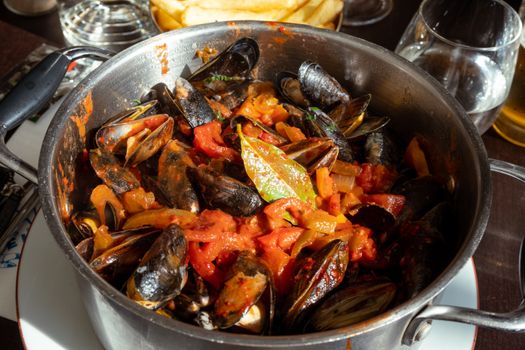
Moules Frites
The diets react (see scores below)
Common Ingredients
- mussels
- white wine
- shallots
- garlic
- parsley
- butter
- French fries
- cream
Specific recipes may vary.
Incompatible with 9 of 11 diets
Diet Ratings
Moules Frites is fundamentally incompatible with ketogenic eating due to the French fries, which are the defining second component of the dish. A standard serving of French fries contains 40-60g of net carbs on its own, instantly breaking ketosis regardless of portion size. The mussels themselves are borderline for keto (they contain modest glycogen/carbs at ~3-4g per 100g), and the broth components — white wine, shallots, butter, cream, garlic, parsley — are manageable in moderation, though white wine adds additional carbs. As a complete dish in its traditional form, the frites make it a clear avoid. Only a heavily modified version (replacing fries with a keto alternative) could be considered.
Moules Frites contains multiple animal products that are unambiguously non-vegan. Mussels are animals (bivalve molluscs), and their consumption is excluded under all major vegan frameworks. Beyond the primary protein, the dish also contains butter (dairy) and cream (dairy), both of which are animal-derived ingredients. There is no plant-based interpretation of this dish as described — it is fundamentally built on animal products.
Moules Frites is fundamentally incompatible with the paleo diet. While mussels are an excellent paleo protein — rich in omega-3s and minerals, clearly available to Paleolithic coastal humans — the dish is undermined by several non-paleo components. French fries, though made from white potatoes (already debated in paleo), are deep-fried in seed oils in any restaurant context, making them a clear avoid. Cream and butter are dairy products excluded under strict paleo guidelines. White wine, while technically derived from fruit, is an alcoholic and processed beverage placing it in the caution zone at best. The dish as a whole cannot be considered paleo-compliant due to the dairy (cream, butter), the seed-oil-fried fries, and the overall processed nature of the preparation.
Moules Frites presents a mixed Mediterranean diet picture. The mussels are an excellent Mediterranean staple — shellfish are encouraged 2-3 times weekly and are nutrient-dense. Garlic, shallots, parsley, and white wine are all classically Mediterranean aromatics. However, the dish diverges significantly with butter (instead of olive oil as the primary fat), cream in the sauce, and especially French fries — a deep-fried, refined carbohydrate side that contradicts core Mediterranean principles. The frites alone would push this toward 'avoid,' but the high-quality protein source and aromatic base provide redemption. Without the fries and with olive oil substituted for butter/cream, this would be an 'approve.'
Some traditional French coastal cooking overlaps with Mediterranean practice, and mussels cooked in white wine with aromatics (moules marinières without cream) is arguably close to Mediterranean spirit. A Mediterranean-informed adaptation — swapping butter for olive oil, omitting cream, and replacing fries with crusty whole-grain bread or roasted vegetables — would earn a strong approval, and some practitioners would encourage this dish in modified form.
Moules Frites is fundamentally incompatible with the carnivore diet. While mussels themselves are an approved animal-based seafood, the dish as a whole is dominated by plant-derived and non-carnivore ingredients. French fries are a plant food (potatoes) and represent a major carbohydrate source explicitly excluded from carnivore. The preparation includes shallots, garlic, and parsley — all plant-based aromatics and herbs that are off-limits. White wine is a plant-derived fermented beverage. Cream and butter are dairy and would carry their own debate, but they are the least problematic ingredients here. The dish cannot be considered carnivore-compatible in its traditional form due to the foundational role of French fries and the plant-heavy broth base.
Moules Frites contains multiple Whole30-excluded ingredients. Butter (regular, not ghee or clarified butter) is a dairy product and explicitly excluded from the program. Cream is also dairy and excluded. French fries, while made from potatoes (which are allowed), fall into the 'tots/french fries' category that is explicitly prohibited under the 'no recreating junk food' rule. The mussels, white wine, shallots, garlic, and parsley are all individually compliant, but the combination of butter, cream, and french fries makes this dish firmly non-compliant. To make a compliant version, one would need to substitute ghee for butter, omit the cream, and serve without fries — essentially transforming the dish into something quite different from classic Moules Frites.
Moules Frites as classically prepared contains multiple high-FODMAP ingredients that make it unsuitable during the elimination phase. Garlic is one of the highest-FODMAP foods tested by Monash University, rich in fructans, and is a core flavoring in this dish — even small amounts cooked into the broth are problematic as fructans are water-soluble and leach into the cooking liquid. Shallots are similarly high in fructans and GOS, and again the broth would be saturated with these FODMAPs. Cream in anything beyond a small splash (typically around 1 tablespoon) contributes lactose at moderate-to-high levels, and the amount used in a moules marinière-style sauce would typically exceed this threshold. While mussels themselves are low-FODMAP, white wine (dry, in small amounts) is generally low-FODMAP, and French fries made from plain potato are low-FODMAP, the dish as a whole cannot be considered safe due to the garlic, shallots, and cream in the broth. There is no practical way to order or prepare classic Moules Frites without these core ingredients.
Moules Frites as traditionally prepared is poorly suited to the DASH diet despite mussels themselves being an excellent DASH food. Mussels are a lean, high-protein seafood rich in potassium, magnesium, and omega-3 fatty acids — fully aligned with DASH principles. However, the dish as commonly consumed undermines these benefits in several ways: (1) Butter and cream form a rich, high-saturated-fat broth that directly conflicts with DASH limits on saturated fat and full-fat dairy; (2) French fries are deep-fried, calorie-dense, and typically heavily salted, often contributing 500–1,000mg of sodium per serving on their own; (3) The combined dish commonly exceeds DASH sodium thresholds (2,300mg/day standard, 1,500mg/day low-sodium) in a single meal; (4) The high total fat content from frying oil, butter, and cream is inconsistent with DASH's emphasis on healthy fats and lean preparation. White wine, shallots, garlic, and parsley are all DASH-compatible, and mussels alone would score highly. But the dish as a whole — defined by its cream-butter broth and fried potatoes — earns an avoid rating.
Moules Frites is a challenging dish for Zone compliance on multiple fronts. The mussels themselves are actually an excellent Zone protein — lean, high in omega-3s, and very favorable. However, the dish as traditionally served is dominated by two major Zone problems: (1) French fries are a high-glycemic carbohydrate that Dr. Sears explicitly categorizes as unfavorable — starchy, rapidly digested, and spiking insulin significantly; and (2) the sauce typically combines butter and cream, both of which are saturated fat sources that skew the fat block away from preferred monounsaturated fats while adding significant caloric density. The white wine and shallots are relatively benign in Zone terms. But the fries are the central carbohydrate component of the dish, not a minor ingredient — they define the meal. Reconstructing this dish to be Zone-compliant would require eliminating the fries entirely (replacing with a low-GI vegetable side), removing the cream, and using minimal butter or substituting olive oil — at which point it is no longer recognizably Moules Frites. As the dish is traditionally prepared and served, it cannot be reasonably incorporated into a Zone meal without wholesale reconstruction.
Moules Frites presents a genuinely split anti-inflammatory profile. On the positive side, mussels are an excellent source of omega-3 fatty acids (EPA and DHA), zinc, selenium, and B12, making them one of the more anti-inflammatory shellfish options. Garlic, shallots, and parsley contribute meaningful antioxidant and anti-inflammatory phytochemicals. White wine in cooking amounts is largely neutral. However, the dish is substantially undermined by its pro-inflammatory components: butter and cream are saturated fat sources that the anti-inflammatory framework recommends limiting, and French fries are deep-fried refined starch — high in acrylamide potential, likely cooked in high-omega-6 seed oils, and devoid of meaningful anti-inflammatory benefit. The fries alone are a significant liability, representing the kind of refined, fried carbohydrate the framework explicitly limits. The combination of cream and butter in the broth further tips the dish toward the 'limit' category. If the mussels were served with a broth made with olive oil instead of butter and cream, and accompanied by a whole-grain or vegetable side, the dish would rate much higher. As traditionally prepared, the beneficial mussels are paired with enough pro-inflammatory elements to render the overall dish a moderate concern.
Moules frites as a complete dish is a poor fit for GLP-1 patients. The mussels themselves are an excellent protein source — lean, nutrient-dense, and easy to digest — but the preparation and accompaniments undermine this significantly. The classic sauce contains butter and cream, adding substantial saturated fat that worsens GLP-1 side effects including nausea, bloating, and reflux. The white wine introduces alcohol, which adds empty calories. Most critically, the frites component is deep-fried, high in fat, low in fiber, and represents exactly the kind of empty-calorie, GI-aggravating food that GLP-1 patients should avoid. The dish as served is not portion-friendly — the fries dominate volume and calories. The combination of high saturated fat (cream, butter), alcohol (wine in the broth), and fried food (frites) stacks multiple 'avoid' triggers simultaneously. Mussels alone in a light broth would be a strong approve, but the dish as a whole cannot be separated from its components in a real-world rating.
*See how scores were generated at our methodology page.
Nutritional profile
Six traits that cut across every diet.
Fiber & Plants
How much whole-plant food and fiber it delivers.
Healthy Fats
The quality of its fats (unsaturated, omega-3).
Whole / Unprocessed
How close it is to its natural, unprocessed form.
Gut Gentle
How easy it is on digestion (low FODMAP, few irritants).
Low Glycemic
How little it spikes your blood sugar.
Protein Density
How much protein it packs per calorie.
Controversy Index
Higher controversy = more disagreement between diets.
Diet-Specific Tips
 Mediterranean — 4/10
View tips
- Mussels are an excellent Mediterranean protein source, encouraged 2-3x weekly
- French fries are a deep-fried refined carbohydrate that strongly contradicts Mediterranean principles
- Butter and cream replace olive oil as the fat base, misaligning with the diet's primary fat recommendation
- Garlic, shallots, parsley, and white wine are authentically Mediterranean aromatics
- Dish is not inherently processed but preparation method (deep frying) is problematic
- Easy to adapt: substituting olive oil and removing fries would make this Mediterranean-friendly
 Anti-Inflammatory — 4/10
View tips
- Mussels are rich in omega-3s (EPA/DHA), zinc, and selenium — strongly anti-inflammatory
- Garlic, shallots, and parsley provide antioxidant and anti-inflammatory phytochemicals
- Butter and cream add saturated fat, which anti-inflammatory guidelines recommend limiting
- French fries are deep-fried refined starch, likely cooked in high-omega-6 seed oils
- No significant fiber, whole grains, or additional anti-inflammatory vegetables in the dish
- White wine used in cooking is largely neutral at typical preparation quantities