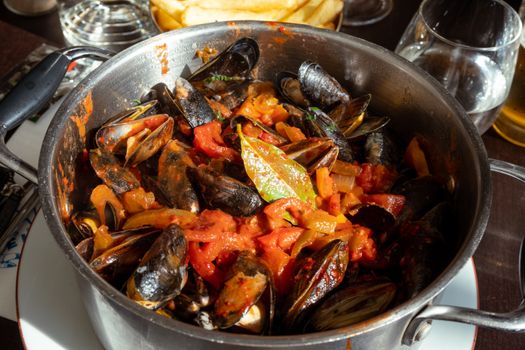
Photo: Bingqian Li / Pexels
French
Moules Marinières
The diets react (see scores below)
Common Ingredients
- mussels
- white wine
- shallots
- garlic
- parsley
- butter
- thyme
- black pepper
Specific recipes may vary.
Incompatible with 5 of 11 diets
Diet Ratings
Moules Marinières is a reasonably keto-friendly dish with some caveats. Mussels are a lean, moderate-protein seafood with low net carbs (roughly 3-4g per 100g cooked). Butter adds healthy fat and aligns well with keto macros. The aromatics — garlic, shallots, parsley, thyme — contribute minimal carbs in typical cooking quantities. The main concern is white wine, which adds residual sugars and carbs (roughly 1-3g net carbs per 100ml, depending on variety and how much reduces); a standard recipe uses 150-250ml, contributing 2-5g net carbs to the dish. Shallots are slightly higher in carbs than onions and should be used sparingly. Overall, a standard serving (400-500g mussels with broth) fits within daily keto limits for most practitioners, but the wine and shallots require awareness. Mussels also contain glycogen, adding a small natural carb load (~3-5g per serving). Total net carbs per serving likely fall in the 8-14g range — manageable but not trivial.
Strict keto practitioners may flag this dish due to the white wine (any alcohol or residual sugar is discouraged in clinical or therapeutic ketogenic protocols) and the modest glycogen content of mussels, arguing the dish should be avoided or significantly modified by omitting wine entirely.
Moules Marinières contains multiple animal-derived ingredients that disqualify it from a vegan diet. Mussels are bivalve molluscs and are animal products excluded under standard vegan definitions. Butter is a dairy product, also strictly excluded. These two ingredients alone make this dish incompatible with veganism. The remaining ingredients — white wine, shallots, garlic, parsley, thyme, and black pepper — are all plant-based.
A small but vocal minority within plant-based circles, sometimes called 'ostrovegans,' argue that bivalves like mussels lack a central nervous system capable of sentience and therefore cause no meaningful suffering, making them ethically acceptable to consume. Some plant-based health advocates similarly exclude bivalves from their ethical concern. However, mainstream vegan organizations including the Vegan Society and PETA classify all molluscs as animals and explicitly exclude them.
Moules Marinières is built on a paleo-friendly protein (mussels are shellfish, fully approved), and most aromatics — shallots, garlic, parsley, thyme, and black pepper — are unambiguously paleo. However, two ingredients disqualify the dish in its traditional form: butter (a dairy product excluded by paleo rules) and white wine (an alcoholic, processed product made from fermented grapes). Butter is the more clear-cut violation; white wine sits in a gray zone — alcohol is fermented and not a hunter-gatherer staple, though some lenient paleo practitioners accept it occasionally. Because the dish's cooking liquid and fat base both rely on non-paleo ingredients, it cannot be approved as traditionally prepared. A paleo adaptation substituting ghee or olive oil for butter and omitting or replacing the wine (with seafood stock) would shift this into 'approve' territory.
Some modern paleo practitioners (e.g., following Mark Sisson's 80/20 Primal approach) would accept both butter and dry white wine as occasional indulgences, and most accept ghee as a near-equivalent to butter — under that lens, a relaxed paleo follower might rate this as 'caution' rather than 'avoid.'
Moules Marinières is built around mussels, an excellent shellfish protein that the Mediterranean diet strongly endorses at 2-3 servings per week. Mussels are rich in omega-3s, lean protein, and micronutrients, making them a model seafood choice. The aromatics—garlic, shallots, parsley, thyme, black pepper—are quintessentially Mediterranean and wholly encouraged. White wine is a traditional Mediterranean cooking ingredient used in moderation. The significant caveat is butter: Mediterranean diet principles call for olive oil as the primary fat, and butter (a saturated animal fat) is not a traditional Mediterranean staple. A strict Mediterranean interpretation would substitute olive oil for the butter, or at minimum use it very sparingly. The dish scores well on protein and aromatics but is pulled down by its reliance on butter rather than olive oil as the cooking fat.
Some traditional French coastal preparations use only a minimal knob of butter for finish rather than as a primary fat, and certain Mediterranean diet practitioners consider small amounts of dairy fat acceptable within a broadly plant-forward, seafood-rich diet. Additionally, in some southern French (Provençal) adaptations, olive oil fully replaces the butter, which would elevate this dish to a clear 'approve.'
Moules Marinières as prepared is heavily non-carnivore. While mussels themselves are an approved animal product (seafood), the dish contains multiple plant-derived ingredients that disqualify it: white wine (fermented plant product), shallots, garlic, parsley, thyme, and black pepper are all plant foods strictly excluded on carnivore. Butter is a debated dairy item, but the plant additives are the primary disqualifying factors. To be carnivore-compliant, this dish would need to be stripped down to just mussels cooked in butter or animal fat with salt — a fundamentally different preparation than Moules Marinières.
Moules Marinières contains regular butter, which is an excluded dairy product on the Whole30. While mussels, white wine (used in cooking), shallots, garlic, parsley, thyme, and black pepper are all compliant, butter is explicitly excluded — only ghee and clarified butter are permitted as the sole dairy exception. The dish could be made compliant by substituting ghee or clarified butter for the regular butter, but as traditionally prepared it fails the program's rules.
Moules Marinières as traditionally prepared contains two significant high-FODMAP ingredients that make it unsuitable during the elimination phase: shallots and garlic. Both are among the highest fructan-containing foods in the Monash database. Shallots are rated red/high-FODMAP even at very small servings (1/4 shallot is already high), and garlic is one of the worst offenders — any amount of garlic clove is high-FODMAP. These aromatics are core structural ingredients in this dish, not optional garnishes, and they cook directly into the wine-butter broth that the mussels are served in, meaning the fructans leach throughout the entire dish. The mussels themselves are low-FODMAP (shellfish is safe), white wine is low-FODMAP at standard servings (up to 150ml), butter is low-FODMAP, parsley is low-FODMAP, thyme is low-FODMAP, and black pepper is low-FODMAP. However, the shallot and garlic contamination of the cooking liquid is unavoidable in a standard recipe. The dish could theoretically be modified using garlic-infused oil (FODMAPs are water-soluble, not fat-soluble) and omitting shallots/substituting with green onion tops, but as classically prepared it must be avoided.
Moules Marinières is built around mussels, which are an excellent DASH-friendly protein — low in fat, high in lean protein, rich in potassium, magnesium, zinc, and omega-3 fatty acids. The aromatics (shallots, garlic, parsley, thyme) and white wine broth are all low in sodium and align well with DASH principles. The primary concern is butter, which contributes saturated fat — a nutrient DASH explicitly limits. A traditional recipe typically uses 2-4 tablespoons of butter for a serving of mussels, adding meaningful saturated fat. Mussels themselves also contain a modest but notable amount of natural sodium (~286mg per 3oz), which accumulates quickly in a full serving. The white wine adds minimal nutritional concern. Overall, this dish is far healthier than most French main courses, but the butter content warrants a 'caution' rating rather than full approval. Reducing butter or substituting olive oil would move this dish firmly into 'approve' territory.
NIH DASH guidelines emphasize limiting saturated fat and specify low-fat cooking methods, which would flag traditional butter-based Moules Marinières. However, updated clinical interpretations note that the overall saturated fat load from 2 tablespoons of butter split across a large mussel dish is relatively modest, and some DASH-oriented dietitians would approve this dish given its exceptional lean protein, mineral, and omega-3 profile — arguing the net cardiovascular benefit of mussels outweighs the small butter contribution.
Moules Marinières is a reasonably Zone-compatible dish with some important caveats. Mussels are an excellent lean protein source — low in fat, rich in omega-3 fatty acids, and highly favorable in Zone terms. A standard serving provides roughly 20-25g of protein, fitting neatly into a 3-block protein portion. The aromatic base (shallots, garlic, parsley, thyme) contributes minimal carbohydrates and adds polyphenols that align well with Sears' anti-inflammatory emphasis. White wine adds some carbohydrate (roughly 1-2 carb blocks depending on quantity used), which is manageable. The primary issue is butter: traditional Moules Marinières uses a meaningful amount of butter, which adds saturated fat rather than the monounsaturated fat the Zone prefers. This shifts the fat profile away from Zone ideals. The dish is also carbohydrate-light on its own, meaning it would need to be paired with low-glycemic vegetables or a small whole-grain portion to achieve the 40/30/30 ratio. As a standalone meal, the macro balance is skewed toward protein and fat (saturated). With modifications — reducing butter, adding olive oil, and pairing with a large vegetable side — this dish fits the Zone well. As traditionally prepared and served, it earns a cautious approval.
Some Zone practitioners would score this higher (7-8) noting that mussels are among the most omega-3-rich shellfish and the overall fat content of the dish is not dramatically high even with butter — a standard preparation uses only 1-2 tablespoons for a full pot. Sears' later anti-inflammatory writing is less rigid about small amounts of saturated fat when omega-3 content is high, suggesting the mussel-butter combination may be more acceptable than early Zone guidelines implied. Additionally, the white wine's alcohol content means a portion of its carbohydrates are metabolized differently, potentially reducing the effective glycemic load.
Moules Marinières has a genuinely mixed anti-inflammatory profile. On the positive side, mussels are an excellent source of omega-3 fatty acids (EPA and DHA), lean protein, zinc, selenium, and vitamin B12 — all associated with reduced inflammatory markers. Garlic, thyme, parsley, and black pepper are all recognized anti-inflammatory herbs and spices, contributing polyphenols and flavonoids. Shallots provide quercetin, a well-studied anti-inflammatory flavonoid. The overall dish is low in saturated fat and high in micronutrients. However, the recipe includes butter, a saturated fat that anti-inflammatory frameworks recommend limiting, and white wine, which most anti-inflammatory guidelines either caution against or recommend avoiding (unlike red wine, white wine lacks resveratrol and significant polyphenol content). The butter quantity in a traditional preparation is meaningful — it's not a trace amount. If butter were replaced with extra virgin olive oil, this dish would score solidly in the 'approve' range. As written, the combination of strong anti-inflammatory ingredients (mussels, garlic, herbs) partially offset by butter and white wine lands this in cautious approval territory. A score of 6 reflects a dish that is nutritionally strong at its core but benefits from a minor modification to fully align with anti-inflammatory principles.
Some anti-inflammatory practitioners (e.g., Dr. Weil's framework) would be relatively permissive about a small amount of butter in an otherwise nutrient-dense shellfish dish, potentially scoring this higher. Conversely, stricter anti-inflammatory and AIP-oriented approaches would flag both butter (saturated fat, dairy) and alcohol in any form as clearly pro-inflammatory, pushing the score lower.
Moules Marinières is a protein-rich, relatively lean dish built around mussels, which are an excellent GLP-1-friendly protein source — roughly 18-20g of protein per 200g serving with low fat and good micronutrient density (zinc, B12, iron, selenium). The shallots, garlic, and herbs add modest fiber and are easy to digest. However, two ingredients create meaningful concern for GLP-1 patients: butter adds saturated fat that can worsen nausea and reflux given slowed gastric emptying, and the white wine introduces alcohol, which contributes empty calories. In traditional preparations, the butter content is moderate (1-2 tbsp for a serving) and much of the alcohol in wine cooks off, but residual alcohol remains. The broth-based preparation is otherwise gentle on digestion and portion-friendly. Scores as a caution rather than approve primarily due to the butter and wine — a home-prepared version with butter reduced and wine minimized or substituted with low-sodium broth would score 7-8.
Some GLP-1-focused dietitians would rate this higher, arguing that the alcohol in wine-based cooking sauces is substantially reduced through heat and the dish's overall protein density and lean profile outweigh the minor fat content from a modest butter amount. Others maintain stricter avoidance of any alcohol-containing ingredients given GLP-1 patients' altered alcohol metabolism and heightened liver sensitivity, which would push the score lower.
*See how scores were generated at our methodology page.
Nutritional profile
Six traits that cut across every diet.
Fiber & Plants
How much whole-plant food and fiber it delivers.
Healthy Fats
The quality of its fats (unsaturated, omega-3).
Whole / Unprocessed
How close it is to its natural, unprocessed form.
Gut Gentle
How easy it is on digestion (low FODMAP, few irritants).
Low Glycemic
How little it spikes your blood sugar.
Protein Density
How much protein it packs per calorie.
Controversy Index
Higher controversy = more disagreement between diets.
Diet-Specific Tips
 Keto — 6/10
View tips
- Mussels are low-carb but contain natural glycogen (~3-5g net carbs per serving)
- White wine adds 2-5g net carbs and residual sugars depending on amount used and reduction
- Butter aligns well with keto fat macros
- Shallots and garlic contribute minor but non-zero carbs
- Total estimated net carbs per serving: 8-14g — fits keto with portion awareness
- No grains, starches, or added sugars in the recipe
 Mediterranean — 6/10
View tips
- Mussels are an ideal Mediterranean seafood protein, encouraged 2-3 times weekly
- Butter as the primary fat conflicts with olive oil as the canonical Mediterranean fat source
- Garlic, shallots, parsley, thyme are strongly encouraged Mediterranean aromatics
- White wine used in moderate cooking quantities is consistent with Mediterranean tradition
- Dish is minimally processed with whole, recognizable ingredients
- Substituting olive oil for butter would make this a near-ideal Mediterranean dish
 DASH — 6/10
View tips
- Mussels are a DASH-approved lean protein rich in potassium, magnesium, and omega-3 fatty acids
- Butter adds saturated fat, which DASH explicitly limits
- Natural sodium content in mussels is moderate (~286mg/3oz) and accumulates in a full serving
- Aromatics (shallots, garlic, herbs) are fully DASH-compatible and nutrient-positive
- White wine broth is low in sodium and calories
- Substituting olive oil for butter would significantly improve DASH compatibility
- No added salt in the ingredient list is favorable for sodium management
 Zone — 6/10
View tips
- Mussels are a highly favorable Zone lean protein — low fat, rich in omega-3 fatty acids
- Butter introduces saturated fat, which Zone protocol prefers to minimize in favor of monounsaturated fats
- White wine contributes carbohydrate blocks but in moderate, manageable amounts
- Dish is carbohydrate-light and requires pairing with vegetables to achieve Zone 40/30/30 balance
- Aromatic herbs and garlic provide polyphenols consistent with Sears' anti-inflammatory framework
- Traditional French preparation uses no seed oils — fat source is butter only, which is a Zone trade-off rather than a disqualifier
 Anti-Inflammatory — 6/10
View tips
- Mussels are rich in omega-3 fatty acids (EPA/DHA), supporting a strong anti-inflammatory base
- Garlic, thyme, parsley, and black pepper are recognized anti-inflammatory herbs
- Shallots contribute quercetin, a potent anti-inflammatory flavonoid
- Butter adds saturated fat, a component anti-inflammatory diets recommend limiting
- White wine lacks the resveratrol of red wine and most anti-inflammatory frameworks caution against alcohol
- Dish is low in refined carbohydrates, added sugar, and processed ingredients
- Substituting butter with extra virgin olive oil would significantly improve anti-inflammatory alignment
 GLP-1 Friendly — 6/10
View tips
- Mussels are a high-quality, lean protein source (~18-20g protein per 200g serving) — strongly GLP-1 compatible
- White wine introduces residual alcohol even after cooking — concern given empty calories
- Butter adds saturated fat that may worsen nausea, bloating, or reflux due to slowed gastric emptying
- Broth-based preparation is easy to digest and gentle on the GI tract
- Shallots, garlic, and herbs are low-calorie, nutrient-dense additions with no significant drawbacks
- Low fiber content — mussels and aromatics contribute minimally; consider a side of crusty whole grain bread cautiously or a vegetable side to increase fiber
- Nutrient-dense per calorie: mussels are rich in B12, zinc, iron, and selenium — high nutritional value for reduced-appetite patients
- Portion-friendly as typically served — works well as a small meal format