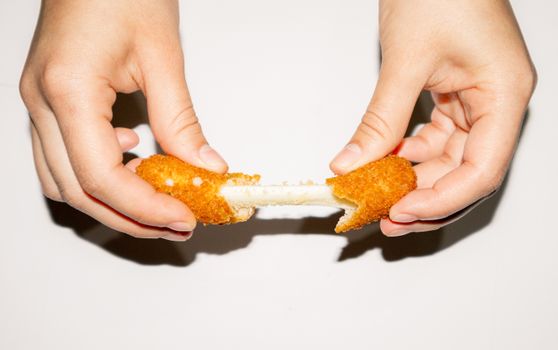
Photo: José Pérez (Artesano) / Pexels
American
Mozzarella Sticks
The diets react (see scores below)
Common Ingredients
- mozzarella cheese
- flour
- eggs
- breadcrumbs
- Italian seasoning
- marinara sauce
- vegetable oil
Specific recipes may vary.
Incompatible with 11 of 11 diets
Diet Ratings
Mozzarella sticks are fundamentally incompatible with a ketogenic diet in their traditional form. The breading—made from flour and breadcrumbs—is grain-based and high in net carbs, adding roughly 15-20g of net carbs per serving of 3-4 sticks. The marinara dipping sauce adds additional sugars and carbs. While mozzarella cheese itself is keto-friendly, the coating completely disqualifies this dish. Vegetable oil is also a poor fat choice. The only path to a keto version would require a complete reformulation using almond flour or pork rind breading, but the dish as described is not keto.
Mozzarella sticks contain multiple animal-derived ingredients that are clearly incompatible with a vegan diet. Mozzarella cheese is a dairy product made from cow's milk, and eggs are used in the batter coating. Both are direct animal products explicitly excluded under all vegan frameworks. The remaining ingredients — flour, breadcrumbs, Italian seasoning, marinara sauce, and vegetable oil — are plant-based, but the presence of cheese and eggs is disqualifying regardless.
Mozzarella sticks are fundamentally incompatible with the paleo diet on multiple levels. The dish contains mozzarella cheese (dairy, excluded from paleo), flour (wheat grain, excluded), breadcrumbs (processed grain product, excluded), and vegetable oil (seed oil, excluded). That is four distinct paleo violations in a single dish. The only arguably paleo-compatible ingredient is eggs, and even the marinara sauce likely contains added sugar and salt. This is a deeply processed, grain-and-dairy-centric snack with no meaningful paleo redeeming qualities.
Mozzarella sticks are a heavily processed American snack food that contradicts core Mediterranean diet principles on multiple fronts. They are deep-fried in vegetable oil (not olive oil), coated in refined white flour breadcrumbs, and consist primarily of breaded, fried cheese. The cooking method adds excessive unhealthy fats, the refined grain coating offers no nutritional value, and frying in industrial vegetable oils is the antithesis of Mediterranean fat sourcing. While mozzarella and marinara sauce have Mediterranean-adjacent ingredients, the overall preparation transforms them into a highly processed, calorie-dense snack with no redeeming Mediterranean qualities.
Mozzarella sticks are fundamentally incompatible with the carnivore diet. While mozzarella cheese is an animal-derived ingredient (though already debated in strict carnivore circles), the dish is dominated by plant-based components: wheat flour breading, breadcrumbs, Italian seasoning, and marinara sauce. The frying medium is vegetable oil, a seed/plant oil that is explicitly excluded. The breading alone makes this a grain-based food. Served with marinara sauce (tomatoes, plant-based), there is virtually no redeeming carnivore quality to this dish as prepared. Even the most lenient carnivore practitioners who include dairy would reject this due to the processed wheat coating and plant-based sides.
Mozzarella sticks contain multiple excluded ingredients that make them clearly non-compliant with Whole30. Mozzarella cheese is dairy (excluded), flour is a grain (excluded), and breadcrumbs are also grain-based (excluded). Additionally, this dish is essentially a fried, breaded snack food — exactly the type of 'junk food recreation' the program prohibits. Even if somehow reformulated, it would fall under the spirit-of-the-program rule against recreating comfort/junk foods.
Mozzarella sticks contain multiple high-FODMAP ingredients that make this dish unsuitable during the elimination phase. The primary issues are: (1) wheat flour — high in fructans, a key FODMAP trigger; (2) breadcrumbs — typically wheat-based and also high in fructans; (3) marinara sauce — standard marinara contains onion and/or garlic, both of which are among the highest-FODMAP foods per Monash University. While mozzarella cheese itself is low-FODMAP (it is a low-lactose hard/semi-hard cheese, safe at standard servings), and eggs and vegetable oil are low-FODMAP, the wheat-based coating and the marinara dipping sauce create unavoidable high-FODMAP exposure. Even a small serving of 2-3 mozzarella sticks would deliver a clinically significant fructan load from the batter and breading, plus fructan/GOS exposure from the sauce. There is no realistic way to consume this dish as described within safe FODMAP limits during elimination.
Mozzarella sticks are fundamentally incompatible with DASH diet principles. The dish is deep-fried in vegetable oil, adding significant total fat and calories. The primary ingredient, mozzarella cheese, is a full-fat dairy product high in saturated fat and sodium — directly contradicting DASH's emphasis on low-fat or fat-free dairy. Breadcrumb coatings and marinara sauce add additional sodium, pushing total sodium content well above DASH-friendly levels (a typical restaurant serving of 6 mozzarella sticks can contain 700–1,200mg of sodium, representing 50–80% of the low-sodium DASH daily limit in a single snack). The deep-frying method adds excess saturated and total fat. There is no meaningful contribution of potassium, magnesium, fiber, or other DASH-valued nutrients. This is a heavily processed, fried, high-saturated-fat, high-sodium snack that conflicts with nearly every core DASH principle.
Mozzarella sticks are a deeply problematic food from a Zone Diet perspective on multiple fronts. The coating consists of refined flour and breadcrumbs — high-glycemic, nutritionally empty carbohydrates that spike insulin rapidly. The frying medium is vegetable oil, typically a high omega-6 seed oil (soybean, canola, or corn oil), which Sears explicitly discourages due to its pro-inflammatory arachidonic acid cascade. The cheese itself contributes significant saturated fat with very little lean protein relative to its fat load. The macronutrient ratio is severely distorted: the dish skews heavily toward fat (primarily saturated and omega-6) and refined carbohydrates, with minimal lean protein contribution. There is no low-glycemic vegetable component, no monounsaturated fat source, and no lean protein anchor. The marinara sauce adds a small polyphenol benefit from tomatoes but is insufficient to rehabilitate the dish. Even in a controlled portion, this snack would require an almost impossible dietary correction in the surrounding meal to restore Zone balance. It fails on nearly every Zone criterion simultaneously: glycemic load, fat quality, fat type, and macro ratio.
Mozzarella sticks are a deeply problematic food from an anti-inflammatory standpoint across nearly every component. The base is full-fat mozzarella cheese, which contributes saturated fat — a known promoter of inflammatory markers including CRP and IL-6. The coating combines refined white flour and breadcrumbs, both refined carbohydrates that spike blood sugar and contribute to glycation-driven inflammation. Deep frying in vegetable oil (typically soybean, corn, or sunflower) introduces a high omega-6 fatty acid load; at frying temperatures, these polyunsaturated oils also oxidize and can generate aldehydes and other pro-inflammatory byproducts. The only redemptive element is the marinara sauce, which contains lycopene-rich tomatoes with modest anti-inflammatory properties, and the Italian seasoning which may include small amounts of anti-inflammatory herbs. These are entirely insufficient to offset the dish's overall inflammatory profile. As a deep-fried, refined-carbohydrate, full-fat dairy snack, mozzarella sticks represent a convergence of multiple anti-inflammatory diet 'avoid' categories simultaneously.
Mozzarella sticks are a deep-fried, high-fat snack with minimal protein density and poor fiber content. They are fried in vegetable oil, which dramatically increases fat content and caloric density while contributing nothing nutritionally. The mozzarella cheese provides some protein, but the ratio of fat and refined carbohydrates (white flour, breadcrumbs) to protein is unfavorable for GLP-1 patients. Deep-fried foods are a known trigger for nausea, bloating, and reflux — side effects that GLP-1 medications already amplify through slowed gastric emptying. The refined breading coating adds empty carbohydrates with no fiber. The marinara sauce adds minimal nutritional value and, depending on preparation, may contain added sugars. This food also fails the small-portion-friendliness test: a typical serving is 4-6 sticks delivering roughly 15-20g fat, 25-30g refined carbs, and only 10-12g protein — a poor nutritional trade-off at a time when every calorie must count.
*See how scores were generated at our methodology page.
Nutritional profile
Six traits that cut across every diet.
Fiber & Plants
How much whole-plant food and fiber it delivers.
Healthy Fats
The quality of its fats (unsaturated, omega-3).
Whole / Unprocessed
How close it is to its natural, unprocessed form.
Gut Gentle
How easy it is on digestion (low FODMAP, few irritants).
Low Glycemic
How little it spikes your blood sugar.
Protein Density
How much protein it packs per calorie.
Controversy Index
Higher controversy = more disagreement between diets.