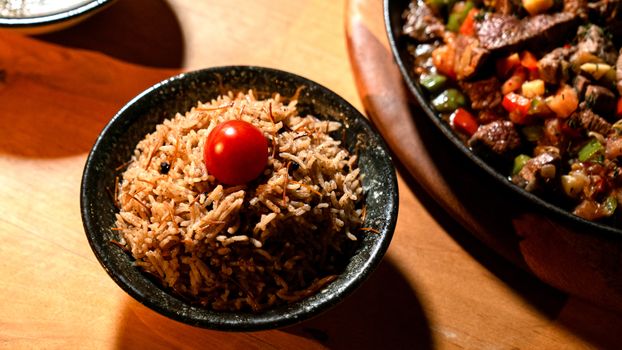
Photo: Mohamed Olwy / Pexels
Middle-Eastern
Mujadara
The diets react (see scores below)
Common Ingredients
- lentils
- rice
- onions
- olive oil
- cumin
- cinnamon
- black pepper
- salt
Specific recipes may vary.
Incompatible with 5 of 11 diets
Diet Ratings
Mujadara is fundamentally incompatible with a ketogenic diet. Its two primary ingredients — lentils and rice — are both dense sources of net carbohydrates. A standard serving (roughly 1 cup) contains approximately 40-50g of net carbs from rice alone, and lentils add another 25-30g net carbs per cup after fiber subtraction. Together, a single serving easily exceeds the entire daily keto carb allowance of 20-50g. Lentils are legumes with a moderate glycemic impact, and white rice is a rapidly digested starch that spikes blood glucose and insulin, directly disrupting ketosis. The olive oil and spices are keto-friendly, but they cannot offset the overwhelming carbohydrate load from the base ingredients. There is no realistic portion size that makes this dish compatible with ketosis.
Mujadara is a traditional Middle Eastern dish composed entirely of whole plant foods: lentils, rice, onions, olive oil, and spices. Every ingredient is unambiguously plant-derived with no animal products or animal-derived additives. Lentils provide protein and fiber, making this a nutritionally complete and satisfying whole-food vegan meal. The use of olive oil is minimal and standard. There is no meaningful debate within the vegan community about any of these ingredients.
Mujadara is built on two core paleo-excluded ingredients: lentils (a legume) and rice (a grain). Both are explicitly off-limits in virtually all paleo frameworks due to their lectin, phytate, and anti-nutrient content. Added salt is also discouraged under strict paleo guidelines. The olive oil, onions, and spices (cumin, cinnamon, black pepper) are paleo-approved, but they are minor supporting ingredients and cannot redeem a dish whose foundation is entirely non-paleo. This is not a gray-area case — lentils and grains are among the most unambiguously excluded food categories in paleo.
Mujadara is a wholesome, plant-based dish built on lentils and rice — both staples deeply aligned with Mediterranean diet principles. Lentils are an excellent legume protein source, strongly encouraged as a daily food. Olive oil is the cooking fat, perfectly in line with the diet's primary fat source. The aromatics (onion, cumin, cinnamon) add flavor without nutritional compromise. The only mild caveat is the use of white rice rather than a whole grain, which is why the score doesn't reach a 9 or 10.
Some modern Mediterranean diet clinical guidelines (e.g., those aligned with the PREDIMED study framework) would prefer brown rice or bulgur over white rice to maximize whole-grain intake and glycemic benefit. However, white rice has a long tradition in Levantine and Eastern Mediterranean cuisines, and in the context of a legume-rich dish like mujadara, the lentils significantly moderate the overall glycemic load.
Mujadara is entirely plant-based and contains zero animal products. Every single ingredient — lentils, rice, onions, olive oil, cumin, cinnamon, black pepper, and salt (the only borderline-acceptable component) — is plant-derived. Lentils and rice are legumes and grains respectively, both strictly excluded from the carnivore diet. Onions are vegetables, olive oil is a plant oil, and cumin and cinnamon are plant spices. This dish is fundamentally incompatible with carnivore principles at every level, with no animal-derived component whatsoever. There is universal consensus across all carnivore diet tiers — from the most permissive 'animal-based' approach to the strictest Lion Diet — that this dish must be avoided entirely.
Mujadara contains two explicitly excluded ingredient categories: lentils (legumes) and rice (grains). Both are clearly prohibited on the Whole30 program. There are no exceptions for lentils or rice, and no compliant substitutions that would preserve the identity of this dish. The remaining ingredients — onions, olive oil, cumin, cinnamon, black pepper, and salt — are all Whole30-compliant, but the foundational components of the dish disqualify it entirely.
Mujadara contains two major high-FODMAP ingredients that make it unsuitable during the elimination phase at standard serving sizes. Lentils are high in GOS (galacto-oligosaccharides) — while canned/drained lentils are somewhat lower in GOS than dried, a standard serving (½ cup or more) still exceeds the low-FODMAP threshold. Onions are one of the highest-FODMAP foods tested by Monash University, being very high in fructans even at small amounts (1/8 of a medium onion can be problematic). Since caramelized or fried onions are a defining, generous component of mujadara, there is no realistic way to make a standard portion of this dish low-FODMAP without fundamentally altering the recipe. Rice, olive oil, cumin, cinnamon, black pepper, and salt are all low-FODMAP and pose no concern, but the lentil and onion combination makes this dish a clear avoid during elimination.
Mujadara is a highly DASH-compatible dish. Lentils are an excellent source of plant-based protein, fiber, potassium, and magnesium — all nutrients emphasized in the DASH eating plan. Rice (preferably brown) provides complex carbohydrates, and caramelized onions contribute additional fiber, potassium, and antioxidants. Olive oil is a heart-healthy unsaturated fat aligned with DASH principles. The spices (cumin, cinnamon, black pepper) add flavor without sodium. The main concern is salt — the amount added during cooking determines whether this dish fits standard DASH (<2,300mg/day) or low-sodium DASH (<1,500mg/day) targets. Prepared with minimal salt, this dish scores very highly. The use of white rice rather than brown rice is a minor drawback, as DASH emphasizes whole grains. The olive oil quantity should be moderate to avoid excess calories.
NIH DASH guidelines strongly endorse legumes (4-5 servings/week) and favor whole grains; updated clinical interpretations would note that white rice, while less ideal than brown, is not excluded from DASH and that the overall nutrient profile of this dish (high fiber, potassium, magnesium, plant protein, minimal saturated fat) makes it a strong DASH choice regardless of rice variety.
Mujadara is a traditional Middle Eastern dish combining lentils, rice, and caramelized onions in olive oil. From a Zone perspective, it presents a mixed picture. Lentils are one of the Zone's most favorable carbohydrate sources — they are low-glycemic, high in fiber, and provide modest protein (roughly 9g protein and 20g net carbs per 100g cooked), making them a reasonable dual carb-protein block contributor. However, rice is classified as an 'unfavorable' Zone carbohydrate — it is higher glycemic and nutritionally less dense than vegetables or legumes. The olive oil is an ideal Zone fat source. The core Zone problem with mujadara as a standalone main dish is the macro imbalance: it is very carbohydrate-heavy (lentils + rice combined), with insufficient protein to hit the 30% protein target, and no lean animal or high-protein source listed. The lentil protein alone is incomplete for a Zone meal block target of ~25g protein per meal. As a vegetarian protein source in Zone terms, fat blocks would count at 3g fat per block rather than 1.5g. To Zone-balance this dish, one would need to significantly reduce the rice portion (or substitute cauliflower rice), increase the lentil-to-rice ratio, and add a lean protein source on the side. The dish is not disqualifying — lentils are genuinely favorable — but as presented it skews heavily carbohydrate with an unfavorable rice component and no adequate protein anchor.
Some Zone practitioners, particularly those following Sears' later work on polyphenols and anti-inflammatory eating, would note that lentils' exceptional fiber content and very low glycemic load make them nearly ideal Zone carbs, and that a small rice portion alongside a large lentil base is workable within Zone block math. Sears has also softened his position on legume-based vegetarian meals in later writings, acknowledging their favorable insulin response despite carbohydrate density. A strict early-Zone reading would flag the rice and absent lean protein more harshly.
Mujadara is a strong anti-inflammatory dish. Lentils are a legume — a cornerstone of anti-inflammatory eating — providing plant protein, soluble fiber, folate, and polyphenols that support a healthy gut microbiome and reduce inflammatory markers like CRP. Rice provides a whole-food carbohydrate base (though white rice is less beneficial than brown, it is not pro-inflammatory). Caramelized onions contribute quercetin and other flavonoids with well-documented anti-inflammatory effects. Olive oil is a flagship anti-inflammatory fat, rich in oleocanthal and monounsaturated fatty acids. Cumin and cinnamon are both recognized anti-inflammatory spices with antioxidant properties; cinnamon in particular has been associated with reduced NF-κB activation. The dish contains no refined sugar, no trans fats, no seed oils, no processed ingredients, and no red meat. The overall profile is high in fiber, polyphenols, and plant compounds while being low in saturated fat — a near-ideal anti-inflammatory meal pattern aligned closely with Dr. Weil's Anti-Inflammatory Food Pyramid.
Mujadara is a nutritionally respectable Middle Eastern dish built on lentils and rice. Lentils are a genuine GLP-1 asset — they deliver meaningful plant protein (~18g per cooked cup) and substantial fiber (~16g per cup), supporting both muscle preservation and the constipation prevention that GLP-1 patients need. The caramelized onions add additional fiber and micronutrients. Olive oil is a preferred unsaturated fat and is used in moderate amounts. Cumin and cinnamon are well-tolerated spices with no significant GI concern at typical doses. The limiting factors are the rice (refined carbohydrate, low protein density, moderate glycemic load) and the absence of a concentrated animal or complementary protein source — lentils alone provide incomplete amino acid coverage and the dish as classified has no primary protein. For a GLP-1 patient eating small volumes, a standard serving may not reliably hit the 15–30g per-meal protein target without augmentation. The dish is easy to digest, low in fat, and nutrient-dense per calorie, which are meaningful positives. It earns a caution-range approval: excellent as a side or base, but should be paired with a lean protein (grilled chicken, a poached egg, Greek yogurt on the side) to meet GLP-1 meal protein thresholds.
Some GLP-1-focused dietitians consider lentil-forward dishes like mujadara fully approvable as a main when portion is controlled and the lentil-to-rice ratio is increased, arguing the combined fiber and plant protein profile is sufficient and that the whole-food, minimally processed character outweighs the protein gap. Others maintain that GLP-1 patients eating reduced volumes cannot afford a main dish without a concentrated protein anchor, and would categorize this as a side dish only.
*See how scores were generated at our methodology page.
Nutritional profile
Six traits that cut across every diet.
Fiber & Plants
How much whole-plant food and fiber it delivers.
Healthy Fats
The quality of its fats (unsaturated, omega-3).
Whole / Unprocessed
How close it is to its natural, unprocessed form.
Gut Gentle
How easy it is on digestion (low FODMAP, few irritants).
Low Glycemic
How little it spikes your blood sugar.
Protein Density
How much protein it packs per calorie.
Controversy Index
Higher controversy = more disagreement between diets.
Diet-Specific Tips
 Vegan — 9/10
View tips
- Lentils and rice are whole plant foods and core vegan staples
- Caramelized onions are fully plant-based
- Olive oil is plant-derived with no animal ingredients
- All spices (cumin, cinnamon, black pepper, salt) are plant-based or mineral
- No animal products, dairy, eggs, or animal-derived additives present
- High nutritional value: protein-rich legume combined with complex carbohydrate
 Mediterranean — 8/10
View tips
- Lentils are a core Mediterranean legume, strongly encouraged
- Olive oil as the primary fat is ideal
- White rice is a refined grain, less preferred than whole grains
- No processed ingredients, added sugars, or red meat
- Plant-forward, nutrient-dense profile
- Traditional Levantine dish consistent with Eastern Mediterranean food culture
 DASH — 8/10
View tips
- Lentils are a DASH-emphasized legume — excellent source of fiber, potassium, magnesium, and plant protein
- Olive oil provides heart-healthy monounsaturated fats aligned with DASH
- No saturated fat, no cholesterol, no added sugar
- White rice is less ideal than brown rice for DASH (lower fiber, higher glycemic index)
- Salt content is the key variable — must be kept low to meet DASH sodium targets (<2,300mg/day standard, <1,500mg/day low-sodium)
- Spice-forward flavor profile reduces need for added sodium
- Portion control of olive oil recommended to manage calorie density
 Zone — 5/10
View tips
- Lentils are a Zone-favorable low-glycemic carbohydrate with useful protein contribution
- Rice is an 'unfavorable' Zone carbohydrate — higher glycemic, lower fiber than preferred sources
- Dish is carbohydrate-dominant, making 40/30/30 ratio difficult to achieve without modifications
- No primary lean protein source — lentil protein alone is insufficient to meet Zone protein block targets for a main meal
- Olive oil is an ideal Zone fat (monounsaturated)
- Cumin and cinnamon contribute polyphenols aligned with Sears' anti-inflammatory focus
- Dish is salvageable in Zone with rice reduction and addition of a lean protein side
 Anti-Inflammatory — 8/10
View tips
- Lentils are an emphasized legume — fiber-rich, high in polyphenols, associated with reduced CRP
- Olive oil provides oleocanthal and monounsaturated fats with established anti-inflammatory action
- Onions supply quercetin and flavonoids with anti-inflammatory and antioxidant properties
- Cumin and cinnamon are recognized anti-inflammatory spices
- No refined sugars, trans fats, processed additives, or pro-inflammatory seed oils
- White rice is neutral — not pro-inflammatory, but brown rice would add additional fiber and nutrients
- Entirely plant-based with no saturated fat burden
 GLP-1 Friendly — 6/10
View tips
- Lentils provide meaningful plant protein (~18g/cup cooked) and high fiber (~16g/cup) — strong GLP-1 positives
- No primary protein source listed; dish alone unlikely to meet 15–30g per-meal protein target in small GLP-1 portions
- Rice contributes refined carbohydrates with limited protein or fiber payoff — using brown rice would improve rating
- Olive oil is a preferred unsaturated fat; used in moderate amounts, no fat-overload concern
- Spices (cumin, cinnamon, black pepper) are well-tolerated and carry no significant GI side effect risk
- High fiber content actively supports constipation prevention, a key GLP-1 side effect concern
- Easy to digest, low fat per serving, nutrient-dense per calorie — all favorable for GLP-1 patients
- Best used as a base or side paired with a lean protein to meet meal protein targets