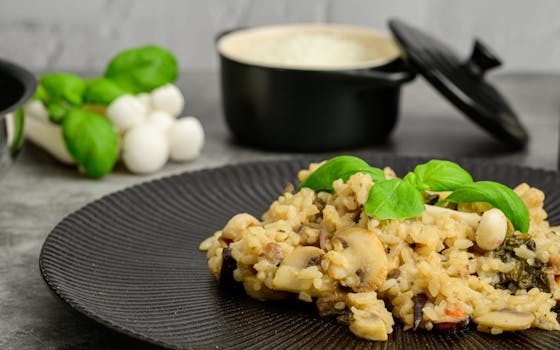
Photo: Jana Ohajdova / Pexels
Italian
Mushroom Risotto
The diets react (see scores below)
Common Ingredients
- arborio rice
- mixed mushrooms
- white wine
- Parmesan
- butter
- onion
- garlic
- chicken broth
Specific recipes may vary.
Incompatible with 6 of 11 diets
Diet Ratings
Mushroom risotto is fundamentally incompatible with a ketogenic diet. The primary ingredient, arborio rice, is a high-starch short-grain rice that contains approximately 35-40g of net carbs per half-cup cooked serving — already exceeding or consuming nearly the entire daily keto carb budget in a single component. A standard risotto serving would contain well over 50-70g of net carbs from the rice alone, making ketosis impossible. White wine and onion add further carbohydrates. The butter and Parmesan are keto-friendly, and mushrooms are low-carb, but these positives are entirely overwhelmed by the rice base. There is no portion size small enough to make traditional risotto compatible with ketosis — it would cease to be risotto. Keto-friendly alternatives exist using cauliflower rice as a substitute.
This mushroom risotto contains multiple animal-derived ingredients that make it incompatible with a vegan diet. Parmesan cheese is a dairy product (and specifically contains animal rennet), butter is a dairy fat, and chicken broth is an animal-based stock. All three must be excluded for the dish to be vegan. The base ingredients — arborio rice, mixed mushrooms, white wine, onion, and garlic — are fully plant-based, so a vegan version is achievable by substituting vegetable broth, vegan butter or olive oil, and nutritional yeast or a vegan Parmesan alternative.
Mushroom Risotto is fundamentally incompatible with the Paleo diet. Arborio rice is a grain — explicitly excluded under all mainstream paleo frameworks. Parmesan is dairy, and butter is dairy — both avoided in strict paleo. White wine, while debated in some circles, is a processed alcoholic product. Chicken broth may contain added salt and additives depending on preparation. The only paleo-compliant ingredients in this dish are the mixed mushrooms, onion, and garlic. With multiple core violations — grain, dairy (x2), and processed ingredients — this dish scores at the very bottom of the paleo scale.
Mushroom risotto presents a mixed Mediterranean diet picture. The mushrooms, onion, garlic, and wine are all Mediterranean-friendly ingredients. However, the dish is built on arborio rice — a refined, starchy white rice — rather than a whole grain, and relies on butter as the primary fat instead of extra virgin olive oil. Parmesan is present in a moderate amount typical of Italian cuisine, which is acceptable but adds saturated fat. The absence of olive oil and the use of refined grain as the base are the main concerns. This is a culturally authentic Italian dish, but it diverges from core Mediterranean diet principles around whole grains and olive oil as the primary fat.
Traditional Italian cuisine, which forms a pillar of the Mediterranean diet, has always included risotto made with arborio rice and finished with butter and Parmesan (the 'mantecatura' technique). Some Mediterranean diet authorities, particularly those emphasizing the traditional dietary patterns of northern Italy, would view this dish as an acceptable occasional meal within a broader plant-forward diet rather than a problematic outlier.
Mushroom Risotto is fundamentally incompatible with the carnivore diet. The dish is built almost entirely on plant-based ingredients: arborio rice (a grain), mixed mushrooms (fungi), onion, garlic, and white wine. Even the small amount of animal-derived ingredients present — butter and Parmesan — are secondary and don't redeem the dish. There is no meaningful animal protein source. The primary macronutrient base is a high-carbohydrate grain, which is strictly excluded on any tier of carnivore eating. This dish represents the opposite of carnivore principles.
Mushroom Risotto contains multiple Whole30-excluded ingredients. Arborio rice is a grain and is explicitly excluded from the Whole30 program. Parmesan is a dairy product (cheese), which is also excluded. Regular butter is excluded (only ghee and clarified butter are allowed). White wine is alcohol, which is excluded. This dish fails on four separate exclusion criteria, making it clearly non-compliant.
Mushroom Risotto as traditionally prepared contains multiple high-FODMAP ingredients that make it unsuitable during the elimination phase. Onion is one of the highest-FODMAP foods tested by Monash University, rich in fructans and problematic at any typical serving size. Garlic is similarly high in fructans and must be avoided entirely during elimination. Mixed mushrooms are high in polyols (mannitol) — while some mushroom varieties like oyster mushrooms are lower-FODMAP, most common mushrooms (button, cremini, portobello, shiitake) are high-FODMAP even at small servings. The combination of onion, garlic, and mushrooms creates a triple FODMAP hit that cannot be rescued by portion control. Arborio rice, Parmesan, butter, white wine (in small amounts), and chicken broth (if onion/garlic-free) would otherwise be low-FODMAP components. This dish would require fundamental reformulation — removing onion and garlic entirely, substituting garlic-infused oil and green onion tops, and selecting low-FODMAP mushrooms — to become elimination-phase safe.
Mushroom risotto contains several DASH-friendly components — mushrooms provide potassium and fiber, onion and garlic are heart-healthy aromatics, and arborio rice is an acceptable grain. However, the dish raises concerns from a DASH perspective. Traditional preparation uses regular chicken broth (high sodium, often 700-900mg per cup), butter (saturated fat), and Parmesan (high in sodium and saturated fat), making the overall sodium and saturated fat load significant. White wine adds minimal concern but contributes alcohol and empty calories. Arborio rice is also a refined, high-glycemic grain rather than a whole grain preferred by DASH. The dish is not inherently off-limits but requires meaningful modifications — low-sodium broth, reduced butter, limited Parmesan — to align with DASH guidelines. As typically prepared in restaurants or at home, it lands in cautious territory.
NIH DASH guidelines emphasize low-sodium broth alternatives and limiting saturated fat from butter and full-fat cheese; however, updated clinical interpretations note that small amounts of Parmesan used for flavor (rather than large portions) may be acceptable given its strong taste-per-gram ratio, and some DASH-oriented dietitians allow modest refined grains within an otherwise compliant eating pattern rather than requiring strict whole-grain substitution at every meal.
Mushroom risotto is a challenging dish for the Zone Diet for several reasons. Arborio rice is a high-glycemic, starchy carbohydrate — exactly what Dr. Sears classifies as 'unfavorable' in Zone terminology. It causes rapid blood sugar spikes and is difficult to portion into Zone blocks without throwing the 40/30/30 ratio off significantly. The dish also lacks meaningful lean protein (no primary protein source listed), which is a core Zone meal requirement of ~25g protein per meal. Butter contributes saturated fat rather than the preferred monounsaturated fats. Parmesan adds some protein but also saturated fat. The mushrooms are a genuine Zone-favorable vegetable — low-glycemic, rich in polyphenols — but they are overwhelmed by the rice base. White wine contributes fermentable sugars. The overall macronutrient profile of this dish is heavily carbohydrate-skewed (primarily high-GI), low in lean protein, and the fat profile leans saturated rather than monounsaturated. While a small portion could technically be incorporated as a carb block in a larger Zone meal, as a standalone main dish it fundamentally conflicts with Zone principles. The score is kept at 3 rather than 1-2 because mushrooms are favorable and small portions are technically workable, but this dish as presented is one of the harder items to reconcile with Zone methodology.
Mushroom risotto has a mixed anti-inflammatory profile. On the positive side, mixed mushrooms (especially varieties like shiitake, oyster, or maitake) are explicitly emphasized in anti-inflammatory frameworks for their beta-glucans, polysaccharides, and immune-modulating compounds. Garlic and onion contribute quercetin and allicin, both with documented anti-inflammatory activity. White wine in cooking amounts contributes minimal concern. However, several ingredients pull the dish toward neutral or mildly pro-inflammatory territory: arborio rice is a refined, high-glycemic grain with virtually no fiber, which can spike blood sugar and promote insulin-driven inflammation — a meaningful concern in anti-inflammatory eating. Butter is a saturated fat that anti-inflammatory guidelines recommend limiting. Parmesan is a full-fat aged cheese, also in the 'limit' category for saturated fat content. Chicken broth is generally neutral. The dish is not a red-flag inflammatory food, but its foundation of refined starch plus saturated fat (butter and Parmesan) prevents it from earning an 'approve.' Substituting brown rice or farro (impractical for traditional risotto) or reducing butter in favor of olive oil would meaningfully improve the profile.
Dr. Weil's pyramid permits whole grains and occasional dairy in moderation, and some practitioners would consider this dish acceptable given the mushroom and allium content and the absence of processed ingredients or seed oils. However, stricter anti-inflammatory protocols would flag the high-glycemic arborio rice and saturated fat load as meaningful negatives that outweigh the mushroom benefits.
Mushroom risotto is a carbohydrate-dominant dish built on arborio rice, a refined, starchy grain with minimal fiber and low protein density. The cooking method (butter, Parmesan, white wine) adds saturated fat and empty calories, and the creamy texture — while easy to eat in small portions — comes at a nutritional cost. Mushrooms contribute some fiber, B vitamins, and trace minerals, and the chicken broth adds modest depth, but neither meaningfully shifts the protein or fiber profile. A standard serving delivers roughly 6–8g protein and 1–2g fiber, well below GLP-1 targets of 15–30g protein per meal and 25–30g fiber daily. The dish is not inherently harmful — it is easy to digest, soft in texture, and portion-friendly — but it occupies caloric real estate that patients with suppressed appetites cannot afford to waste on low-nutrient-density foods. It is acceptable occasionally as a side or small course, particularly if augmented with a lean protein (grilled chicken, shrimp), but as a standalone main with no primary protein source it falls short of GLP-1 dietary priorities.
Some GLP-1-focused dietitians accept risotto in small portions as a tolerable, easy-to-digest comfort food during high-nausea periods when palatable options are limited — prioritizing adequate caloric intake over ideal nutrient density. Others flag the butter and Parmesan as meaningful saturated fat contributors that may worsen GI side effects, particularly in patients already experiencing reflux or delayed gastric emptying.
*See how scores were generated at our methodology page.
Nutritional profile
Six traits that cut across every diet.
Fiber & Plants
How much whole-plant food and fiber it delivers.
Healthy Fats
The quality of its fats (unsaturated, omega-3).
Whole / Unprocessed
How close it is to its natural, unprocessed form.
Gut Gentle
How easy it is on digestion (low FODMAP, few irritants).
Low Glycemic
How little it spikes your blood sugar.
Protein Density
How much protein it packs per calorie.
Controversy Index
Higher controversy = more disagreement between diets.
Diet-Specific Tips
 Mediterranean — 4/10
View tips
- Arborio rice is a refined grain, not a whole grain — conflicts with Mediterranean grain guidance
- Butter used as primary fat instead of extra virgin olive oil
- Mushrooms, onion, and garlic are excellent Mediterranean vegetables
- Parmesan in moderate amounts is acceptable but adds saturated fat
- White wine is a traditional Mediterranean cooking ingredient
- No added sugars or highly processed ingredients
- Dish lacks plant protein or healthy fat sources like legumes or nuts
 DASH — 5/10
View tips
- Arborio rice is refined, not a whole grain — DASH prefers whole grains
- Chicken broth is typically high in sodium; low-sodium versions significantly improve DASH compatibility
- Butter contributes saturated fat, which DASH limits
- Parmesan is high in sodium and saturated fat — portion size is critical
- Mushrooms are DASH-positive: rich in potassium, fiber, and low in calories
- Onion and garlic are heart-healthy and DASH-approved aromatics
- Overall sodium content of the dish as traditionally prepared likely exceeds DASH per-meal targets
 Zone — 5/10
View tips
- Arborio rice is high-glycemic and classified as 'unfavorable' carbohydrate in Zone — causes rapid insulin spike
- No lean protein source — fails Zone's ~25g protein per meal requirement
- Butter contributes saturated fat, not the preferred monounsaturated fats (olive oil, avocado, almonds)
- Parmesan adds some protein but also saturated fat
- Mixed mushrooms are Zone-favorable (low-glycemic, polyphenol-rich) but are a minor component
- Dish is heavily carbohydrate-dominant, making 40/30/30 ratio very difficult to achieve
- White wine adds additional fermentable sugars/high-glycemic carbohydrates
 Anti-Inflammatory — 5/10
View tips
- Mixed mushrooms: strong anti-inflammatory asset (beta-glucans, immune modulation)
- Garlic and onion: quercetin and allicin contribute anti-inflammatory benefit
- Arborio rice: refined, high-glycemic grain with minimal fiber — promotes blood sugar spikes
- Butter: saturated fat, falls in the 'limit' category per anti-inflammatory guidelines
- Parmesan: full-fat cheese, adds to saturated fat load
- No omega-3 sources, no leafy greens, no olive oil in traditional preparation
- White wine: negligible concern in cooking quantities
 GLP-1 Friendly — 4/10
View tips
- Low protein — approximately 6–8g per serving, significantly below the 15–30g per meal target
- Refined starch base (arborio rice) with minimal fiber — poor blood sugar stability
- Butter and Parmesan add saturated fat, which can worsen nausea, reflux, and bloating
- Mushrooms provide modest fiber and micronutrients but do not compensate for macro deficiencies
- White wine adds alcohol-derived empty calories, though quantity per serving is small after cooking
- Soft texture and small-portion friendliness are genuine positives for GLP-1 patients with GI sensitivity
- No designated primary protein source — unsuitable as a standalone main on a GLP-1 diet
- Nutritional profile improves substantially if paired with a lean protein addition