Photo: Rama Tria Wijaya / Pexels
American
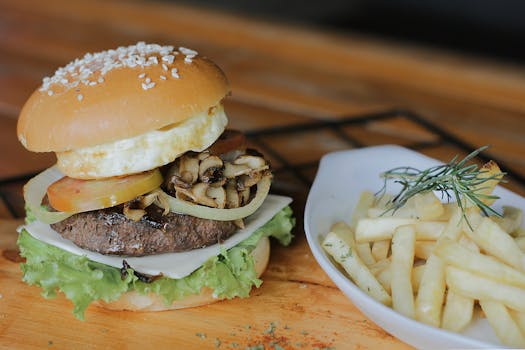
Mushroom Swiss Burger
The diets react (see scores below)

That’s a heavy plate — want to see the leaner version?
Common Ingredients
- ground beefGround turkey
Lean ground turkey cuts the saturated fat of ground beef while keeping the dish a ground-meat dish.
- button mushrooms
- Swiss cheese
- brioche bunWhole wheat hamburger bun
A whole-wheat bun adds fiber over the refined brioche bun.
- butterExtra virgin olive oil
Extra-virgin olive oil swaps saturated fat for monounsaturated fat in place of butter.
- garlic
- thyme
Specific recipes may vary.
Incompatible with 10 of 11 diets
Diet Ratings
The Mushroom Swiss Burger as traditionally prepared is incompatible with a ketogenic diet primarily because of the brioche bun. Brioche is a highly refined, enriched bread typically containing 25-30g of net carbs per bun — enough to exceed or nearly exhaust an entire day's carb budget in one component alone. The remaining ingredients (ground beef, Swiss cheese, butter, mushrooms, garlic, thyme) are all keto-friendly and would otherwise make an excellent keto meal. The dish is categorized as a sandwich, meaning the bun is a defining structural and culinary element, not an optional garnish. Without modification, this dish cannot be consumed on keto without breaking ketosis.
The Mushroom Swiss Burger contains multiple animal products that are strictly excluded from a vegan diet. Ground beef is slaughtered animal flesh, Swiss cheese is a dairy product derived from cow's milk, and butter is an animal-derived fat also from dairy. The brioche bun typically contains eggs and butter as well. There is nothing ambiguous here — this dish is fundamentally built around animal products and is entirely incompatible with vegan dietary standards.
The Mushroom Swiss Burger contains multiple non-paleo ingredients that make it clearly incompatible with the paleo diet. The brioche bun is made from wheat flour, a grain strictly excluded from paleo. Swiss cheese is dairy, also excluded. Butter is a dairy product excluded by strict paleo guidelines. While ground beef, button mushrooms, garlic, and thyme are all paleo-approved, the core structural components of this dish — the bun and the cheese — are definitive paleo violations. The dish as presented cannot be considered paleo-compatible in any mainstream interpretation.
The Mushroom Swiss Burger is fundamentally misaligned with Mediterranean diet principles across multiple dimensions. Ground beef is a red meat that should be limited to a few times per month, making it an infrequent exception rather than a dietary staple. The brioche bun is a refined, enriched grain product made with butter and eggs, contradicting the preference for whole grains. Butter is used instead of olive oil as the primary fat, directly opposing the foundational principle of extra virgin olive oil as the primary fat source. Swiss cheese, while not prohibited, adds significant saturated fat. The only Mediterranean-friendly elements are the mushrooms, garlic, and thyme, which are minor components that do not redeem the overall dish. This is a highly processed, fast-food-style American dish with no meaningful Mediterranean diet alignment.
The Mushroom Swiss Burger contains multiple disqualifying ingredients for the carnivore diet. The brioche bun is a grain-based bread product — a clear violation. Button mushrooms are fungi (plant kingdom). Garlic and thyme are plant-derived aromatics. While the ground beef, Swiss cheese, and butter have carnivore merit individually, the dish as a whole is built around a bread-based sandwich format with plant foods as core components. This cannot be adapted into a carnivore meal without fundamentally deconstructing it into a different dish entirely.
The Mushroom Swiss Burger contains multiple excluded ingredients. Swiss cheese is dairy, which is excluded on Whole30 (only ghee and clarified butter are permitted dairy exceptions). Regular butter is also excluded for the same reason. The brioche bun is a grain-based bread product, and grains (including wheat) are fully excluded. Additionally, even if the burger patty and mushrooms were compliant, serving a burger on a bun would violate Rule 4, as buns/bread are explicitly listed among the 'no recreating baked goods' category. This dish fails on at least three separate Whole30 rules.
This dish contains multiple high-FODMAP ingredients that make it unsuitable during the elimination phase. Garlic is one of the highest FODMAP foods tested by Monash University, containing significant fructans even in tiny amounts. Button mushrooms are high in polyols (mannitol) and are rated high-FODMAP by Monash at standard serving sizes. The brioche bun is made from wheat flour, which is high in fructans and a major FODMAP source. Swiss cheese is relatively low in lactose and generally considered low-FODMAP at standard portions, and ground beef is naturally FODMAP-free. However, three independently high-FODMAP ingredients (garlic, mushrooms, wheat bun) make this dish a clear 'avoid' during elimination phase with no realistic modification path without fundamentally changing the dish.
The Mushroom Swiss Burger conflicts with DASH diet principles on multiple fronts. Ground beef is a red meat high in saturated fat, which DASH explicitly limits. Swiss cheese adds saturated fat and significant sodium. Butter contributes additional saturated fat. The brioche bun is a refined grain product made with eggs and butter, not a whole grain as DASH emphasizes. While button mushrooms, garlic, and thyme are DASH-friendly ingredients, they are minor components that do not offset the overall nutritional profile. The combined saturated fat load from ground beef, Swiss cheese, and butter, along with the refined carbohydrates from brioche and the moderate-to-high sodium content, makes this dish a poor fit for DASH dietary goals. DASH guidelines explicitly call for limiting red meat, full-fat dairy, and saturated fat while emphasizing whole grains over refined ones.
The Mushroom Swiss Burger presents multiple Zone Diet challenges. Ground beef (unless extra-lean, 96%+) carries significant saturated fat, making it an 'unfavorable' protein source compared to skinless chicken or fish. Swiss cheese adds additional saturated fat and modest protein. The brioche bun is a high-glycemic, refined carbohydrate — exactly the type Zone discourages — and a typical brioche bun represents 2-3 carb blocks of poor-quality carbs. Butter adds saturated fat on top of what's already in the beef and cheese. On the positive side, button mushrooms are an excellent Zone-favorable vegetable (low glycemic, polyphenol-rich), and garlic and thyme are anti-inflammatory additions Sears would endorse. To rehabilitate this dish for Zone compliance, one would need to: swap brioche for a lettuce wrap or thin whole-grain bun (reducing carb block quality issues), use extra-lean ground beef or a leaner protein, eliminate butter, and add more vegetables to hit the 40% carb target from low-GI sources. As served in a typical restaurant preparation, the ratio skews heavily toward saturated fat and high-glycemic carbs with insufficient low-GI vegetable carbs to balance. The dish can be 'zoned' with significant modifications but is problematic as traditionally prepared.
The Mushroom Swiss Burger is predominantly pro-inflammatory. Ground beef is a red meat high in saturated fat and arachidonic acid, both linked to elevated inflammatory markers (CRP, IL-6) — the anti-inflammatory framework explicitly limits red meat. Swiss cheese adds full-fat dairy, another source of saturated fat that the framework recommends limiting. Butter, used for cooking, is a concentrated saturated fat the framework advises against. The brioche bun is a refined carbohydrate made with white flour and added fats/sugars, which drives glycemic spikes and promotes inflammation. These four core components all fall in the 'limit' or 'avoid' categories. The beneficial elements — button mushrooms (though not the emphasized Asian varieties like shiitake or maitake), garlic, and thyme — are genuinely anti-inflammatory and add some redeeming value, but they are far outweighed by the dish's inflammatory load. This is a calorie-dense, saturated fat-heavy, refined carb meal that represents nearly the opposite of the anti-inflammatory dietary pattern.
A Mushroom Swiss Burger is a poor choice for GLP-1 patients across nearly every key criterion. Ground beef (typically 80/20) is high in saturated fat, Swiss cheese adds additional fat, and the brioche bun is a refined, buttery carbohydrate with minimal fiber or nutritional value. Butter is used in preparation, further elevating the saturated fat load. High dietary fat is a primary driver of GLP-1 side effects including nausea, bloating, and reflux due to slowed gastric emptying — this dish delivers fat from multiple sources simultaneously. While it does contain protein from the beef and some benefit from mushrooms (fiber, micronutrients), the overall macronutrient profile is dominated by fat and refined carbs rather than lean protein and fiber. The portion is large and heavy, not small-portion friendly, and the caloric density is high relative to nutrient value. Mushrooms, garlic, and thyme are the only genuinely GLP-1-friendly components of this dish.
*See how scores were generated at our methodology page.
Nutritional profile
Six traits that cut across every diet.
Fiber & Plants
How much whole-plant food and fiber it delivers.
Healthy Fats
The quality of its fats (unsaturated, omega-3).
Whole / Unprocessed
How close it is to its natural, unprocessed form.
Gut Gentle
How easy it is on digestion (low FODMAP, few irritants).
Low Glycemic
How little it spikes your blood sugar.
Protein Density
How much protein it packs per calorie.
Controversy Index
Higher controversy = more disagreement between diets.
Diet-Specific Tips
 Zone — 4/10
View tips
- Brioche bun is high-glycemic refined carbohydrate — unfavorable Zone carb source
- Ground beef is typically high in saturated fat unless using extra-lean (96%+) variety
- Swiss cheese adds additional saturated fat, compounding the saturated fat load
- Butter further increases saturated fat beyond Zone's recommended limits
- Button mushrooms are Zone-favorable: low glycemic, rich in polyphenols
- Garlic and thyme are anti-inflammatory, consistent with Sears' later Zone Evolution writings
- Macro ratio skews toward fat and poor-quality carbs rather than Zone's 40/30/30 target
- Dish can be modified (lettuce wrap, leaner beef, skip butter) but requires major restructuring