Photo: Alejandro Aznar / Pexels
Mexican
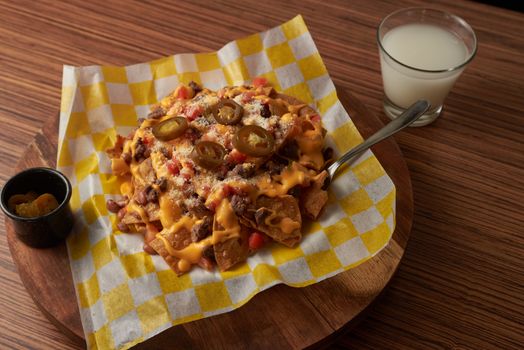
Mexican Nachos
The diets react (see scores below)
Common Ingredients
- tortilla chips
- Monterey Jack cheese
- refried beans
- jalapeños
- pico de gallo
- sour cream
- guacamole
- cilantro
Specific recipes may vary.
Incompatible with 10 of 11 diets
Diet Ratings
Mexican nachos are fundamentally incompatible with a ketogenic diet. The base ingredient — tortilla chips — is a corn-based grain product loaded with net carbs (roughly 18-20g per small 1oz serving), and a full nacho plate easily delivers 60-100g of net carbs before any toppings are added. Refried beans compound the problem significantly, adding another 20-25g net carbs per half-cup serving as a legume high in starch. Pico de gallo and jalapeños contribute minor carbs but are negligible in the overall picture. The keto-friendly elements — Monterey Jack cheese, sour cream, guacamole, and cilantro — cannot offset the massive carb load from the chips and beans. No realistic portion size of standard nachos can be made keto-compatible without fundamentally replacing the base (e.g., substituting chips with low-carb alternatives and omitting beans entirely).
Mexican Nachos as described contain multiple animal-derived ingredients that make them clearly non-vegan. Monterey Jack cheese is a dairy product made from cow's milk, and sour cream is also a dairy product. These are unambiguous animal products excluded under all vegan definitions. The remaining ingredients — tortilla chips, refried beans (assuming lard-free), jalapeños, pico de gallo, guacamole, and cilantro — are plant-based, but the dish as a whole cannot be considered vegan due to the cheese and sour cream. A vegan version could be made by substituting dairy cheese with plant-based cheese, replacing sour cream with cashew cream or coconut-based sour cream, and ensuring refried beans are made without lard.
Mexican Nachos are fundamentally incompatible with the Paleo diet. The dish is built on tortilla chips (corn-based grain, explicitly excluded), topped with Monterey Jack cheese and sour cream (dairy, excluded), and refried beans (legumes, excluded). These are not minor or debatable ingredients — they are the core components of the dish. Jalapeños, pico de gallo, guacamole, and cilantro are paleo-friendly, but they function only as garnishes here and cannot redeem a dish whose foundation violates multiple core paleo exclusions simultaneously. No meaningful substitution could make this 'nachos' in any recognizable sense.
Mexican nachos as classically prepared contradict Mediterranean diet principles on multiple fronts. The base is tortilla chips — a refined, processed grain product typically deep-fried or heavily processed with added salt, which falls squarely in the 'minimal refined/processed foods' category to avoid. Monterey Jack cheese and sour cream add significant saturated fat from dairy well beyond moderate amounts. While some individual ingredients have Mediterranean-friendly qualities — refried beans (legumes), jalapeños and pico de gallo (vegetables), guacamole (healthy monounsaturated fats from avocado), and cilantro (herb) — these positives are overshadowed by the processed chip base and heavy dairy load. The overall dish is a processed snack food with no Mediterranean analog, high in refined carbohydrates and saturated fat, and not structured around the whole, plant-forward principles the diet emphasizes.
Mexican Nachos are almost entirely composed of plant-derived and processed ingredients that are fundamentally incompatible with the carnivore diet. Tortilla chips are grain-based (corn), refried beans are legumes, jalapeños and cilantro are plants, pico de gallo is a plant-based salsa, and guacamole is made from avocado — all strictly excluded. The only potentially carnivore-adjacent ingredient is sour cream (dairy) and Monterey Jack cheese (dairy), both of which are debated even among carnivore practitioners. This dish has no animal protein as its primary component and is built entirely on a foundation of grains, legumes, and vegetables. There is universal consensus in the carnivore community that this dish is completely off-plan.
Mexican Nachos contain multiple Whole30-excluded ingredients, making this dish entirely incompatible with the program. Tortilla chips are a grain-based food (corn) that also falls under the explicitly banned 'chips' category in the no-recreating-junk-food rule. Monterey Jack cheese is dairy, which is excluded. Refried beans are legumes, which are excluded. Sour cream is dairy, which is excluded. Additionally, even if those ingredients were swapped out, nachos themselves are the archetypal 'junk food' recreation that Whole30 explicitly prohibits by name (chips). Guacamole, pico de gallo, jalapeños, and cilantro are compliant, but they cannot redeem a dish with this many foundational violations.
Mexican Nachos as described contain multiple high-FODMAP ingredients that make this dish unsuitable during the elimination phase. Refried beans are the most problematic ingredient — they are high in GOS (galacto-oligosaccharides) and fructans, and are high-FODMAP at any reasonable serving size. Guacamole, while made from avocado (low-FODMAP at 1/8 per Monash), is typically consumed in quantities that quickly exceed the safe threshold, pushing it into high-FODMAP territory. Sour cream contains lactose and becomes high-FODMAP in servings greater than 2 tablespoons. Pico de gallo typically contains onion and garlic, both of which are among the highest-FODMAP foods due to fructans, and are problematic even in small amounts. Monterey Jack cheese is a hard/semi-hard aged cheese and is generally low-FODMAP due to minimal lactose. Tortilla chips (corn-based, plain) are low-FODMAP. Jalapeños are low-FODMAP at small servings (up to 28g per Monash). Cilantro is low-FODMAP. However, the combination of refried beans, onion/garlic in pico de gallo, lactose in sour cream, and excess avocado in guacamole creates a cumulative high-FODMAP load that clearly makes this dish a strong avoid during elimination.
Mexican Nachos as commonly prepared are poorly aligned with DASH diet principles. Tortilla chips are typically high in sodium and refined carbohydrates with little fiber. Monterey Jack cheese adds significant saturated fat and sodium. Refried beans (canned/restaurant-style) are often high in sodium and may contain added lard or fat. Sour cream is a full-fat dairy product, directly contrary to DASH's emphasis on low-fat or fat-free dairy. Guacamole, while made from heart-healthy avocado, adds calories and is usually salted. The cumulative sodium load from chips, cheese, refried beans, and pico de gallo easily exceeds several hundred milligrams per serving. While jalapeños, pico de gallo, and cilantro are DASH-friendly vegetables, they are minor components of the overall dish. The combination of high sodium, high saturated fat, refined carbohydrates, and full-fat dairy makes this dish a poor fit for the DASH eating plan.
Mexican nachos as traditionally prepared are a poor fit for the Zone Diet across nearly every macro dimension. The primary carbohydrate base — tortilla chips — is a high-glycemic, processed grain product that delivers rapid blood sugar spikes, exactly what the Zone aims to avoid. Refried beans add some protein and fiber but are typically prepared with lard or oil and contribute a dense carbohydrate load. The fat profile is problematic: Monterey Jack cheese and sour cream bring significant saturated fat, not the monounsaturated fat the Zone prioritizes. There is no lean protein source — the dish is listed with 'none' as its primary protein, meaning it fails to provide the ~25g of lean protein per meal that the Zone requires. Guacamole is the one genuinely Zone-friendly component (avocado = monounsaturated fat), and jalapeños, pico de gallo, and cilantro are low-glycemic vegetables that align with Zone principles. However, these favorable elements are overwhelmed by the chip base, saturated dairy fats, and carbohydrate-heavy beans. The overall macro ratio would be heavily skewed toward carbohydrates and saturated fat, with negligible lean protein — the opposite of a Zone-balanced 40/30/30 meal. Even with careful portioning, the tortilla chip foundation makes it structurally impossible to build a Zone-compliant snack without a near-total reformulation of the dish.
Mexican nachos present a mixed anti-inflammatory profile. On the positive side, guacamole contributes avocado's monounsaturated fats and anti-inflammatory oleic acid; jalapeños and pico de gallo (tomatoes, onion, cilantro, lime) bring capsaicin, lycopene, quercetin, and vitamin C — all with documented anti-inflammatory activity; refried beans provide fiber and plant protein supportive of a healthy gut microbiome; and cilantro adds modest polyphenol content. However, several components pull in a pro-inflammatory direction: tortilla chips are a refined carbohydrate typically fried in seed oils (corn, sunflower, or canola), contributing both refined starch and potentially high omega-6 content; Monterey Jack cheese and sour cream are full-fat dairy products high in saturated fat, which anti-inflammatory frameworks classify as 'limit'; and standard refried beans are often made with lard or high amounts of salt, adding saturated fat. The overall dish is calorie-dense with a high refined-carb and saturated-fat load that offsets its genuinely beneficial vegetable components. As a regular dietary choice it conflicts with anti-inflammatory principles, but the presence of avocado, legumes, and fresh vegetables prevents it from being outright pro-inflammatory. Occasion-based consumption with attention to portion size and ingredient quality (baked chips, less cheese, fresh refried beans with no lard) could shift the profile upward.
Some anti-inflammatory practitioners would rate this more harshly, pointing to the refined corn chips and full-fat dairy as reliable drivers of elevated omega-6 intake and saturated fat burden that consistently worsen inflammatory markers; Dr. Weil's pyramid would place this firmly in the 'limit' zone. Conversely, a whole-foods-leaning nutritionist might note that the legume and fresh vegetable content — refried beans, guacamole, fresh salsa, jalapeños — provides enough fiber, flavonoids, and healthy fats to keep this in acceptable territory when consumed occasionally and prepared with quality ingredients.
Mexican nachos as described are a poor fit for GLP-1 patients across nearly every rating criterion. The base is tortilla chips — a refined, fried, low-fiber, low-protein, calorie-dense food that offers minimal nutritional value per bite. Monterey Jack cheese and sour cream add significant saturated fat, which worsens GLP-1 side effects including nausea, bloating, and reflux. Refried beans are the one redeeming ingredient, offering some protein and fiber, but they represent a small fraction of the overall dish. Guacamole provides healthy unsaturated fats but also adds caloric density. Jalapeños may worsen reflux and nausea, which are already common GLP-1 side effects. The dish is heavily portion-sensitive — a small serving dilutes the bean content further while still delivering a high fat and refined carbohydrate load. With no primary protein, high saturated fat, minimal fiber relative to caloric load, and multiple ingredients known to trigger GI discomfort on GLP-1 medications, this dish is not appropriate as a regular snack for patients on these medications.
*See how scores were generated at our methodology page.
Nutritional profile
Six traits that cut across every diet.
Fiber & Plants
How much whole-plant food and fiber it delivers.
Healthy Fats
The quality of its fats (unsaturated, omega-3).
Whole / Unprocessed
How close it is to its natural, unprocessed form.
Gut Gentle
How easy it is on digestion (low FODMAP, few irritants).
Low Glycemic
How little it spikes your blood sugar.
Protein Density
How much protein it packs per calorie.
Controversy Index
Higher controversy = more disagreement between diets.
Diet-Specific Tips
 Anti-Inflammatory — 4/10
View tips
- Guacamole/avocado: rich in anti-inflammatory monounsaturated fats and oleic acid
- Jalapeños and pico de gallo: capsaicin, lycopene, vitamin C, quercetin
- Refried beans: fiber and plant protein, but often made with lard
- Tortilla chips: refined carbohydrate, typically fried in high-omega-6 seed oils
- Monterey Jack cheese and sour cream: full-fat dairy, high in saturated fat — 'limit' category
- Cilantro: minor polyphenol benefit
- Overall dish is calorie-dense with pro-inflammatory refined carb and saturated fat load partially offset by beneficial vegetable and legume components