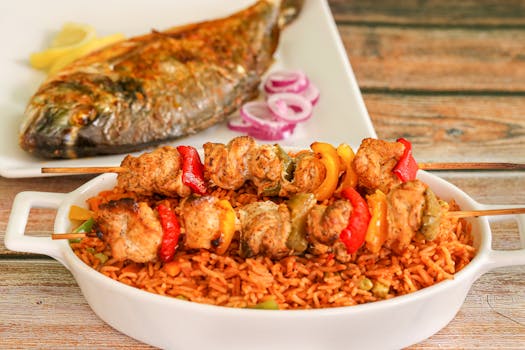
Photo: Keesha's Kitchen / Pexels
The diets react (see scores below)
Common Ingredients
- rice
- tomatoes
- red bell pepper
- Scotch bonnet
- onion
- garlic
- ginger
- thyme
Specific recipes may vary.
Incompatible with 5 of 11 diets
Diet Ratings
Jollof Rice is fundamentally incompatible with a ketogenic diet. The primary ingredient, white rice, is a high-glycemic grain that delivers approximately 45g of net carbs per single cup (cooked serving) — easily exceeding the entire daily keto carb allowance in one meal. The remaining ingredients (tomatoes, red bell pepper, onion) add additional net carbs. There is no meaningful fat content and no primary protein source. This dish would immediately spike blood glucose and halt ketosis. No reasonable portion size makes this keto-compatible.
Jollof Rice as described here is entirely plant-based. Every ingredient — rice, tomatoes, red bell pepper, Scotch bonnet pepper, onion, garlic, ginger, and thyme — is a whole plant food with no animal products or animal-derived ingredients. This version contains no meat, fish, dairy, or eggs that sometimes appear in restaurant or home preparations of Jollof Rice. It is a nutrient-dense, whole-food dish rich in complex carbohydrates, vitamins, and antioxidants, making it an excellent fit for a vegan diet. The score stops short of 10 only because rice is a refined grain rather than a whole grain, though this is a minor consideration.
Jollof Rice is disqualified from the paleo diet primarily because of its central ingredient: rice. Rice is a grain, and all grains are excluded from the paleo diet due to their anti-nutrient content (lectins, phytic acid) and the fact that they were not part of the Paleolithic diet. The remaining ingredients — tomatoes, red bell pepper, Scotch bonnet, onion, garlic, ginger, and thyme — are all paleo-approved vegetables, aromatics, and herbs. However, rice is not a minor or optional component; it is the defining base of this dish, making it fundamentally incompatible with paleo principles regardless of the quality of the other ingredients.
Jollof Rice is a tomato-based rice dish with a rich array of Mediterranean-friendly vegetables (tomatoes, bell peppers, onion, garlic, ginger) and aromatic herbs (thyme), all of which align well with Mediterranean principles. However, the base ingredient is white rice — a refined grain — rather than a whole grain like brown rice or farro. White rice lacks the fiber and nutrients of whole grains and is not a staple of the core Mediterranean diet, though it is consumed in some traditional Mediterranean regions in moderation. The vegetable-forward flavor base and absence of red meat, processed ingredients, or added sugars are positive factors. With olive oil as the cooking fat (a common substitution), this dish becomes more compatible, but the refined grain base keeps it in the 'caution' zone rather than a full approval.
Some traditional Mediterranean cuisines, particularly in parts of the Middle East and Southern Europe, do include white rice as a staple grain, and certain modern Mediterranean diet interpretations (e.g., Oldways guidelines) allow white rice in moderation, especially when paired with abundant vegetables as seen here. In that context, this dish could edge toward approval given its strong vegetable profile.
Jollof Rice is entirely plant-based with zero animal-derived ingredients. Rice is a grain — one of the most excluded foods on the carnivore diet. Every other ingredient (tomatoes, red bell pepper, Scotch bonnet, onion, garlic, ginger, thyme) is a plant food, all of which are strictly excluded under carnivore principles. There is no animal protein, no animal fat, and no animal product of any kind in this dish. This is incompatible with the carnivore diet at every level.
Jollof Rice is built on rice as its foundational ingredient. Rice is explicitly excluded on the Whole30 as a grain, making this dish non-compliant regardless of all other ingredients. The remaining components — tomatoes, red bell pepper, Scotch bonnet, onion, garlic, ginger, and thyme — are all individually Whole30-compliant, but the dish cannot be made without its defining ingredient, rice.
Jollof Rice as traditionally prepared contains two major high-FODMAP ingredients that cannot be reduced to safe levels without fundamentally altering the dish: onion and garlic. Both are high in fructans and are typically used in substantial quantities as the aromatic base of the dish. Onion is one of the highest dietary sources of fructans and is high-FODMAP at any meaningful serving. Garlic is similarly high-FODMAP even at very small amounts (one clove is enough to cause issues). The remaining ingredients are largely low-FODMAP: white rice is a safe staple, tomatoes are low-FODMAP at standard servings (up to 1 medium/75g), red bell pepper is low-FODMAP, Scotch bonnet pepper is low-FODMAP (it is a chili, not a high-FODMAP food), ginger is low-FODMAP at typical culinary amounts (up to 1 tsp/5g), and thyme is low-FODMAP as a herb. However, the onion and garlic alone make this dish a clear avoid during the elimination phase. There is no realistic portion size at which a standard serving of Jollof Rice made with onion and garlic would become low-FODMAP.
Jollof Rice as listed here contains a favorable base of DASH-friendly ingredients: tomatoes, red bell pepper, Scotch bonnet, onion, garlic, and ginger are all vegetables rich in potassium, antioxidants, and fiber. The spices (thyme, garlic, ginger) align well with DASH's encouragement of herbs and spices as sodium-free flavor enhancers. However, the primary starch is white rice rather than a whole grain, which is less ideal under DASH guidelines that emphasize whole grains. Additionally, Jollof Rice in practice is commonly prepared with added salt, bouillon cubes, or seasoning packets that can significantly elevate sodium content — making the real-world dish potentially high in sodium despite the healthy ingredient list. The dish also lacks a lean protein source and low-fat dairy, meaning it doesn't fully leverage the DASH nutrient profile (calcium, magnesium, complete protein). As listed with no explicit sodium-heavy additives, the dish is acceptable in moderation but warrants caution due to white rice use and the high-sodium preparation norms associated with this dish.
NIH DASH guidelines focus on limiting sodium and saturated fat while emphasizing whole grains — white rice and typical high-sodium preparation of Jollof Rice conflict with these priorities. However, updated clinical interpretations note that when prepared with minimal added salt and consumed in portion-controlled servings alongside lean protein and vegetables, the rich tomato-vegetable base provides meaningful potassium and lycopene that support blood pressure goals, potentially elevating the dish's practical DASH compatibility.
Jollof Rice is primarily a rice-based dish, making it predominantly a carbohydrate source with minimal protein or fat. White rice is classified as an 'unfavorable' carbohydrate in Zone terminology due to its high glycemic index — it raises blood sugar rapidly and is difficult to balance within the 40/30/30 block structure. The tomato-based sauce with red bell pepper, onion, garlic, ginger, and Scotch bonnet provides excellent polyphenols, antioxidants, and some low-glycemic vegetable carbs, which Sears would strongly endorse. However, these favorable vegetables are swamped by the dominant white rice base. The dish contains no protein source and virtually no fat as listed, meaning it fails the Zone's core 40/30/30 balance entirely as a standalone meal. As a small side component paired with lean protein (grilled fish or chicken) and a monounsaturated fat source (avocado or olive oil), a modest portion could technically fit into a Zone meal — rice is allowed in Zone at 0-1 servings, and roughly 1/3 cup cooked white rice constitutes one carb block. The key issue is the practical reality: Jollof Rice is typically served in larger portions as a main, making Zone compliance very difficult.
Some Zone practitioners note that Sears' later work on polyphenols and anti-inflammatory eating would view the tomato-pepper-spice base very favorably — these ingredients are rich in beneficial polyphenols. A small portion of Jollof Rice could be defended as a vehicle for these beneficial compounds, with the rice portion kept to one block (~1/3 cup cooked). The vegetable-forward sauce partially offsets the high-GI rice, and some Zone-adjacent practitioners apply a lower effective glycemic load when rice is mixed with tomatoes and fiber-containing vegetables.
Jollof rice presents a mixed anti-inflammatory profile. On the positive side, the dish is rich in anti-inflammatory spices and aromatics: garlic, ginger, and thyme are all well-supported anti-inflammatory ingredients. Tomatoes and red bell pepper provide lycopene, vitamin C, quercetin, and other antioxidants and carotenoids. Scotch bonnet peppers contain capsaicin, which has demonstrated anti-inflammatory effects. Onion contributes quercetin. The base, however, is white rice — a refined carbohydrate with minimal fiber, a high glycemic index, and no meaningful anti-inflammatory contribution. Refined carbohydrates are explicitly limited in anti-inflammatory frameworks due to their potential to spike blood sugar and promote low-grade inflammation. If made with brown or parboiled rice, the score and verdict would improve. The dish contains no protein, no omega-3 source, and no significant healthy fats unless oil is added in cooking. The overall profile is: strong anti-inflammatory spice and vegetable base undermined by a refined white rice foundation, making this a caution-level dish that can be improved with whole grain substitutions.
Some anti-inflammatory practitioners would rate this more favorably, noting the exceptional density of anti-inflammatory aromatics and the cooking process (which increases lycopene bioavailability in tomatoes). Additionally, nightshade skeptics following Autoimmune Protocol (AIP) frameworks — such as Dr. Tom O'Bryan — would flag the tomatoes, red bell pepper, and Scotch bonnet as potentially pro-inflammatory for individuals with autoimmune conditions, while mainstream anti-inflammatory authorities like Dr. Weil consider nightshades beneficial for the general population.
Jollof rice is a tomato-based rice dish with aromatic vegetables and spices. The base is white rice — a refined grain with moderate glycemic impact, low protein, and minimal fiber. The tomato, bell pepper, and onion base adds modest amounts of vitamins and some fiber, and the dish is relatively low in fat. However, for GLP-1 patients, it falls short on two critical priorities: protein content is negligible (no primary protein source listed) and fiber is low due to the white rice base. The scotch bonnet pepper is a meaningful concern — it is one of the hotter chili varieties and may worsen nausea, reflux, or GI discomfort, which are already common GLP-1 side effects. The dish is easy to prepare in small portions and is not fried or high in saturated fat, which prevents a lower score. As a standalone main with no protein, it is poorly suited for GLP-1 dietary needs. Paired with a lean protein (grilled chicken, fish, or legumes) and served in a small portion, it becomes more acceptable.
Some GLP-1-focused dietitians may allow white rice dishes like jollof in small portions for cultural adherence and palatability, arguing that rigid restriction of culturally significant foods undermines long-term compliance. Others flag refined rice more firmly as an empty-calorie starch that displaces protein and fiber in an already calorie-restricted eating pattern, particularly given GLP-1 patients' dramatically reduced meal volumes.
*See how scores were generated at our methodology page.
Nutritional profile
Six traits that cut across every diet.
Fiber & Plants
How much whole-plant food and fiber it delivers.
Healthy Fats
The quality of its fats (unsaturated, omega-3).
Whole / Unprocessed
How close it is to its natural, unprocessed form.
Gut Gentle
How easy it is on digestion (low FODMAP, few irritants).
Low Glycemic
How little it spikes your blood sugar.
Protein Density
How much protein it packs per calorie.
Controversy Index
Higher controversy = more disagreement between diets.
Diet-Specific Tips
 Vegan — 9/10
View tips
- All ingredients are whole plant foods
- No animal products or animal-derived ingredients
- Common non-vegan additions (chicken stock, butter, meat) are absent from this version
- Tomato-pepper base provides lycopene and vitamin C
- Scotch bonnet and spices add flavor without any animal derivatives
- Whole-grain rice substitution (e.g., brown rice) could further improve nutritional profile
 Mediterranean — 5/10
View tips
- White rice is a refined grain, not a whole grain — a moderate concern under Mediterranean guidelines
- Tomatoes, bell pepper, onion, garlic, and ginger are strongly Mediterranean-compatible vegetables
- No red meat, processed foods, or added sugars
- Thyme and aromatics are consistent with Mediterranean herb traditions
- Compatibility improves significantly if prepared with extra virgin olive oil
- No protein source listed — adding legumes or fish would improve Mediterranean alignment
 DASH — 5/10
View tips
- White rice rather than whole grain rice is less optimal for DASH
- Tomatoes, red bell pepper, and Scotch bonnet provide potassium and antioxidants — core DASH nutrients
- Garlic, ginger, and thyme are DASH-approved sodium-free flavor enhancers
- Real-world preparation frequently includes high-sodium bouillon or seasoning cubes not listed here
- No lean protein or low-fat dairy included, limiting full DASH nutrient profile
- Portion control of the rice component is important to avoid excess refined carbohydrates
- Low-sodium preparation with brown rice substitution would significantly improve DASH compatibility
 Zone — 4/10
View tips
- White rice is an 'unfavorable' high-glycemic carbohydrate in Zone — one of the most challenging carb sources to fit
- No protein source listed — dish fails Zone's 30% protein requirement entirely as served
- No fat source listed — dish also fails Zone's 30% fat requirement
- Tomato, red bell pepper, onion, garlic, ginger are all Zone-favorable polyphenol-rich vegetables
- Scotch bonnet pepper contains capsaicin, which Sears views positively for anti-inflammatory effects
- Could be incorporated as a single carb block (~1/3 cup) alongside lean protein and monounsaturated fat
- Portion discipline is the primary challenge — traditional serving sizes far exceed one Zone carb block
 Anti-Inflammatory — 5/10
View tips
- White rice is a refined carbohydrate with high glycemic index — a caution in anti-inflammatory frameworks
- Tomatoes and red bell pepper provide lycopene, quercetin, and vitamin C — anti-inflammatory antioxidants
- Scotch bonnet pepper contains capsaicin, with documented anti-inflammatory properties
- Garlic, ginger, and thyme are all emphasized anti-inflammatory spices/aromatics
- No omega-3 fatty acids or significant healthy fats in this version
- No protein source — dish is nutritionally incomplete as a standalone meal
- Nightshade vegetables (tomatoes, peppers) may be problematic for autoimmune-sensitive individuals per AIP protocols
- Substituting brown or parboiled rice would meaningfully improve the anti-inflammatory profile
 GLP-1 Friendly — 4/10
View tips
- No protein source — falls critically short of 15-30g per meal protein target
- White rice is a refined grain with low fiber and moderate glycemic load
- Scotch bonnet pepper is a high-heat chili that may worsen GLP-1-related nausea, reflux, or GI discomfort
- Tomato, bell pepper, onion, garlic, and ginger base adds modest micronutrients and some anti-inflammatory benefit
- Low fat profile is a positive — dish is not fried or heavy
- Small-portion friendly by nature, but low nutritional density per calorie
- Significantly improved if paired with a lean protein and/or legumes, or if brown rice is substituted