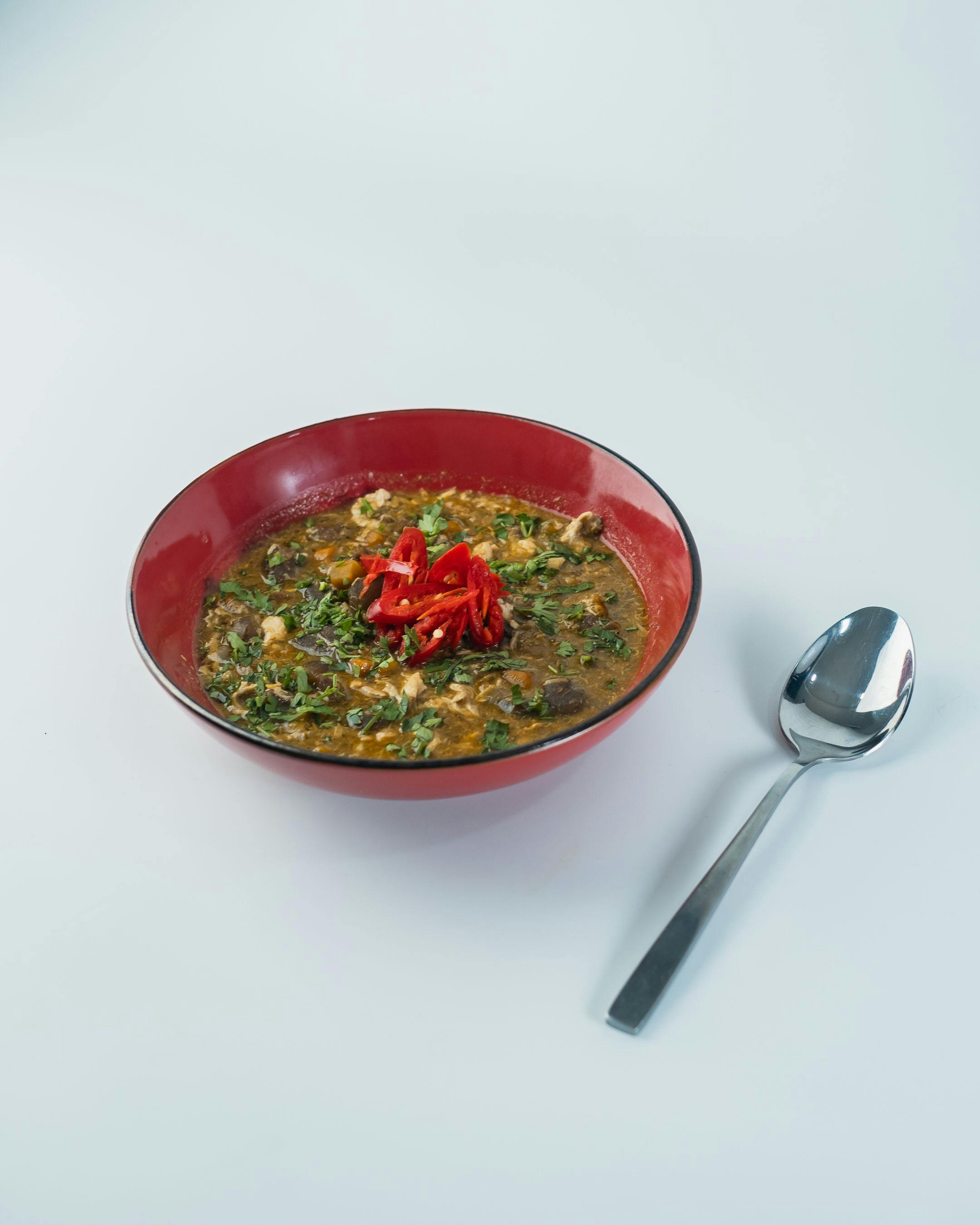
African
Okra Soup
The diets react (see scores below)
Common Ingredients
- okra
- beef
- stockfish
- palm oil
- onion
- crayfish
- Scotch bonnet
- spinach
Specific recipes may vary.
Incompatible with 3 of 11 diets
Diet Ratings
African Okra Soup is a strong keto candidate. Palm oil is a highly keto-friendly fat source, providing the bulk of calories from healthy saturated fats. Beef and stockfish (dried cod) deliver quality protein with minimal carbs. Okra, while containing some carbs, is relatively low in net carbs (approximately 3-4g net carbs per 100g after fiber deduction) and its high fiber and mucilaginous content actually supports gut health on keto. Spinach, onion, crayfish, and Scotch bonnet peppers contribute negligible net carbs at typical serving amounts. The macronutrient profile — high fat from palm oil, moderate protein from beef and fish, low net carbs from vegetables — aligns well with ketogenic targets. A standard bowl is unlikely to push net carbs beyond 8-12g, leaving ample room within the daily 20-50g limit.
Some strict keto practitioners flag okra for its borderline carb content and caution that large servings or recipes using thickened okra paste (more okra by volume) could accumulate carbs faster than expected. Carnivore-leaning keto adherents may also avoid plant ingredients like onion and spinach altogether.
Okra Soup as described contains multiple animal products: beef (red meat), stockfish (dried fish), and crayfish (shellfish/crustacean). All three are direct animal-derived ingredients that are unambiguously excluded from a vegan diet. While the base vegetables — okra, onion, Scotch bonnet, and spinach — are fully plant-based, and palm oil is technically vegan, the presence of beef, stockfish, and crayfish makes this dish entirely incompatible with veganism. There is no ambiguity here.
Okra Soup is largely paleo-compatible but palm oil introduces the key debate. The core ingredients — okra, beef, stockfish, onion, crayfish, Scotch bonnet, and spinach — are all whole, unprocessed paleo-approved foods. Palm oil is the central gray area: it is a fruit oil (not a seed oil) and was available in ancestral African diets, which gives it a stronger paleo case than seed oils. However, modern commercial palm oil is often heavily refined and processed, raising concerns about its alignment with paleo principles. Unrefined (red) palm oil is generally accepted by many paleo practitioners. Stockfish (dried/salted cod) may also contain added salt, which is excluded under strict paleo rules. Overall, this dish scores well given its whole-food, grain-free, legume-free, and dairy-free profile, but palm oil processing and potential salt in stockfish prevent a full approval.
Strict paleo purists (Cordain school) may flag palm oil entirely due to its high saturated fat profile and modern processing methods, and would exclude stockfish if it contains added salt. On the other hand, practitioners like Mark Sisson and ancestral health advocates broadly accept unrefined red palm oil as a traditional fat with a valid place in a paleo framework.
Okra Soup has several Mediterranean-compatible ingredients — okra, spinach, onion, and Scotch bonnet are all vegetables aligned with plant-forward principles, and stockfish (dried/cured fish) adds a seafood component. However, the dish is anchored by two significant concerns: (1) beef as a primary protein, which the Mediterranean diet limits to a few times per month, and (2) palm oil as the primary fat, which is not part of Mediterranean tradition and is high in saturated fat — directly contradicting the core principle of extra virgin olive oil as the primary fat source. The combination of red meat and palm oil together pushes this dish into 'avoid' territory despite its vegetable content.
Some Mediterranean diet interpreters focus on the overall dietary pattern rather than individual dishes, and might rate this as 'caution' given the strong vegetable and fish components (okra, spinach, stockfish). If beef were reduced to a minor flavoring role and the dish were adapted with olive oil, Mediterranean clinicians might consider it an acceptable occasional meal within a broader healthy pattern.
Okra Soup is fundamentally incompatible with the carnivore diet. While the dish contains carnivore-approved ingredients — beef and stockfish (protein sources) and crayfish — the base of the soup is built almost entirely on plant foods. Okra is a plant vegetable and the primary ingredient. Palm oil is a plant-derived oil. Onion, Scotch bonnet pepper, and spinach are all plant foods explicitly excluded from the carnivore diet. The majority of this dish by ingredient count and volume is plant-derived, making it an avoid regardless of the animal protein content.
All ingredients in this African Okra Soup are fully Whole30 compliant. Okra is a vegetable, beef and stockfish are compliant proteins, palm oil is a natural fat, onion and spinach are vegetables, crayfish (dried shrimp) is a compliant seafood seasoning, and Scotch bonnet is a chili pepper — all allowed. There are no grains, legumes, dairy, added sugars, or other excluded ingredients in this dish as described.
This African Okra Soup contains several ingredients that require careful evaluation. Beef and fish (stockfish) are FODMAP-free proteins and safe. Palm oil is low-FODMAP. Spinach is low-FODMAP at standard servings. Scotch bonnet pepper is low-FODMAP. Crayfish (dried shrimp) is low-FODMAP. The two main concerns are: (1) Onion — a high-FODMAP ingredient containing fructans, problematic at virtually any culinary amount; onion is commonly used in significant quantities in this dish and cannot simply be omitted without changing the recipe. (2) Okra — Monash University has tested okra and found it to be low-FODMAP at small servings (around 75g or approximately 6 pods), but okra is the titular ingredient of this soup and is typically used in large quantities, potentially pushing it into high-FODMAP territory due to its polyol content at higher doses. The combination of onion (likely high-FODMAP) and potentially large quantities of okra makes this dish risky during the strict elimination phase, though modifications (omitting onion, using garlic-infused oil, limiting okra quantity) could make it more tolerable.
Monash University rates okra as low-FODMAP at approximately 75g per serve, but clinical FODMAP practitioners often note that the amount of okra used in a traditional soup serving far exceeds this threshold. Additionally, onion — a staple FODMAP trigger — is integral to this recipe, and most elimination phase dietitians would flag this dish as high-risk without significant ingredient substitutions.
Okra Soup contains several DASH-friendly ingredients — okra (high in fiber, magnesium, and folate), spinach (potassium, magnesium, calcium), onion, and Scotch bonnet pepper are all core DASH vegetables. Fish and lean cuts of beef can fit within DASH's lean protein allowance. However, the dish has two significant DASH concerns: (1) Palm oil is a tropical oil high in saturated fat, which DASH explicitly limits alongside coconut and palm kernel oils — this is the most disqualifying ingredient. (2) Stockfish and crayfish are typically high in sodium; crayfish used as a seasoning base in West African cooking can contribute substantial sodium, pushing the dish toward or beyond DASH's 2,300mg/day sodium ceiling. The combination of a tropical oil base and high-sodium dried seafood seasonings prevents an 'approve' rating despite the otherwise vegetable-rich profile. Preparation matters greatly: reducing palm oil quantity, rinsing stockfish to lower sodium, and controlling crayfish amounts could bring this dish closer to DASH compliance.
NIH DASH guidelines explicitly restrict tropical oils including palm oil due to saturated fat content. However, some updated clinical interpretations note that palm oil (distinct from hydrogenated palm oil) contains tocotrienols and that its saturated fat profile differs from palmitic-acid-dominant fats — a minority of DASH-oriented dietitians may permit small amounts in culturally relevant dishes, prioritizing overall dietary pattern adherence over single-ingredient exclusion.
Okra Soup has several Zone-friendly elements but is challenged primarily by palm oil. Okra is an excellent low-glycemic vegetable — rich in fiber and polyphenols, it counts as a favorable Zone carb block. Spinach is another ideal Zone vegetable. Beef and stockfish (dried cod) together provide solid protein blocks, though beef introduces some saturated fat and stockfish is a lean, omega-3-rich protein that Sears would strongly favor. Onion, crayfish, and Scotch bonnet add minimal macro impact. The main Zone concern is palm oil: it is high in saturated fat (palmitic acid), which early Zone writings specifically discouraged in favor of monounsaturated fats. The dish also lacks a clear fat-block replacement from monounsaturated sources. However, palm oil does contain some monounsaturated oleic acid (~40%), and Sears' later anti-inflammatory writings acknowledge that not all saturated fats are equally harmful. Portioning is the practical challenge: the ratio of palm oil to protein and vegetables must be carefully controlled to avoid excess saturated fat and caloric imbalance. With reduced palm oil and a lean beef-to-fish protein split, this dish can approximate a Zone-favorable meal built around low-GI vegetables and lean protein — but as traditionally prepared it skews toward caution.
Some Zone practitioners following Sears' later Zone Diet writings (notably 'The Zone Diet' revised editions and his anti-inflammatory focus) have softened the stance on saturated fats from whole-food sources like palm oil, arguing that the polyphenol content of the dish (okra mucilage, spinach, Scotch bonnet capsaicin) and the omega-3 contribution of stockfish partially offset the inflammatory potential. In that context, this dish could edge toward a low approve (6-7) if portioned correctly with lean beef and generous vegetables relative to oil.
African Okra Soup is a nutritionally complex dish with both strong anti-inflammatory components and some offsetting concerns. On the positive side: okra is a fiber-rich vegetable with antioxidant flavonoids (quercetin, catechins) and mucilaginous compounds that support gut health; spinach is rich in carotenoids, vitamin K, and polyphenols; Scotch bonnet peppers contain high levels of capsaicin, a potent anti-inflammatory compound; onion provides quercetin; and crayfish (dried shellfish) supplies minerals and some omega-3s. Stockfish (dried cod) is lean white fish with minimal saturated fat. The primary concern is palm oil — a saturated-fat-rich oil that sits in the 'limit' category of anti-inflammatory frameworks due to its palmitic acid content, which some research links to pro-inflammatory signaling. Beef, depending on cut and quantity, also adds saturated fat. However, palm oil is not in the same category as trans fats or highly refined seed oils — it contains some tocotrienols (vitamin E forms) with antioxidant properties, and traditional unrefined red palm oil retains carotenoids. The overall dish is not processed, relies on whole ingredients, and features several genuinely anti-inflammatory foods, but the palm oil + beef combination prevents a full approval.
Red palm oil (unrefined) used in traditional West African cooking contains tocotrienols and beta-carotene that some researchers, including those studying traditional diets, consider potentially anti-inflammatory — distinguishing it meaningfully from refined palm kernel oil. Proponents of traditional African dietary patterns argue the food matrix context (fiber-rich vegetables, spices) modulates the impact of palm oil. Conversely, mainstream anti-inflammatory frameworks (Dr. Weil, IF Rating system) categorize palm oil as a saturated fat to limit, and some cardiovascular researchers flag palmitic acid as pro-inflammatory at elevated intakes.
Nigerian okra soup has meaningful nutritional strengths but is held back by palm oil, which is high in saturated fat and a known GLP-1 side effect trigger. On the positive side, okra is an excellent GLP-1 food — high in soluble fiber (which also aids the mucilaginous texture that eases digestion), low in calories, and nutrient-dense. Beef and stockfish together provide solid protein, and spinach adds micronutrients and additional fiber. Crayfish contributes umami flavor with minimal caloric cost. However, palm oil is typically added in generous amounts in traditional preparation and is high in saturated fat, which worsens nausea, bloating, and reflux — the most common GLP-1 side effects. Scotch bonnet pepper adds significant heat, which can worsen reflux and GI discomfort in GLP-1 patients whose gastric emptying is already slowed. The beef component also depends heavily on cut — fatty cuts of beef compound the fat concern. A modified version with palm oil reduced to 1 teaspoon or less, a leaner beef cut, and Scotch bonnet used sparingly would score meaningfully higher (7-8). As traditionally prepared, this is a caution food, not an avoid, because the protein and fiber profile is genuinely strong.
Some GLP-1-focused dietitians would rate this more favorably, arguing that palm oil in traditional African cooking is used in culturally appropriate portions and that the overall fiber and protein density of okra soup outweighs the fat concern — particularly when beef and fish are the primary proteins. Others would push this closer to avoid on injection days or during the early dose-escalation phase when GI side effects are most severe, citing the combination of saturated fat and spicy pepper as a meaningful nausea risk for sensitive patients.
*See how scores were generated at our methodology page.
Nutritional profile
Six traits that cut across every diet.
Fiber & Plants
How much whole-plant food and fiber it delivers.
Healthy Fats
The quality of its fats (unsaturated, omega-3).
Whole / Unprocessed
How close it is to its natural, unprocessed form.
Gut Gentle
How easy it is on digestion (low FODMAP, few irritants).
Low Glycemic
How little it spikes your blood sugar.
Protein Density
How much protein it packs per calorie.
Controversy Index
Higher controversy = more disagreement between diets.
Diet-Specific Tips
 Keto — 8/10
View tips
- Palm oil is an excellent keto fat source — high in saturated fat, zero carbs
- Okra has moderate net carbs (~3-4g/100g) but high fiber makes it keto-friendly in normal portions
- Beef and stockfish provide quality protein with minimal carbohydrates
- Spinach and Scotch bonnet contribute negligible net carbs
- Onion adds minor carbs — portion size matters if used in large quantities
- No grains, added sugars, or starchy thickeners in traditional preparation
- Crayfish (dried shrimp powder) is essentially zero-carb and adds flavor/protein
 Paleo — 6/10
View tips
- Okra, beef, spinach, onion, Scotch bonnet are all unprocessed paleo-approved whole foods
- Crayfish (dried seafood) is paleo-compliant and ancestrally available
- Palm oil is a fruit-derived oil — unrefined red palm oil is generally paleo-accepted, but refined palm oil raises concerns
- Stockfish may contain added salt, which is excluded under strict paleo guidelines
- No grains, legumes, dairy, refined sugar, or seed oils present
- Dish is naturally gluten-free and dairy-free, aligning well with core paleo principles
 Whole30 — 9/10
View tips
- Okra: compliant vegetable
- Beef and stockfish: compliant animal proteins
- Palm oil: compliant natural fat
- Crayfish (dried shrimp): compliant seafood-based seasoning
- Scotch bonnet pepper and onion: compliant vegetables/aromatics
- Spinach: compliant leafy green
- No grains, legumes, dairy, or added sugars present
 Low-FODMAP — 5/10
View tips
- Onion is high-FODMAP due to fructans and is used as a base flavoring — a significant concern during elimination phase
- Okra is low-FODMAP at ≤75g (approx. 6 pods) but is the primary ingredient and likely consumed in larger amounts
- Beef and stockfish are FODMAP-free proteins — safe
- Palm oil is FODMAP-free — safe
- Spinach is low-FODMAP at standard serving sizes
- Crayfish (dried shrimp) is FODMAP-free
- Scotch bonnet pepper is low-FODMAP
- Dish could be modified (remove onion, substitute scallion greens, limit okra quantity) to become low-FODMAP
 DASH — 4/10
View tips
- Palm oil is a tropical oil high in saturated fat — explicitly limited by DASH guidelines
- Stockfish is a dried, heavily salted fish contributing significant sodium
- Crayfish used as seasoning adds additional sodium burden
- Okra is an excellent DASH food: high fiber, magnesium, folate, and potassium
- Spinach is a core DASH vegetable rich in potassium, magnesium, and calcium
- Beef content should be lean and portion-controlled under DASH
- Low-sodium adaptation (reduced/rinsed stockfish, less crayfish, minimal palm oil) would score higher
 Zone — 5/10
View tips
- Okra is a favorable Zone carbohydrate — low glycemic, high fiber, excellent polyphenol source
- Spinach adds more favorable low-GI vegetable blocks
- Stockfish (dried cod) is a lean omega-3-rich protein — strongly Zone-favorable
- Beef provides adequate protein blocks but adds saturated fat
- Palm oil is predominantly saturated fat (palmitic acid), conflicting with Zone's monounsaturated fat preference
- No monounsaturated fat source present to replace or offset palm oil
- Traditional preparation likely uses excess palm oil relative to Zone fat block targets (1.5g/block)
- Dish can be Zone-adjusted by reducing palm oil volume and increasing vegetable-to-protein ratio
 Anti-Inflammatory — 5/10
View tips
- Okra: rich in quercetin, catechins, fiber, and mucilaginous gut-supportive compounds — strongly anti-inflammatory
- Spinach: high in carotenoids, vitamin K, and polyphenols — approve
- Scotch bonnet pepper: very high capsaicin content — potent anti-inflammatory
- Onion: quercetin source — anti-inflammatory
- Crayfish (dried shrimp): provides minerals and modest omega-3s — mildly beneficial
- Stockfish (dried cod): lean white fish, low saturated fat — neutral to mildly positive
- Palm oil: high in saturated palmitic acid — anti-inflammatory frameworks recommend limiting; unrefined red palm oil has some tocotrienols/carotenoids but remains a concern
- Beef: adds saturated fat — should be limited in anti-inflammatory diet, impact depends on cut and quantity
 GLP-1 Friendly — 5/10
View tips
- Palm oil is high in saturated fat and a known trigger for GLP-1 GI side effects including nausea and reflux
- Scotch bonnet pepper is very spicy and may worsen reflux and GI discomfort in patients with slowed gastric emptying
- Okra is an excellent GLP-1 food — high in soluble fiber, low calorie, and easy to digest
- Beef and stockfish together provide substantial protein but the fat content of the beef depends on cut
- Spinach adds micronutrients and fiber, supporting nutrient density
- Traditional preparation typically uses more palm oil than is advisable for GLP-1 patients — portion and preparation method are critical
- Dish can be made GLP-1-friendly with simple modifications: reduce palm oil significantly, use lean beef, and reduce Scotch bonnet