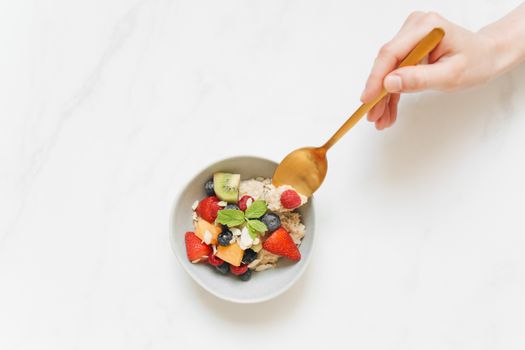
Photo: Polina Tankilevitch / Pexels
American
Oatmeal with Fruit
The diets react (see scores below)
Common Ingredients
- rolled oats
- milk
- banana
- blueberries
- brown sugar
- cinnamon
- walnuts
- honey
Specific recipes may vary.
Incompatible with 6 of 11 diets
Diet Ratings
Oatmeal with fruit is one of the most keto-incompatible breakfast dishes possible. Rolled oats alone contain roughly 27g of net carbs per half-cup serving, instantly exceeding or consuming the majority of a daily keto carb budget. The dish compounds this with a banana (~24g net carbs), blueberries (~17g net carbs per cup), brown sugar (~13g net carbs per tablespoon), and honey (~17g net carbs per tablespoon). Combined, a standard serving of this dish likely delivers 80-100g+ of net carbs — far exceeding the entire daily keto limit of 20-50g. Oats are a grain and are categorically excluded from ketogenic eating. The multiple added sugars (brown sugar, honey) violate the zero-tolerance rule for added sugars. The banana is a high-glycemic fruit explicitly excluded from keto. Even the milk adds additional carbs. The only keto-friendly ingredients are the walnuts and cinnamon, which are completely insufficient to offset the carbohydrate load. This dish would immediately and definitively break ketosis.
This oatmeal contains two animal-derived ingredients: milk (dairy) and honey. Dairy milk is unambiguously excluded from a vegan diet, making this dish non-vegan as presented. Honey is also excluded by mainstream vegan organizations (Vegan Society, PETA). The remaining ingredients — rolled oats, banana, blueberries, brown sugar, cinnamon, and walnuts — are all fully plant-based. The dish could be made vegan with simple substitutions: plant-based milk (oat, almond, soy) and maple syrup or agave in place of honey.
A small minority of plant-based eaters accept honey, arguing that bee-keeping, when practiced ethically, does not constitute animal exploitation in a morally significant way. However, the milk renders this dish non-vegan regardless, and even that minority position does not extend to dairy products.
Oatmeal with Fruit is firmly non-paleo. The dish is anchored by rolled oats, a grain that is explicitly excluded from the Paleolithic diet — grains are among the most consistently rejected food categories across all major paleo authorities (Cordain, Sisson, Wolf). Milk is a dairy product, also universally avoided in strict paleo. Brown sugar is refined sugar, another clear violation. These three ingredients alone are enough to disqualify the dish entirely. While several components are paleo-friendly — banana, blueberries, cinnamon, walnuts, and honey (honey being a caution/moderation item) — the presence of multiple core 'avoid' ingredients makes this dish incompatible with a Paleolithic diet. No reasonable paleo adaptation of this dish exists without a fundamental reconstruction of the recipe.
Oatmeal with fruit is broadly compatible with Mediterranean diet principles. Rolled oats are a whole grain, banana and blueberries are nutrient-rich fruits, and walnuts are an excellent source of healthy fats strongly encouraged in the Mediterranean pattern. Cinnamon adds flavor without dietary concern. The main caveats are the use of milk (a moderate dairy ingredient, acceptable in small amounts), and the combination of both brown sugar and honey as added sweeteners, which introduces more refined/added sugar than ideal. Substituting water or a plant-based milk and reducing or eliminating the brown sugar would make this dish more strictly Mediterranean. Still, the overall composition is whole-food, plant-forward, and nutritionally sound.
Some strict Mediterranean diet interpretations would flag the dual use of added sweeteners (brown sugar and honey together) as unnecessary sugar loading, and prefer unsweetened preparations relying solely on the natural sweetness of fruit. Additionally, traditional Mediterranean breakfasts are not oat-centric — oats are more of a Northern European staple — though modern Mediterranean diet guidelines broadly endorse all whole grains regardless of regional origin.
Oatmeal with Fruit is entirely incompatible with the carnivore diet. Every single ingredient — rolled oats, banana, blueberries, brown sugar, cinnamon, walnuts, and honey — is plant-derived or a processed sugar. The only animal-derived ingredient is milk, which alone would rate as a 'caution' item. Oats are a grain, which is explicitly excluded from all tiers of the carnivore diet. The fruits (banana, blueberries) are high-carbohydrate plant foods. Brown sugar is a processed sweetener. Walnuts are a plant seed. Cinnamon is a plant spice. This dish represents the antithesis of the carnivore dietary framework and would be rejected universally across all carnivore protocols including the most lenient 'animal-based' approaches.
This dish contains multiple explicitly excluded ingredients: rolled oats (a grain), milk (dairy), brown sugar (added sugar), and honey (added sugar). Oats are one of the most clearly excluded foods on Whole30, as grains are entirely off-limits for the 30-day program. Dairy milk is also excluded. Brown sugar and honey are both added sugars, which are banned regardless of their natural origin. The banana, blueberries, cinnamon, and walnuts would individually be compliant, but the combination of four excluded ingredients makes this dish firmly off-limits.
This dish contains multiple high-FODMAP ingredients that make it problematic during the elimination phase. The two most significant offenders are milk (high in lactose — a disaccharide FODMAP) and honey (high in excess fructose). Banana is dose-dependent: unripe/firm banana is low-FODMAP at one small banana (~100g), but ripe banana becomes high-FODMAP due to increased fructans and fructose as it ripens. Rolled oats themselves are low-FODMAP at a standard serving (½ cup dry / ~52g per Monash), and blueberries are low-FODMAP at ½ cup (75g). Brown sugar is low-FODMAP in small amounts. Walnuts are low-FODMAP at a small serve (~10 halves/30g). Cinnamon is fine. However, the combination of lactose-heavy milk and honey — both clearly high-FODMAP at any standard serving — means this dish as written is not suitable for the elimination phase. Substitutions (lactose-free milk or plant-based milk like oat milk at 180ml, maple syrup instead of honey) could make this dish low-FODMAP.
Oatmeal with fruit is an excellent DASH-aligned breakfast. Rolled oats are a whole grain rich in soluble fiber (beta-glucan) that supports cardiovascular health and blood pressure reduction. Banana and blueberries provide potassium, magnesium, fiber, and antioxidants — all core DASH nutrients. Walnuts contribute heart-healthy unsaturated fats and magnesium. Cinnamon adds flavor without sodium. The primary caution is the dual use of both brown sugar and honey, which adds unnecessary added sugar and nudges the dish toward the DASH limit on sweets. If milk is low-fat or fat-free, it aligns perfectly with DASH dairy guidance; whole milk would be a minor concern. Overall, with modest portions of sweeteners and low-fat milk, this dish is a strong DASH breakfast option.
NIH DASH guidelines broadly endorse whole grains, fruits, and nuts in this combination with minimal reservation. However, some DASH-focused clinicians caution that the combined added sugars from both brown sugar and honey — even in small amounts — can be problematic for individuals managing blood glucose or metabolic syndrome alongside hypertension, and would recommend eliminating one or both sweeteners entirely, relying on the natural sweetness of banana and blueberries.
This oatmeal bowl has several Zone-friendly elements but significant concerns. Rolled oats are classified as an 'unfavorable' carbohydrate in Zone terminology — they are moderate-glycemic and carb-dense, requiring careful block portioning. Walnuts provide beneficial monounsaturated and omega-3 fats, and blueberries are an excellent low-glycemic, polyphenol-rich carb source that Sears explicitly endorses. However, the dish compounds its glycemic load with three separate added-sugar or high-glycemic carb sources: banana (a Zone 'unfavorable' high-sugar fruit), brown sugar, and honey — both of which are essentially pure sugar and would score as 'avoid' individually. The combination dramatically overshoots the carbohydrate block allowance and creates a blood sugar spike inconsistent with Zone principles. Critically, the dish lists 'none' as the primary protein, which means it lacks the lean protein component essential to every Zone meal. Without protein to anchor the 40/30/30 ratio, this is a carbohydrate-dominant meal that will trigger an insulin response rather than maintaining the Zone. Milk contributes some protein but is insufficient. To Zone-ify this dish, one would need to eliminate banana, brown sugar, and honey; add a lean protein (e.g., egg whites or Greek yogurt); reduce oat portion; and keep blueberries and walnuts as the carb and fat blocks respectively.
Some Zone practitioners and Sears' later writings (particularly around polyphenols) view oatmeal with berries and nuts as a reasonable Zone breakfast foundation, arguing the fiber in oats moderates glycemic response sufficiently. The blueberries and walnuts are genuinely ideal Zone ingredients. A stripped-down version of this dish — oats, blueberries, walnuts, and a protein source — could reach a moderate approve score. The caution rating here is driven primarily by the added sugars and absent protein rather than the dish concept itself.
Oatmeal with fruit is a strong anti-inflammatory breakfast overall. Rolled oats are a whole grain rich in beta-glucan fiber, which has been shown to reduce CRP and other inflammatory markers. Blueberries are among the most antioxidant-dense foods available, packed with anthocyanins and polyphenols that actively suppress NF-κB inflammatory pathways. Walnuts are an excellent plant-based omega-3 source (ALA) and are explicitly emphasized in anti-inflammatory frameworks. Cinnamon is a featured anti-inflammatory spice with evidence for reducing oxidative stress. Banana contributes potassium, vitamin B6, and prebiotic fiber. The milk is a moderate-category ingredient (low-fat dairy is acceptable in the anti-inflammatory framework). Brown sugar and honey are added sugars — the amount matters significantly here. In modest quantities they are acceptable, but if used liberally they shift the dish toward a more neutral or mixed profile. In typical portions, the combined added sugar load is the main limiting factor, preventing a score of 9-10. The dish has no trans fats, no refined grains, no processed additives, and several strongly anti-inflammatory components.
Some anti-inflammatory practitioners, particularly those following AIP or low-glycemic protocols, caution that oats contain avenin (a prolamin similar to gluten) and that the banana-plus-added-sugar combination creates a significant glycemic spike that can trigger inflammatory insulin responses in metabolically sensitive individuals. Dr. Weil's framework, by contrast, endorses oats, whole fruit, and moderate honey/natural sweeteners as compatible with anti-inflammatory eating for the general population.
Oatmeal with fruit has genuine strengths for GLP-1 patients — rolled oats provide meaningful soluble fiber (beta-glucan), which supports digestion, helps prevent constipation, and stabilizes blood sugar. Blueberries add antioxidants and additional fiber. Walnuts contribute omega-3 fats and a small protein boost. Milk adds some protein. However, the dish falls short on the #1 priority: protein. With no dedicated protein source, this bowl likely delivers only 8-12g of protein (mostly from milk), well below the 15-30g per meal target. The banana, brown sugar, and honey together create a meaningful sugar load that can spike blood glucose — a concern especially for GLP-1 patients managing type 2 diabetes or insulin resistance. The added sugars (brown sugar + honey) are essentially empty calories in a context where every bite must count nutritionally. Walnuts, while healthy fat, add caloric density without proportionate protein benefit. The dish is easy to digest and portion-friendly, which are positives. To reach 'approve' territory, this bowl needs a significant protein upgrade (Greek yogurt stirred in, protein powder, cottage cheese, or egg whites) and removal or sharp reduction of the added sugars.
Some GLP-1-focused RDs consider plain oatmeal with fruit a solid foundation breakfast, arguing that the soluble fiber and blood sugar stabilization effects outweigh the low protein density — particularly for patients who struggle with nausea and need gentle, easy-to-tolerate foods. Others flag that the combined glycemic load of banana, brown sugar, and honey makes this a poor fit for the metabolic profiles common in GLP-1 patients, regardless of fiber content.
*See how scores were generated at our methodology page.
Nutritional profile
Six traits that cut across every diet.
Fiber & Plants
How much whole-plant food and fiber it delivers.
Healthy Fats
The quality of its fats (unsaturated, omega-3).
Whole / Unprocessed
How close it is to its natural, unprocessed form.
Gut Gentle
How easy it is on digestion (low FODMAP, few irritants).
Low Glycemic
How little it spikes your blood sugar.
Protein Density
How much protein it packs per calorie.
Controversy Index
Higher controversy = more disagreement between diets.
Diet-Specific Tips
 Mediterranean — 8/10
View tips
- Rolled oats are a whole grain — strongly encouraged
- Walnuts provide heart-healthy unsaturated fats, a Mediterranean staple
- Banana and blueberries contribute fruit servings aligned with plant-forward principles
- Milk is acceptable dairy in moderation but not the preferred Mediterranean base
- Brown sugar is an added refined sugar, mildly contradicting Mediterranean minimalism
- Honey adds further added sugar — one sweetener would be preferable
- No olive oil or legumes, but not required for every meal
- Overall dish is whole-food and minimally processed
 DASH — 8/10
View tips
- Rolled oats are a DASH-approved whole grain rich in soluble fiber and heart-protective beta-glucan
- Banana and blueberries provide potassium, magnesium, and antioxidants central to DASH goals
- Walnuts add healthy unsaturated fats and magnesium without significant saturated fat
- Combined use of brown sugar AND honey doubles added sugar load, which DASH recommends limiting
- Low-fat or fat-free milk aligns with DASH dairy guidance; whole milk would lower the score
- Naturally very low in sodium, consistent with both standard and low-sodium DASH targets
- Cinnamon enhances flavor without contributing sodium or calories
 Zone — 4/10
View tips
- No lean protein source — violates core Zone meal structure requiring 40/30/30 ratio
- Banana is a Zone 'unfavorable' high-sugar fruit explicitly cautioned against by Sears
- Brown sugar and honey are pure added sugars — spike insulin and are antithetical to Zone goals
- Rolled oats are 'unfavorable' moderate-glycemic carbs requiring strict portioning
- Blueberries are an excellent Zone-approved polyphenol-rich carb source
- Walnuts provide beneficial omega-3 fatty acids and monounsaturated fat — Zone-favorable
- Milk contributes minimal protein — insufficient to anchor Zone meal ratio
- Carbohydrate blocks heavily exceed Zone targets for a single meal without protein balance
 Anti-Inflammatory — 8/10
View tips
- Blueberries: exceptionally high in anti-inflammatory anthocyanins and polyphenols
- Walnuts: plant-based omega-3 (ALA) — explicitly emphasized in anti-inflammatory frameworks
- Rolled oats: whole grain with beta-glucan fiber shown to reduce CRP
- Cinnamon: anti-inflammatory spice with oxidative stress-reducing properties
- Brown sugar + honey: added sugars that should be kept minimal to preserve anti-inflammatory profile
- Milk: acceptable as low-fat dairy in moderation per anti-inflammatory guidelines
- Banana: contributes prebiotic fiber and micronutrients but adds to glycemic load
 GLP-1 Friendly — 5/10
View tips
- Low protein content (~8-12g estimated) — significantly below the 15-30g per meal target
- Good soluble fiber from rolled oats (beta-glucan) supports digestion and constipation prevention
- Triple added sugar sources (banana + brown sugar + honey) create unnecessary glycemic load
- Walnuts provide beneficial omega-3 fats but add caloric density without meaningful protein
- Easy to digest — a positive given GLP-1 slowed gastric emptying
- Milk contributes modest protein and hydration support
- Dish is highly salvageable with a protein addition (Greek yogurt, protein powder) and removal of brown sugar and honey