Photo: Anthony Rahayel / Pexels
Italian
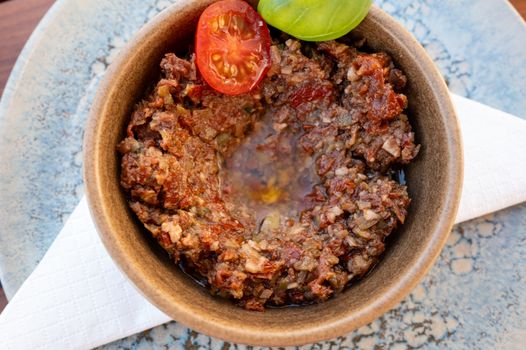
Olive Tapenade
The diets react (see scores below)
Common Ingredients
- Kalamata olives
- capers
- anchovies
- garlic
- olive oil
- lemon juice
- parsley
Specific recipes may vary.
Incompatible with 4 of 11 diets
Diet Ratings
Olive tapenade is an excellent keto condiment. Kalamata olives are high in healthy monounsaturated fats and very low in net carbs. Capers, anchovies, garlic, lemon juice, and parsley contribute negligible carbohydrates in typical serving amounts. Olive oil further boosts the healthy fat profile. A standard 2-tablespoon serving contains roughly 1-2g net carbs, making it trivially easy to fit within daily keto limits. All ingredients are whole and unprocessed, with no added sugars or grains. Anchovies provide quality protein and omega-3 fatty acids as a bonus.
This olive tapenade contains anchovies as a primary protein ingredient, which are fish — a clear animal product excluded under all vegan frameworks. While the base ingredients (Kalamata olives, capers, garlic, olive oil, lemon juice, parsley) are entirely plant-based, the inclusion of anchovies makes this dish non-vegan without any ambiguity. A vegan version of tapenade is easily achievable by simply omitting the anchovies, as the olives and capers provide sufficient savory, umami depth.
Olive tapenade is composed almost entirely of paleo-approved whole foods. Kalamata olives, anchovies, garlic, olive oil, lemon juice, and parsley are all unprocessed or minimally processed ingredients fully consistent with a Paleolithic eating pattern. Anchovies as the primary protein are an excellent whole-food source. Olive oil is a preferred fat in paleo. Capers are a pickled flower bud — whole food, paleo-compatible. The main caveat is that commercial versions of this dish often contain added salt, which is discouraged in strict paleo. If prepared at home without added salt (or with minimal salt), this is a strong approve. The score reflects a slight deduction for the near-universal use of added salt in any prepared or store-bought version.
Strict Cordain-school paleo discourages added salt as a non-Paleolithic processing ingredient, and commercial tapenades almost universally include it. Capers are also typically preserved in brine (salt) or vinegar, which some strict interpretations flag as processed. A home-made, salt-free version would rate higher, but the dish as commonly prepared warrants some caution from purists.
Olive tapenade is an exemplary Mediterranean condiment. Every ingredient aligns perfectly with Mediterranean diet principles: Kalamata olives and extra virgin olive oil are foundational Mediterranean staples providing heart-healthy monounsaturated fats and polyphenols; anchovies contribute beneficial omega-3 fatty acids consistent with the diet's emphasis on seafood; capers, garlic, lemon juice, and parsley are classic Mediterranean flavor components that are whole, minimally processed plant foods. The dish contains no refined grains, added sugars, or unhealthy fats. It is traditionally consumed across the Mediterranean basin, particularly in Southern France and Italy, as well as Greece, making it both historically authentic and nutritionally sound.
Olive Tapenade is almost entirely plant-derived and must be avoided on a carnivore diet. The base ingredients — Kalamata olives, capers, garlic, olive oil, lemon juice, and parsley — are all plant foods explicitly excluded from the carnivore diet. While anchovies are an approved animal product, they represent a minor component of this condiment and cannot redeem the dish. The overwhelming majority of this preparation is incompatible with carnivore principles, making it a clear avoid with high confidence.
All listed ingredients — Kalamata olives, capers, anchovies, garlic, olive oil, lemon juice, and parsley — are individually Whole30-compliant. These are whole, minimally processed foods that align well with the program's dietary guidelines. However, commercial versions of this dish warrant label scrutiny, as store-bought tapenades and packaged anchovies can contain added sugars, wine, or other excluded ingredients. When made from scratch with compliant ingredients, this is a solid Whole30-friendly condiment.
Official Whole30 guidelines approve all these individual ingredients without reservation. However, some community members caution that store-bought tapenades frequently contain added sugars or non-compliant preservatives, and that anchovies packed in anything other than olive oil or salt should be carefully vetted — making homemade preparation the safest route.
Olive tapenade contains garlic as a listed ingredient, which is one of the highest-FODMAP foods known — it contains significant fructans even in very small quantities (a single clove is enough to trigger symptoms in sensitive individuals). Garlic is explicitly rated as high-FODMAP at any reasonable serving by Monash University, making this dish a clear 'avoid' during the elimination phase regardless of the other ingredients. The remaining ingredients are generally low-FODMAP: Kalamata olives are low-FODMAP at standard servings (~10 olives), capers are low-FODMAP in small amounts, anchovies are a protein with no significant FODMAPs, olive oil is FODMAP-free (fats don't carry FODMAPs), lemon juice is low-FODMAP at standard serving sizes, and parsley is low-FODMAP. However, garlic alone disqualifies this dish entirely during elimination phase. Note: if garlic were replaced with garlic-infused olive oil (which is low-FODMAP since fructans are water-soluble and don't transfer into oil), the tapenade could be made low-FODMAP compliant.
Olive tapenade is extremely high in sodium due to the combination of three inherently high-sodium ingredients: Kalamata olives (which are salt-cured), capers (packed in brine), and anchovies (salt-preserved). A typical 2-tablespoon serving can contain 400–600mg of sodium, making even a modest portion a significant portion of the DASH daily sodium budget of 1,500–2,300mg. While individual components like olive oil, garlic, lemon juice, and parsley are DASH-friendly, the overall sodium density of tapenade as commonly prepared makes it incompatible with DASH principles. The NHLBI DASH guidelines explicitly limit sodium and emphasize avoiding salt-preserved, brined, and cured foods — all of which are foundational to this condiment. The heart-healthy monounsaturated fats from olives and olive oil are a positive attribute, but they do not offset the sodium burden.
Olive tapenade is an excellent Zone-compatible condiment. Its primary fat source — Kalamata olives and olive oil — is predominantly monounsaturated, which is exactly the type of fat Dr. Sears prioritizes in the Zone framework. Anchovies provide a small but high-quality lean protein contribution along with beneficial omega-3 fatty acids, directly supporting the anti-inflammatory goals central to Sears' later Zone work. Capers, garlic, lemon juice, and parsley are all low-glycemic, polyphenol-rich additions that contribute negligible carbohydrate load. The dish is minimally processed and contains no problematic high-glycemic carbohydrates, trans fats, or omega-6-heavy seed oils. As a condiment, tapenade functions primarily as a fat block in Zone meal planning (1–2 tablespoons ≈ 1 fat block), making it very easy to incorporate without disrupting the 40/30/30 ratio. The portion-controlled nature of condiment use further reduces any risk of macronutrient imbalance. The only minor caution is sodium content from olives, capers, and anchovies, which is a health consideration but not a Zone macronutrient concern.
Olive tapenade is a near-ideal anti-inflammatory condiment. Kalamata olives are rich in oleic acid and polyphenols (hydroxytyrosol, oleuropein) with documented anti-inflammatory effects. Extra virgin olive oil amplifies this with oleocanthal, which inhibits COX enzymes similarly to ibuprofen. Anchovies provide a meaningful dose of omega-3 fatty acids (EPA/DHA), directly countering the omega-6/omega-3 imbalance that drives systemic inflammation. Capers are among the richest dietary sources of quercetin and kaempferol, potent anti-inflammatory flavonoids. Garlic contains allicin and organosulfur compounds that suppress NF-κB inflammatory pathways. Parsley contributes apigenin, luteolin, and vitamin C. Lemon juice adds vitamin C and supports antioxidant activity. Every single ingredient in this dish is on the anti-inflammatory 'emphasize' list. The only minor caveat is the sodium content from olives, capers, and anchovies, which may be relevant for individuals with hypertension, but sodium is not an inflammatory driver per se. As a condiment used in typical portions, this is an exemplary anti-inflammatory food.
Olive tapenade is a condiment used in small servings, which limits both its benefits and drawbacks. The anchovies contribute a modest amount of protein and beneficial omega-3 fatty acids, and olive oil provides heart-healthy unsaturated fats. Kalamata olives and capers add micronutrients and some fiber. However, as a condiment, tapenade is calorie-dense and high in fat per tablespoon — primarily from olives and olive oil — which can worsen GLP-1 side effects like nausea, bloating, and reflux if overused. It is also high in sodium (from olives, capers, and anchovies), which warrants attention for patients managing blood pressure. The protein contribution from anchovies is minimal at condiment-level portions. When used as a small flavor enhancer on lean proteins or whole grain crackers, it is acceptable; when used as a primary spread in larger amounts, the fat load becomes a concern.
Some GLP-1-focused dietitians view olive-based condiments favorably because the fat is predominantly monounsaturated and the serving sizes are naturally small, arguing the nausea risk is negligible at typical use. Others caution that the combined fat from olives and added olive oil makes tapenade one of the more calorie-dense condiments, and that GLP-1 patients with active GI symptoms should avoid high-fat foods even in small amounts.
*See how scores were generated at our methodology page.
Nutritional profile
Six traits that cut across every diet.
Fiber & Plants
How much whole-plant food and fiber it delivers.
Healthy Fats
The quality of its fats (unsaturated, omega-3).
Whole / Unprocessed
How close it is to its natural, unprocessed form.
Gut Gentle
How easy it is on digestion (low FODMAP, few irritants).
Low Glycemic
How little it spikes your blood sugar.
Protein Density
How much protein it packs per calorie.
Controversy Index
Higher controversy = more disagreement between diets.
Diet-Specific Tips
 Keto — 9/10
View tips
- Kalamata olives are high in monounsaturated fat and extremely low in net carbs
- Olive oil base aligns perfectly with keto macros (high healthy fat)
- Anchovies add omega-3s and quality protein with zero carbs
- Capers, garlic, lemon juice, and parsley contribute minimal net carbs at condiment-sized servings
- No added sugars, grains, or starchy ingredients
- Whole, unprocessed ingredients throughout
- Approximately 1-2g net carbs per 2-tablespoon serving
 Paleo — 8/10
View tips
- Kalamata olives — whole food, paleo-approved
- Anchovies — whole-food fish, excellent paleo protein
- Olive oil — preferred paleo fat source
- Capers — whole food but typically brined in salt
- Garlic, lemon juice, parsley — all paleo-approved
- Added salt common in commercial/prepared versions — discouraged in strict paleo
- No grains, legumes, dairy, seed oils, or refined sugar
 Mediterranean — 9/10
View tips
- Kalamata olives are a core Mediterranean staple rich in monounsaturated fats and polyphenols
- Extra virgin olive oil as the primary fat source aligns perfectly with Mediterranean diet principles
- Anchovies provide omega-3 fatty acids consistent with the diet's seafood recommendations
- Capers, garlic, lemon juice, and parsley are whole, minimally processed plant-based ingredients
- No refined grains, added sugars, or unhealthy saturated fats present
- Traditionally consumed across Mediterranean cuisines including Italian, French, and Greek traditions
- Minimally processed preparation preserves nutritional integrity of all ingredients
 Whole30 — 8/10
View tips
- Kalamata olives are Whole30-compliant
- Capers are Whole30-compliant
- Anchovies are compliant but packaged versions may contain added sugars or non-compliant ingredients — check labels
- Garlic, olive oil, lemon juice, and parsley are all explicitly allowed
- No grains, dairy, legumes, or added sugars in the base recipe
- Commercial tapenades may contain wine, sugar, or other excluded additives — homemade is safest
 Zone — 8/10
View tips
- Kalamata olives and olive oil provide ideal monounsaturated fat — the preferred Zone fat source
- Anchovies contribute omega-3 fatty acids and lean protein, supporting Zone anti-inflammatory goals
- All ingredients are low-glycemic; no high-glycemic carbohydrates present
- Functions cleanly as a fat block (~1.5–3g fat per fat block) in Zone meal calculations
- Rich in polyphenols from olives, capers, parsley, and garlic — aligned with Sears' anti-inflammatory focus
- No seed oils, trans fats, or processed ingredients
- High sodium content is a health note but does not affect Zone macronutrient ratios
 Anti-Inflammatory — 9/10
View tips
- Kalamata olives rich in oleocanthal and hydroxytyrosol polyphenols
- Extra virgin olive oil with strong anti-inflammatory oleocanthal content
- Anchovies provide omega-3 fatty acids (EPA/DHA) reducing inflammatory markers
- Capers are exceptionally high in quercetin and kaempferol flavonoids
- Garlic suppresses NF-κB inflammatory signaling via organosulfur compounds
- Parsley contributes apigenin, luteolin, and vitamin C
- All seven ingredients align with anti-inflammatory dietary emphasis
- High sodium content from olives, capers, and anchovies is the only nutritional caveat
 GLP-1 Friendly — 5/10
View tips
- High fat density per tablespoon from olives and olive oil — portion control is critical
- Omega-3 fatty acids from anchovies are a positive, but protein contribution is negligible at condiment serving sizes
- High sodium content from olives, capers, and anchovies — relevant for patients with hypertension
- Easy digestibility in small amounts; larger servings may worsen nausea or reflux on GLP-1 medications
- Nutrient-dense relative to typical condiments but calorie-dense relative to volume
- Best used as a flavor enhancer on lean protein or high-fiber foods rather than as a primary spread