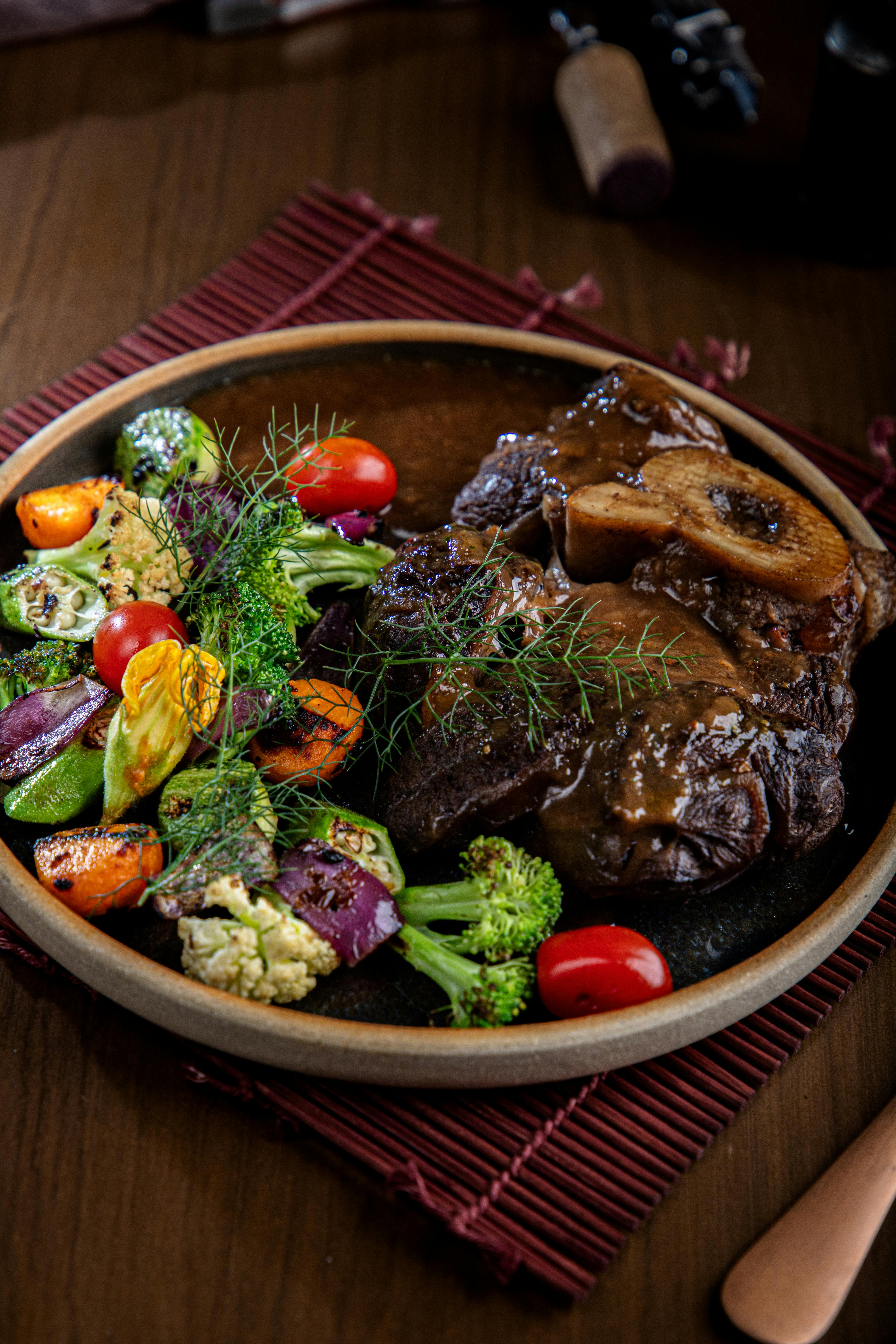
Photo: Eduardo Krajan / Pexels
Italian
Osso Buco
The diets react (see scores below)
Common Ingredients
- veal shanks
- white wine
- tomatoes
- carrots
- celery
- onion
- lemon zest
- parsley
Specific recipes may vary.
Incompatible with 4 of 11 diets
Diet Ratings
Osso Buco is built around veal shanks, which are an excellent keto protein and fat source with zero carbs and rich collagen from the bone marrow. However, the traditional braising liquid introduces meaningful carbohydrate sources: white wine adds residual sugars even after cooking (roughly 3-5g net carbs per serving), tomatoes contribute ~3-4g net carbs, and the mirepoix of carrots, celery, and onion adds another 5-8g net carbs depending on quantities used. Combined, a full serving could range from 10-18g net carbs, which is manageable within a daily keto budget but not trivially low. The dish is not inherently keto-unfriendly, but it requires portion control on the sauce and awareness that the vegetable and wine components accumulate. Lemon zest and parsley are negligible. The bone marrow is a keto superfood. With careful portioning of sauce and reduction of carrots/onion, this dish can fit keto well.
Some strict or clinical keto practitioners would flag the white wine and tomato combination as unnecessary sugar/carb exposure and recommend omitting or substituting (e.g., using broth only), while lazy keto adherents may approve it outright, arguing the carbs easily fit a 50g daily limit in a reasonable serving.
Osso Buco is a classic Italian braised veal dish. Veal shanks are the primary and defining ingredient — a direct animal product (meat from a calf). This makes the dish entirely incompatible with a vegan diet. There is no ambiguity here; no vegan interpretation of this dish retains the veal shank as its centerpiece. The remaining ingredients (wine, tomatoes, vegetables, lemon zest, parsley) are plant-based, but the dish cannot be considered vegan in any meaningful sense while veal is present.
Osso Buco is largely paleo-compatible at its core — veal shanks, tomatoes, carrots, celery, onion, lemon zest, and parsley are all whole, unprocessed paleo-approved foods. The main point of friction is the white wine, which introduces alcohol. Alcohol is a gray area in the paleo community: it is a processed, fermented product not available in its refined form to Paleolithic humans, but dry wine in cooking (where much of the alcohol evaporates) is widely tolerated by modern paleo practitioners. The dish also traditionally calls for added salt, which is excluded under strict paleo rules, though this ingredient was omitted from the listed ingredients. The traditional accompaniment — risotto Milanese or polenta — would be strictly off-limits, but the dish itself as listed avoids grains, legumes, dairy, and seed oils. Prepared without added salt and with awareness of the wine, this is a strong paleo-friendly meal.
Strict Cordain-school paleo excludes alcohol entirely as a non-ancestral, processed substance with metabolic downsides; Loren Cordain's original framework would flag the wine even in cooking. However, most modern paleo authorities including Mark Sisson and Robb Wolf treat occasional dry wine consumption as acceptable, and the cooking process reduces alcohol content substantially.
Osso Buco is a traditional Milanese dish built around veal shanks, which is red/red-adjacent meat (veal is young beef) and falls under the 'limited to a few times per month' category in Mediterranean diet guidelines. While the supporting ingredients — tomatoes, carrots, celery, onion, white wine, lemon zest, and parsley — are exemplary Mediterranean vegetables and aromatics, the dish is fundamentally anchored by a substantial portion of veal. Red and red-adjacent meats are discouraged as regular fare, and a main course centered on a large veal shank significantly exceeds the recommended frequency and portion size for such proteins. The preparation method (braising) is wholesome, but the primary protein drives this into 'avoid' territory for regular consumption.
Some Mediterranean diet authorities acknowledge that veal, being leaner than beef and deeply embedded in Northern Italian culinary tradition (a Mediterranean-adjacent region), could be treated more like poultry in terms of moderation. Under this interpretation, Osso Buco prepared occasionally with abundant vegetables and without added saturated fats could be rated 'caution' rather than 'avoid,' particularly in the context of an otherwise plant-forward diet.
Osso Buco as traditionally prepared is dominated by plant-based ingredients that are strictly excluded from the carnivore diet. While veal shanks are an excellent carnivore-approved protein (ruminant meat, bone-in for marrow access), the dish is built around a braising liquid and soffritto of tomatoes, carrots, celery, and onion — all excluded vegetables. White wine is a plant-derived fermented beverage with sugars and plant compounds. Lemon zest and parsley are plant-derived garnishes also excluded. The gremolata and vegetable base are not incidental — they are structural to the dish. To make this carnivore-compliant, one would need to strip away virtually everything except the veal shank itself, at which point it is simply braised veal shank, not Osso Buco. The dish cannot be rated on the merit of its protein alone when the preparation method is fundamentally incompatible with carnivore principles.
Osso Buco in this form is fully Whole30 compliant. Veal shanks are an approved protein (meat), and all remaining ingredients — white wine, tomatoes, carrots, celery, onion, lemon zest, and parsley — are either allowed vegetables, aromatics, or permitted cooking additions. White wine is allowed as a cooking ingredient per Whole30 rules (alcohol cooks off and wine vinegars/wines used in cooking are accepted); the program explicitly allows alcohol-based extracts and cooking wines. There are no grains, legumes, dairy, added sugars, or other excluded ingredients in this classic preparation. Traditional Osso Buco is often served with gremolata (lemon zest, parsley, garlic) which is also compliant, and without the traditional risotto Milanese accompaniment, the dish itself is a clean, whole-food meal.
Osso Buco as traditionally prepared contains onion as a core aromatic ingredient, which is high in fructans and must be avoided during the FODMAP elimination phase. Onion is one of the most significant FODMAP triggers and cannot be made safe at any reasonable culinary serving size. Celery is also problematic at standard cooking quantities (low-FODMAP only at 10g/small amounts, but recipes typically use full stalks). White wine contributes minimal FODMAPs at small amounts but is used in volume in braising. The remaining ingredients — veal shanks, tomatoes (low-FODMAP at standard serves), carrots, lemon zest, and parsley — are individually low-FODMAP. However, the onion alone disqualifies this dish during elimination. Even if onion is removed, the recipe would need careful reconstruction, as the onion is foundational to the soffritto base of traditional Osso Buco.
Osso Buco presents a mixed profile from a DASH perspective. On the positive side, veal is a lean red meat compared to beef, and the dish is loaded with DASH-favorable vegetables (carrots, celery, onion, tomatoes) and aromatic herbs. The gremolata garnish (lemon zest, parsley) adds nutrients without sodium. White wine contributes minimal residual alcohol and some acidity. However, DASH guidelines limit red meat broadly, and veal shanks are a bone-in cut that, while relatively lean, still contains moderate saturated fat from marbling and connective tissue. Traditional restaurant preparations often add butter and can be high in sodium from broth and wine reduction. Home-prepared versions with low-sodium broth and no added salt can score significantly better. The vegetable-forward nature of the dish and absence of processed ingredients keep it out of 'avoid' territory, but the red meat component and preparation variables warrant caution.
NIH DASH guidelines broadly limit red meat (including veal) as a category to be minimized, favoring poultry and fish instead. However, updated clinical interpretations note that veal is among the leanest red meats available, and some DASH-oriented dietitians consider it acceptable in modest portions (3-4 oz) when prepared without added sodium, viewing the vegetable-rich cooking method as consistent with DASH principles.
Osso Buco presents a mixed Zone profile. On the positive side, the dish is rich in Zone-favorable vegetables (carrots, celery, onion, tomatoes) providing low-glycemic carbohydrates, and the braising liquid includes white wine which adds minimal carb load. Veal is a relatively lean protein compared to fattier red meats, though the shank cut includes bone marrow and connective tissue that contributes saturated fat. The traditional accompaniment — gremolata (lemon zest, parsley) — is Zone-friendly. The main Zone challenge is the veal shank itself: it is not a lean cut like skinless chicken or fish. The bone marrow and braised collagen release saturated fat into the dish, making fat block management tricky. However, with portion control (a modest 3 oz veal portion), the dish can be balanced with extra vegetables and a small olive oil fat source. Notably, Osso Buco is typically served with risotto (Milanese), which would push the meal into high-glycemic territory — but the dish as listed here omits that component. As a standalone braised main with vegetables, it is workable in Zone with careful portioning.
In Sears' earlier Zone writings, all saturated fat sources — including veal shank with marrow — were viewed cautiously as they were not 'favorable' protein sources. However, Sears' later anti-inflammatory work (e.g., 'The Zone') acknowledged that moderate saturated fat from whole-food animal sources is less problematic than processed foods, and that the polyphenols from tomatoes, onion, and parsley in this dish actively support Zone's anti-inflammatory goals. Some Zone practitioners would score this higher (6-7) on the strength of its vegetable content and relatively lean protein profile compared to, say, lamb or beef ribs.
Osso Buco presents a mixed anti-inflammatory profile. On the positive side, the vegetable base — tomatoes, carrots, celery, and onion — provides a meaningful dose of antioxidants, carotenoids, and polyphenols. Lemon zest contributes flavonoids, and parsley is a notable anti-inflammatory herb rich in apigenin and vitamin C. White wine is used in cooking (most alcohol evaporates), which is generally considered less problematic than consuming it as a beverage. The braising method is low in added fat and does not involve frying in inflammatory oils. On the less favorable side, veal shank is a red meat, and anti-inflammatory frameworks typically recommend limiting red meat due to its saturated fat content and pro-inflammatory arachidonic acid. However, veal is leaner than most red meats (e.g., beef ribeye), which somewhat moderates the concern. The collagen-rich marrow and connective tissue in the shank, while calorie-dense, may have some neutral-to-positive effects on gut health in some frameworks. The dish contains no processed ingredients, trans fats, refined carbohydrates, or added sugars — all significant positives. Overall, this is a whole-food, vegetable-rich dish whose main liability is the red meat protein source, placing it firmly in the 'moderate occasionally' category rather than a regular staple on an anti-inflammatory diet.
Most anti-inflammatory frameworks including Dr. Weil's pyramid classify all red meat as 'limit,' making veal shank a recurring concern regardless of leanness; stricter protocols like AIP or functional medicine practitioners may flag it more strongly. Conversely, some researchers argue that unprocessed, lean red meat in moderate portions has a minimal inflammatory impact compared to processed meats, and the abundant vegetable and herb content of this dish substantially offsets the red meat signal.
Osso buco is a braised veal shank dish that offers meaningful protein from veal but comes with notable fat considerations. Veal shank is a moderately fatty cut — the braising process renders some fat into the cooking liquid, and the bone marrow (central to the traditional dish) is very high in saturated fat. The vegetable base (carrots, celery, onion, tomatoes) adds fiber and micronutrients, and the gremolata (lemon zest, parsley) is beneficial. White wine contributes alcohol, though much is cooked off during braising. The braising method is gentler than frying and makes the meat easier to digest than a dry-cooked fatty cut. However, the high fat content of the shank and especially the marrow can worsen GLP-1 side effects (nausea, bloating, delayed gastric emptying compounded by fat load). A typical restaurant portion is also large. At home, prepared lean with fat skimmed from the braising liquid and marrow consumption minimized, it becomes more acceptable — but the standard preparation lands it firmly in caution territory.
Some GLP-1-focused dietitians view braised veal as acceptable given its protein density and the digestibility advantages of slow-cooked meat, particularly for patients who struggle to meet protein targets. Others flag the saturated fat in the marrow and braising liquid as a meaningful trigger for GI side effects, and recommend patients avoid bone-in fatty cuts entirely until GI tolerance is well established.
*See how scores were generated at our methodology page.
Nutritional profile
Six traits that cut across every diet.
Fiber & Plants
How much whole-plant food and fiber it delivers.
Healthy Fats
The quality of its fats (unsaturated, omega-3).
Whole / Unprocessed
How close it is to its natural, unprocessed form.
Gut Gentle
How easy it is on digestion (low FODMAP, few irritants).
Low Glycemic
How little it spikes your blood sugar.
Protein Density
How much protein it packs per calorie.
Controversy Index
Higher controversy = more disagreement between diets.
Diet-Specific Tips
 Keto — 5/10
View tips
- Veal shanks are zero-carb, high-protein, and rich in fat and collagen — highly keto-compatible
- Bone marrow is a keto-approved fat source
- White wine contributes residual sugars (~3-5g net carbs per serving after cooking)
- Tomatoes add ~3-4g net carbs per serving
- Mirepoix (carrots, onion, celery) adds 5-8g net carbs, with carrots being the biggest contributor
- Total net carbs per serving estimated at 10-18g — manageable but requires budget awareness
- Lemon zest and parsley are negligible carb contributors
- Traditional gremolata topping is keto-safe; avoid traditional risotto or polenta sides
 Paleo — 6/10
View tips
- Veal shanks are a whole, unprocessed, paleo-approved protein
- All vegetables (tomatoes, carrots, celery, onion) are paleo-approved
- Lemon zest and parsley are approved herbs/aromatics
- White wine is a gray-area ingredient — alcohol is debated in the paleo community
- No grains, legumes, dairy, or seed oils in the listed ingredients
- Added salt (common in the dish but not listed) would be excluded under strict paleo
- Traditional serving with risotto or polenta would make the full dish non-paleo
 Whole30 — 9/10
View tips
- Veal shanks: compliant meat protein
- White wine used in braising: compliant as a cooking ingredient
- Tomatoes, carrots, celery, onion: all approved vegetables
- Lemon zest and parsley: compliant aromatics/herbs
- No dairy, grains, legumes, or added sugar
- Classic preparation avoids any excluded ingredients
- Typically served with risotto, but dish itself contains no grains
 DASH — 5/10
View tips
- Veal is a red meat, which DASH guidelines advise limiting in favor of poultry and fish
- Veal shank is relatively lean for red meat but contains moderate saturated fat
- Abundant DASH-favorable vegetables: tomatoes, carrots, celery, onion
- No processed or high-sodium packaged ingredients in base recipe
- Traditional preparations often include butter and high-sodium broth — sodium control is preparation-dependent
- White wine and lemon zest add flavor without significant nutritional concern
- Portion size critical: a full shank may exceed DASH red meat recommendations
- Low-sodium home preparation significantly improves DASH compatibility
 Zone — 5/10
View tips
- Veal shank is moderately lean compared to other red meats but contains saturated fat from marrow and connective tissue
- Abundant Zone-favorable low-glycemic vegetables: tomatoes, carrots, celery, onion
- White wine adds minimal carbohydrates and is acceptable in Zone cooking
- Gremolata (lemon zest, parsley) contributes polyphenols consistent with Sears' anti-inflammatory emphasis
- No high-glycemic carbohydrates present in the listed ingredients
- Traditional pairing with risotto (not listed) would significantly worsen Zone balance
- Portion control of veal is critical — a full restaurant-sized shank can exceed Zone protein blocks
- Braising fat content is difficult to measure precisely, requiring caution in fat block accounting
 Anti-Inflammatory — 5/10
View tips
- Veal is red meat — limit category in anti-inflammatory frameworks, though leaner than most red meats
- Rich vegetable base (tomatoes, carrots, celery, onion) provides antioxidants, carotenoids, and polyphenols
- Lemon zest and parsley contribute flavonoids and anti-inflammatory compounds
- Braised preparation avoids inflammatory seed oils and high-heat frying
- No processed ingredients, trans fats, refined carbohydrates, or added sugars
- White wine used in cooking — minimal alcohol concern after reduction
- Bone marrow is high in saturated fat — modest concern in anti-inflammatory context
 GLP-1 Friendly — 5/10
View tips
- Moderate-to-high fat content from veal shank and bone marrow, particularly saturated fat
- Braising method improves digestibility compared to fried or dry-cooked fatty meats
- Good protein source from veal, supporting the primary GLP-1 dietary priority
- Vegetable base adds fiber and micronutrients
- White wine alcohol largely cooked off but worth noting
- Traditional portion sizes are large — portion control essential
- Bone marrow is calorie-dense and fat-heavy; skipping or limiting it improves the rating
- Fat should be skimmed from braising liquid before serving to reduce GI side effect risk