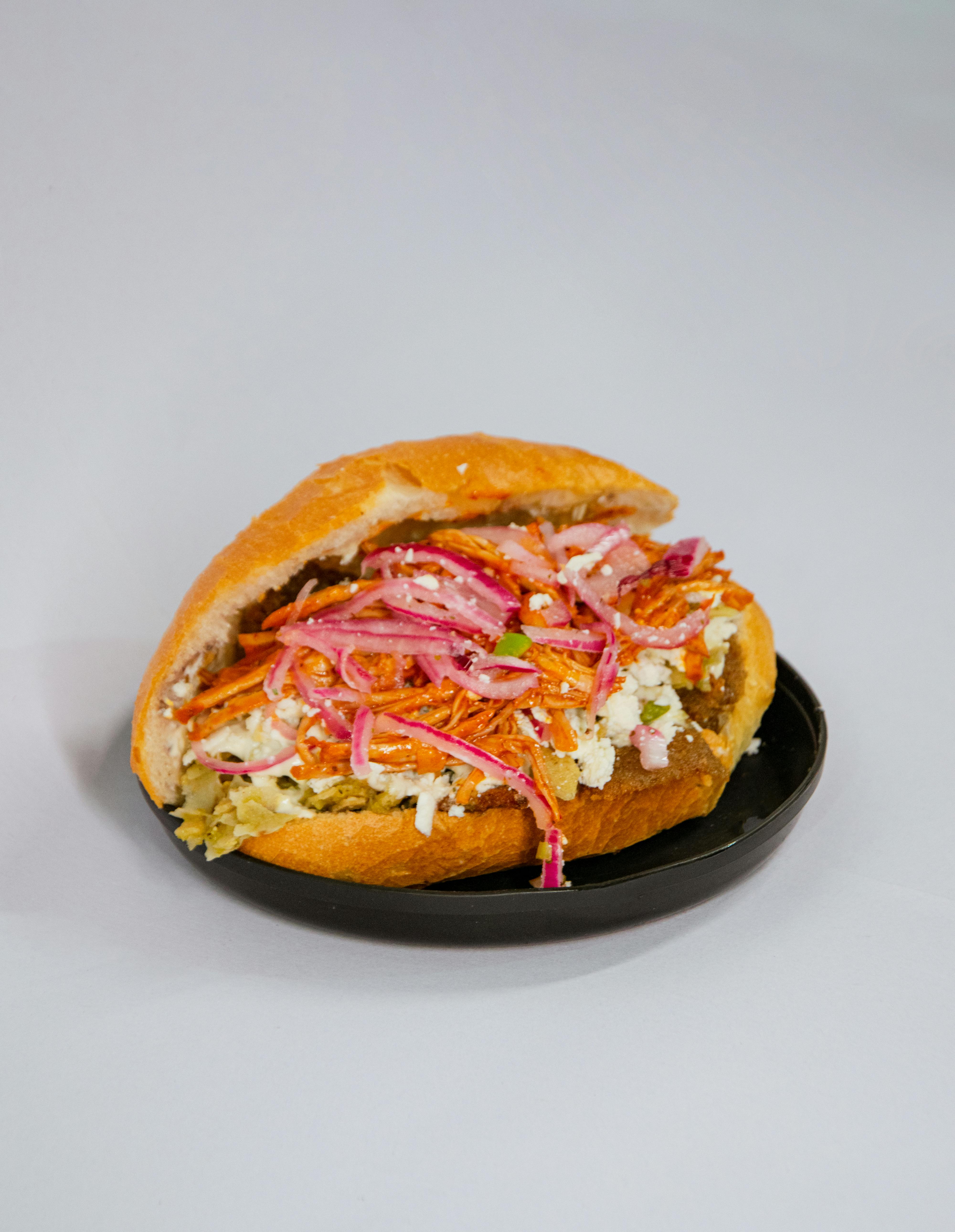
Photo: César O'neill / Pexels
The diets react (see scores below)
Common Ingredients
- telera roll
- Mexican chorizo
- potatoes
- guajillo sauce
- lettuce
- queso fresco
- Mexican crema
- onion
Specific recipes may vary.
Incompatible with 11 of 11 diets
Diet Ratings
Pambazo is fundamentally incompatible with ketogenic diet. The telera roll is a wheat bread roll delivering 40-50g of net carbs on its own — already exceeding or maxing out the entire daily keto carb limit. Compounding this, the dish includes potatoes, which are high-starch vegetables with approximately 15-20g additional net carbs per serving. The guajillo sauce adds a small amount of carbs from dried chiles. While some ingredients are keto-friendly (Mexican chorizo provides fat and protein, queso fresco and crema are low-carb dairy, lettuce and onion are minimal), the two primary structural components — the bread roll and potatoes — make this dish entirely off-limits for ketogenic eating in any reasonable portion size.
Pambazo contains multiple animal-derived ingredients that are clearly non-vegan. Mexican chorizo is a pork-based sausage, queso fresco is a fresh dairy cheese, and Mexican crema is a dairy-based soured cream. Together, these three ingredients make this dish fundamentally incompatible with a vegan diet. There is no ambiguity here — this dish is built around animal products at its core.
Pambazo is fundamentally incompatible with the paleo diet. The telera roll is a wheat-based bread, making it a grain product that is strictly excluded. Mexican crema and queso fresco are dairy products, both excluded under paleo rules. Mexican chorizo is typically a processed meat containing added salt, preservatives, and sometimes fillers. The guajillo sauce, while made from dried chiles, is often prepared with added salt. Even setting aside the debated status of white potatoes, the bread and dairy alone make this dish a clear avoid. There are no gray areas here — the foundational component of this dish (the bread roll) is one of the most explicitly excluded food categories in paleo.
The Pambazo is fundamentally at odds with Mediterranean diet principles on multiple fronts. Mexican chorizo is a highly processed, high-saturated-fat pork sausage — red/processed meat that the Mediterranean diet explicitly limits. The telera roll is a refined white bread with no whole grain value. The dish is deep-dipped and fried in guajillo sauce, adding unnecessary fat from a non-olive-oil source. Mexican crema is a high-fat dairy condiment used liberally rather than moderately. Taken together, the combination of processed meat, refined grains, high-fat dairy, and frying method makes this a poor fit for the Mediterranean dietary pattern.
Pambazo is fundamentally incompatible with the carnivore diet. The dish is built around a telera roll (wheat bread), which is a grain-based plant food and the structural foundation of the sandwich. Beyond the bread, it contains potatoes (starchy vegetable), guajillo sauce (dried chili pepper, a plant-based condiment), lettuce (leafy vegetable), and onion (vegetable). While chorizo is an animal product (though often contains spices and sometimes fillers), and queso fresco and Mexican crema are dairy derivatives that some carnivore practitioners debate, the overwhelming presence of multiple plant-based staple ingredients makes this dish entirely off-limits. There is no meaningful way to modify this dish within its traditional form to make it carnivore-compatible — removing the bread, potatoes, guajillo sauce, lettuce, and onion would leave nothing resembling a pambazo.
Pambazo contains multiple Whole30-excluded ingredients. The telera roll is a wheat-based bread roll, which violates the grain exclusion. Queso fresco is a dairy cheese, which is excluded. Mexican crema is a dairy product (similar to sour cream), also excluded. Mexican chorizo frequently contains added sugar and sometimes non-compliant additives. Even if the fillings could be made compliant, the telera roll alone disqualifies this dish — bread is explicitly excluded under both the grain rule and the 'no recreating baked goods/junk food' rule. A pambazo is defined by its bread, so the dish as a whole is not Whole30 compatible.
Pambazo contains multiple high-FODMAP ingredients that make it unsuitable during the elimination phase. The telera roll is a wheat-based bread, high in fructans — the primary FODMAP concern. Onion is one of the highest-fructan foods and is a core ingredient in the dish. Mexican chorizo typically contains garlic and sometimes onion powder, both major fructan sources. Guajillo sauce, while made from dried chiles that are themselves low-FODMAP, is almost always prepared with onion and garlic, adding further fructan load. Queso fresco is a soft fresh cheese with moderate-to-high lactose content. Mexican crema is also a dairy product with lactose concerns, though in small amounts it may be borderline. Potatoes and lettuce are low-FODMAP and unproblematic. However, the combination of wheat bread, onion, garlic-containing chorizo, and lactose-containing dairy creates an overwhelmingly high-FODMAP dish with no realistic modification path that would preserve the authentic character of a pambazo.
Pambazo is fundamentally incompatible with DASH diet principles across multiple dimensions. Mexican chorizo is high in saturated fat, sodium, and often contains significant amounts of cholesterol — directly opposing DASH's core directive to limit saturated fat and sodium. The telera roll is a refined white bread with minimal fiber or whole grain content. Queso fresco and Mexican crema are full-fat dairy products, contrary to DASH's emphasis on low-fat or fat-free dairy. The guajillo sauce preparation typically adds additional sodium. Collectively, this dish is high in saturated fat, sodium, refined carbohydrates, and full-fat dairy, with very little DASH-positive nutritional density despite the presence of potatoes, onion, and lettuce. It represents a heavily processed, high-fat street food that conflicts with nearly every major DASH dietary guideline.
The Pambazo is a poor fit for the Zone Diet due to multiple unfavorable macro components stacking against each other. The telera roll is a refined white bread — high-glycemic and nutritionally empty by Zone standards, spiking insulin rapidly. Potatoes are explicitly listed as an unfavorable high-glycemic carbohydrate in Sears' published materials. Together, these two carbohydrate sources dominate the dish and both fall into the 'unfavorable' or 'avoid' category. The primary protein, Mexican chorizo, is a fatty, highly processed sausage with significant saturated fat, far from the lean protein ideal of the Zone (7g protein blocks with minimal fat). The guajillo sauce (often contains sugar), Mexican crema (high saturated fat, low protein), and queso fresco (moderate saturated fat) add further unfavorable fat and glycemic load. The only Zone-friendly elements are lettuce and onion, which contribute negligible positive balance. The overall macronutrient ratio skews heavily toward high-GI carbohydrates and saturated fat, with inadequate lean protein — essentially the inverse of the 40/30/30 Zone target. Reformulating this dish to be Zone-compatible would require replacing nearly every primary ingredient, making it no longer a Pambazo in any meaningful sense.
Pambazo is a traditional Mexican street sandwich that presents multiple pro-inflammatory concerns across nearly every component. Mexican chorizo is a highly processed, fatty cured sausage high in saturated fat and sodium, with significant amounts of arachidonic acid — a known inflammatory precursor. The telera roll is a refined white bread with a high glycemic index and minimal fiber, contributing to blood sugar spikes and elevated inflammatory markers like CRP and IL-6. Mexican crema is a full-fat dairy product, in the 'limit' category per anti-inflammatory guidelines. Queso fresco adds more full-fat dairy and sodium. The guajillo sauce itself (dried chiles, which are anti-inflammatory) is the one bright spot, offering capsaicin and polyphenols. Lettuce and onion provide modest anti-inflammatory benefit, and potatoes offer some potassium and resistant starch, but these positives are overwhelmed by the inflammatory load of the protein and bread components. The combination of processed red meat (chorizo), refined carbohydrates (telera roll), and full-fat dairy (crema, queso fresco) stacks multiple 'limit' and 'avoid' categories simultaneously, making this dish a poor fit for an anti-inflammatory dietary pattern.
A pambazo is one of the most challenging foods for GLP-1 patients. The telera roll is dipped in guajillo sauce and pan-fried or griddle-pressed until saturated with oil, making the bread itself a high-fat, greasy vehicle. Mexican chorizo is among the highest-fat proteins available — typically 70-80% of calories from fat, heavily saturated, with minimal protein density per calorie. The potatoes add starchy, low-fiber refined carbohydrates. Mexican crema adds additional saturated fat. Queso fresco contributes modest protein but also fat. The combination of a greasy bread, fatty processed meat, starchy filler, and high-fat dairy toppings hits nearly every GLP-1 avoid category simultaneously: high saturated fat (worsens nausea and reflux), fried/greasy preparation (slows gastric emptying further on top of medication effects), processed meat, and very low protein density per calorie. The lettuce and onion provide negligible nutritional offset. This dish is likely to cause significant GI distress — nausea, reflux, bloating — and delivers poor protein and fiber relative to its caloric load.
*See how scores were generated at our methodology page.
Nutritional profile
Six traits that cut across every diet.
Fiber & Plants
How much whole-plant food and fiber it delivers.
Healthy Fats
The quality of its fats (unsaturated, omega-3).
Whole / Unprocessed
How close it is to its natural, unprocessed form.
Gut Gentle
How easy it is on digestion (low FODMAP, few irritants).
Low Glycemic
How little it spikes your blood sugar.
Protein Density
How much protein it packs per calorie.
Controversy Index
Higher controversy = more disagreement between diets.