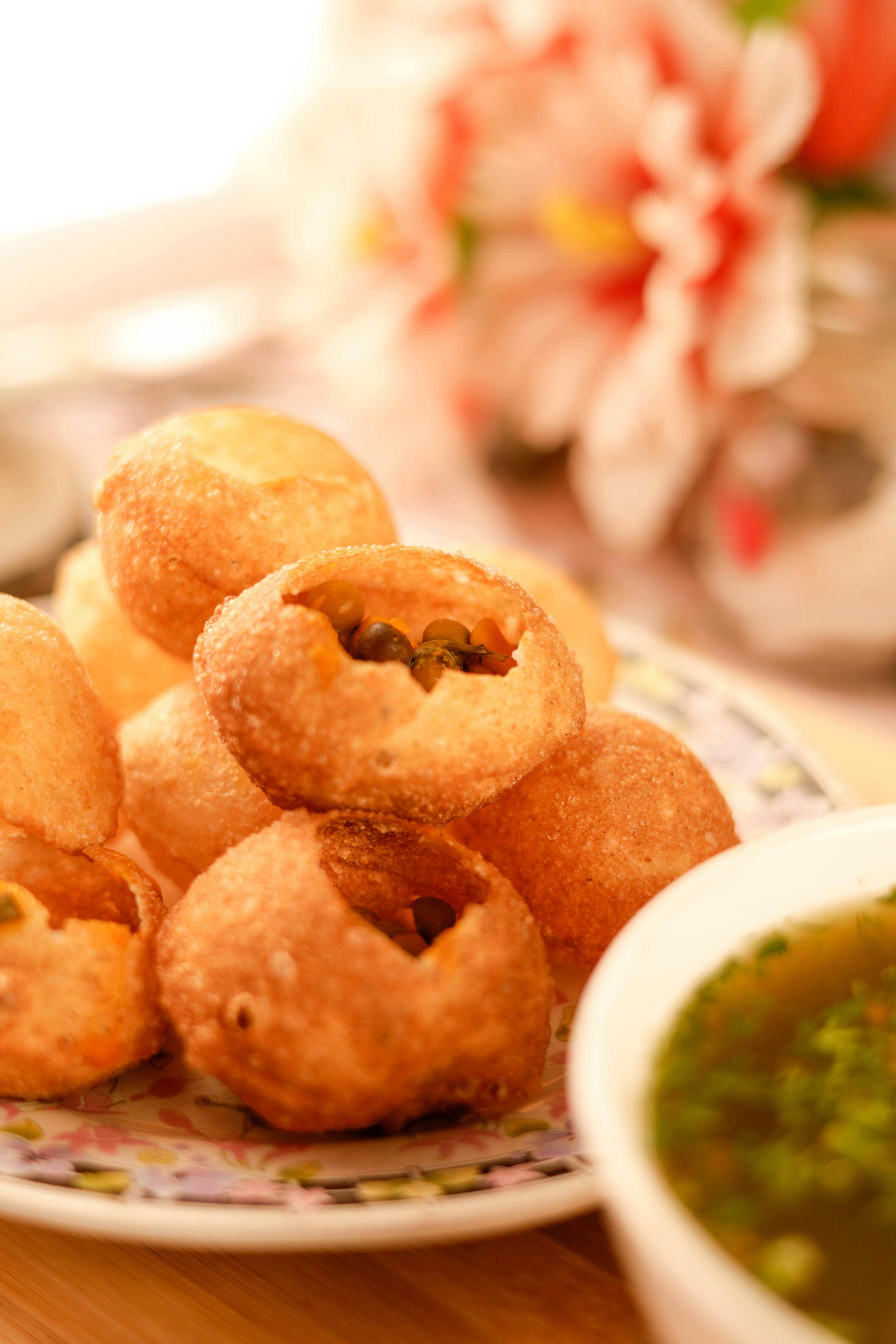
Photo: Shahbaz Ansari / Pexels
The diets react (see scores below)
Common Ingredients
- puri shells
- potatoes
- chickpeas
- mint
- tamarind
- green chilies
- cumin powder
- black salt
Specific recipes may vary.
Incompatible with 6 of 11 diets
Diet Ratings
Pani Puri is fundamentally incompatible with a ketogenic diet. The puri shells are deep-fried wheat/semolina dough — a grain-based product with very high net carbs. Potatoes and chickpeas are both high-starch, high-net-carb foods that alone would exceed a full day's keto carb budget in a single serving. A typical serving of 6 puri contains easily 40-60g of net carbs from the shells alone, with potatoes adding another 15-20g and chickpeas another 10-15g. Tamarind chutney also contains added sugars. There is no meaningful fat content and no protein source. Every primary structural component of this dish directly violates ketogenic principles.
Pani Puri as described is entirely plant-based. The puri shells are traditionally made from semolina or whole wheat flour and water, fried in oil — no animal products involved. The filling of potatoes and chickpeas is straightforwardly vegan, as are all the flavoring and liquid components: mint, tamarind, green chilies, cumin powder, and black salt (kala namak, a volcanic mineral salt). Every ingredient in this dish is whole or minimally processed plant food, making it an excellent fit for a vegan diet. There are no animal-derived ingredients, no contested components, and no meaningful cross-contamination concern in the recipe itself.
Pani Puri is fundamentally incompatible with the paleo diet. The puri shells are made from semolina or wheat flour — both grains that are strictly excluded from paleo. Chickpeas are legumes, another core paleo exclusion. Black salt is an added salt, which is also excluded. The dish has multiple hard paleo violations at its structural core, not just peripheral ingredients. The compliant elements (mint, tamarind, green chilies, cumin, potatoes) are minor and cannot redeem a dish that is built around grains and legumes.
Pani Puri contains a mixed profile from a Mediterranean diet perspective. The filling ingredients — chickpeas, potatoes, mint, tamarind, green chilies, and cumin — are largely plant-based and align well with Mediterranean principles. Chickpeas are a Mediterranean staple legume, and the spiced water base is essentially a herb-forward liquid with no added sugar or unhealthy fats. However, the puri shells are deep-fried refined wheat flour crisps, placing them in the 'refined grain + fried food' category that the Mediterranean diet discourages. The dish is not inherently high in saturated fat or sugar, but the refined, deep-fried shells are a notable departure from whole-grain, minimally processed principles. Overall, the dish is borderline — its plant-based filling pulls it toward approval, while the fried refined shells temper the verdict to caution.
Some Mediterranean diet interpreters might lean more favorably on this dish, noting that the overall fat content is relatively low (the shells are thin and portion sizes are small), and that the legume and herb-heavy filling closely mirrors Mediterranean mezze traditions. Conversely, stricter clinical guidelines would flag the deep-fried refined flour shells as incompatible with the diet's whole-grain emphasis.
Pani Puri is entirely plant-based and contains zero animal products. Every single ingredient — puri shells (fried wheat dough), potatoes, chickpeas, mint, tamarind, green chilies, cumin powder, and black salt — is either a grain, legume, vegetable, herb, or plant-derived spice. This dish violates every core principle of the carnivore diet simultaneously: it contains grains (puri), legumes (chickpeas), starchy vegetables (potatoes), plant spices and herbs (mint, cumin, chilies), and plant-derived acids (tamarind). There is no animal product present whatsoever, making this completely incompatible with any tier of carnivore eating, including the most lenient interpretations.
Pani Puri contains multiple excluded ingredients that make it incompatible with Whole30. First, the puri shells are made from semolina (wheat) or all-purpose flour — both grains, which are entirely excluded from Whole30. Second, chickpeas are legumes, which are also explicitly excluded. Even if the puri shells could somehow be removed from the equation, the chickpeas alone disqualify this dish. Additionally, the puri shells themselves fall under the 'no recreating baked goods/junk food' rule (they function as crackers/chips/shells), which is prohibited even if compliant ingredients were used. The potatoes, mint, tamarind, green chilies, cumin powder, and black salt are all Whole30-compatible, but the grain-based puri shells and chickpeas render this dish entirely non-compliant.
Pani Puri contains multiple high-FODMAP ingredients that make it unsuitable during the elimination phase. Chickpeas are high in GOS (galacto-oligosaccharides) and are high-FODMAP at typical serving sizes used in this dish. The puri shells are traditionally made from semolina or wheat flour, which are high in fructans. Tamarind in larger quantities (as used in the flavored water/chutney) is high-FODMAP due to excess fructose. Even at small servings, the combination of chickpeas and wheat-based puris creates a high FODMAP load. Potatoes, mint, green chilies, cumin powder, and black salt are low-FODMAP, but they cannot offset the significant FODMAP burden from the primary structural and filling ingredients.
Pani Puri is a mixed dish from a DASH perspective. On the positive side, it contains several DASH-friendly ingredients: chickpeas and potatoes provide fiber, potassium, and plant-based protein; mint and tamarind offer antioxidants; and the dish is low in saturated fat and contains no red meat or full-fat dairy. However, the puri shells are deep-fried refined flour (maida) puffs — high in refined carbohydrates and added fat — which conflicts with DASH's emphasis on whole grains and limiting total fat. Black salt (kala namak) is a sodium-containing salt, and when combined with the tamarind water and spice mix, the sodium content of a typical serving (6-8 puris) can be moderate to high, potentially 400-700mg+ depending on preparation. The dish is also a street food snack often consumed in large quantities, making portion control difficult. The refined fried shells are the primary concern, as the filling and water components are broadly aligned with DASH principles.
NIH DASH guidelines would flag the fried refined-grain shells and sodium from black salt and spice mixes as limiting factors. However, some DASH-oriented nutritionists note that if prepared at home with baked whole-wheat puris, reduced black salt, and a herb-forward pani, this dish's chickpea-potato filling and herb-spiced water are quite compatible with DASH's emphasis on plant-based foods, potassium, and magnesium — significantly improving its profile.
Pani Puri is a problematic food from a Zone Diet perspective for multiple compounding reasons. The puri shells are deep-fried refined wheat dough — a high-glycemic, high-omega-6 fat combination with no lean protein or monounsaturated fat value. Potatoes are explicitly listed by Dr. Sears as an unfavorable, high-glycemic carbohydrate to avoid. The dish as a whole is dominated by two of the Zone's most cautioned carbohydrate sources (refined starch + potatoes), contains no meaningful lean protein, and the frying medium introduces inflammatory omega-6 fats rather than monounsaturated fats. Chickpeas are the one redeeming ingredient — they are a moderate-glycemic legume with both protein and fiber — but they represent a minor portion of the overall macro profile. The mint, tamarind, spices, and black salt are Zone-neutral or mildly beneficial (polyphenols in tamarind and mint). However, the structural imbalance is severe: this snack is overwhelmingly carbohydrate-dominant (primarily high-glycemic), provides virtually no lean protein, and the fat content comes from an unfavorable source. It cannot be easily portioned into a Zone-balanced context — even eating one or two pieces still delivers a disproportionate glycemic load with no protein or favorable fat to buffer it. This is one of the rare cases where the food's inherent structure makes Zone compliance essentially impossible without fundamentally deconstructing the dish.
Pani Puri presents a genuinely mixed anti-inflammatory profile. On the positive side, the dish contains several notable anti-inflammatory ingredients: chickpeas provide plant-based protein, fiber, and polyphenols linked to reduced CRP; mint delivers rosmarinic acid and flavonoids with antioxidant properties; green chilies contribute capsaicin, a well-studied anti-inflammatory compound; cumin powder provides anti-inflammatory phytonutrients; and tamarind offers antioxidants and tartaric acid. Black salt is a neutral mineral component. The main concern is the puri shells — deep-fried wheat flour crisps that introduce refined carbohydrates and seed/vegetable oil (typically used for frying), both of which are on the 'limit' or 'avoid' list under anti-inflammatory principles. Potatoes are a mild-starch neutral food in this context. The overall dish is a high-glycemic snack due to the fried puri and starchy potato filling, which can transiently spike blood sugar and promote a low-grade inflammatory response with regular consumption. However, the spice and legume components provide genuine anti-inflammatory offset. Consumed occasionally, this is not a problematic food; as a dietary staple it would lean more inflammatory due to the fried refined-flour shells.
Dr. Weil's framework and most mainstream anti-inflammatory guidance would flag the deep-fried refined flour puris as a regular concern, emphasizing glycemic load and oxidized seed oils. However, traditional Indian dietary research (e.g., work on pulses and spice-rich diets) suggests the cumulative anti-inflammatory benefit of legumes, tamarind, and warming spices like cumin and chili may meaningfully offset the fried shell component when the dish is eaten in culturally appropriate portions.
Pani puri is a low-calorie, low-fat Indian street snack, which sounds appealing on the surface, but it falls short of GLP-1 dietary priorities in several ways. The puri shells are deep-fried, which adds fat, worsens GI side effects, and is generally discouraged for GLP-1 patients. The filling provides some fiber from chickpeas and potatoes, and chickpeas contribute modest protein, but the dish as a whole is protein-poor — nowhere near the 15-30g per meal target. The tamarind-water (pani) is acidic and the green chilies and spice mix may worsen nausea or reflux, which are already common GLP-1 side effects. Portion size is naturally small (typically 6-8 pieces), which is a minor positive, but each piece is essentially a fried shell with a starchy filling and spiced water — nutrient density per calorie is low. The black salt and cumin are fine in small amounts. Overall, pani puri is an occasional-treat food rather than a GLP-1-supportive choice: the fried shells, negligible protein, and spice-acid combination are the primary concerns.
Some GLP-1-focused dietitians may argue that pani puri's naturally small portion size, low overall fat load per piece, and chickpea fiber content make it an acceptable occasional snack when GI side effects are mild — the concern is less about absolute fat content and more about individual spice and acid tolerance, which varies considerably among GLP-1 patients.
*See how scores were generated at our methodology page.
Nutritional profile
Six traits that cut across every diet.
Fiber & Plants
How much whole-plant food and fiber it delivers.
Healthy Fats
The quality of its fats (unsaturated, omega-3).
Whole / Unprocessed
How close it is to its natural, unprocessed form.
Gut Gentle
How easy it is on digestion (low FODMAP, few irritants).
Low Glycemic
How little it spikes your blood sugar.
Protein Density
How much protein it packs per calorie.
Controversy Index
Higher controversy = more disagreement between diets.
Diet-Specific Tips
 Vegan — 9/10
View tips
- Puri shells made from semolina/wheat flour and water — fully plant-based
- Chickpeas and potatoes provide plant-based protein and starch
- Tamarind and mint form the spiced water (pani) — no animal derivatives
- Black salt (kala namak) is a mineral, not animal-derived
- All spices (cumin, green chili) are plant-based
- No dairy, eggs, or other animal products in any component
- Predominantly whole-food ingredients score high on whole-food plant-based standards
 Mediterranean — 5/10
View tips
- Chickpeas are a core Mediterranean legume — positive
- Mint, tamarind, green chilies, cumin are whole, plant-based flavorings — positive
- Puri shells are deep-fried refined wheat flour — negative
- No olive oil, no whole grains — missing key Mediterranean elements
- No added sugars or red meat — neutral to positive
- Small portion format limits overall impact of the fried component
 DASH — 4/10
View tips
- Puri shells are deep-fried refined flour, conflicting with DASH whole-grain and fat-limiting guidelines
- Chickpeas and potatoes are DASH-positive: high in fiber, potassium, and plant protein
- Black salt and spiced tamarind water add meaningful sodium — a key DASH concern
- No saturated fat, red meat, or added sugar — positive attributes
- Portion control is difficult in typical serving contexts (6-10 puris)
- Home preparation with baked whole-wheat puris and reduced salt would substantially improve DASH compatibility
 Anti-Inflammatory — 5/10
View tips
- Puri shells are deep-fried refined flour — pro-inflammatory refined carbs and likely seed oil
- Chickpeas are an anti-inflammatory legume with fiber and polyphenols
- Green chilies provide capsaicin with well-documented anti-inflammatory properties
- Cumin and mint contribute beneficial phytonutrients and antioxidants
- Tamarind offers antioxidants and is a traditional digestive aid
- High glycemic load from fried starch + potato combination is a concern for regular consumption
- No omega-3s, no leafy greens, no olive oil — limited positive anti-inflammatory density beyond spices and legumes
 GLP-1 Friendly — 4/10
View tips
- Fried puri shells add fat and may worsen nausea and bloating
- Negligible protein content — does not meet 15-30g per meal target
- Chickpeas provide some fiber and modest protein but in small quantities
- Tamarind and green chilies are acidic and spicy — risk of worsening reflux or nausea on GLP-1
- Potato filling is starchy with low nutrient density per calorie
- Natural portion control (bite-sized pieces) is a minor positive
- Spiced water contributes to hydration, a marginal benefit