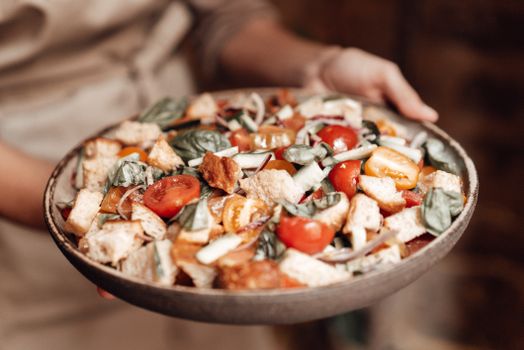
Photo: furkanfdemir / Pexels
Italian
Panzanella
The diets react (see scores below)
Common Ingredients
- stale bread
- tomatoes
- cucumber
- red onion
- fresh basil
- olive oil
- red wine vinegar
- garlic
Specific recipes may vary.
Incompatible with 5 of 11 diets
Diet Ratings
Panzanella is fundamentally built around stale bread, which is a grain-based, high-carb ingredient that is completely incompatible with a ketogenic diet. A typical serving contains a substantial portion of bread (often 2-3 slices worth), contributing 30-45g of net carbs from the bread alone before accounting for the tomatoes and red onion, which add additional sugars and carbs. The vegetables (cucumber, basil, garlic) and dressing (olive oil, red wine vinegar) are keto-friendly, but the core structural ingredient — bread — makes this dish a clear avoid. There is no meaningful way to reduce the bread portion while still calling it panzanella, as it is the defining ingredient of the dish.
Panzanella as listed is entirely plant-based. Every ingredient — stale bread, tomatoes, cucumber, red onion, fresh basil, olive oil, red wine vinegar, and garlic — is derived from plants with no animal products or animal-derived additives. The bread should be checked to confirm it contains no eggs or dairy (many rustic Italian breads are vegan by default), but as described this is a whole-food, minimally processed dish with excellent nutritional value from fresh vegetables, healthy fats from olive oil, and antioxidants from tomatoes and basil. It scores very high on both vegan compliance and whole-food quality.
Panzanella is built around stale bread, which is a wheat-based grain product — one of the clearest exclusions in the paleo diet. All major paleo authorities (Cordain, Sisson, Wolf) unanimously reject grains, and bread is the archetypal non-paleo food. The remaining ingredients — tomatoes, cucumber, red onion, fresh basil, olive oil, red wine vinegar, and garlic — are all paleo-compatible, but the dish is fundamentally defined by its bread base. Without the bread, it is no longer Panzanella. The dish as a whole must be rated avoid due to this core non-paleo ingredient.
Panzanella is a classic Tuscan bread salad that aligns well with Mediterranean diet principles. The dish is dominated by vegetables (tomatoes, cucumber, red onion, garlic, fresh basil), uses extra virgin olive oil as the primary fat, and includes red wine vinegar — all core Mediterranean ingredients. The stale bread component is the only consideration: it is traditionally made with white bread (a refined grain), which is less ideal than whole grain alternatives. However, the bread serves as a minor structural element in a largely plant-forward dish, and the overall nutritional profile remains strongly Mediterranean. The generous use of vegetables, olive oil, and fresh herbs far outweighs the refined grain concern.
Some modern Mediterranean diet clinicians would rate this slightly lower due to the refined white bread base, preferring whole grain bread to better align with current dietary guidelines. Traditional Tuscan practice, however, uses day-old white country bread (pane sciocco) as an authentic and acceptable use of stale bread to minimize waste — a hallmark of the cucina povera tradition.
Panzanella is entirely plant-based with zero animal-derived ingredients. It contains stale bread (grain), tomatoes, cucumber, red onion, and basil (all plant foods), dressed with olive oil (plant oil) and red wine vinegar (plant-derived). Every single ingredient violates carnivore diet principles. There is no animal protein, no animal fat, and no animal-derived component whatsoever. This dish is incompatible with any tier of the carnivore diet.
Panzanella is a Tuscan bread salad whose defining ingredient is stale bread — a grain product that is explicitly excluded on the Whole30. Bread falls squarely within the excluded grains category (wheat), and there is no compliant substitution that would still qualify as panzanella. All other ingredients (tomatoes, cucumber, red onion, fresh basil, olive oil, red wine vinegar, garlic) are fully Whole30-compliant, but the bread alone disqualifies the dish entirely.
Traditional Panzanella contains multiple high-FODMAP ingredients that make it unsuitable during the elimination phase. Stale bread is typically made from wheat, which is high in fructans — a primary FODMAP trigger. Red onion is one of the highest-fructan foods tested by Monash University and is problematic even in small quantities. Garlic (whole cloves, as used in Panzanella dressing or rubbed on bread) is also extremely high in fructans. Together, wheat bread + red onion + garlic create a significant FODMAP load that cannot be mitigated by portion control in a standard serving of this dish. The remaining ingredients — tomatoes (low-FODMAP at ≤1 medium tomato), cucumber (low-FODMAP), fresh basil (low-FODMAP), olive oil (low-FODMAP), and red wine vinegar (low-FODMAP) — are all safe, but they do not offset the core high-FODMAP components.
Panzanella is a Tuscan bread salad featuring vegetables and heart-healthy olive oil, which aligns well with many DASH principles. Tomatoes, cucumber, red onion, basil, and garlic are all DASH-approved vegetables rich in potassium, fiber, and antioxidants. Olive oil is the recommended fat in DASH and Mediterranean-aligned eating. Red wine vinegar adds flavor without sodium. The main limiting factor is the stale bread, which is typically made from refined white bread — not a whole grain, and therefore not the preferred DASH carbohydrate source. Additionally, olive oil quantity can be generous in traditional preparations, raising total fat and calorie density. If made with whole-grain bread and moderate olive oil, this dish would score higher. As commonly prepared with white rustic bread, it earns a cautious approval — nutritionally sound in its vegetable components but not fully optimized for DASH due to refined grain content.
NIH DASH guidelines emphasize whole grains over refined grains, which would penalize traditional white-bread panzanella. However, updated clinical interpretations increasingly recognize that overall dietary pattern and vegetable density matter more than grain refinement in isolation — some DASH-oriented nutritionists would approve this dish given its exceptional vegetable profile, low sodium, and olive oil base, especially when portion-controlled.
Panzanella is a Tuscan bread salad where stale bread serves as the primary carbohydrate base. The Zone Diet classifies bread — even stale crusty bread — as an 'unfavorable' high-glycemic carbohydrate that can spike insulin and disrupt the hormonal balance Sears targets. The vegetable components (tomatoes, cucumber, red onion, garlic, basil) are excellent Zone-friendly, low-glycemic carbs rich in polyphenols. Olive oil is an ideal Zone fat — monounsaturated and anti-inflammatory. Red wine vinegar actually has a mild glycemic-lowering effect, which is a small positive. The critical problems are twofold: (1) bread dominates the carb profile with high-glycemic, low-fiber refined starch, and (2) there is no protein source listed, making this impossible to constitute a balanced Zone meal on its own. As a side dish with a lean protein added (e.g., grilled chicken or fish), it could be incorporated with careful portioning — minimizing bread and maximizing the vegetable components. In that context it becomes a 'caution' rather than 'avoid,' because the vegetable base and olive oil dressing are genuinely favorable. However, the traditional preparation is bread-heavy and protein-free, which makes it poorly suited to Zone ratios without significant modification.
Some Zone practitioners applying Sears' later work (Toxic Fat, The Mediterranean Zone) might view a small portion of rustic sourdough bread in this dish more favorably, noting that the acidity of red wine vinegar and the fiber from vegetables can blunt the glycemic response of the bread somewhat. The Mediterranean Zone framework emphasizes polyphenol-rich foods — tomatoes, olive oil, basil, garlic, and red onion are all high-polyphenol ingredients Sears would commend. A modified panzanella using less bread, more vegetables, and served alongside a lean protein could score as high as 6.
Panzanella is largely built on anti-inflammatory staples. Extra virgin olive oil is one of the most celebrated anti-inflammatory foods, rich in oleocanthal and monounsaturated fats. Tomatoes provide lycopene and other carotenoids; cucumbers offer hydrating polyphenols; red onion delivers quercetin, a potent flavonoid with documented anti-inflammatory effects; fresh basil contains anti-inflammatory volatile oils (eugenol, linalool); garlic contributes allicin and organosulfur compounds; and red wine vinegar has a modest polyphenol content and may help moderate blood sugar response. The main limiting factor is the stale bread — traditionally made from white or rustic Italian bread, which is a refined carbohydrate. This is a meaningful but not disqualifying concern: the portion of bread is relatively modest compared to vegetables, it is used to soak up the anti-inflammatory dressing rather than as a base for a heavy starch load, and substituting whole-grain bread would significantly improve the profile. As a vegetable-forward dish with high antioxidant density and an excellent olive oil base, panzanella aligns well with anti-inflammatory eating principles despite the bread component.
The stale white bread introduces refined carbohydrates that can spike blood glucose and contribute to low-grade inflammation when consumed regularly — a concern emphasized by Dr. Weil's guidelines and glycemic-focused anti-inflammatory approaches. Some autoimmune and grain-free protocols (AIP, Wahls Protocol) would exclude this dish entirely due to the gluten-containing bread.
Panzanella is a colorful, vegetable-forward salad with genuinely positive qualities — hydrating ingredients (tomatoes, cucumber), anti-inflammatory olive oil, and fresh herbs — but it falls short as a GLP-1 meal on the two most critical criteria. First, it has essentially no meaningful protein source; stale bread provides minimal protein and no complete amino acids, making it a poor choice as a standalone meal when patients need 15–30g protein per sitting to protect muscle mass. Second, the bread base is a refined carbohydrate with low fiber density relative to its caloric contribution, and it absorbs olive oil readily, increasing the fat load per serving. The olive oil dressing is an unsaturated fat (a positive), but the total fat per serving can climb quickly depending on dressing quantity. The vegetables and vinegar are genuine positives — easy to digest, hydrating, low calorie, blood sugar stabilizing — and the dish is not actively harmful. It would be acceptable as a side dish paired with a high-protein main (grilled chicken, canned tuna, white beans added to the salad), but as described it does not meet GLP-1 nutritional priorities and would represent a missed opportunity in a calorie-restricted eating window.
*See how scores were generated at our methodology page.
Nutritional profile
Six traits that cut across every diet.
Fiber & Plants
How much whole-plant food and fiber it delivers.
Healthy Fats
The quality of its fats (unsaturated, omega-3).
Whole / Unprocessed
How close it is to its natural, unprocessed form.
Gut Gentle
How easy it is on digestion (low FODMAP, few irritants).
Low Glycemic
How little it spikes your blood sugar.
Protein Density
How much protein it packs per calorie.
Controversy Index
Higher controversy = more disagreement between diets.
Diet-Specific Tips
 Vegan — 9/10
View tips
- All listed ingredients are 100% plant-derived
- No animal products, dairy, eggs, or animal-derived additives present
- Bread should be verified as egg- and dairy-free, though traditional Tuscan bread (pane sciocco) typically is
- Olive oil, red wine vinegar, and garlic are unambiguously vegan
- Whole-food, minimally processed profile earns a high score within the approve range
 Mediterranean — 8/10
View tips
- Abundant fresh vegetables (tomatoes, cucumber, red onion, garlic)
- Extra virgin olive oil as primary fat — a Mediterranean cornerstone
- Fresh basil and red wine vinegar align with Mediterranean flavors
- Stale bread is traditionally white/refined, not whole grain
- No animal proteins or processed ingredients
- Plant-forward dish with no added sugars
 DASH — 6/10
View tips
- Tomatoes, cucumber, red onion, and garlic are excellent DASH vegetables rich in potassium and fiber
- Olive oil is the DASH-preferred fat source — heart-healthy monounsaturated fat
- Red wine vinegar adds flavor with no sodium contribution
- Stale bread is typically refined white bread, not a DASH-preferred whole grain
- No added sodium in the ingredient list — sodium content depends on bread type
- Generous olive oil portions can increase caloric density
- Substituting whole-grain bread would significantly improve DASH compatibility
- No saturated fat, no added sugar, no processed meat — aligns with DASH avoidance criteria
 Zone — 4/10
View tips
- Stale bread is a high-glycemic 'unfavorable' carbohydrate in Zone terminology — the primary structural flaw
- No protein source present — cannot form a balanced Zone meal without addition of lean protein
- Olive oil is an ideal Zone fat — monounsaturated, anti-inflammatory
- Tomatoes, cucumber, red onion, and garlic are low-glycemic, polyphenol-rich Zone-favorable vegetables
- Red wine vinegar has a mild glycemic index-lowering effect — a small positive
- Fresh basil contributes polyphenols aligned with Sears' anti-inflammatory emphasis
- Dish can be partially rehabilitated by reducing bread quantity and pairing with lean protein
 Anti-Inflammatory — 8/10
View tips
- Extra virgin olive oil — rich in oleocanthal and MUFAs, strongly anti-inflammatory
- Tomatoes — lycopene and carotenoids with antioxidant activity
- Red onion — high in quercetin, a potent anti-inflammatory flavonoid
- Fresh basil — eugenol and linalool with anti-inflammatory properties
- Garlic — allicin and organosulfur compounds reduce inflammatory markers
- Stale white bread — refined carbohydrate, modest glycemic concern; whole-grain substitution recommended
- No processed ingredients, additives, or pro-inflammatory seed oils
- Plant-forward, high-antioxidant overall profile
 GLP-1 Friendly — 4/10
View tips
- No significant protein source — fails the #1 GLP-1 dietary priority as a standalone dish
- Refined bread base offers low fiber density and absorbs fat from dressing
- Olive oil dressing is unsaturated and appropriate, but volume must be controlled
- Tomatoes and cucumber provide excellent hydration support — a genuine positive
- Easy to digest; unlikely to worsen GI side effects
- Could be upgraded to 'approve' range by adding white beans, tuna, or grilled chicken
- Better suited as a side dish than a primary meal for GLP-1 patients