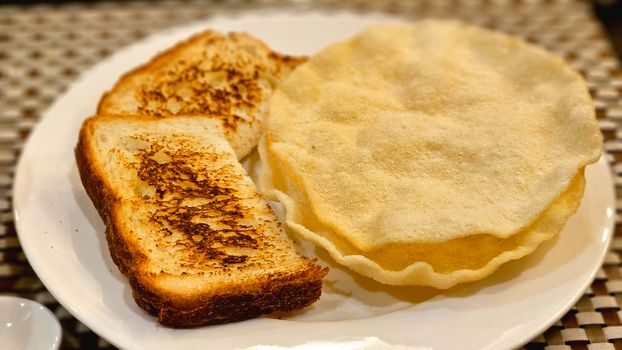
Photo: Muhammad Khawar Nazir / Pexels
The diets react (see scores below)
Common Ingredients
- urad dal flour
- cumin seeds
- black pepper
- salt
- vegetable oil
Specific recipes may vary.
Incompatible with 4 of 11 diets
Diet Ratings
Papadum is made primarily from urad dal (black lentil) flour, which is a legume-based flour with a high net carb content. A single standard papadum (approximately 10-15g) contains roughly 5-7g net carbs, and they are rarely consumed alone — a typical serving of 3-4 pieces delivers 15-25g net carbs, consuming the majority or entirety of a keto daily carb budget. Urad dal flour is essentially a grain/legume flour substitute that behaves like any other high-carb flour on keto. While the spices (cumin, black pepper, salt) and frying oil are keto-neutral, the base ingredient fundamentally disqualifies this food from routine keto consumption.
Papadum as described contains entirely plant-based ingredients: urad dal (black lentil) flour as the base, cumin seeds and black pepper as spices, salt, and vegetable oil. All components are whole or minimally processed plant foods. Urad dal flour is a legume-based ingredient rich in protein and fiber, making this a nutritionally respectable choice. There are no animal products, animal-derived additives, or contested ingredients in this formulation. Commercial papadums occasionally contain asafoetida (hing) as an additional spice, which is plant-derived and vegan-compatible. The dish scores highly as it centers a legume flour with whole spices.
Papadum is fundamentally incompatible with the paleo diet on multiple counts. The primary ingredient, urad dal flour, is a legume flour — urad dal (black gram) is a legume, and legumes are explicitly excluded from paleo due to their lectin, phytate, and antinutrient content. Additionally, salt is an excluded ingredient, vegetable oil (a seed oil) is used in preparation, and the dish itself is a processed, grain/legume-based flatbread. There is no gray area here — this dish fails on its core ingredient alone, before even considering the other problematic components.
Papadum is made from urad dal (black lentil) flour, which is a legume — a Mediterranean diet staple. The spices (cumin, black pepper, salt) are perfectly aligned with Mediterranean flavoring principles. However, papadum is typically deep-fried or roasted in vegetable oil, and it is a processed/prepared food rather than a whole food. When roasted or baked with minimal oil, it is reasonably compatible. The thin, crispy format means portion sizes are small, limiting fat and calorie impact. It does not contain red meat, added sugars, or refined grains. The main concerns are the frying method and that vegetable oil (if highly refined, e.g., soybean or sunflower) is not the Mediterranean-preferred extra virgin olive oil. Overall, this is an acceptable moderate food rather than a core Mediterranean staple.
Some Mediterranean diet authorities would rate this more favorably if roasted rather than fried, noting that legume-based flatbreads align with the diet's emphasis on pulses and plant proteins. Conversely, stricter interpretations would flag any deep-fried or highly processed crisp as an 'avoid,' since the Mediterranean diet discourages fried snack foods regardless of base ingredient.
Papadum is entirely plant-based and incompatible with the carnivore diet. It is made from urad dal flour (a legume), cumin seeds (a spice/seed), black pepper (a plant spice), and vegetable oil (a plant-derived oil). Every single ingredient is explicitly excluded on a carnivore diet. There are no animal-derived components whatsoever. This is one of the clearest possible 'avoid' cases.
Papadum is made primarily from urad dal flour, which is a legume flour. Legumes are explicitly excluded on the Whole30 program. Urad dal (black lentil) is a lentil, which falls squarely in the excluded legume category. Additionally, papadum is a cracker/flatbread-style food that would also fall under the 'no recreating baked goods/crackers/chips' rule even if the ingredients were otherwise compliant. The remaining ingredients (cumin seeds, black pepper, salt, vegetable oil) are individually compliant, but the foundational ingredient disqualifies the dish entirely.
Papadum is made primarily from urad dal (black gram) flour, which is a legume flour high in GOS (galacto-oligosaccharides). Urad dal itself is a high-FODMAP food. However, papadums are very thin, crispy wafers, so a single standard serving (1-2 papadums, approximately 13-26g) contains a relatively small amount of urad dal flour compared to a full serving of whole lentils. Monash University has not specifically tested papadum, but the processing and very small per-serving flour quantity may reduce the effective FODMAP load. The other ingredients — cumin seeds (small amounts), black pepper, salt, and vegetable oil — are all low-FODMAP at standard quantities. The primary concern is whether the GOS content in the small amount of urad flour used per papadum crosses clinically relevant thresholds. Most FODMAP practitioners recommend caution due to the legume flour base, even if the quantity per piece is small.
Monash University has not specifically tested papadum; some clinical FODMAP dietitians advise avoiding it during elimination due to urad dal flour being a high-FODMAP legume source, while others suggest 1-2 thin papadums may be tolerable given the minimal flour per serving. Until specific testing is available, cautious portion control (1 papadum) is advisable during the strict elimination phase.
Papadum is made from urad dal (black lentil) flour, which is a legume and therefore aligned with DASH's emphasis on beans and legumes as a protein source. The base ingredient provides plant protein and fiber. However, papadum is typically high in sodium due to added salt during preparation — a single papadum can contain 200–400mg of sodium, and multiple pieces are commonly consumed. It is also fried or roasted in oil; the fried version adds fat and calories, though vegetable oil is preferred over tropical oils in DASH. The spices (cumin, black pepper) are DASH-friendly. Overall, the legume base is a positive, but the sodium load and common frying method make this a 'caution' food requiring portion control and preparation awareness.
NIH DASH guidelines would flag papadum primarily for its sodium content, which can quickly accumulate toward the 1,500–2,300mg daily limit. However, updated clinical interpretations note that the urad dal base provides meaningful plant protein and fiber, and baked or air-popped papadum with reduced salt could fit reasonably within a DASH eating pattern in small portions.
Papadum is a thin, crispy Indian flatbread made primarily from urad dal (black lentil) flour, which gives it a notably different nutritional profile compared to wheat-based crackers or breads. Urad dal flour is relatively high in protein and fiber compared to refined grain flours, which moderates its glycemic impact somewhat. A standard papadum (roughly 10-15g) provides approximately 5-7g carbohydrates (net), 2-3g protein, and 1-2g fat when prepared with minimal oil, or significantly more fat when deep-fried. The Zone block value is modest — roughly half a carb block and under half a protein block per piece — making it a borderline 'unfavorable' carb that nonetheless has more nutritional value than refined grain crackers. The spices (cumin, black pepper) are polyphenol-rich and anti-inflammatory, aligning well with Sears' later focus on polyphenols. The main concerns are: (1) the vegetable oil used for frying is typically high in omega-6 fatty acids (e.g., sunflower or palm oil), which conflicts with Zone's anti-inflammatory emphasis; (2) as a starchy legume product, it is more glycemic than vegetables but less so than white bread; (3) it provides minimal satiety value per block equivalent. In small portions (1-2 pieces) as part of a balanced Zone meal, it is usable but requires careful accounting and pairing with lean protein and monounsaturated fat.
Some Zone practitioners would rate urad dal-based products more favorably than wheat crackers given lentils' lower glycemic index and higher protein-to-carb ratio compared to grain flours. Dr. Sears' later writings (The Zone Diet anti-inflammatory framework) place greater weight on polyphenol content and omega-6/omega-3 balance, which could push the rating lower due to frying oil concerns, or higher if roasted/dry-cooked preparations are used.
Papadum has a mixed anti-inflammatory profile. On the positive side, urad dal (black lentil) flour is a legume-based ingredient rich in fiber, protein, and minerals — legumes are emphasized in anti-inflammatory frameworks. Cumin seeds and black pepper both carry meaningful anti-inflammatory properties: cumin contains flavonoids and terpenoids, while black pepper's piperine has demonstrated anti-inflammatory activity in research. These spices contribute meaningfully to the dish's benefit. The main concern is the frying oil: papadum is traditionally fried in vegetable oil, which in most commercial contexts means refined seed oils (sunflower, corn, or similar) high in omega-6 fatty acids. Frequent or large-quantity consumption of such oils conflicts with anti-inflammatory principles. However, papadum is typically consumed in small portions as a side accompaniment, limiting the overall omega-6 load. If roasted or air-fried — a common preparation — the oil concern largely disappears. Salt content is moderate and not a primary inflammatory concern. Net assessment: a small-portion papadum, particularly roasted, leans toward acceptable. Fried versions with refined seed oils are more concerning but still moderate given typical serving sizes.
Some anti-inflammatory practitioners would rate fried papadum more critically, citing the omega-6 load from repeated high-heat frying in seed oils (sunflower/corn) as meaningfully pro-inflammatory — a concern emphasized by sources like the Omega-6/Omega-3 ratio literature and practitioners like Dr. Axe. Conversely, mainstream dietitians and those following Dr. Weil's more flexible pyramid would note that the legume base, anti-inflammatory spices, and small portion size make this an acceptable occasional side regardless of preparation method.
Papadum is a thin, crispy lentil wafer made from urad dal flour, which provides modest plant-based protein and some fiber relative to its small size. A standard serving (1-2 papadums, ~15-20g) is low in calories and reasonably portion-friendly. However, the rating depends heavily on preparation method: traditionally roasted or microwaved papadums are fairly lean and digestible, while deep-fried versions add significant fat and become harder to digest — a real concern given GLP-1 slowed gastric emptying. The spices (cumin, black pepper) are generally well-tolerated in the amounts present in papadum, though black pepper in quantity can mildly irritate a sensitive GI tract. Urad dal does provide some fiber and protein, but not enough per serving to move the needle meaningfully on daily targets. It contributes limited nutrient density per calorie compared to whole lentils or legumes in other forms. As an occasional light side in its roasted form, it is acceptable; as a fried appetizer eaten in multiples, it trends toward avoid territory.
Some GLP-1-focused dietitians view roasted papadum favorably as a low-calorie, portion-controlled vehicle that can accompany protein-rich dishes without significant GI burden; others caution that even roasted versions offer minimal nutritional payoff relative to better snack options, and that patients may use them as a gateway to higher-fat accompaniments like chutneys or fried versions.
*See how scores were generated at our methodology page.
Nutritional profile
Six traits that cut across every diet.
Fiber & Plants
How much whole-plant food and fiber it delivers.
Healthy Fats
The quality of its fats (unsaturated, omega-3).
Whole / Unprocessed
How close it is to its natural, unprocessed form.
Gut Gentle
How easy it is on digestion (low FODMAP, few irritants).
Low Glycemic
How little it spikes your blood sugar.
Protein Density
How much protein it packs per calorie.
Controversy Index
Higher controversy = more disagreement between diets.
Diet-Specific Tips
 Vegan — 9/10
View tips
- Urad dal flour is a plant-based legume ingredient — fully vegan
- Cumin, black pepper, and salt are whole plant-derived spices
- Vegetable oil confirmed — no ghee or animal fat used
- No dairy, eggs, or animal-derived additives present
- Legume base provides nutritional value, supporting a high score within the approve range
 Mediterranean — 5/10
View tips
- Urad dal flour is a legume, aligning with Mediterranean plant-based emphasis
- Spices used (cumin, black pepper) are compatible with Mediterranean flavor profiles
- Typically fried in refined vegetable oil, not extra virgin olive oil — less ideal
- Processing method (frying/crisping) reduces whole-food quality
- Small portion sizes mitigate fat intake concerns
- Not a traditional Mediterranean food but nutritionally compatible in moderation
 Low-FODMAP — 4/10
View tips
- Urad dal flour is a high-FODMAP legume flour containing GOS
- No specific Monash University testing data for papadum
- Very small quantity of urad flour per thin papadum may limit FODMAP load
- Cumin seeds, black pepper, salt, and vegetable oil are all low-FODMAP
- Serving size is critical — 1 small papadum is lower risk than multiple
- Processing into thin wafer form does not reliably reduce GOS content unlike, e.g., canned lentils
 DASH — 5/10
View tips
- Urad dal flour base is a DASH-friendly legume ingredient providing plant protein and fiber
- High sodium content from added salt is a primary concern — can contribute 200–400mg per piece
- Fried preparation adds fat, though vegetable oil is preferable to saturated/tropical oils
- Baked or roasted versions with reduced salt are significantly more DASH-compatible
- Small portion (1–2 pieces) acceptable; multiple servings risk exceeding sodium targets
- Spices (cumin, black pepper) are DASH-neutral and sodium-free
 Zone — 5/10
View tips
- Urad dal flour has moderate protein and fiber, giving it a lower glycemic impact than refined grain equivalents
- Typically fried in omega-6-rich vegetable oils, conflicting with Zone's anti-inflammatory fat priorities
- Cumin and black pepper provide polyphenols aligned with Sears' later anti-inflammatory focus
- Small serving size keeps carb block impact modest (~0.5 carb blocks per papadum)
- Negligible protein contribution per serving means it cannot anchor a Zone block meal
- Classified as an 'unfavorable' starchy carbohydrate in classic Zone terminology, but usable in strict portion control
 Anti-Inflammatory — 5/10
View tips
- Urad dal flour is a legume base — anti-inflammatory and fiber-rich
- Cumin and black pepper provide meaningful anti-inflammatory spice compounds (flavonoids, piperine)
- Frying in refined seed oils (if applicable) adds pro-inflammatory omega-6 fatty acids
- Roasted/air-fried versions avoid the oil concern almost entirely
- Typically consumed in small portions, limiting overall inflammatory impact
- Minimal added sugar, no trans fats, no artificial additives
 GLP-1 Friendly — 5/10
View tips
- Preparation method is decisive: roasted or microwaved is acceptable, deep-fried should be avoided
- Modest protein and fiber from urad dal flour, but insufficient per serving to meet GLP-1 protein priorities
- Low calorie density in roasted form — portion-friendly
- Black pepper and cumin generally tolerated but may mildly irritate sensitive GI tracts
- No significant micronutrient density — nutritionally limited per calorie
- Frequently served alongside high-fat or high-sugar chutneys which would lower the overall meal rating