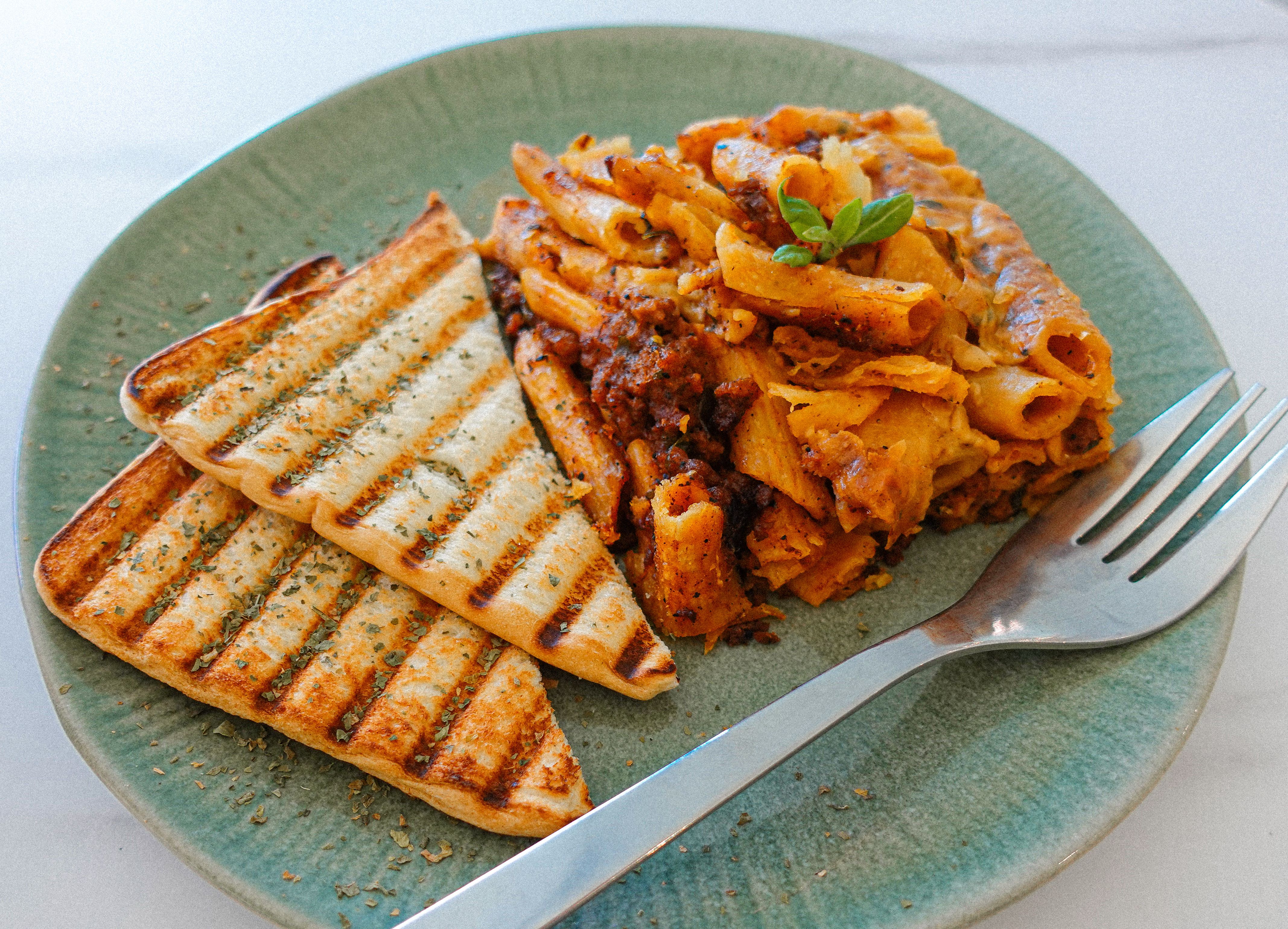
Mediterranean
Pastitsio
The diets react (see scores below)
Common Ingredients
- bucatini
- ground beef
- tomato sauce
- béchamel
- kefalotyri
- cinnamon
- onion
- egg
Specific recipes may vary.
Incompatible with 8 of 11 diets
Diet Ratings
Pastitsio is a Greek baked pasta dish built around bucatini (pasta), which is a high-carb grain-based ingredient that alone provides roughly 40-50g of net carbs per serving. This single ingredient immediately disqualifies the dish from ketogenic compatibility. The béchamel sauce typically also contains wheat flour, adding further carbs. While several components — ground beef, kefalotyri cheese, egg, and the fat in béchamel — are individually keto-friendly, the foundational pasta structure makes this dish fundamentally incompatible with ketosis. There is no realistic portion size that would keep net carbs within keto limits.
Pastitsio contains multiple animal-derived ingredients that are incompatible with a vegan diet. Ground beef is a direct animal product (meat). Béchamel sauce is traditionally made with dairy milk and butter. Kefalotyri is a hard Greek cheese made from sheep's or goat's milk. Eggs are an animal product used to bind the béchamel topping. This dish is thoroughly non-vegan with at least four distinct animal-derived components.
Pastitsio is fundamentally incompatible with the Paleo diet. The dish is built on bucatini (a wheat-based pasta — a grain), which is strictly excluded. The béchamel sauce is a dairy-based preparation (typically butter, milk, and flour), contributing both dairy and grain violations. Kefalotyri is a hard cheese — another dairy product, clearly excluded. While ground beef, tomato sauce, cinnamon, onion, and egg are all Paleo-approved ingredients, the core structural components of this dish (pasta, béchamel, cheese) are multiple hard violations. There is no version of traditional Pastitsio that can be considered Paleo-compliant without being fundamentally reconstructed into a different dish entirely.
Pastitsio is a traditional Greek baked pasta dish that presents several conflicts with Mediterranean diet principles. The primary protein is ground beef (red meat), which should be limited to only a few times per month. The dish is built on bucatini, a refined white pasta rather than a whole grain. The béchamel sauce adds significant saturated fat and calories beyond what olive oil-based preparations would provide. Kefalotyri cheese contributes additional saturated fat. While some ingredients like tomato sauce, onion, cinnamon, and egg are compatible with the diet, the overall profile — red meat as the centerpiece, refined pasta base, and heavy cream sauce — makes this dish an occasional indulgence at best. It does not align with daily or even weekly Mediterranean diet recommendations.
Traditional Greek cuisine, which is a cornerstone of the Mediterranean diet, includes dishes like pastitsio as part of celebratory or Sunday family meals. Some Mediterranean diet researchers argue that culturally embedded dishes eaten infrequently in social contexts fit within the diet's spirit, even if individual ingredients are suboptimal. The PREDIMED study's Greek participants would recognize pastitsio as part of their traditional food culture, suggesting it has a legitimate, if rare, place in an authentic Mediterranean eating pattern.
Pastitsio is fundamentally incompatible with the carnivore diet. The dish is built on bucatini pasta (wheat-based grain), which is a plant food and strictly excluded. Beyond the pasta, it contains tomato sauce (plant-derived), onion (plant-derived vegetable), cinnamon (plant-derived spice), and béchamel sauce (which, even if dairy-based, typically contains flour). The only carnivore-compatible elements are the ground beef, egg, and kefalotyri cheese — which are minor components in the overall dish structure. This is a carbohydrate-heavy, plant-ingredient-dominant Mediterranean baked pasta dish with essentially no path to carnivore adaptation without completely reconstructing it into a different dish entirely.
Pastitsio contains multiple excluded ingredients that make it entirely incompatible with Whole30. Bucatini is a wheat-based pasta (grain, excluded). Béchamel is a flour-and-butter sauce (grain + dairy, both excluded). Kefalotyri is a hard Greek cheese (dairy, excluded). These are not minor or debatable infractions — grains and dairy are core exclusions of the Whole30 program, and this dish is structurally built around all three. Even the spirit-of-the-program rule against recreating pasta dishes would apply here. The ground beef, tomato sauce, cinnamon, onion, and egg are compliant on their own, but they cannot redeem a dish so fundamentally constructed from excluded ingredients.
Pastitsio contains multiple high-FODMAP ingredients that make it unsuitable during the elimination phase. Bucatini is a wheat-based pasta, which is high in fructans — a major FODMAP. Onion is one of the highest-FODMAP foods tested by Monash University and is a primary source of fructans; even small amounts cooked into a dish can trigger symptoms. Béchamel sauce is traditionally made with wheat flour (fructans) and cow's milk (lactose), adding two more FODMAP sources. Kefalotyri is a hard aged cheese that is generally low-FODMAP in small amounts, but its use here alongside several other high-FODMAP ingredients is irrelevant to the overall assessment. Ground beef, tomato sauce (in moderate portions), cinnamon, and egg are all low-FODMAP. However, the combination of wheat pasta, onion, and milk-based béchamel makes this dish high-FODMAP with no practical way to consume a standard serving safely during elimination.
Pastitsio is a Greek baked pasta dish that presents multiple DASH diet concerns simultaneously. Ground beef is a red meat that DASH guidelines explicitly limit due to saturated fat content. Béchamel sauce is traditionally made with butter and whole milk or cream, adding significant saturated fat. Kefalotyri is a hard, salty Greek cheese with high sodium and saturated fat content — a full-fat dairy product DASH discourages. The combination of refined pasta (bucatini), fatty red meat, a butter-based cream sauce, and high-fat salty cheese creates a dish that conflicts with DASH on multiple fronts: high saturated fat, likely high sodium (exceeding DASH thresholds in a single serving), full-fat dairy, and red meat. The tomatoes, onion, and cinnamon offer negligible DASH benefit given the overall nutritional profile. Even as an occasional dish, a typical serving would likely deliver 1,000+ mg sodium, 15-20g saturated fat, and excess total fat — all well outside DASH parameters.
Pastitsio is a Greek baked pasta dish that presents several Zone Diet challenges. The dominant carbohydrate source is bucatini (pasta), which is a higher-glycemic, refined carbohydrate — an 'unfavorable' Zone carb. A traditional serving delivers far more carbohydrate blocks than protein blocks, breaking the 1:1 block ratio central to Zone balance. The béchamel sauce adds significant saturated fat (from butter and milk), and kefalotyri cheese further adds saturated fat — both unfavorable in Zone's preference for monounsaturated fats. Ground beef can be used in Zone but lean varieties are preferred, and traditional pastitsio recipes don't specify lean beef. On the positive side, the dish does contain protein from beef, egg, and cheese, and the tomato sauce and onion provide some polyphenol and micronutrient value, as does cinnamon (an anti-inflammatory spice Sears actually recommends). However, the overall macro ratio of a standard pastitsio serving skews heavily toward carbohydrates and saturated fat, making it very difficult to fit into Zone blocks without dramatically reducing portion size (particularly of pasta) and supplementing with additional lean protein and low-GI vegetables. With careful deconstruction and downsizing, it can appear in a Zone meal, but as prepared it does not approximate 40/30/30.
Pastitsio is a Greek baked pasta dish with a mixed inflammatory profile. On the positive side, it contains cinnamon (a notable anti-inflammatory spice), onion (quercetin and prebiotic fiber), tomato sauce (lycopene, antioxidants), and eggs (choline, selenium). However, the dish is built around several pro-inflammatory or neutral-at-best components: refined pasta (bucatini is a white flour pasta, a refined carbohydrate with a high glycemic load), ground beef (saturated fat, arachidonic acid precursors — a 'limit' food on the anti-inflammatory framework), béchamel sauce (butter and full-fat milk, both high in saturated fat — a 'limit' category), and kefalotyri (a hard, full-fat sheep/goat cheese, high in saturated fat). The combination of refined carbs, red meat, and full-fat dairy creates a cumulative pro-inflammatory burden that is not offset by the modest anti-inflammatory contributions from spices and tomato. This is a classic comfort food that fits squarely in the 'caution' zone — not categorically avoid, but not a dish to eat regularly on an anti-inflammatory diet. Portion size and frequency matter significantly here.
Pastitsio is a Greek baked pasta dish combining bucatini, a beef-tomato meat sauce, and a rich béchamel topping with kefalotyri cheese. While it provides moderate protein from ground beef and egg, it comes with significant drawbacks for GLP-1 patients. The béchamel sauce is butter- and milk-based and high in saturated fat, and kefalotyri is a hard, salty, relatively high-fat cheese — together these elevate the fat load per serving considerably. Bucatini is a refined-grain pasta with low fiber and moderate glycemic impact. The overall dish is calorie-dense per bite, heavy, and slow to digest — exactly the profile that worsens GLP-1 side effects like nausea, bloating, and delayed gastric emptying. The cinnamon and tomato sauce are fine. Ground beef contributes protein but is moderate-to-high in saturated fat depending on the cut used. A small portion could provide useful protein, but the fat-heavy béchamel layer makes portion control difficult and the nutrient-density-per-calorie ratio is poor. Not a recommended regular meal for GLP-1 patients, though an occasional small serving is not strictly off-limits.
Some GLP-1-focused dietitians allow dishes like pastitsio occasionally if portions are strictly limited (a small square) and the meal is otherwise low-fat, noting that the beef and egg contribute meaningful protein. Others advise avoiding béchamel-based dishes categorically due to the high saturated fat content reliably worsening nausea and reflux in GLP-1 patients, particularly in the early dose-escalation phase.
*See how scores were generated at our methodology page.
Nutritional profile
Six traits that cut across every diet.
Fiber & Plants
How much whole-plant food and fiber it delivers.
Healthy Fats
The quality of its fats (unsaturated, omega-3).
Whole / Unprocessed
How close it is to its natural, unprocessed form.
Gut Gentle
How easy it is on digestion (low FODMAP, few irritants).
Low Glycemic
How little it spikes your blood sugar.
Protein Density
How much protein it packs per calorie.
Controversy Index
Higher controversy = more disagreement between diets.
Diet-Specific Tips
 Zone — 4/10
View tips
- Bucatini pasta is a high-glycemic, refined carbohydrate — an 'unfavorable' Zone carb that skews carb blocks well above protein blocks in a standard serving
- Béchamel sauce and kefalotyri cheese contribute substantial saturated fat, conflicting with Zone's preference for monounsaturated fats
- Ground beef is an acceptable Zone protein if lean, but traditional pastitsio doesn't ensure lean cuts
- Dish macro ratio (carb-heavy, saturated-fat-heavy) is far from the 40/30/30 Zone target as traditionally prepared
- Cinnamon is anti-inflammatory and polyphenol-rich — a Zone-favorable ingredient
- Tomato sauce and onion offer polyphenols and micronutrients, mildly positive from a Zone anti-inflammatory standpoint
- Could theoretically be portioned into Zone by reducing pasta dramatically and pairing with a large vegetable side, but this departs significantly from traditional preparation
 Anti-Inflammatory — 4/10
View tips
- Refined pasta (bucatini) — high glycemic refined carbohydrate, pro-inflammatory
- Ground beef — red meat; limited on anti-inflammatory diets due to saturated fat and AA precursors
- Béchamel sauce — butter and full-fat dairy are in the 'limit' category
- Kefalotyri cheese — high-fat hard cheese, significant saturated fat
- Tomato sauce — lycopene and antioxidants, anti-inflammatory positive
- Cinnamon — polyphenols with anti-inflammatory activity
- Onion — quercetin content, mildly anti-inflammatory
- Overall: pro-inflammatory components outweigh anti-inflammatory ones; acceptable occasionally, not regularly
 GLP-1 Friendly — 4/10
View tips
- High saturated fat from béchamel sauce and kefalotyri cheese worsens nausea and bloating
- Refined-grain pasta (bucatini) is low in fiber, reducing satiety and glycemic benefit
- Moderate protein from ground beef and egg, but diluted by high-calorie fat components
- Heavy, slow-digesting dish conflicts with GLP-1 slowed gastric emptying
- Poor nutrient density per calorie — fat and refined carbs dominate the calorie budget
- Small portion may be tolerable but the dish is not naturally portion-friendly
- Ground beef fat content variable — leaner beef would partially improve the meat layer