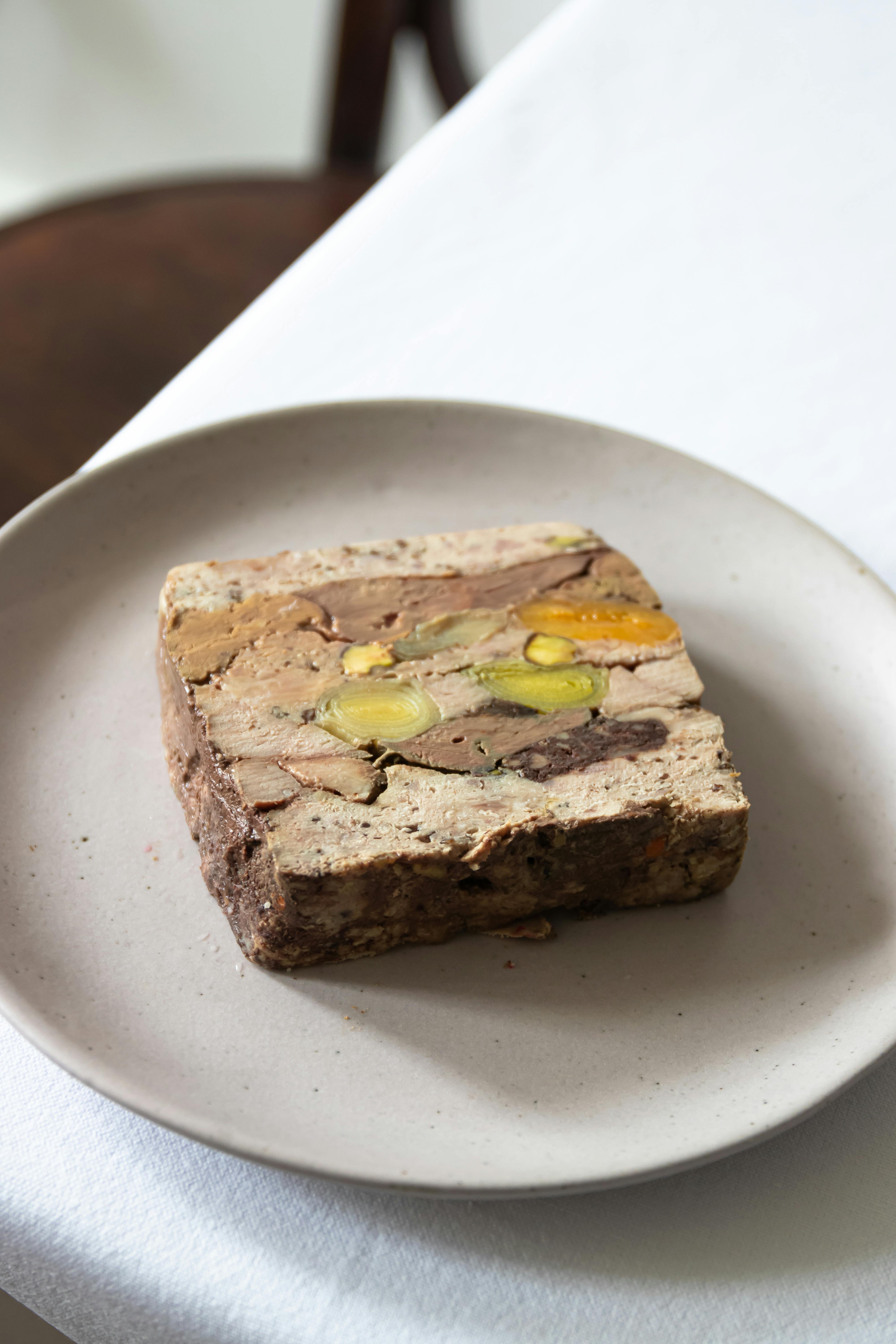
Photo: Geraud pfeiffer / Pexels
French
Pâté de Campagne
The diets react (see scores below)
Common Ingredients
- pork shoulder
- pork liver
- fatback
- brandy
- thyme
- garlic
- black pepper
- bay leaves
Specific recipes may vary.
Incompatible with 6 of 11 diets
Diet Ratings
Pâté de Campagne is an excellent keto food. The primary ingredients — pork shoulder, pork liver, and fatback — are high in fat and protein with virtually zero net carbs. The aromatics (thyme, garlic, bay leaves, black pepper) contribute negligible carbohydrates in the quantities used. Brandy is used in small amounts during cooking, with most alcohol evaporating and leaving only trace carbs. Pork liver does contain some glycogen (~4g carbs per 100g), but in the context of a blended pâté where liver is one component among several, the per-serving carb contribution is minimal. The high fat content from fatback aligns perfectly with keto macros, and this is a whole, minimally processed food.
Some strict keto practitioners flag organ meats like liver for their glycogen content and higher carb count relative to muscle meat, and may caution against eating large portions. A minority also flags brandy-containing preparations as introducing unnecessary sugar, though the trace amounts in a standard serving are unlikely to affect ketosis.
Pâté de Campagne is entirely composed of animal products. The primary ingredients — pork shoulder, pork liver, and fatback — are all derived directly from pigs, making this dish fundamentally incompatible with a vegan diet. There are no plant-based substitutes present in this recipe; the aromatics (thyme, garlic, black pepper, bay leaves) and brandy are plant-derived, but they represent only a minor flavoring role in what is overwhelmingly a meat-based preparation. This dish cannot be made vegan without replacing every primary ingredient.
Pâté de Campagne is built on a strong paleo foundation — pork shoulder, liver, fatback, and classic herbs (thyme, garlic, black pepper, bay leaves) are all whole, unprocessed ingredients well within the paleo framework. Organ meats like liver are actually celebrated in ancestral eating for their nutrient density. The two gray-area elements are brandy (an alcohol derived from fermented grapes — distilled and therefore grain-free, but still a processed product debated in paleo circles) and the pâté format itself. Traditional Pâté de Campagne is typically made with added salt and often includes curing agents, pink salt (sodium nitrite), or bread/flour as a binder — common in restaurant and commercial versions. Evaluated in its most paleo-friendly homemade form without salt, binders, or additives, the dish skews toward approval. However, the processed/cured nature of classic preparations and the alcohol inclusion keep it in caution territory.
Strict Loren Cordain-school paleo would flag the brandy outright as a processed, calorie-dense alcohol with no ancestral justification, and would also raise concern about fatback if salted or cured. Conversely, practitioners like Chris Kresser and the organ-meat revival movement (e.g., Paul Saladino's carnivore-adjacent paleo) would enthusiastically approve a homemade, salt-free version, emphasizing liver as one of the most nutrient-dense foods available.
Pâté de Campagne is a heavily processed pork product built around pork shoulder, pork liver, and fatback — all red/processed meat components. It is high in saturated fat due to the fatback, and as a prepared pâté it qualifies as a processed meat product. Red meat is limited to a few times per month in the Mediterranean diet, and processed or cured meat products are explicitly discouraged. The aromatic herbs (thyme, garlic, bay leaves) and small amount of brandy are fine, but they cannot offset the dominant protein and fat sources. This dish fundamentally contradicts Mediterranean diet principles around red meat limitation and minimizing processed foods.
Pâté de Campagne is built on a solid carnivore foundation — pork shoulder, pork liver (an excellent organ meat), and fatback are all prime animal products that carnivore practitioners encourage. The liver especially is celebrated for its micronutrient density. However, the dish includes several plant-derived ingredients: brandy (alcohol distilled from grapes), thyme, garlic, black pepper, and bay leaves. These herbs and spices are excluded under strict carnivore rules as plant compounds. Brandy in particular introduces plant-derived alcohol and potential sugars. Most carnivore practitioners tolerate trace spices pragmatically, but purists reject them. The overall dish is animal-dominant with no grains, sugars, or fillers, keeping it in 'caution' rather than 'avoid.'
Strict carnivore purists and Lion Diet adherents would flag the plant-based spices (thyme, garlic, black pepper, bay leaves) and brandy as incompatible with a true animal-only protocol, arguing that even small amounts of plant compounds can trigger inflammation or disrupt the elimination benefits of carnivore. A stripped-down version with only pork, liver, fat, and salt would earn a clear approve.
Pâté de Campagne as listed uses all Whole30-compatible ingredients: pork shoulder, pork liver, fatback, thyme, garlic, black pepper, and bay leaves are all allowed meats, organs, fats, and seasonings. The brandy is the key complication — alcohol is excluded on Whole30, but alcohol-based extracts used in cooking (where the alcohol largely cooks off) exist in a gray zone. However, brandy here is used as a flavoring agent in a cooked preparation, not consumed as a drink, which some practitioners accept similarly to vanilla extract. That said, brandy is not an 'extract' in the botanical sense and is used in a meaningful quantity for flavor, making this distinct from a few drops of vanilla. Additionally, pâté is a processed, blended preparation that — while not a baked good — represents a comfort/charcuterie food that some Whole30 purists feel contradicts the program's whole-food spirit. The dish is also typically served as a snack or appetizer in a way that can mimic pre-Whole30 indulgent eating patterns.
The official Whole30 program excludes alcohol as an ingredient, and brandy used in a savory preparation like pâté goes beyond the accepted 'alcohol-based botanical extracts' (vanilla, lemon, lavender). Melissa Urban's guidance would likely flag the brandy as non-compliant; however, some community members and coaches accept small amounts of wine or spirits used in cooked savory dishes where the alcohol burns off, creating ongoing debate.
Pâté de Campagne contains garlic as a direct ingredient, which is a well-established high-FODMAP food due to its significant fructan content. Even small amounts of garlic added during cooking and blended throughout the dish make it unsuitable for the elimination phase. The other ingredients — pork shoulder, pork liver, fatback, brandy (small amounts), thyme, black pepper, and bay leaves — are generally low-FODMAP individually. However, garlic is so concentrated in FODMAPs that its presence in any meaningful culinary quantity throughout the entire pâté makes the dish unavoidable as a high-FODMAP food. There is no realistic way to consume a standard serving of this dish without ingesting a problematic dose of fructans from garlic.
Pâté de Campagne is fundamentally incompatible with DASH diet principles. The dish is built around fatback (pure pork fat), pork liver, and pork shoulder — a combination delivering very high saturated fat and cholesterol. Fatback alone is one of the most saturated-fat-dense ingredients possible, directly contradicting DASH's explicit limit on saturated fat and total fat. Pork liver contributes extremely high cholesterol. Additionally, traditional pâté is heavily salted during preparation and curing, with typical servings containing 400–600mg or more of sodium — problematic within DASH's 1,500–2,300mg/day ceiling, especially as a snack. Red/processed meat is a DASH-limited category, and pâté represents a concentrated, high-fat form of it. The herbs and brandy are benign, but they cannot offset the core nutritional concerns. This food is categorically at odds with DASH's emphasis on lean proteins, low saturated fat, and sodium control.
Pâté de Campagne is a classic French country terrine that presents several Zone Diet challenges. The primary concerns are its high saturated fat content from fatback and pork shoulder, and its dense caloric profile making block management difficult. Fatback is essentially pure saturated fat, which conflicts with Zone's emphasis on monounsaturated fats. Pork liver adds organ meat protein that is moderately lean but rich in nutrients. Pork shoulder is a higher-fat cut compared to Zone-preferred lean proteins like skinless chicken or fish. The dish has virtually zero carbohydrates, meaning it cannot independently form a Zone block — it would need to be paired with low-glycemic carb sources (vegetables, low-GI crackers) and a Zone meal would require carefully limiting the pâté portion to control saturated fat intake. As a snack, it could theoretically work as a partial protein+fat contribution if portioned very small (perhaps 30-40g) alongside vegetables like cucumber or endive, but the fat-to-protein ratio skews heavily toward fat, and most of that fat is saturated rather than monounsaturated. Zone's anti-inflammatory framework specifically discourages saturated fat-heavy foods.
Some Zone practitioners and Sears' later writings (particularly 'The Mediterranean Zone') take a more nuanced view of saturated fat, acknowledging that traditional whole-food sources of saturated fat are less problematic than processed equivalents. From this perspective, a small portion of traditionally prepared pâté — rich in polyphenols from herbs, garlic, and brandy — could be an acceptable occasional snack when balanced with abundant vegetables. The liver component also provides high-quality protein and significant micronutrients (iron, B12, folate) that align with Zone's nutritional density goals.
Pâté de Campagne is a traditional French country terrine with a heavily pro-inflammatory nutritional profile from an anti-inflammatory diet perspective. The primary components — pork shoulder, pork liver, and especially fatback — deliver a high load of saturated fat, which is consistently flagged as pro-inflammatory at elevated intake levels. Fatback in particular is almost pure saturated and monounsaturated animal fat with no redeeming omega-3 content; it falls squarely in the 'limit to avoid' category alongside butter and high-fat cheese. The dish's fat-to-protein ratio is extremely high given the fatback inclusion. Pork liver does provide micronutrients (iron, B12, zinc, vitamin A), but these benefits are outweighed by the saturated fat burden in this preparation. Brandy contributes alcohol, which — except for moderate red wine — is on the avoid list. The one genuinely positive element is the herbal seasoning: thyme, garlic, bay leaves, and black pepper all carry modest anti-inflammatory properties (garlic especially, with allicin and organosulfur compounds), but these aromatics are present in quantities too small to offset the dominant pro-inflammatory macronutrient profile. As a snack — a category that implies regular or casual consumption rather than occasional indulgence — this dish poses a meaningful inflammatory burden, particularly for cardiovascular and metabolic health markers.
Pâté de Campagne is fundamentally incompatible with GLP-1 dietary guidelines. The dish is built around fatback and pork shoulder, making it extremely high in saturated fat — the primary driver of GLP-1 side effects including nausea, bloating, and reflux, all of which are significantly worsened by high-fat meals due to slowed gastric emptying. Pork liver adds some micronutrient density and protein, but the fat content of the overall preparation overwhelms any benefit. Brandy introduces alcohol, which adds empty calories. Despite being protein-containing, the protein-to-fat ratio is poor — a typical serving delivers far more fat calories than protein calories. As a rich, dense, fatty preparation eaten as a spread, it also lacks fiber entirely. This is precisely the category of food — heavy, greasy, high saturated fat, alcohol-containing — that GLP-1 patients are advised to avoid.
*See how scores were generated at our methodology page.
Nutritional profile
Six traits that cut across every diet.
Fiber & Plants
How much whole-plant food and fiber it delivers.
Healthy Fats
The quality of its fats (unsaturated, omega-3).
Whole / Unprocessed
How close it is to its natural, unprocessed form.
Gut Gentle
How easy it is on digestion (low FODMAP, few irritants).
Low Glycemic
How little it spikes your blood sugar.
Protein Density
How much protein it packs per calorie.
Controversy Index
Higher controversy = more disagreement between diets.
Diet-Specific Tips
 Keto — 9/10
View tips
- High fat content from pork shoulder and fatback aligns with 70-80% fat keto target
- Pork liver adds minimal net carbs (~1-2g per typical serving) and is nutrient-dense
- Brandy contributes negligible carbs in cooking quantities
- No grains, sugars, or starchy binders in this traditional recipe
- Aromatics used in trace amounts pose no meaningful carb load
- Whole, unprocessed ingredients preferred on keto
 Paleo — 5/10
View tips
- Pork shoulder and fatback are whole, unprocessed animal foods — paleo approved
- Pork liver is an organ meat highly valued in ancestral nutrition
- Herbs and garlic (thyme, bay leaves, black pepper) are unambiguously paleo
- Brandy is an alcohol — debated in paleo; distilled from grapes (not grain) but still processed
- Traditional recipes commonly include added salt, curing salts, or flour binders — non-paleo additions
- Homemade, binder-free, salt-free versions are significantly more paleo-compliant
- Pâté format is a processed preparation, which some strict interpretations flag philosophically
 Carnivore — 5/10
View tips
- Pork liver is a highly valued organ meat on carnivore — strong positive
- Pork shoulder and fatback are quality animal protein and fat sources
- Brandy is plant-derived (grape) alcohol — excluded under strict rules
- Thyme, garlic, black pepper, and bay leaves are plant-derived spices — excluded by purists
- No grains, fillers, sugar, or artificial additives — relatively clean
- Many pragmatic carnivore practitioners tolerate trace spices, keeping this borderline acceptable
 Whole30 — 5/10
View tips
- Brandy is an alcoholic ingredient — alcohol is excluded on Whole30, and brandy is not an approved botanical extract
- Pork shoulder, liver, and fatback are all Whole30-compliant protein and fat sources
- Thyme, garlic, black pepper, and bay leaves are all compliant herbs and spices
- Pâté is a heavily processed, blended preparation that may conflict with the whole-food philosophy
- No grains, dairy, legumes, or sweeteners are present in this recipe
- If brandy is omitted or replaced, the remaining ingredients would be fully compliant
 Zone — 4/10
View tips
- Very high saturated fat content from fatback — conflicts with Zone's monounsaturated fat preference
- Zero carbohydrates — cannot stand alone as a Zone snack without carb pairing
- Fat-to-protein ratio is skewed: fat calories significantly exceed protein calories
- Pork liver provides quality protein but organ meats are not featured in classic Zone food lists
- Herbs, garlic, and brandy contribute polyphenols consistent with Zone anti-inflammatory goals
- Portion control is critical — small amounts (30-40g) could fit as a partial protein/fat block
- High caloric density makes block tracking difficult in practice