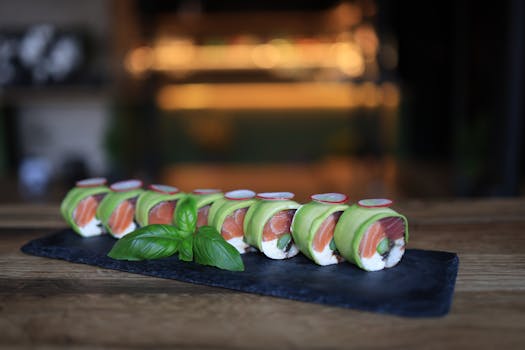
Photo: Valeria Boltneva / Pexels
Japanese
Philadelphia Roll
The diets react (see scores below)
Common Ingredients
- sushi rice
- nori
- smoked salmon
- cream cheese
- cucumber
- rice vinegar
- sesame seeds
Specific recipes may vary.
Incompatible with 5 of 11 diets
Diet Ratings
The Philadelphia Roll is fundamentally incompatible with a ketogenic diet due to sushi rice, which is the primary ingredient by volume. A standard 6-8 piece roll contains approximately 30-40g of net carbs from white rice alone, which can single-handedly exhaust or exceed the entire daily keto carb budget. Rice vinegar adds minimal additional sugar. The remaining ingredients — smoked salmon, cream cheese, cucumber, nori, and sesame seeds — are individually keto-friendly, but they cannot redeem the dish as long as sushi rice is present. This is not a portion-control situation; even a half-roll would push most people out of ketosis.
The Philadelphia Roll contains two distinct animal-derived ingredients that make it incompatible with a vegan diet. Smoked salmon is a fish product, and cream cheese is a dairy product derived from cow's milk. Both are explicitly excluded under vegan principles. The remaining ingredients — sushi rice, nori, cucumber, rice vinegar, and sesame seeds — are all plant-based, but the presence of salmon and cream cheese is disqualifying. There is no meaningful debate within the vegan community about whether fish or dairy are acceptable; both are unambiguously non-vegan.
The Philadelphia Roll contains multiple non-paleo ingredients that make it clearly incompatible with the paleo diet. Sushi rice is a grain and a core paleo exclusion. Rice vinegar, derived from rice, is also grain-based. Cream cheese is a dairy product, excluded across virtually all paleo frameworks. Smoked salmon is a processed food that typically contains added salt and sometimes sugar or preservatives. Sesame seeds are technically borderline as a seed oil source, and sesame in whole form is generally tolerated, but the overall dish is disqualifying due to the rice and dairy alone. Cucumber and nori are the only fully paleo-compliant ingredients here.
The Philadelphia Roll contains smoked salmon, which provides the Mediterranean-valued omega-3-rich fish component, and cucumber, a beneficial vegetable. However, several factors limit its compatibility: sushi rice is a refined white grain (not whole grain), cream cheese is a processed dairy product high in saturated fat that is not part of Mediterranean eating patterns, and smoked salmon — while nutritious — is a processed/cured fish higher in sodium than fresh fish. The dish lacks olive oil, legumes, or whole grains. It is not traditional Mediterranean fare, but the salmon and cucumber prevent it from being outright avoided.
Some Mediterranean diet interpreters would score this lower, arguing that cream cheese (a processed dairy fat) directly contradicts the principle of olive oil as the primary fat, and that refined sushi rice combined with cured/smoked fish makes this dish misaligned with Mediterranean principles. Others might note that fish-forward dishes with vegetables are generally acceptable, and the salmon content partially redeems it.
The Philadelphia Roll is fundamentally incompatible with the carnivore diet. While smoked salmon and cream cheese are animal-derived, the dish is primarily composed of plant-based ingredients: sushi rice (a grain), nori (seaweed), cucumber (vegetable), rice vinegar (plant-derived), and sesame seeds (plant seeds). The majority of this dish is plant food, and grains alone are a strict exclusion on all tiers of carnivore eating. No modification short of completely rebuilding the dish would make it carnivore-compatible.
The Philadelphia Roll contains multiple excluded ingredients. Sushi rice is a grain (rice) and is explicitly prohibited on Whole30. Cream cheese is dairy and is also explicitly excluded. These two ingredients alone make this dish non-compliant, regardless of the other ingredients. The smoked salmon, nori, cucumber, rice vinegar, and sesame seeds would otherwise be acceptable.
The Philadelphia Roll contains mostly low-FODMAP ingredients — sushi rice, nori, smoked salmon, cucumber, rice vinegar, and sesame seeds are all low-FODMAP and generally safe during elimination. The problematic ingredient is cream cheese, which contains lactose. Monash University rates regular cream cheese as low-FODMAP at approximately 2 tablespoons (40g), as it is a hard/spreadable cheese with relatively low lactose content compared to soft fresh cheeses or milk. However, a typical Philadelphia roll uses a generous ribbon of cream cheese, and multiple rolls in a sitting can push the total cream cheese intake above the safe threshold. Smoked salmon is low-FODMAP at standard servings. The dish is borderline safe depending on portion size, particularly how liberally the cream cheese is applied.
Monash University rates cream cheese as low-FODMAP at up to 40g per sitting, which may accommodate a moderate serving of Philadelphia rolls. However, many clinical FODMAP practitioners advise caution with cream cheese during strict elimination because portion control is difficult in restaurant settings and lactose sensitivity varies significantly between individuals.
The Philadelphia Roll contains several ingredients with mixed DASH compatibility. Smoked salmon is high in sodium (typically 600-1,200mg per 3oz serving) due to the curing/smoking process, which directly conflicts with DASH sodium targets. Cream cheese is a full-fat dairy product high in saturated fat, which DASH explicitly limits in favor of low-fat or fat-free dairy. Sushi rice is refined white rice rather than a whole grain, offering limited fiber benefit. On the positive side, cucumber provides potassium and fiber, nori offers minerals, and salmon itself is a lean protein rich in omega-3 fatty acids that DASH encourages. The rice vinegar and sesame seeds are acceptable. The combination of high-sodium smoked salmon plus full-fat cream cheese makes this dish challenging for DASH adherence, though occasional moderate consumption could fit within a broader DASH pattern.
NIH DASH guidelines emphasize limiting sodium and saturated fat, both of which are problematic in this roll. However, some updated clinical interpretations note that salmon's omega-3 fatty acids and cardiovascular benefits may partially offset concerns, and that a single roll consumed infrequently within an otherwise DASH-compliant diet is unlikely to undermine outcomes — some DASH-oriented dietitians would allow this as an occasional treat rather than a regular menu item.
The Philadelphia Roll presents a mixed Zone Diet profile. On the positive side, smoked salmon provides lean protein with beneficial omega-3 fatty acids, cucumber adds low-glycemic vegetable content, nori contributes micronutrients and polyphenols, and sesame seeds offer some monounsaturated fat. However, sushi rice is a significant Zone concern — white rice is a high-glycemic, 'unfavorable' carbohydrate in Zone terminology, and the sticky/vinegared preparation used in sushi tends to spike glycemic load further. Cream cheese adds saturated fat, which Zone diet (especially early Sears) discourages, and provides minimal protein benefit relative to its fat profile. A typical Philadelphia Roll (~6 pieces) might contain 30-40g net carbs almost entirely from white rice, making it very difficult to balance the 40/30/30 ratio without dramatically reducing portions. To fit Zone principles, one would need to limit to 2-3 pieces, paired with additional lean protein and low-GI vegetables on the side. As-served in a standard restaurant portion, the carbohydrate block count far exceeds what protein and fat blocks can balance.
Some Zone practitioners and later Sears anti-inflammatory writings acknowledge that fish-forward Japanese cuisine, even with white rice, can be compatible in moderate portions due to the high omega-3 content of salmon and the generally clean ingredient list. The rice vinegar may also have a modest glycemic-blunting effect. A small portion of Philadelphia Roll as part of a larger Zone-balanced meal (with added vegetables and protein) could fit within a 3-block meal framework, making it more 'caution' than outright problematic for flexible Zone followers.
The Philadelphia Roll is a mixed bag from an anti-inflammatory perspective. On the positive side, smoked salmon provides omega-3 fatty acids (EPA and DHA), which are among the most potent anti-inflammatory nutrients. Nori (seaweed) contains beneficial minerals and antioxidants. Cucumber adds hydration and modest anti-inflammatory phytonutrients. Sesame seeds offer some antioxidants and minerals. Rice vinegar is neutral to mildly beneficial. However, several components introduce concern: cream cheese is a full-fat dairy product high in saturated fat, which is flagged under the 'limit' category in anti-inflammatory frameworks. Sushi rice is white refined rice with added sugar (via seasoned rice vinegar/sugar), representing refined carbohydrates that can promote glycemic response and mild inflammatory signaling when consumed regularly. The smoked salmon, while rich in omega-3s, is a processed form of salmon that contains high sodium and often preservatives, distinguishing it from fresh or wild-caught salmon. The combination of beneficial omega-3s from salmon with the pro-inflammatory signals of cream cheese and refined white rice lands this dish in the caution zone — it's not a dish to build an anti-inflammatory diet around, but the salmon content prevents it from being an outright avoid.
Some anti-inflammatory practitioners would score this more negatively, citing cream cheese (saturated fat, inflammatory dairy) and refined white rice as sufficient reason to avoid — particularly within stricter anti-inflammatory or autoimmune protocols that limit full-fat dairy and refined carbohydrates altogether. Conversely, more moderate frameworks like Dr. Weil's would note that the omega-3 content from salmon partially offsets these concerns, and occasional consumption of full-fat dairy in small quantities (as present here) is acceptable within a broadly anti-inflammatory diet pattern.
The Philadelphia Roll offers some GLP-1-friendly elements — smoked salmon provides omega-3 fats and moderate protein, cucumber adds hydration and fiber, and nori contributes micronutrients. However, cream cheese is a meaningful source of saturated fat with low protein density, which can worsen nausea, bloating, and reflux in GLP-1 patients. Sushi rice is a refined carbohydrate with minimal fiber, and a standard roll (6–8 pieces) delivers only roughly 12–15g of protein — below the 15–30g per meal target. The dish is not fried or high-sugar, and portions are naturally small, which is a practical advantage. Overall it is acceptable occasionally but falls short on protein density and fiber, and the cream cheese fat content is a real GI risk for sensitive patients.
Some GLP-1-focused dietitians accept the Philadelphia Roll as a reasonable restaurant choice given its small-portion format and omega-3 content from salmon, particularly if paired with edamame or miso soup to boost protein and fiber. Others flag cream cheese more strongly, noting that even moderate saturated fat loads can significantly worsen gastroparesis-like GLP-1 side effects in some patients, and recommend substituting avocado for the cream cheese if possible.
*See how scores were generated at our methodology page.
Nutritional profile
Six traits that cut across every diet.
Fiber & Plants
How much whole-plant food and fiber it delivers.
Healthy Fats
The quality of its fats (unsaturated, omega-3).
Whole / Unprocessed
How close it is to its natural, unprocessed form.
Gut Gentle
How easy it is on digestion (low FODMAP, few irritants).
Low Glycemic
How little it spikes your blood sugar.
Protein Density
How much protein it packs per calorie.
Controversy Index
Higher controversy = more disagreement between diets.
Diet-Specific Tips
 Mediterranean — 5/10
View tips
- Smoked salmon provides beneficial omega-3 fatty acids but is processed and high in sodium
- Cream cheese is a processed dairy high in saturated fat, not a Mediterranean staple
- Sushi rice is a refined white grain, not a whole grain
- Cucumber adds a positive vegetable component
- No olive oil or legumes present
- Not a traditional Mediterranean preparation
 Low-FODMAP — 5/10
View tips
- Cream cheese contains lactose — low-FODMAP only at ≤40g (approx. 2 tbsp); multiple rolls may exceed this threshold
- Sushi rice is low-FODMAP (white rice, rice vinegar — safe)
- Smoked salmon is low-FODMAP at standard serving sizes
- Nori, cucumber, and sesame seeds are all low-FODMAP
- No onion, garlic, wheat, or high-FODMAP additives in standard preparation
- Portion size of cream cheese is the primary FODMAP risk factor
 DASH — 4/10
View tips
- Smoked salmon is very high in sodium (600-1,200mg per serving), conflicting with DASH sodium limits
- Cream cheese is full-fat dairy, high in saturated fat — DASH specifies low-fat or fat-free dairy
- White sushi rice is a refined grain, not a whole grain as DASH recommends
- Salmon itself is a DASH-approved lean protein rich in beneficial omega-3s
- Cucumber contributes potassium, hydration, and fiber in line with DASH vegetable goals
- Nori provides minerals including magnesium and iodine
- Low-sodium smoked salmon and reduced-fat cream cheese substitutions would significantly improve DASH compatibility
 Zone — 4/10
View tips
- Sushi rice is high-glycemic white rice — an 'unfavorable' carbohydrate in Zone terminology
- Smoked salmon is a favorable lean protein source rich in omega-3 fatty acids
- Cream cheese contributes saturated fat with minimal Zone-useful protein, misaligning the fat block
- Cucumber and nori are favorable low-glycemic, low-calorie Zone vegetables
- Standard restaurant portions are carbohydrate-heavy and difficult to Zone-balance without deliberate restriction
- The dish lacks sufficient lean protein and monounsaturated fat relative to its carbohydrate load at normal serving sizes
 Anti-Inflammatory — 5/10
View tips
- Smoked salmon provides omega-3 fatty acids (EPA/DHA) — anti-inflammatory
- Cream cheese is full-fat dairy high in saturated fat — flagged as 'limit'
- Sushi rice is refined white rice with added sugar — pro-inflammatory glycemic load
- Smoked/processed salmon contains high sodium and preservatives vs. fresh salmon
- Nori and cucumber add modest anti-inflammatory micronutrients
- Sesame seeds contribute antioxidants and beneficial minerals
- Overall dish is energy-dense with mixed inflammatory profile
 GLP-1 Friendly — 5/10
View tips
- Cream cheese adds saturated fat with low protein return — a known GLP-1 GI risk factor
- Smoked salmon provides omega-3 fats but protein per serving is moderate, not high
- Sushi rice is a refined carbohydrate with negligible fiber — does not support the 25–30g daily fiber target
- Standard serving of 6–8 pieces yields approximately 12–15g protein, below the per-meal target
- Cucumber adds hydration and volume with minimal calories — a modest positive
- Small individual piece format is naturally portion-friendly for reduced-appetite patients
- No fried components, no added sugar, no carbonation — avoids the hardest avoid categories