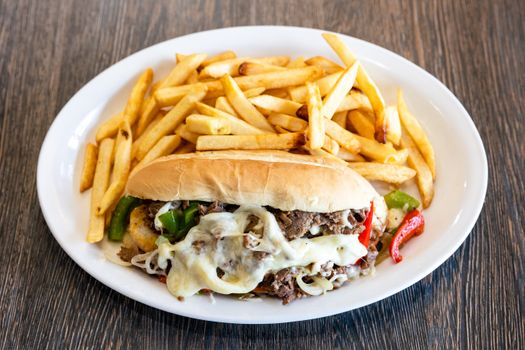
American
Philly Cheesesteak
The diets react (see scores below)
Common Ingredients
- ribeye steak
- provolone cheese
- hoagie roll
- yellow onion
- green bell pepper
- mushrooms
- butter
Specific recipes may vary.
Incompatible with 10 of 11 diets
Diet Ratings
The Philly Cheesesteak as traditionally prepared is incompatible with a ketogenic diet primarily due to the hoagie roll — a white bread roll that contributes approximately 40-50g of net carbs on its own, instantly exceeding or maxing out the daily keto carb limit in a single serving. The remaining ingredients (ribeye steak, provolone cheese, butter, onions, peppers, mushrooms) are largely keto-friendly, but the defining structural element of the sandwich — the roll — makes this dish a clear avoid in its standard form. Onions and bell peppers also add modest carbs (~5-8g net combined) that further compound the issue. Without the roll, the filling itself would be an approvable keto meal.
Philly Cheesesteak contains multiple animal products that are strictly excluded from a vegan diet. Ribeye steak is beef (animal flesh), provolone cheese is a dairy product, and butter is also dairy-derived. These are not trace or incidental ingredients — they are the defining, central components of the dish. There is no ambiguity here: this sandwich is fundamentally incompatible with a vegan diet.
A Philly Cheesesteak contains multiple hard paleo violations that make it firmly non-compliant. The hoagie roll is a wheat-based grain product — one of the clearest 'avoid' categories in all paleo frameworks. Provolone cheese is dairy, excluded across virtually all paleo interpretations. Butter is also dairy, though it occupies a slightly greyer zone than cheese. The ribeye steak, yellow onion, green bell pepper, and mushrooms are all paleo-approved ingredients, but they cannot redeem a dish whose structural components (bread, cheese) are foundational paleo exclusions. This is not a dish that can be made paleo-compliant with minor modifications — it would require replacing the roll and removing the cheese, at which point it is no longer a Philly Cheesesteak.
The Philly Cheesesteak directly contradicts core Mediterranean diet principles on multiple fronts. Ribeye steak is a high-saturated-fat red meat that Mediterranean guidelines restrict to a few times per month at most. The hoagie roll is a refined grain product with little nutritional value. Butter is used as the cooking fat instead of the canonical extra virgin olive oil. Provolone cheese in the quantity typical of this dish exceeds moderate dairy guidelines. While the onions, bell peppers, and mushrooms are genuinely positive Mediterranean components, they are overwhelmed by the problematic elements. This dish is an emblematic example of the American dietary pattern that the Mediterranean diet is positioned against.
The Philly Cheesesteak as traditionally prepared is fundamentally incompatible with the carnivore diet. While the ribeye steak is an excellent animal protein and the provolone cheese is at least animal-derived, the dish is built around a hoagie roll — a grain-based bread that is entirely excluded from carnivore. Beyond the roll, yellow onion, green bell pepper, and mushrooms are all plant foods that are strictly off the menu. The butter is an animal-derived fat, and the provolone is a dairy product with the usual caveats, but these minor positives are completely overshadowed by the multiple disqualifying plant ingredients. This is structurally a sandwich centered on bread and vegetables — the antithesis of a carnivore meal. The ribeye could be salvaged as a standalone cut, but the dish as described cannot be adapted without being fundamentally reconstructed.
A Philly Cheesesteak contains multiple Whole30-excluded ingredients. The hoagie roll is a grain-based bread product, which is excluded both as a grain (wheat) and as a bread/baked good that falls under the 'no recreating junk food' rule. Provolone cheese is dairy, which is explicitly excluded on Whole30 (only ghee and clarified butter are permitted dairy exceptions). Butter is also excluded dairy. The remaining ingredients — ribeye steak, yellow onion, green bell pepper, and mushrooms — are all Whole30-compliant, but the combination as a Philly Cheesesteak sandwich cannot be made compliant without fundamentally changing the dish.
A Philly Cheesesteak as traditionally prepared contains multiple high-FODMAP ingredients that make it unsuitable during the elimination phase. The hoagie roll is made from wheat flour, which is high in fructans — a major FODMAP trigger. Yellow onion is one of the highest-fructan foods tested by Monash University and is a primary offender. Mushrooms contain polyols (mannitol) and are high-FODMAP at standard serving sizes. While ribeye steak is naturally low-FODMAP, provolone cheese is generally considered low-FODMAP at small portions (aged cheeses have low lactose), and green bell pepper is low-FODMAP, the combination of wheat bread, onion, and mushrooms makes this dish definitively high-FODMAP in its classic form. Butter is low-FODMAP. There is no realistic way to consume a standard Philly Cheesesteak without triggering multiple FODMAP categories simultaneously.
A Philly Cheesesteak is fundamentally incompatible with the DASH eating plan across multiple dimensions. Ribeye steak is a high-fat red meat with significant saturated fat content — DASH explicitly limits red meat and calls for lean cuts when meat is consumed at all. Provolone cheese adds substantial saturated fat and sodium (a single serving can contribute 400-500mg sodium). The hoagie roll is a refined white bread product, not a whole grain. Butter adds additional saturated fat. Combined, this sandwich likely delivers 1,200-1,800mg of sodium and 15-25g of saturated fat in a single serving — potentially exceeding the entire daily saturated fat budget for a DASH dieter. The only DASH-positive components are the yellow onion, green bell pepper, and mushrooms, which provide some potassium, fiber, and micronutrients, but they cannot redeem the overall profile. This dish represents concentrated red meat, full-fat cheese, refined grains, and added butter — all in the 'limit' or 'avoid' categories under DASH guidelines.
A Philly cheesesteak presents multiple Zone Diet challenges that make it difficult to balance without significant modification. Ribeye is a fatty cut of beef with substantial saturated fat, putting it in the 'unfavorable' protein category — Zone prefers lean proteins like skinless chicken, fish, or lean beef cuts. The hoagie roll is a high-glycemic refined carbohydrate that counts as an 'unfavorable' carb block, spiking insulin and disrupting the hormonal balance the Zone targets. Provolone and butter add saturated fat, further skewing the fat profile away from the preferred monounsaturated fats (olive oil, avocado, almonds). On the positive side, the yellow onion, green bell pepper, and mushrooms are genuinely favorable Zone vegetables — low-glycemic, polyphenol-rich, and anti-inflammatory. In a heavily modified form (swapping ribeye for lean sirloin, eliminating butter, reducing or replacing the hoagie roll with a lettuce wrap or small whole-grain option, and increasing the vegetable load), the core concept could approach Zone balance. As traditionally prepared, however, the combination of fatty protein, refined high-glycemic carbs, saturated fat from butter, and calorie-dense cheese makes achieving a 40/30/30 ratio extremely difficult without radical portion distortion.
Some Zone practitioners argue that the cheesesteak's vegetables (peppers, onions, mushrooms) provide enough favorable carb blocks to partially offset the hoagie roll, and that beef — even fatty cuts — contributes valid protein blocks. Sears' later writings (The Anti-Inflammation Zone) also softened the strict condemnation of saturated fat, acknowledging that overall dietary pattern matters more than any single meal. A strict portionist might argue that a half-sandwich with extra vegetables and modest cheese could be squeezed into Zone parameters at the 'caution' level rather than near-avoid.
The Philly cheesesteak as prepared here has several significant pro-inflammatory features. Ribeye steak is a high-fat red meat, rich in saturated fat and arachidonic acid, both associated with elevated inflammatory markers (CRP, IL-6). Anti-inflammatory guidelines consistently place red meat — especially high-fat cuts — in the 'limit' or 'avoid' category. Provolone cheese adds more saturated fat and full-fat dairy, further compounding the inflammatory load. Butter for cooking adds additional saturated fat and places this dish solidly in the 'limit' tier. The hoagie roll is a refined carbohydrate with high glycemic index, contributing to postprandial glucose spikes linked to increased inflammatory signaling. On the positive side, yellow onion contains quercetin (an anti-inflammatory flavonoid), green bell peppers provide vitamin C and carotenoids, and mushrooms — though not the emphasized Asian varieties — still contribute some beneficial beta-glucans and antioxidants. However, these beneficial ingredients are present in modest quantities and cannot offset the cumulative pro-inflammatory burden of the predominant ingredients. This dish is a classic example of Western-pattern diet food, consistently associated in epidemiological research with elevated inflammatory markers. Occasional consumption is not catastrophic, but it contradicts the core principles of the anti-inflammatory dietary framework.
A traditional Philly cheesesteak is a poor fit for GLP-1 patients on nearly every key criterion. Ribeye is one of the fattiest cuts of beef available, with a high saturated fat load that worsens GLP-1 side effects — particularly nausea, bloating, and reflux — because high-fat meals are retained in the stomach far longer than normal, compounding the already-slowed gastric emptying caused by the medication. Provolone adds additional saturated fat and calories with modest protein return per calorie. Butter used in cooking further elevates the fat content. The hoagie roll is a large refined-grain carbohydrate with low fiber and low protein density, consuming valuable appetite real estate that should be occupied by nutrient-dense foods. While the dish does contain protein (roughly 30-40g in a full sandwich), the protein-to-fat ratio is unfavorable, and the overall calorie density is high for a meal that GLP-1 patients will likely only partially eat — meaning they absorb the fat-heavy components without getting proportional protein benefit. The vegetables (onion, bell pepper, mushrooms) are the only redeeming elements, contributing some fiber and micronutrients, but they are minor in the context of the full dish. This is not a small-portion-friendly food — its nutritional profile only partially balances at full serving size, which GLP-1 patients are unlikely to reach.
*See how scores were generated at our methodology page.
Nutritional profile
Six traits that cut across every diet.
Fiber & Plants
How much whole-plant food and fiber it delivers.
Healthy Fats
The quality of its fats (unsaturated, omega-3).
Whole / Unprocessed
How close it is to its natural, unprocessed form.
Gut Gentle
How easy it is on digestion (low FODMAP, few irritants).
Low Glycemic
How little it spikes your blood sugar.
Protein Density
How much protein it packs per calorie.
Controversy Index
Higher controversy = more disagreement between diets.
Diet-Specific Tips
 Zone — 5/10
View tips
- Ribeye is a high-fat, high-saturated-fat cut — unfavorable Zone protein compared to lean alternatives
- Hoagie roll is a refined, high-glycemic carbohydrate — a primary Zone 'avoid' carb category
- Butter adds saturated fat, conflicting with the Zone's monounsaturated fat preference
- Provolone cheese adds additional saturated fat and complicates the fat block ratio
- Bell peppers, onions, and mushrooms are favorable low-glycemic Zone vegetables — a genuine positive
- As served, the macro ratio skews heavily toward fat and refined carbs, far from 40/30/30
- Significant modification (lean cut, wrap instead of roll, no butter) would be required for Zone compatibility