Vietnamese
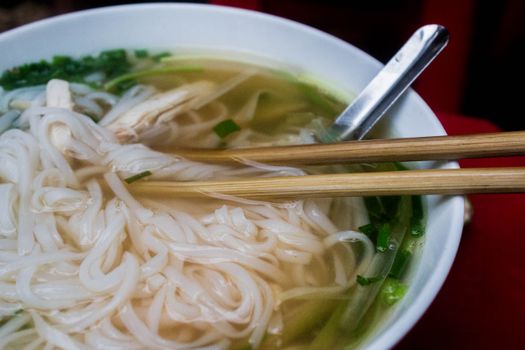
Pho Ga (Chicken Pho)
The diets react (see scores below)
Common Ingredients
- rice noodles
- chicken
- ginger
- star anise
- coriander seeds
- scallions
- Thai basil
- fish sauce
Specific recipes may vary.
Incompatible with 5 of 11 diets
Diet Ratings
Pho Ga is fundamentally incompatible with ketogenic diet due to its rice noodles, which are the primary carbohydrate source. A standard serving of pho contains 40-60g of net carbs from rice noodles alone, easily exceeding the entire daily keto carb budget in a single bowl. The broth, chicken, aromatics, and herbs are all keto-friendly, but the rice noodles are non-negotiable in traditional pho and cannot be consumed on keto in any meaningful portion. The dish would need to be completely reconstructed (e.g., replacing noodles with zucchini noodles or shirataki) to be keto-compatible, at which point it is no longer authentic Pho Ga.
Pho Ga contains multiple animal products that are strictly excluded from a vegan diet. Chicken is direct animal flesh, and fish sauce is derived from fermented fish — both are unambiguous animal-derived ingredients. There is no meaningful debate within the vegan community about either of these ingredients. While the aromatic base (ginger, star anise, coriander seeds, scallions, Thai basil) and rice noodles are entirely plant-based, the dish as described cannot be considered vegan in any interpretation.
Pho Ga is disqualified primarily by its rice noodles, which are a grain-based product. Rice — and all grains — are excluded from the paleo diet due to their anti-nutrient content (lectins, phytic acid) and the fact that they represent an agricultural-era food unavailable to Paleolithic hunter-gatherers. The remaining ingredients are largely paleo-compliant: chicken is an approved protein, ginger, star anise, coriander seeds, scallions, and Thai basil are all approved herbs and aromatics, and fish sauce (fermented fish and salt) is a borderline-acceptable condiment in most paleo frameworks, though the added salt is technically discouraged. Without the rice noodles, a stripped-down version of this broth would score quite well, but as traditionally prepared, the dish cannot be approved.
Pho Ga is a nutrient-dense, whole-food soup featuring lean chicken, aromatic herbs, and a broth rich in anti-inflammatory spices like ginger, star anise, and coriander. These elements align well with Mediterranean principles. However, the base is rice noodles — a refined grain — rather than whole grains, which the Mediterranean diet de-emphasizes. Chicken itself is acceptable in moderation (a few times per week). The dish contains no olive oil, relies on fish sauce for saltiness (a non-traditional but not harmful condiment), and lacks legumes or the plant-forward density typical of Mediterranean staples. Overall it is a healthy, minimally processed dish that fits occasional consumption but is not a Mediterranean core food.
Some modern Mediterranean diet researchers adopt a broader 'dietary pattern' lens, acknowledging that lean poultry soups with abundant herbs and minimal processing share the spirit of the diet regardless of culinary origin; under this view the dish could score higher. Conversely, stricter interpretations would flag refined rice noodles as a meaningful departure from whole-grain principles and keep the score at the lower end of caution.
Pho Ga is fundamentally incompatible with the carnivore diet. The dish is built around rice noodles, which are a grain-based plant food and the primary carbohydrate vehicle of the dish. Beyond the noodles, the aromatic base relies entirely on plant ingredients: ginger, star anise, coriander seeds, scallions, and Thai basil. While chicken and fish sauce are animal-derived components, they are minor elements within a framework dominated by excluded plant foods. No amount of modification could make this dish carnivore — it would need to be deconstructed into an entirely different meal (plain chicken broth with chicken meat) to qualify.
Pho Ga contains rice noodles, which are a grain-based product (rice is explicitly excluded on Whole30). All other ingredients — chicken, ginger, star anise, coriander seeds, scallions, Thai basil, and fish sauce — are individually Whole30-compliant. However, the rice noodles are a core, non-optional component of pho, making this dish non-compliant as described. A broth-only or zucchini-noodle version could be adapted to be compliant, but traditional Pho Ga cannot be approved.
Pho Ga is largely low-FODMAP in its core components — rice noodles and chicken are both clearly safe. Ginger, star anise, coriander seeds, and fish sauce are all low-FODMAP at typical culinary quantities. Thai basil is also safe. The main concerns arise from two ingredients: scallions and the practical reality of restaurant preparation. Scallions (green onions) are low-FODMAP only in their green tops — the white bulb portion is high in fructans. In pho, scallions are commonly added raw as a garnish using both the green and white portions. Additionally, many restaurant broths are made with onion and garlic as foundational aromatics, even if not listed explicitly; this is extremely common in traditional pho stock preparation. At home with careful preparation (green tops only, no onion/garlic in broth), this dish would score higher. In a restaurant context, it earns caution.
Monash University confirms rice noodles, chicken, ginger, and fish sauce as low-FODMAP, and scallion green tops are explicitly approved. However, clinical FODMAP practitioners routinely advise caution with restaurant pho during elimination phase because traditional broth almost universally includes charred onion and garlic, which are high-fructan ingredients not visible in ingredient lists — making this dish difficult to verify as truly safe without confirming broth preparation with the restaurant.
Pho Ga contains several DASH-friendly ingredients — lean chicken, rice noodles, aromatic spices (ginger, star anise, coriander), scallions, and Thai basil — which align well with DASH principles for lean protein, vegetables, and anti-inflammatory herbs. However, the primary concern is sodium. Fish sauce is extremely high in sodium (roughly 1,400–1,500mg per tablespoon), and restaurant-style pho broth is typically high in sodium overall, often delivering 1,000–1,500mg per serving — a substantial portion of even the standard DASH daily limit of 2,300mg, and potentially exceeding the lower 1,500mg target in a single bowl. Rice noodles are refined carbohydrates, lacking the fiber of whole grains that DASH emphasizes. The dish has no saturated fat concerns with lean chicken, and the spice profile is entirely DASH-compatible. Home-prepared versions using reduced fish sauce, low-sodium broth, and adding more vegetables can significantly improve the DASH profile. As commonly served in restaurants, the sodium load warrants a caution rating.
NIH DASH guidelines focus on overall sodium limits rather than specific cuisines, and a clinician applying DASH principles might approve a home-prepared version of Pho Ga with controlled fish sauce and low-sodium broth; some DASH-oriented dietitians note that the lean protein, herbs, and potential for vegetable additions make this a structurally sound dish that can be adapted rather than categorically avoided.
Pho Ga is a nutritionally rich dish with lean chicken protein, anti-inflammatory spices (ginger, star anise, coriander), and polyphenol-rich herbs (Thai basil, scallions) — all favorable Zone elements. The primary Zone challenge is the rice noodles, which are a refined, high-glycemic carbohydrate that Sears classifies as 'unfavorable.' A standard bowl contains 40-60g of rice noodles, which would represent a large carb block load with minimal fiber to slow glycemic impact. However, Pho Ga is inherently a ratio-adjustable dish: the noodle portion can be reduced (or substituted with zucchini noodles), while the broth, chicken, and vegetables are increased. With careful portioning — roughly 60-90g cooked noodles max, 85g lean chicken, and extra herbs/scallions — the meal can approximate Zone ratios. Fish sauce adds sodium but negligible macros. The dish lacks a deliberate fat source, so a small addition of avocado or a drizzle of olive oil would complete a Zone block. As typically served in restaurants, the noodle-heavy portion makes this a caution, but the dish's structure is fundamentally Zone-friendlier than most noodle soups.
Some Zone practitioners and later Sears anti-inflammatory writings place greater emphasis on polyphenol and omega-3 intake over strict GI management. From this perspective, the anti-inflammatory broth, ginger, and herbs in Pho Ga provide meaningful Zone benefits that partially offset the rice noodle load — especially if portion-controlled. Additionally, rice noodles have a moderate rather than extreme glycemic impact when consumed within a protein-and-broth-rich context, which slows gastric emptying.
Pho Ga is a well-aligned anti-inflammatory dish. The broth is built on ginger and aromatic spices (star anise, coriander seeds), all of which carry meaningful anti-inflammatory credentials. Ginger contains gingerols and shogaols that demonstrably reduce inflammatory markers. Star anise provides anethole, a compound with documented anti-inflammatory activity. The lean chicken protein is explicitly in the 'moderate-to-approve' category of anti-inflammatory frameworks. Thai basil contributes eugenol and rosmarinic acid, both with anti-inflammatory properties, while scallions add quercetin. Rice noodles are gluten-free and relatively neutral — a refined carbohydrate but consumed in modest portions within a broth-heavy dish, which limits glycemic impact. Fish sauce is high in sodium and should be consumed in moderation, but the quantities used as a seasoning are not a meaningful inflammatory concern for most people. The dish is whole-food based, free of processed ingredients, seed oils, added sugars, and trans fats. Overall this is a nutrient-dense, anti-inflammatory-friendly meal.
Pho Ga is an excellent fit for GLP-1 patients in its standard form. The lean chicken (typically breast or a mix of breast and thigh) delivers solid protein in a small-volume, broth-based format that is easy to digest and gentle on a slowed GI tract. The bone broth base is hydrating and nutrient-dense per calorie. Aromatic spices (ginger, star anise, coriander) are mild and ginger specifically has anti-nausea properties that may help offset GLP-1 side effects. Fish sauce adds sodium and umami with negligible fat or sugar. The primary caution is the rice noodles: they are refined, low-fiber, and contribute a significant glycemic load, but their portion can easily be reduced and replaced partially with extra chicken, bean sprouts, or herbs to improve the protein-to-carb ratio. Overall the dish is low-fat, hydrating, protein-forward (especially if ordered with extra chicken), and easy on the stomach — all priorities for GLP-1 patients.
Some GLP-1-focused dietitians flag the refined rice noodles as a concern, noting that the low fiber content and high glycemic index of standard pho noodles may blunt the blood sugar stabilization benefits they aim to support, particularly for patients with concurrent type 2 diabetes. A minority would recommend requesting a smaller noodle portion or substituting with shirataki noodles or extra vegetables, while others consider the overall low-fat, hydrating, protein-rich profile sufficient to outweigh the noodle drawback for most patients.
*See how scores were generated at our methodology page.
Nutritional profile
Six traits that cut across every diet.
Fiber & Plants
How much whole-plant food and fiber it delivers.
Healthy Fats
The quality of its fats (unsaturated, omega-3).
Whole / Unprocessed
How close it is to its natural, unprocessed form.
Gut Gentle
How easy it is on digestion (low FODMAP, few irritants).
Low Glycemic
How little it spikes your blood sugar.
Protein Density
How much protein it packs per calorie.
Controversy Index
Higher controversy = more disagreement between diets.
Diet-Specific Tips
 Mediterranean — 5/10
View tips
- Lean chicken protein — acceptable in moderation per Mediterranean guidelines
- Rice noodles are a refined grain, not a whole grain — a notable drawback
- Rich in anti-inflammatory aromatics: ginger, star anise, coriander seeds, fresh herbs
- No olive oil present — primary fat source of the Mediterranean diet is absent
- Fish sauce adds sodium but is minimally processed and used in small amounts
- Dish is whole-food based with no added sugars or highly processed ingredients
- Not a traditional Mediterranean dish, so assessment involves cultural extrapolation
 Low-FODMAP — 6/10
View tips
- Rice noodles are low-FODMAP and a safe wheat-free noodle choice
- Chicken is low-FODMAP with no FODMAP content
- Scallion green tops are low-FODMAP, but white bulb portions are high in fructans — portion and part used matters
- Traditional pho broth is typically made with charred onion (high fructan) and sometimes garlic, which are not listed but commonly present
- Ginger, star anise, coriander seeds, fish sauce, and Thai basil are all low-FODMAP at standard culinary quantities
- Restaurant preparation creates high uncertainty during the strict elimination phase
 DASH — 5/10
View tips
- High sodium from fish sauce (≈1,400–1,500mg/tbsp) and broth — major DASH concern
- Lean chicken is an approved DASH protein source
- Rice noodles are refined carbohydrates, not DASH-preferred whole grains
- Aromatics and herbs (ginger, basil, scallions) are fully DASH-compatible
- No saturated fat concerns with chicken-based broth
- Restaurant versions likely exceed low-sodium DASH target (1,500mg/day) in a single serving
- Home preparation with reduced-sodium broth and less fish sauce significantly improves compatibility
 Zone — 5/10
View tips
- Rice noodles are a high-glycemic 'unfavorable' Zone carbohydrate with minimal fiber
- Lean chicken is an ideal Zone protein source
- Ginger, star anise, coriander, and Thai basil are anti-inflammatory polyphenol sources — strongly Zone-positive
- Dish lacks a dedicated monounsaturated fat source and needs supplementation (avocado, olive oil)
- Noodle portion is the key variable — reducing to 60-90g cooked brings the dish closer to Zone balance
- Broth-based preparation is low in saturated fat and supports Zone meal structure
- Fish sauce contributes sodium but does not significantly affect macro ratios
 Anti-Inflammatory — 8/10
View tips
- Ginger: gingerols and shogaols are well-researched anti-inflammatory compounds
- Star anise and coriander seeds: anethole and polyphenols support anti-inflammatory profile
- Lean chicken: approved protein in anti-inflammatory frameworks
- Thai basil: eugenol and rosmarinic acid reduce inflammatory markers
- Rice noodles: gluten-free, neutral glycemic impact in broth context
- Fish sauce: high sodium but used in small quantities as seasoning
- No seed oils, processed ingredients, refined sugars, or trans fats
- Whole-food, herb-forward dish aligned with Dr. Weil's Anti-Inflammatory Pyramid
 GLP-1 Friendly — 8/10
View tips
- Lean chicken protein — supports 15-30g protein per serving goal, especially with generous chicken portion
- Broth base is hydrating — critical given reduced thirst sensation on GLP-1s
- Ginger in broth may provide mild anti-nausea benefit
- Low fat overall — minimal saturated fat, no frying, gentle on digestion
- Rice noodles are refined and low-fiber — the main drawback; portion control advised
- Mild spice profile — aromatic but not irritating to GI tract
- Small-volume, liquid-forward format suits reduced stomach capacity on GLP-1s
- Nutrient-dense per calorie when noodle portion is moderate