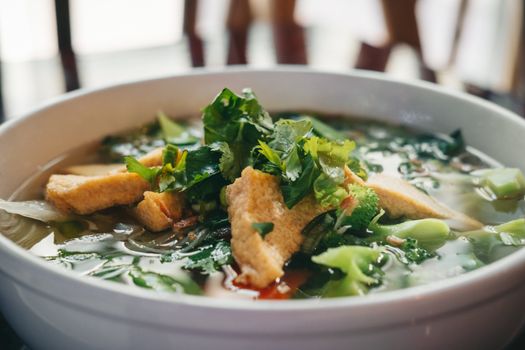
Photo: Connor Scott McManus / Pexels
Vietnamese
Vegetarian Pho
The diets react (see scores below)
Common Ingredients
- rice noodles
- tofu
- mushrooms
- star anise
- cinnamon
- ginger
- Thai basil
- soy sauce
Specific recipes may vary.
Incompatible with 4 of 11 diets
Diet Ratings
Vegetarian Pho is fundamentally incompatible with ketogenic eating due to rice noodles, which are the defining base of the dish. A standard serving of rice noodles (about 200g cooked) delivers roughly 40-45g of net carbs on its own, effectively consuming or exceeding the entire daily keto carb allowance in a single bowl. The remaining ingredients are largely keto-friendly — tofu provides protein and fat, mushrooms add minimal carbs, ginger and aromatics (star anise, cinnamon) are used in small quantities, Thai basil is fine, and soy sauce contributes negligible carbs — but none of this offsets the disqualifying carb load from the rice noodles. This dish cannot be made keto-compatible without fundamentally replacing its core ingredient, at which point it is no longer pho in any traditional sense.
Vegetarian Pho as listed contains exclusively plant-based ingredients: rice noodles (starch-based), tofu (soy protein), mushrooms (fungi), and a fragrant broth built from star anise, cinnamon, and ginger — all fully vegan. Thai basil and soy sauce complete the profile with no animal-derived components. Traditional beef pho uses bone broth and fish sauce, but this vegetarian version explicitly replaces those with plant-based alternatives. Mushrooms (especially shiitake or king oyster) replicate the umami depth normally provided by bone broth. Soy sauce should be verified as standard brewed soy sauce (vegan) rather than a fish sauce-blended variant, but the ingredient as listed is fully plant-based. This is a whole-food-forward dish with minimal processing, scoring near the top of the approval range.
Vegetarian Pho contains multiple hard paleo violations with no ambiguity. Rice noodles are a grain product and strictly excluded from paleo. Tofu is a soy-based product, and soy is a legume — both are firmly on the avoid list. Soy sauce is a processed, grain-fermented condiment containing both soy and wheat. The mushrooms, star anise, cinnamon, ginger, and Thai basil are paleo-compliant, but the foundational ingredients of this dish — the noodles, the protein, and the seasoning — all fail paleo criteria decisively. This dish cannot be adapted with minor swaps; it would need to be fundamentally reconstructed to qualify.
Vegetarian Pho contains several Mediterranean-friendly elements: tofu provides plant-based protein, mushrooms are excellent vegetables, and aromatic spices like ginger, star anise, and cinnamon are anti-inflammatory and compatible with Mediterranean principles. Thai basil adds fresh herbal value. However, the dish uses rice noodles (refined grain, not a whole grain), and soy sauce introduces sodium and a highly processed condiment not typical of Mediterranean eating. The dish lacks olive oil as the primary fat and is not rooted in Mediterranean culinary traditions, though it is plant-forward and minimally processed overall. It scores as acceptable in moderation rather than a staple.
Some Mediterranean diet interpreters, particularly those focused on plant-forward eating over strict regional tradition (e.g., modern clinical adaptations like the Oldways model), would score this higher, noting that tofu, mushrooms, and broth-based soups with anti-inflammatory spices align well with Mediterranean health goals even if not geographically Mediterranean. Conversely, stricter traditionalists would note the absence of olive oil and the use of refined rice noodles as meaningful departures.
Vegetarian Pho is entirely incompatible with the carnivore diet. Every single ingredient is plant-derived or plant-based: rice noodles (grain), tofu (legume/soy), mushrooms (fungi), star anise (spice), cinnamon (spice), ginger (root), Thai basil (herb), and soy sauce (fermented soy/grain). There are zero animal products present. This dish is not only non-carnivore but is specifically designed to exclude all animal products, making it the antithesis of the carnivore dietary framework. The carnivore community universally rejects this dish without any debate.
Vegetarian Pho contains two clearly excluded ingredients: rice noodles (a grain product — rice is explicitly excluded on Whole30) and soy sauce (soy is a legume and explicitly excluded). Additionally, tofu is made from soy, which is also excluded. These are not edge cases or spirit-of-the-program debates — all three violations are explicitly named in the official Whole30 rules. The broth aromatics (star anise, cinnamon, ginger) and mushrooms and Thai basil are fully compliant, but the foundational components of this dish — its noodles, its protein, and its seasoning — all fail Whole30 compliance.
Vegetarian Pho contains several ingredients that are individually manageable on a low-FODMAP diet, but mushrooms are the primary concern. Most mushrooms (button, shiitake, cremini) are high in polyols (mannitol) and are high-FODMAP even at small servings. Oyster mushrooms are an exception, being low-FODMAP at 75g per Monash. Rice noodles, firm tofu (up to 170g), star anise (used in small culinary amounts), cinnamon, ginger (low-FODMAP up to 1 tsp fresh), Thai basil, and soy sauce (low-FODMAP at standard servings — check for wheat-containing varieties) are generally safe during elimination. The dish lives or dies on which mushrooms are used and in what quantity. If oyster mushrooms are substituted or mushrooms are omitted, this dish could be approved. As typically prepared with shiitake or button mushrooms, caution is warranted.
Monash University rates oyster mushrooms as low-FODMAP at 75g, but most clinical FODMAP practitioners advise avoiding mushrooms entirely during elimination due to the high mannitol content in common varieties and the risk of accidental substitution. Additionally, some FODMAP practitioners flag soy sauce as potentially problematic during strict elimination if it contains wheat-derived fructans, recommending tamari (gluten-free) instead.
Vegetarian Pho has many DASH-friendly components — tofu (lean plant protein), mushrooms (potassium, fiber), ginger, and aromatic spices are all well-aligned with DASH principles. Rice noodles are refined carbohydrates rather than whole grains, which is a mild concern but acceptable in moderation. The primary issue is soy sauce, which is extremely high in sodium (one tablespoon contains ~900–1,000mg), and a typical pho broth relies heavily on it. Even a moderate bowl could easily approach or exceed the standard DASH sodium limit of 2,300mg/day, and certainly the stricter 1,500mg/day target. The dish earns a 'caution' rather than 'avoid' because the non-broth ingredients are genuinely DASH-positive, and preparation modifications (low-sodium soy sauce or tamari, reduced quantity) can bring sodium to acceptable levels. As commonly prepared in restaurants, sodium remains the key limiting factor.
NIH DASH guidelines clearly restrict sodium and would flag standard soy sauce-based broths as high-sodium; however, updated clinical interpretations and home-preparation guidance note that using low-sodium soy sauce or coconut aminos can reduce sodium substantially, making this dish a legitimate DASH-compatible meal with plant protein, vegetables, and anti-inflammatory spices.
Vegetarian Pho has several Zone-favorable elements but is structurally challenged by the rice noodles. Tofu is an acceptable vegetarian protein source in Zone (though it requires more fat blocks since vegetarian protein fat blocks are 3g rather than 1.5g). Mushrooms are low-glycemic, anti-inflammatory vegetables that Zone approves strongly. The aromatic spices (star anise, cinnamon, ginger) are polyphenol-rich, aligning with Sears' anti-inflammatory emphasis. However, rice noodles are the central problem: they are high-glycemic, refined carbohydrates that Zone classifies as 'unfavorable.' A typical pho serving contains 40-60g of carbs from noodles alone, which would consume nearly all carb blocks for the meal while providing little fiber. This crowding-out effect leaves no room for the favorable low-GI vegetable carbs Zone prioritizes. Additionally, tofu as the primary protein requires careful portioning to hit the ~25g protein target per meal, and the fat content of the dish is low, meaning monounsaturated fats would need to be added separately. The dish can be Zone-adapted by dramatically reducing noodle portions, increasing mushrooms and other vegetables, and adding a side fat source, but as served in a typical restaurant portion, it skews heavily toward unfavorable high-GI carbs.
Some Zone practitioners, particularly those following Sears' later writings emphasizing overall anti-inflammatory eating patterns, might rate this more favorably. The broth is rich in polyphenols from ginger, star anise, and cinnamon — compounds Sears increasingly emphasized in his post-Zone books. A small portion of rice noodles can technically be counted as carb blocks, and if the tofu and noodle portions are carefully controlled while mushroom content is high, the meal can approximate Zone ratios. The dish is arguably more Zone-compatible than many Western carbohydrate-heavy meals like pasta or sandwiches.
Vegetarian Pho is an exceptionally well-aligned anti-inflammatory dish. The broth is built on ginger (gingerols reduce NF-κB signaling), star anise (rich in anethole, shown to inhibit inflammatory pathways), and cinnamon (cinnamaldehyde reduces prostaglandin synthesis) — three potent anti-inflammatory spices. Tofu provides whole soy protein, which is explicitly emphasized in Dr. Weil's Anti-Inflammatory Food Pyramid for its isoflavones and favorable cytokine profile. Mushrooms (likely shiitake or similar Asian varieties common in pho) contain beta-glucans that modulate immune response and reduce inflammatory markers. Thai basil contributes eugenol and rosmarinic acid, both established anti-inflammatory phytonutrients. Rice noodles are a refined carbohydrate with a moderate glycemic index — a mild neutral-to-slight negative, but offset strongly by the rest of the dish. Soy sauce adds sodium (a practical concern in large quantities) and is fermented, offering some beneficial compounds, though the sodium load is worth noting for inflammatory conditions where hypertension or kidney stress is a factor. Overall, this dish concentrates multiple high-quality anti-inflammatory ingredients with no significant pro-inflammatory components.
Vegetarian pho has meaningful strengths for GLP-1 patients: it is broth-based (high water content, excellent hydration support), low in fat, easy to digest, and contains beneficial spices like ginger that may ease nausea. Tofu provides plant-based protein and unsaturated fats. Mushrooms add fiber, micronutrients, and umami depth. However, the dish falls short on protein density — a standard serving of tofu in pho typically delivers only 8–12g of protein, well below the 15–30g per meal target. Rice noodles are a refined carbohydrate with low fiber and minimal nutritional value per calorie, which is a concern given how critical nutrient density is on a reduced-calorie GLP-1 diet. Star anise and cinnamon are generally well-tolerated and may actually support digestion. Soy sauce contributes sodium, which warrants attention for patients monitoring blood pressure but is not a disqualifying factor in typical portions. This dish scores well on digestibility, hydration, and fat profile but needs intentional protein boosting — doubling the tofu portion or adding edamame — to be truly GLP-1 optimized.
Some GLP-1-focused dietitians would rate this dish more favorably, emphasizing that its broth base, gentle spices, and easy digestibility make it one of the better options for patients struggling with nausea or slow gastric emptying, and that protein can be augmented through preparation choices. Others would rate it lower, arguing that rice noodles represent empty refined carbohydrate calories that crowd out more nutrient-dense ingredients in an already calorie-restricted eating window, and would recommend substituting shirataki or zucchini noodles.
*See how scores were generated at our methodology page.
Nutritional profile
Six traits that cut across every diet.
Fiber & Plants
How much whole-plant food and fiber it delivers.
Healthy Fats
The quality of its fats (unsaturated, omega-3).
Whole / Unprocessed
How close it is to its natural, unprocessed form.
Gut Gentle
How easy it is on digestion (low FODMAP, few irritants).
Low Glycemic
How little it spikes your blood sugar.
Protein Density
How much protein it packs per calorie.
Controversy Index
Higher controversy = more disagreement between diets.
Diet-Specific Tips
 Vegan — 9/10
View tips
- Rice noodles are plant-based with no egg
- Tofu is a whole soy food and clearly vegan
- Mushrooms provide umami as a plant-based broth base
- Aromatic spices (star anise, cinnamon, ginger) are fully plant-derived
- Thai basil is a herb with no animal components
- Soy sauce as listed contains no animal ingredients
- No fish sauce, bone broth, or other traditional pho animal ingredients present
 Mediterranean — 6/10
View tips
- Tofu is an approved plant-based protein source
- Mushrooms and aromatic spices are Mediterranean-compatible
- Rice noodles are refined grains, not whole grains — a moderate concern
- Soy sauce is a processed, high-sodium condiment not typical of Mediterranean cuisine
- No olive oil present as primary fat
- Broth-based soup format is healthy and low in saturated fat
- Overall dish is plant-forward and minimally processed
 Low-FODMAP — 5/10
View tips
- Mushrooms are typically high in polyols (mannitol) — shiitake and button mushrooms are high-FODMAP at standard serving sizes
- Oyster mushrooms are low-FODMAP at ≤75g and would be a safe substitution
- Rice noodles are low-FODMAP and safe
- Firm tofu is low-FODMAP up to 170g per Monash
- Ginger is low-FODMAP up to 1 tsp fresh; larger quantities may be problematic
- Soy sauce should ideally be replaced with tamari to avoid wheat-derived fructans
- Star anise and cinnamon used in typical culinary quantities are low-FODMAP
- Thai basil is low-FODMAP at standard garnish portions
 DASH — 5/10
View tips
- High sodium from soy sauce and broth — primary DASH concern
- Tofu is an excellent DASH-approved plant-based lean protein
- Mushrooms provide potassium, magnesium, and fiber — core DASH nutrients
- Rice noodles are refined, not whole grain — modest concern
- Spices (ginger, star anise, cinnamon) are DASH-neutral or beneficial
- Low-sodium soy sauce substitution would raise score to 7–8
- Restaurant preparations likely exceed DASH sodium targets significantly
 Zone — 5/10
View tips
- Rice noodles are high-glycemic 'unfavorable' carbohydrates that dominate the carb block budget
- Tofu is an acceptable Zone vegetarian protein but requires larger fat block allocation (3g fat per block vs 1.5g for animal protein)
- Mushrooms are Zone-favorable low-glycemic vegetables with anti-inflammatory properties
- Ginger, star anise, and cinnamon are polyphenol-rich spices aligned with Sears' anti-inflammatory focus
- Dish is naturally low in fat, requiring additional monounsaturated fat to balance Zone ratios
- Typical restaurant portion heavily skews toward carbohydrates, making 40/30/30 ratio difficult without significant modification
- Soy sauce adds sodium but negligible macronutrient impact
 Anti-Inflammatory — 8/10
View tips
- Ginger, cinnamon, and star anise are all well-documented anti-inflammatory spices that reduce NF-κB and prostaglandin activity
- Tofu (whole soy food) is explicitly emphasized in anti-inflammatory frameworks for isoflavones and favorable inflammatory cytokine effects
- Mushrooms provide beta-glucans with immunomodulatory and anti-inflammatory properties
- Thai basil contains eugenol and rosmarinic acid, established anti-inflammatory phytonutrients
- Rice noodles are a refined carbohydrate — a minor neutral-to-slight negative, but outweighed by the dish's strengths
- Soy sauce adds sodium; high sodium intake can exacerbate inflammation in sensitive individuals or those with cardiovascular concerns
- No red meat, saturated fat, trans fats, refined sugars, or seed oils present
 GLP-1 Friendly — 6/10
View tips
- Low protein density per serving — tofu quantity in a standard bowl typically yields only 8–12g protein, below the 15–30g per meal target
- Rice noodles are refined carbohydrates with low fiber and low nutrient density per calorie
- Broth base provides excellent hydration support, important given GLP-1 reduced thirst sensation
- Very low fat profile — no fried components, no saturated fat sources
- Easy to digest — broth-based soups are among the most GLP-1-friendly formats for patients with GI side effects
- Ginger is well-evidenced for nausea relief, directly relevant to GLP-1 side effects
- Mushrooms contribute fiber and micronutrients
- Highly portion-flexible — tofu can be doubled and noodle volume reduced to improve nutritional profile