Photo: Valeria Boltneva / Pexels
Eastern-European
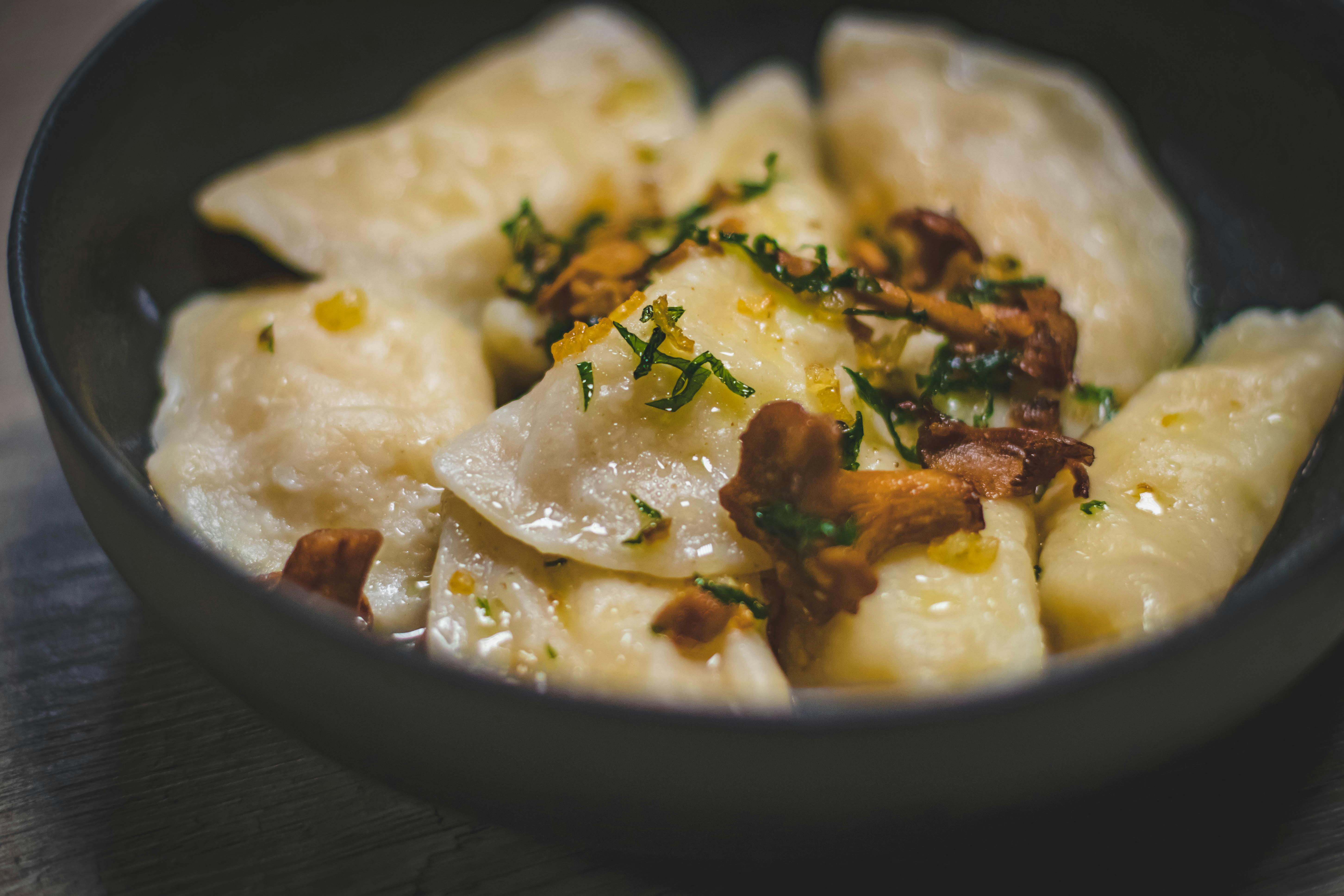
Meat Pierogi
The diets react (see scores below)

That’s a heavy plate — want to see the leaner version?
Common Ingredients
- flourWhole wheat flour
Whole-wheat flour adds fiber and lowers the refined-grain load versus flour.
- eggs
- ground beefGround turkey
Lean ground turkey cuts the saturated fat of ground beef while keeping the dish a ground-meat dish.
- ground porkGround turkey
Lean ground turkey cuts the saturated fat of ground pork while keeping the dish a ground-meat dish.
- onion
- sour creamGreek yogurt (plain, nonfat)
Nonfat Greek yogurt keeps the creamy body of sour cream with more protein and far less fat.
- butterExtra virgin olive oil
Extra-virgin olive oil swaps saturated fat for monounsaturated fat in place of butter.
- black pepper
Specific recipes may vary.
Incompatible with 9 of 11 diets
Diet Ratings
Meat pierogi are fundamentally incompatible with a ketogenic diet. The defining characteristic of pierogi is their wheat flour dough wrapper, which is a grain-based, high-carbohydrate ingredient. A standard serving of 5-6 pierogi can contain 40-60g of net carbs from the dough alone, easily exceeding the entire daily carb budget for ketosis. While the filling of ground beef, ground pork, onion, and butter is largely keto-friendly, and sour cream and eggs are acceptable keto foods, the flour-based dough is non-negotiable and disqualifying. There is no portion size small enough to make traditional pierogi compatible with ketosis.
Meat Pierogi contain multiple animal products, making them entirely incompatible with a vegan diet. The filling includes ground beef and ground pork (slaughtered animal flesh), the dough contains eggs, and the dish is finished with butter and sour cream (both dairy derivatives). There is no ambiguity here — this dish is disqualified by at least five separate animal-derived ingredients across the dough, filling, and accompaniments.
Meat Pierogi are fundamentally incompatible with the Paleo diet. The dish's core structure relies on flour-based dough (wheat), which is a grain and one of the most clearly excluded foods in Paleo. Additionally, sour cream is a dairy product and butter is a dairy derivative — both excluded under strict Paleo guidelines. While the ground beef, ground pork, onion, eggs, and black pepper are all Paleo-approved ingredients, the non-compliant components (wheat flour, sour cream, butter) are structural and essential to the dish — they cannot be removed without fundamentally changing what a pierogi is. This is not a borderline case.
Meat pierogi are fundamentally at odds with Mediterranean diet principles on multiple fronts. The dish combines refined white flour dough (a refined grain) with a filling of ground beef and ground pork (red meats that should be limited to a few times per month), finished with butter and sour cream (saturated fat sources far from the olive oil-centered Mediterranean fat profile). There is no significant vegetable, legume, or whole grain component. The overall dish is high in saturated fat, relies on red and processed meat as the primary protein, uses refined grains as the base, and contains no olive oil. This Eastern European comfort food has virtually no alignment with Mediterranean dietary patterns.
Meat Pierogi are fundamentally incompatible with the carnivore diet. The dish is built around a wheat flour dough wrapper, which is a plant-derived grain product and one of the most strictly excluded food categories on carnivore. While the filling contains acceptable carnivore ingredients — ground beef, ground pork, eggs, and butter — the flour dough dominates the dish structurally and cannot be separated from it. Additional plant-based ingredients include onion (vegetable) and black pepper (plant spice). Sour cream is a dairy product that sits in the 'caution' zone for carnivore, but its presence is irrelevant given the disqualifying flour base. This dish cannot be modified into a carnivore-compatible form without ceasing to be pierogi entirely.
Meat pierogi contain multiple excluded ingredients that make them incompatible with Whole30. Flour (a grain/wheat product) is explicitly excluded. Sour cream (dairy) is excluded. Butter (regular dairy butter, not ghee) is excluded. Furthermore, pierogi are a pasta/dumpling — a filled dough pocket — which falls squarely into the 'no recreating baked goods, pasta, or noodles' rule even if compliant ingredient substitutions were attempted. The beef, pork, onion, eggs, and black pepper are compliant, but the dish as a whole fails on multiple counts.
Meat pierogi contain multiple high-FODMAP ingredients that make them unsuitable during the elimination phase. The dough is made with wheat flour, which is high in fructans — a primary FODMAP trigger — and this is unavoidable in traditional pierogi at any reasonable serving size. Onion is one of the highest-FODMAP foods tested by Monash University, containing significant fructans even in small quantities; it is typically mixed directly into the meat filling, making it impossible to separate out. Sour cream contains lactose and becomes high-FODMAP above approximately 2 tablespoons. Even one or two pierogi would deliver a substantial fructan load from the wheat dough alone, and the onion in the filling compounds the problem significantly. The ground beef and pork, eggs, butter, and black pepper are themselves low-FODMAP, but the dish as a whole is not salvageable during elimination without fundamental recipe changes (e.g., gluten-free dough, substituting onion with green onion tops or garlic-infused oil, and using lactose-free sour cream).
Meat pierogi conflict with core DASH diet principles on multiple fronts. The filling combines ground beef and ground pork — both red meats high in saturated fat, which DASH explicitly limits. The dough is refined white flour, offering little fiber or micronutrient benefit compared to whole grains emphasized by DASH. Sour cream and butter are full-fat dairy products high in saturated fat and cholesterol, directly opposed to DASH's requirement for fat-free or low-fat dairy. Commercial and home-prepared pierogi are also typically high in sodium. The dish lacks the potassium, magnesium, calcium, and fiber density that DASH prioritizes. While onion and eggs provide minor nutritional value, they do not offset the saturated fat load from three separate high-fat sources (beef, pork, butter/sour cream). This dish as traditionally prepared is fundamentally misaligned with DASH eating patterns.
Meat pierogi present multiple Zone Diet challenges. The flour-based dough is a high-glycemic refined carbohydrate that Zone methodology classifies as 'unfavorable' — white flour dough spikes insulin and offers minimal fiber to offset net carbs. The filling combines ground beef and ground pork, which are higher in saturated fat than Zone-preferred lean proteins like skinless chicken or fish. Butter and sour cream add saturated fat, further skewing the fat profile away from the preferred monounsaturated sources. The macro ratio is heavily carb-forward from the dough and fat-forward from the meat and dairy, making the 40/30/30 balance difficult to achieve. That said, the dish is not entirely without Zone merit: eggs in the dough contribute some protein, onion is a favorable low-glycemic vegetable, and the ground meat does provide real protein blocks. With very careful portioning — treating 2-3 pierogi as a partial protein/carb source and pairing with a large serving of non-starchy vegetables and a lean protein supplement — the meal could technically be Zone-balanced, but this requires significant dietary restructuring beyond the dish itself.
Some Zone practitioners following Sears' later anti-inflammatory framework (Toxic Fat, The Mediterranean Zone) are more permissive with occasional saturated fat and would focus more on portion control and pairing strategy than on categorically penalizing the dish. In this view, a small serving of 2-3 pierogi as a carb block source, combined with lean protein and a salad with olive oil, could fit a Zone meal without issue. The dish's real-world glycemic load per small serving may be moderate, making strict avoidance unnecessarily rigid.
Meat pierogi combine multiple pro-inflammatory elements into a single dish. The filling features both ground beef and ground pork — two red meats high in saturated fat and arachidonic acid, both of which are consistently flagged as pro-inflammatory in anti-inflammatory nutrition research. The dough is made from refined white flour, a refined carbohydrate that raises blood glucose and contributes to inflammatory signaling. Butter and sour cream add further saturated fat load. The only redeeming elements are onion (which contains quercetin, a mild anti-inflammatory flavonoid) and black pepper (which has modest anti-inflammatory properties and enhances bioavailability of other compounds), but these are present in negligible quantities relative to the inflammatory burden of the dish. There are no omega-3 sources, no meaningful antioxidants, no fiber-rich whole grains, and the fat profile is dominated by saturated fat. This dish is the kind of combination — refined carbs + red meat + full-fat dairy — that anti-inflammatory diet frameworks consistently recommend avoiding or strictly limiting.
Meat pierogi present a mixed nutritional profile for GLP-1 patients. The ground beef and pork filling does provide meaningful protein, but the combination of refined flour dough, butter, sour cream, and fatty mixed meats introduces significant concerns. The dough is made from refined white flour — low fiber, low nutrient density, and a source of empty carbohydrate calories. The filling uses ground beef and ground pork together, which typically carries moderate-to-high saturated fat depending on the grind. Butter and sour cream as accompaniments add additional saturated fat and calories with minimal protein payoff. GLP-1 patients eating small portions will fill up on the dough before reaching adequate protein intake, making this a portion-efficiency problem. Slowed gastric emptying on GLP-1 medications means the heavy, doughy texture is likely to sit uncomfortably and increase nausea or bloating risk. The dish is not fried, which is a mild point in its favor, and if consumed as a small portion with a lean protein side, the harm is limited. As a standalone main dish, it underdelivers on protein density per calorie and overdelivers on refined carbohydrate and saturated fat.
Some GLP-1-focused dietitians accept traditional cultural dishes like pierogi in small, controlled portions, arguing that rigid elimination increases the risk of dietary non-adherence, which is itself a clinical concern. However, those who prioritize minimizing GI side effects — particularly nausea and early satiety on injection days — tend to flag doughy, high-fat dishes as particularly problematic because patients report them as among the hardest foods to tolerate comfortably.
*See how scores were generated at our methodology page.
Nutritional profile
Six traits that cut across every diet.
Fiber & Plants
How much whole-plant food and fiber it delivers.
Healthy Fats
The quality of its fats (unsaturated, omega-3).
Whole / Unprocessed
How close it is to its natural, unprocessed form.
Gut Gentle
How easy it is on digestion (low FODMAP, few irritants).
Low Glycemic
How little it spikes your blood sugar.
Protein Density
How much protein it packs per calorie.
Controversy Index
Higher controversy = more disagreement between diets.
Diet-Specific Tips
 Zone — 4/10
View tips
- Refined white flour dough is a high-glycemic 'unfavorable' carbohydrate in Zone terminology
- Ground beef and pork are higher in saturated fat than Zone-preferred lean proteins
- Butter and sour cream skew fat profile toward saturated rather than monounsaturated fats
- Macro ratio is carb-and-fat heavy, making 40/30/30 balance difficult without significant pairing adjustments
- Onion and egg contribute modest Zone-favorable nutrients
- Very small portions could be incorporated as a carb block within a broader Zone meal
- No omega-3 sources or polyphenol-rich ingredients to support Zone anti-inflammatory goals
 GLP-1 Friendly — 4/10
View tips
- Refined flour dough is low in fiber and nutrient density — poor use of limited caloric capacity
- Mixed beef and pork filling carries moderate-to-high saturated fat load
- Butter and sour cream accompaniments add saturated fat with minimal protein benefit
- Doughy texture is poorly tolerated by many GLP-1 patients due to slowed gastric emptying
- Protein-per-calorie ratio is low — dough dilutes the protein contribution of the meat filling
- Not fried, which prevents a lower score
- Small portion may be manageable but limits protein intake at a meal — pairing with a lean protein source would be necessary to meet 15–30g per meal target
- No meaningful fiber contribution from any ingredient