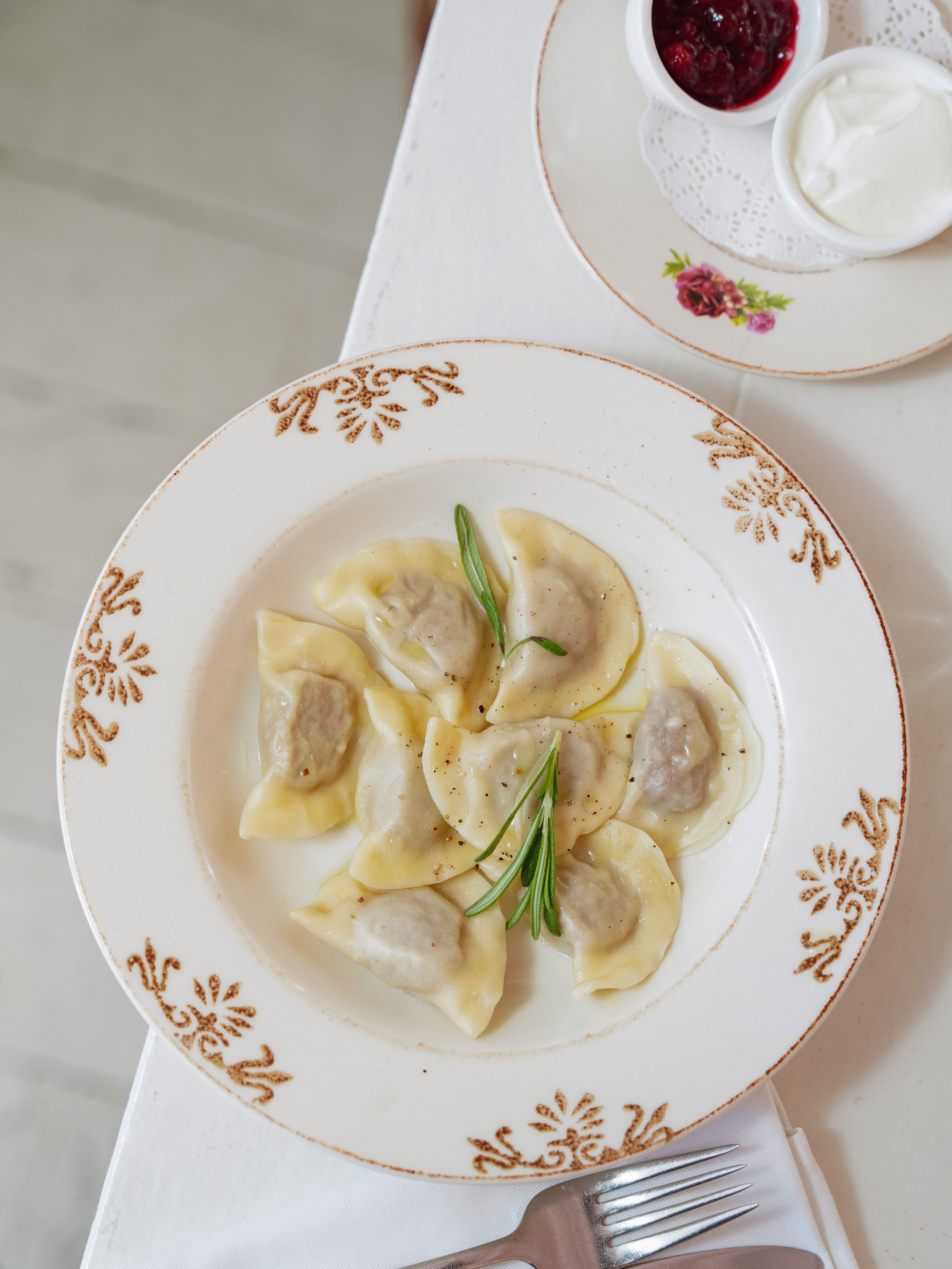
Eastern-European
Potato and Cheese Pierogi
The diets react (see scores below)
Common Ingredients
- flour
- eggs
- potatoes
- farmer's cheese
- onion
- sour cream
- butter
- salt
Specific recipes may vary.
Incompatible with 8 of 11 diets
Diet Ratings
Potato and Cheese Pierogi are fundamentally incompatible with a ketogenic diet. The dough wrapper is made from wheat flour, a grain that is strictly excluded from keto. Potatoes, the primary filling ingredient, are a high-starch vegetable with extremely high net carbs. A standard serving of 4-6 pierogi can easily contain 40-60g of net carbs from flour and potatoes alone — exceeding or maxing out the entire daily keto carb budget in one dish. While sour cream and butter are keto-friendly accompaniments, they cannot offset the massive carbohydrate load from the core ingredients. There is no meaningful portion size at which this dish becomes keto-compatible.
Potato and Cheese Pierogi contains multiple animal-derived ingredients that are clearly incompatible with a vegan diet. Eggs are used in the dough, farmer's cheese and sour cream are dairy products, and butter is an animal fat. These are all unambiguous animal products with no vegan debate surrounding them. This dish is fundamentally non-vegan as traditionally prepared, though vegan versions can be made by substituting plant-based alternatives for all four animal ingredients.
Potato and Cheese Pierogi contains multiple core paleo violations that make it entirely incompatible with the paleo diet. Flour (wheat) is a grain and one of the most strictly excluded foods in paleo. Farmer's cheese and sour cream are dairy products, excluded across virtually all paleo frameworks. Butter is debated but generally discouraged. Salt is added. The dish is also a processed, flour-based dumpling — the very type of grain-heavy, agricultural-era food the paleo diet is designed to avoid. Even if the potato filling were considered borderline acceptable, the wheat dough alone disqualifies the dish entirely.
Potato and Cheese Pierogi are fundamentally misaligned with Mediterranean diet principles. The dish is built around refined white flour dough (a processed, low-fiber carbohydrate), butter as the primary fat (saturated fat, displacing olive oil), and sour cream as a condiment (high saturated fat dairy). There is no olive oil, no legumes, no vegetables beyond onion, no whole grains, and no fish or lean protein. The overall dish is starchy, high in saturated fat, and low in the plant diversity and healthy fats that define Mediterranean eating. While eggs and farmer's cheese are acceptable in moderation, they are not the issue here — the dish's structure (refined dough, butter-based cooking, sour cream topping) directly contradicts core Mediterranean principles.
Potato and Cheese Pierogi is fundamentally incompatible with the carnivore diet. The dish is built almost entirely on plant-derived ingredients: flour (grain), potatoes (tuber), and onion (vegetable) form the structural core. While eggs, farmer's cheese, sour cream, and butter are animal-derived, they are minor components in a dish dominated by plant foods. No amount of animal-derived toppings or fillings can redeem a dish whose foundation is wheat dough and potato filling. This is a starchy, grain-based dish that would be universally rejected by every tier of carnivore eating, from the most lenient 'animal-based' approach to the strictest Lion Diet.
Potato and Cheese Pierogi contain multiple excluded ingredients that make them clearly non-compliant with Whole30. Flour (wheat grain) is explicitly excluded from the program, dairy ingredients including farmer's cheese, sour cream, and butter are all excluded (only ghee/clarified butter is the permitted dairy exception). Additionally, pierogi are a pasta/dumpling — a dough-wrapped food that falls squarely into the 'no recreating baked goods/pasta/noodles' rule even if compliant ingredients were somehow substituted. This dish fails on multiple fronts simultaneously.
Potato and cheese pierogi contain multiple high-FODMAP ingredients that make this dish unsuitable during the elimination phase. The primary issue is wheat flour in the dough, which is high in fructans at any standard serving size — a typical serving of 4-6 pierogi would contain significant fructan load. Onion is one of the highest-FODMAP foods tested by Monash University, rich in fructans, and is a standard ingredient both in the filling and as a topping. Farmer's cheese (twaróg/quark-style) is a soft, fresh cheese with moderate-to-high lactose content depending on preparation. Sour cream contains lactose and is only low-FODMAP at very small portions (2 tablespoons). Even setting aside the dough, the combination of onion and lactose-containing dairy in the filling creates a multi-FODMAP hit. Potatoes and eggs are low-FODMAP, and butter is safe, but the problematic ingredients dominate this dish. There is no realistic way to consume a standard serving of traditional pierogi within low-FODMAP limits without reformulating the recipe entirely (e.g., gluten-free flour, removing onion, using lactose-free cheese and sour cream).
Potato and cheese pierogi contain several ingredients that conflict with DASH diet principles, but not so severely as to warrant outright avoidance. The primary concerns are: (1) butter adds saturated fat, which DASH limits; (2) sour cream is a full-fat dairy product, whereas DASH emphasizes low-fat or fat-free dairy; (3) farmer's cheese can vary in sodium and fat content; (4) refined white flour dough is not a whole grain; and (5) salt is added during preparation, raising sodium content. On the positive side, potatoes are a DASH-friendly vegetable rich in potassium, onions are a DASH-approved vegetable, and eggs are an acceptable lean protein. The dish is not inherently high in processed sodium like cured meats or packaged foods, but the combination of refined dough, full-fat dairy (sour cream, butter), and added salt makes this a moderate-concern dish. With modifications — whole wheat dough, low-fat cottage cheese instead of full-fat farmer's cheese, minimal butter, low-fat or no sour cream, and reduced salt — the dish could score higher. As commonly served, it is acceptable occasionally but not a DASH staple.
NIH DASH guidelines emphasize limiting saturated fat and full-fat dairy, which would place this dish firmly in the caution category. However, some updated DASH-oriented clinicians note that recent evidence (including the 2020-2025 Dietary Guidelines) has moderated concerns about full-fat dairy and dietary cholesterol, and that a portion-controlled serving of pierogi made with real food ingredients (no processed additives or high-sodium cured meats) can fit into a broadly heart-healthy eating pattern.
Potato and cheese pierogi present a nearly impossible Zone balancing challenge. The dish is dominated by high-glycemic, unfavorable carbohydrates: refined white flour dough wrapping a potato filling — two of the most problematic carb sources in Zone methodology. Potatoes are explicitly listed by Dr. Sears as 'unfavorable' high-glycemic carbohydrates to avoid, and white flour is similarly discouraged. Together they create a carbohydrate-dense, high-glycemic load that would spike insulin and disrupt the hormonal balance the Zone targets. The fat profile is also problematic: butter and sour cream contribute saturated fat rather than the preferred monounsaturated fats. The dish is critically protein-deficient — farmer's cheese contributes some protein but far less than the ~25g per meal target, and no lean protein is present. The macro ratio is wildly skewed: heavily carbohydrate-forward with saturated fat and minimal lean protein. While eggs in the dough and farmer's cheese offer small protein contributions, they cannot rescue the overall profile. A small serving of 2-3 pierogi could technically be consumed alongside a large lean protein and vegetable side, but as a standalone main dish, this is among the most Zone-incompatible Eastern European staples due to the dual high-glycemic carb sources, saturated fat dominance, and protein deficit.
Potato and cheese pierogi present a mixed anti-inflammatory profile. The dish is built on refined white flour dough, which is a refined carbohydrate with a high glycemic index that can promote inflammatory responses — this is its most significant drawback. Potatoes themselves are starchy but contain vitamin C, potassium, and resistant starch; they are neutral-to-borderline when considered in the anti-inflammatory framework. Farmer's cheese is a low-fat fresh cheese, which places it in the 'moderate' dairy category rather than the high-fat dairy that is more clearly pro-inflammatory. Eggs contribute some beneficial nutrients (choline, selenium) though their inflammatory profile is debated. Onion is a genuine anti-inflammatory positive, providing quercetin and other flavonoids. Butter and sour cream add saturated fat, which the anti-inflammatory framework advises limiting. There are no meaningful omega-3 sources, antioxidant-rich vegetables, or anti-inflammatory spices (turmeric, ginger, etc.) present. The overall picture is a starchy, moderate-fat comfort food with little anti-inflammatory benefit beyond the onion. Occasional consumption is acceptable, but this dish should not be a dietary staple for those following an anti-inflammatory approach. Serving with a large vegetable-based side and minimizing the butter/sour cream topping would improve its profile.
Potato and cheese pierogi present a mixed nutritional profile for GLP-1 patients. The primary macronutrient is refined carbohydrate from flour and potato, with modest protein from eggs and farmer's cheese. A typical serving of 4-6 pierogi provides roughly 8-12g protein, well below the 15-30g per meal target, and fat comes from butter and sour cream — both saturated sources that can worsen nausea, reflux, and bloating given slowed gastric emptying. The dish is low in fiber, calorie-dense relative to its nutrient return, and the buttered onion topping and sour cream further increase saturated fat load. On the positive side, pierogi are soft, easy to digest mechanically, portion-controllable, and not fried in the traditional boiled preparation. The farmer's cheese does contribute some protein and calcium. A small portion (2-3 pierogi) paired with a lean protein source such as grilled chicken or a Greek yogurt side could make this meal more GLP-1 compatible, but on its own it falls short of protein and fiber targets while delivering excess refined starch and saturated fat.
Some GLP-1-focused dietitians may view a small serving of boiled pierogi more favorably as a comfort food that is gentle on the stomach during periods of nausea or GI sensitivity, particularly in the early weeks of medication titration when palatability and food tolerance take temporary priority over optimal macros. Others would flag the refined carbohydrate and saturated fat combination as consistently problematic for patients managing blood sugar or experiencing persistent GI side effects, and would discourage it even in small amounts.
*See how scores were generated at our methodology page.
Nutritional profile
Six traits that cut across every diet.
Fiber & Plants
How much whole-plant food and fiber it delivers.
Healthy Fats
The quality of its fats (unsaturated, omega-3).
Whole / Unprocessed
How close it is to its natural, unprocessed form.
Gut Gentle
How easy it is on digestion (low FODMAP, few irritants).
Low Glycemic
How little it spikes your blood sugar.
Protein Density
How much protein it packs per calorie.
Controversy Index
Higher controversy = more disagreement between diets.
Diet-Specific Tips
 DASH — 4/10
View tips
- Refined white flour dough — not a whole grain as preferred by DASH
- Butter contributes saturated fat, limited by DASH guidelines
- Sour cream is full-fat dairy, inconsistent with DASH low-fat dairy emphasis
- Farmer's cheese varies in sodium and fat; can be moderate concern
- Potatoes are potassium-rich and DASH-friendly
- Onions are a DASH-approved vegetable
- Added salt increases sodium load
- No processed or cured meats, keeping sodium lower than many Eastern European dishes
- Portion control is critical — a large serving amplifies saturated fat and refined carb concerns
- Modification potential: whole wheat dough, low-fat cheese, reduced butter/sour cream improves DASH compatibility
 Anti-Inflammatory — 4/10
View tips
- Refined white flour dough is a high-glycemic refined carbohydrate — the primary anti-inflammatory concern
- No omega-3 fatty acids or significant antioxidant sources present
- Onion provides quercetin and anti-inflammatory flavonoids
- Butter and sour cream contribute saturated fat (limit category)
- Farmer's cheese is low-fat dairy — more acceptable than full-fat dairy in anti-inflammatory guidelines
- Potatoes are starchy but nutritionally neutral; not inherently pro-inflammatory
- Absence of anti-inflammatory herbs, spices, or colorful vegetables
 GLP-1 Friendly — 4/10
View tips
- Low protein density — well below 15-30g per meal target without supplementation
- Dominant macronutrient is refined carbohydrate from flour and potato with minimal fiber
- Butter and sour cream add saturated fat that may worsen nausea and reflux with slowed gastric emptying
- Boiled preparation is easy to digest mechanically — less GI burden than fried versions
- Farmer's cheese contributes modest protein and calcium
- Calorie density is moderate but nutrient density per calorie is low
- Portion-sensitive: 2-3 pierogi as a side with added lean protein is more defensible than a full main-course serving
- Traditional toppings (extra butter, full-fat sour cream) significantly worsen the rating if used