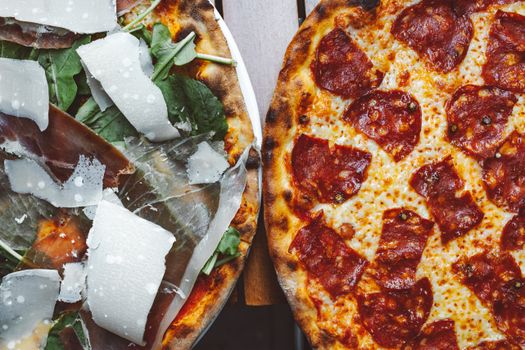
Photo: ROMAN ODINTSOV / Pexels
Italian
Pizza Diavola
The diets react (see scores below)
Common Ingredients
- pizza dough
- tomato sauce
- mozzarella
- spicy salami
- chili oil
- red pepper flakes
- oregano
- basil
Specific recipes may vary.
Incompatible with 10 of 11 diets
Diet Ratings
Pizza Diavola is fundamentally incompatible with a ketogenic diet. The foundation is pizza dough, a grain-based product that delivers a massive carbohydrate load — a single slice can contain 25-35g net carbs, with a full pizza easily exceeding 100-150g net carbs. This alone blows the entire daily keto carb budget multiple times over. The tomato sauce adds additional sugar and carbs. While the toppings — spicy salami, mozzarella, chili oil, red pepper flakes, oregano, and basil — are largely keto-friendly on their own, the dough makes this dish entirely incompatible with ketosis in its standard form.
Pizza Diavola contains multiple animal-derived ingredients that are strictly excluded from a vegan diet. Mozzarella is a dairy cheese made from animal milk, and spicy salami is a cured meat product. Both are clear animal products with no ambiguity in vegan classification. The remaining ingredients — pizza dough, tomato sauce, chili oil, red pepper flakes, oregano, and basil — are plant-based, but the presence of mozzarella and salami makes this dish entirely incompatible with a vegan diet. A vegan version could theoretically be constructed by substituting dairy-free mozzarella and omitting the salami or replacing it with a plant-based alternative.
Pizza Diavola is fundamentally incompatible with the Paleo diet. The foundation of this dish — pizza dough — is made from wheat flour, a grain explicitly excluded from the Paleo framework. Mozzarella is dairy, also excluded. Chili oil is almost certainly a seed oil (likely sunflower or soybean-based), which is prohibited. Spicy salami is a processed meat containing additives, preservatives, and likely added salt and sugar. Tomato sauce may contain added sugar and salt. The only Paleo-compliant ingredients in this dish are the herbs (oregano, basil) and red pepper flakes. This dish violates multiple core Paleo principles simultaneously, leaving no meaningful path to a favorable rating.
Pizza Diavola's primary protein is spicy salami, a cured processed red meat high in saturated fat and sodium, which directly conflicts with Mediterranean diet principles that limit red meat to a few times per month and minimize processed foods. The refined white flour pizza dough is a refined grain, not a whole grain. Mozzarella adds saturated dairy fat, and chili oil (likely not extra virgin olive oil) is a less ideal fat source. While the tomato sauce, herbs (oregano, basil), and chili flakes are genuinely Mediterranean-friendly ingredients, they cannot offset the dominant processed meat and refined carbohydrate base. This dish is an occasional indulgence at best, not a Mediterranean staple.
Traditional Southern Italian and Neapolitan cuisine—birthplaces of pizza—do include pizza as part of the cultural food landscape, and some Mediterranean diet authorities acknowledge that occasional pizza with vegetable toppings and modest cheese can fit within the dietary pattern. However, the processed salami topping here moves this firmly outside acceptable moderation for most clinical Mediterranean diet guidelines.
Pizza Diavola is entirely incompatible with the carnivore diet. The dish is built on a plant-based foundation: pizza dough is a grain product (wheat flour), which is one of the most strictly excluded foods on any tier of carnivore eating. Tomato sauce is a plant-derived condiment. Chili oil, red pepper flakes, oregano, and basil are all plant-derived spices and oils. The only animal-derived components are mozzarella (dairy, debated but generally accepted by many carnivore practitioners) and spicy salami (processed meat that likely contains spices and possibly sugar). Even if the salami and mozzarella were acceptable in isolation, they represent a small fraction of this dish. The dominant ingredients — dough, tomato sauce, and plant-based seasonings — make this dish a clear avoid with no ambiguity across any camp of carnivore eating.
Pizza Diavola is excluded on multiple grounds. First and most fundamentally, pizza is explicitly listed in Whole30's 'no recreating baked goods/junk food' rule — pizza crust is called out by name as a prohibited food form regardless of ingredients. Beyond the spirit violation, the ingredients themselves contain multiple excluded items: pizza dough is made from grains (wheat flour), which are categorically excluded; mozzarella is dairy, which is excluded (ghee and clarified butter are the only dairy exceptions); and spicy salami commonly contains added sugars, sulfites (though sulfites are now allowed per 2024 rules), and potentially soy-based fillers. This dish fails on category (pizza), structural ingredients (grain-based dough, dairy cheese), and the junk food recreation rule simultaneously.
Pizza Diavola contains multiple high-FODMAP ingredients that make it unsuitable during the elimination phase. The primary offender is conventional pizza dough, which is wheat-based and high in fructans — a major FODMAP category. A standard pizza slice contains far more wheat than the negligible threshold at which fructans might be tolerable. Mozzarella is relatively low-FODMAP in small amounts (fresh mozzarella at ~40g is typically safe), but the tomato sauce must be scrutinized for added garlic or onion, which are almost universally present in commercial and restaurant preparations and are among the highest-FODMAP ingredients. Spicy salami itself is generally low-FODMAP (cured meats without high-FODMAP additives), and chili oil is low-FODMAP (FODMAPs are water-soluble, not fat-soluble). Red pepper flakes, oregano, and basil are low-FODMAP herbs/spices at typical culinary quantities. However, the combination of wheat-based dough and highly probable garlic/onion in tomato sauce makes this dish a clear avoid during elimination. Even if the sauce were garlic-free, the standard wheat crust alone would disqualify this dish.
Pizza Diavola is a poor fit for the DASH diet across multiple dimensions. Spicy salami is a cured, processed red meat high in sodium and saturated fat — two of the primary nutrients DASH limits. A typical slice of this pizza can deliver 600–900mg of sodium, with a full serving easily exceeding half the standard DASH daily sodium limit (2,300mg) or nearly the entire low-sodium DASH limit (1,500mg). Full-fat mozzarella adds saturated fat, which DASH discourages. The refined white pizza dough provides little fiber and lacks the whole-grain qualities DASH emphasizes. Chili oil adds additional fat. The only redeeming elements are the tomato sauce (provides lycopene and some potassium) and herbs (oregano, basil, red pepper flakes), which are DASH-friendly, but they do not offset the dominant negatives. Processed meats like salami are explicitly incompatible with DASH principles, which emphasize lean proteins and strict sodium limits.
Pizza Diavola presents significant Zone Diet challenges. The pizza dough is a high-glycemic refined carbohydrate — one of the most 'unfavorable' carb sources in Zone terminology — that will spike blood sugar and make 40/30/30 macro balancing very difficult. Spicy salami is a fatty, processed meat high in saturated fat and omega-6s, clashing with Zone's lean protein and anti-inflammatory principles. Mozzarella adds saturated fat. Chili oil, depending on the base oil (often soybean or sunflower), may contribute inflammatory omega-6 seed oils. On the positive side, tomato sauce provides polyphenols (lycopene), and herbs like basil and oregano align with Zone's anti-inflammatory focus. Red pepper flakes are a negligible but favorable addition. In practice, a small slice could theoretically be incorporated into a Zone meal if surrounded by vegetables and lean protein to correct the ratio imbalance, but the dish as a standalone main is structurally misaligned with Zone principles — dominated by high-GI carbs, saturated fat, and processed meat. This warrants a low caution score rather than outright avoid, because the Zone is ratio-based and small portions are technically possible.
Some Zone practitioners argue that occasional pizza in a very small portion (1 thin-crust slice) with added vegetables can be workable within Zone blocks, and Dr. Sears' later writings acknowledge that the overall dietary pattern matters more than single meals. However, Pizza Diavola's specific combination of refined dough, processed fatty salami, and potentially inflammatory chili oil makes it harder to rehabilitate than a plain vegetable pizza, pushing this toward the lower end of the caution range.
Pizza Diavola has a predominantly pro-inflammatory profile driven by several compounding factors. The pizza dough is a refined carbohydrate that spikes blood sugar and promotes inflammatory signaling. Spicy salami is a processed red meat high in saturated fat, sodium, and nitrate/nitrite preservatives — all linked to elevated inflammatory markers (CRP, IL-6) in research. Full-fat mozzarella contributes saturated fat, which at these quantities moves beyond the 'moderate' dairy threshold. The chili oil base raises a concern depending on the oil used — if it is a refined seed oil (common in commercial preparations), it adds excessive omega-6. These pro-inflammatory components substantially outweigh the beneficial ones. On the positive side, tomato sauce provides lycopene (a carotenoid antioxidant that becomes more bioavailable when cooked), red pepper flakes and oregano offer polyphenols and anti-inflammatory phytochemicals, and basil contributes flavonoids. However, these minor positives cannot offset the refined-dough base, processed meat, and saturated fat load. As an occasional indulgence, the tomato-based, herb-forward aspects provide some mitigation, but as a regular dietary item, this dish is firmly in the avoid category.
Pizza Diavola is a poor fit for GLP-1 patients on multiple fronts. The primary protein is spicy salami, a processed fatty meat high in saturated fat that can worsen nausea, reflux, and GI discomfort — all common GLP-1 side effects. The base is refined pizza dough, offering low fiber and low nutrient density per calorie. Full-fat mozzarella adds significant saturated fat. Chili oil and red pepper flakes compound the GI irritation risk, as spicy, high-fat foods are among the worst triggers for GLP-1-related nausea and reflux given slowed gastric emptying. The dish is low in fiber, low in lean protein relative to its calorie load, high in refined carbohydrates, and dominated by saturated fat and spice — hitting nearly every avoid criterion simultaneously. Even a small portion delivers poor nutritional value relative to calories consumed, which is especially counterproductive when total food intake is already suppressed.
*See how scores were generated at our methodology page.
Nutritional profile
Six traits that cut across every diet.
Fiber & Plants
How much whole-plant food and fiber it delivers.
Healthy Fats
The quality of its fats (unsaturated, omega-3).
Whole / Unprocessed
How close it is to its natural, unprocessed form.
Gut Gentle
How easy it is on digestion (low FODMAP, few irritants).
Low Glycemic
How little it spikes your blood sugar.
Protein Density
How much protein it packs per calorie.
Controversy Index
Higher controversy = more disagreement between diets.
Diet-Specific Tips
 Zone — 5/10
View tips
- Pizza dough is a high-glycemic refined carbohydrate — unfavorable Zone carb source
- Spicy salami is processed, high in saturated fat and omega-6s — poor Zone protein choice
- Mozzarella adds saturated fat, limiting monounsaturated fat intake
- Chili oil may be seed-oil based, contributing inflammatory omega-6 fatty acids
- Tomato sauce provides lycopene and polyphenols — anti-inflammatory positive
- Herbs (basil, oregano, red pepper flakes) align with Zone anti-inflammatory focus
- Macro ratio of the dish skews heavily toward carbs and saturated fat, far from 40/30/30
- Small portions could technically fit Zone blocks but practical meal balancing is very difficult