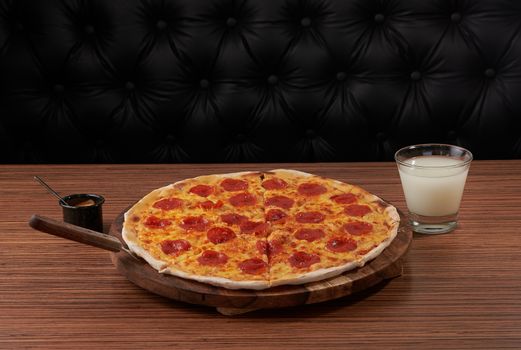
Photo: Alejandro Aznar / Pexels
Italian
Pepperoni Pizza
The diets react (see scores below)
Common Ingredients
- pizza dough
- tomato sauce
- mozzarella
- pepperoni
- Parmesan
- oregano
- olive oil
Specific recipes may vary.
Incompatible with 10 of 11 diets
Diet Ratings
Pepperoni pizza in its standard form is fundamentally incompatible with a ketogenic diet. The primary disqualifier is the pizza dough, which is made from refined wheat flour and delivers an enormous net carb load — a single slice can contain 25-35g of net carbs, easily exceeding the entire daily keto limit. The tomato sauce adds further sugar and carbs. While individual ingredients like pepperoni, mozzarella, Parmesan, olive oil, and oregano are all keto-friendly, the foundation of the dish (the dough) makes the assembled product a keto disqualifier. There is no portion size small enough to make traditional pizza dough acceptable on a ketogenic diet.
Pepperoni pizza contains multiple animal-derived ingredients that are entirely incompatible with a vegan diet. Pepperoni is a cured meat product made from pork and/or beef. Mozzarella and Parmesan are both dairy cheeses derived from animal milk. These three ingredients alone constitute clear and unambiguous violations of vegan principles. The remaining ingredients — pizza dough, tomato sauce, oregano, and olive oil — are plant-based, but they do not offset the presence of animal products. There is no meaningful debate within the vegan community about this dish.
Pepperoni pizza is fundamentally incompatible with the paleo diet. The pizza dough is made from wheat flour, a grain that is categorically excluded from paleo. Mozzarella and Parmesan are dairy products, also excluded. Pepperoni is a heavily processed meat containing additives, preservatives, and often added salt and sugar. Multiple core ingredients violate paleo principles simultaneously, making this one of the clearest possible avoid verdicts with no meaningful gray area.
Pepperoni pizza as typically prepared contradicts core Mediterranean diet principles on multiple fronts. Pepperoni is a highly processed cured meat (salami-style), high in saturated fat, sodium, and preservatives — categorically discouraged. Standard pizza dough is made from refined white flour, a refined grain that the Mediterranean diet discourages in favor of whole grains. The cheese load (mozzarella plus Parmesan) pushes dairy well beyond the moderate amounts recommended. While tomato sauce, oregano, and olive oil are genuinely Mediterranean-friendly ingredients, they are insufficient to redeem a dish dominated by processed meat and refined carbohydrates. This combination would be a rare indulgence at most under strict Mediterranean diet interpretation.
Traditional Neapolitan and Italian pizza culture does overlap geographically with Mediterranean cuisine, and some Mediterranean diet authorities (particularly Italian-tradition researchers) acknowledge that a modest slice of homemade pizza with tomato, olive oil, and minimal cheese can fit occasionally. A plant-forward version without processed meat would score far higher, but even a cheese pizza might be granted 'caution' status in lenient interpretations.
Pepperoni Pizza is fundamentally incompatible with the carnivore diet. The dish is built on a foundation of plant-based ingredients: pizza dough (grain-based), tomato sauce (plant-derived), oregano (plant spice), and olive oil (plant oil). While mozzarella, Parmesan, and pepperoni are animal-derived, they are minor components embedded in a heavily plant-based dish. Even setting aside the dairy debate within carnivore circles, the grain crust alone is an absolute disqualifier — grains are one of the most universally excluded food categories across all carnivore tiers. This dish represents processed, mixed food that carnivore is specifically designed to eliminate.
Pepperoni Pizza contains multiple Whole30-excluded ingredients and violates the program's core rules on multiple fronts. First, pizza dough is made from grains (wheat flour), which are strictly excluded. Second, mozzarella and Parmesan are dairy products, both explicitly excluded. Third, even if the other ingredients were compliant, pizza itself is explicitly named in Rule 4 as a banned 'junk food recreation' — pizza crust and pizza as a dish are called out by name as prohibited even when made with technically compliant ingredients. Pepperoni also commonly contains sugar, nitrates, and other additives that may not be compliant. This dish fails on category exclusions (grains, dairy) and the spirit-of-the-program rule simultaneously.
Pepperoni pizza contains multiple high-FODMAP ingredients that make it unsuitable during the elimination phase. Standard pizza dough is made from wheat flour, which is high in fructans — a major FODMAP trigger — and is problematic at any normal serving size. Mozzarella in small amounts (around 40g) can be low-FODMAP as it is a fresh but relatively low-lactose cheese, but typical pizza portions often exceed this. Tomato sauce is generally low-FODMAP if made without garlic or onion, but commercial or restaurant tomato sauces almost universally contain garlic and/or onion, making them high-FODMAP. Pepperoni itself is typically low-FODMAP (processed meat with minimal FODMAP ingredients), Parmesan is very low in lactose and safe, oregano is safe as a herb, and olive oil is safe. However, the wheat-based pizza dough alone is sufficient to classify this dish as high-FODMAP and unsuitable during elimination. There is no realistic standard serving of regular pizza that avoids the fructan load from wheat dough.
Pepperoni pizza is a poor fit for the DASH diet across multiple dimensions. Pepperoni is a processed red meat high in sodium and saturated fat — both of which DASH explicitly limits. A typical 2-slice serving of pepperoni pizza can deliver 1,200–1,500mg of sodium (over half the standard DASH daily limit and nearly the entire low-sodium DASH limit), largely from the pepperoni, processed pizza dough, tomato sauce, and aged cheeses (mozzarella and Parmesan). The saturated fat load from full-fat mozzarella, Parmesan, and pepperoni further conflicts with DASH guidelines. While the tomato sauce contributes some potassium and lycopene, and oregano and olive oil have DASH-compatible profiles, these positives are overwhelmed by the sodium and saturated fat content of the dish as a whole. Processed meats like pepperoni are among the most explicitly discouraged foods in DASH eating plans.
Pepperoni pizza presents significant Zone Diet challenges but isn't categorically impossible to fit. The primary issues are: (1) Pizza dough is a high-glycemic refined carbohydrate — an 'unfavorable' Zone carb that spikes insulin rapidly, which is precisely what Zone seeks to avoid. (2) Pepperoni is a fatty, processed meat high in saturated fat and omega-6s, the opposite of Zone's preferred lean protein and anti-inflammatory focus. (3) Mozzarella and Parmesan add saturated fat, pushing the fat profile toward the unfavorable end. On the positive side, tomato sauce provides polyphenols and acts as a low-glycemic carb component, olive oil contributes monounsaturated fat, and oregano offers anti-inflammatory polyphenols. A small, thin-crust slice (1 slice) could theoretically be incorporated into a Zone meal if the rest of the day's eating is tightly controlled — using it as a partial carb and fat block while adding a lean protein source on the side. However, as typically consumed (multiple slices), the macro ratio is badly skewed: too many high-GI carbs, too much saturated fat, not enough lean protein, with virtually no favorable vegetables. This is a 'have occasionally and in strict moderation' food in Zone terms.
Some Zone practitioners note that in Sears' later anti-inflammatory writings (The OmegaRx Zone, The Mediterranean Zone), the framework became more permissive about occasional inclusion of Mediterranean-style foods. A thin-crust pizza with vegetable toppings and reduced cheese is closer to acceptable; the pepperoni version, however, runs counter to his consistent guidance against processed meats and refined grains even in later editions.
Pepperoni pizza is a combination of several pro-inflammatory components. Pepperoni is a processed meat high in saturated fat, sodium, and nitrates/nitrite preservatives — all associated with increased inflammatory markers including CRP and IL-6. The refined white flour pizza dough is a high-glycemic refined carbohydrate that spikes blood sugar and promotes inflammation. Mozzarella and Parmesan contribute significant saturated fat from full-fat dairy, which the anti-inflammatory framework recommends limiting. Pepperoni is also rich in arachidonic acid, an omega-6 fatty acid precursor to pro-inflammatory eicosanoids. The only redeeming elements are the tomato sauce (lycopene, antioxidants), olive oil (oleocanthal, polyphenols), and oregano (rosmarinic acid, antioxidants) — but these are present in quantities insufficient to offset the dominant pro-inflammatory components. This dish hits multiple 'avoid' or 'limit' categories simultaneously: processed meat, refined carbs, saturated fat, and sodium. It would be a poor regular choice on an anti-inflammatory diet.
Pepperoni pizza is a poor fit for GLP-1 patients across nearly every rating criterion. Pepperoni is a high-fat processed meat loaded with saturated fat and sodium, which worsens nausea, bloating, and reflux — the most common GLP-1 side effects. The cheese adds additional saturated fat. The pizza dough is a refined carbohydrate with minimal fiber and negligible protein per calorie. The overall protein-to-calorie ratio is poor: a typical 2-slice serving delivers roughly 12-16g of protein but at the cost of 500-600+ calories, 20-25g of fat, and very little fiber. GLP-1 patients eating reduced volumes cannot afford this nutritional profile. The high fat content combined with slowed gastric emptying significantly increases the risk of prolonged nausea, heaviness, and GI distress. Even a single slice is portion-sensitive in a way that works against — not with — GLP-1 therapy.
*See how scores were generated at our methodology page.
Nutritional profile
Six traits that cut across every diet.
Fiber & Plants
How much whole-plant food and fiber it delivers.
Healthy Fats
The quality of its fats (unsaturated, omega-3).
Whole / Unprocessed
How close it is to its natural, unprocessed form.
Gut Gentle
How easy it is on digestion (low FODMAP, few irritants).
Low Glycemic
How little it spikes your blood sugar.
Protein Density
How much protein it packs per calorie.
Controversy Index
Higher controversy = more disagreement between diets.
Diet-Specific Tips
 Zone — 4/10
View tips
- Pizza dough is a high-glycemic refined carbohydrate — a classic 'unfavorable' Zone carb
- Pepperoni is a processed, high-saturated-fat, omega-6-heavy protein — opposite of Zone's lean protein ideal
- Mozzarella and Parmesan add significant saturated fat load
- Tomato sauce contributes beneficial polyphenols and is a low-glycemic carb component
- Olive oil provides favorable monounsaturated fat
- As typically consumed, macro ratio is badly skewed away from 40/30/30
- A single small thin-crust slice can technically be portioned as partial Zone blocks but requires significant dietary discipline elsewhere